

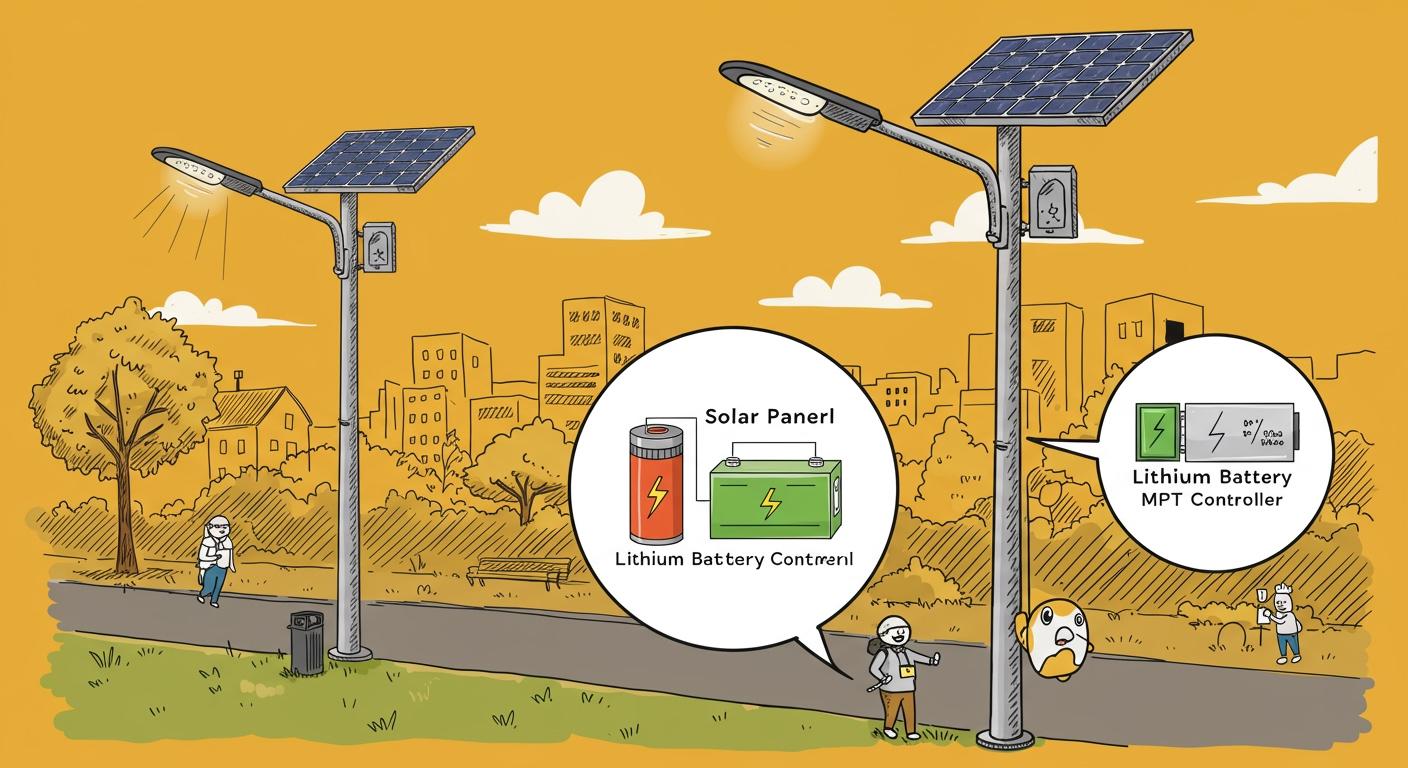
You demand reliable outdoor lighting for your projects. Solar street lights with lithium battery packs deliver strong energy storage and consistent performance, even during rainy days. MPPT technology optimizes solar efficiency and extends battery life. See how these advances provide longer working times, stable operation, and real energy savings.
Benefit | Description |
|---|---|
Energy Optimization | MPPT adjusts voltage and current, maximizing solar energy harvested in changing environments. |
Increased Efficiency | MPPT significantly boosts solar panel output and system productivity. |
Battery Longevity | MPPT reduces stress on components, extending the life of your battery investment. |
Key Takeaways
Solar street lights with lithium batteries provide reliable lighting for up to three days, even in cloudy weather, reducing maintenance and replacement costs.
MPPT technology maximizes solar energy capture, increasing efficiency by up to 30% compared to traditional systems, ensuring longer battery life and stable performance.
Choosing lithium iron phosphate (LiFePO4) batteries offers superior longevity and safety, lasting 6 to 10 years with minimal maintenance, making them ideal for outdoor applications.
Part1: Solar Street Lights Performance
1.1 Lithium Battery Efficiency
You need solar street lights that perform reliably, even when the weather turns cloudy or rainy. Lithium battery packs deliver consistent lighting for up to three days during poor weather, which is a significant improvement over traditional lead-acid batteries. This extended lighting duration ensures that your infrastructure projects, security installations, or municipal pathways remain illuminated without interruption.
Tip: Lithium battery packs, especially lithium iron phosphate (LiFePO4), offer superior cycle life and efficiency. Learn more about LiFePO4 batteries and their applications in industrial and infrastructure sectors.
The following table highlights the differences in cycle life and capacity retention between lithium-ion and lead-acid batteries:
Battery Type | Cycle Life | Capacity Degradation (Year 1) | Capacity Degradation (Year 3) |
|---|---|---|---|
Lead-acid | 300–500 cycles | 15–20% | 60–70% |
Lithium-ion | 1,000–1,500 cycles | >90% | 75–80% |
You benefit from lower maintenance needs and longer service intervals with lithium battery technology. Lithium-ion and LiFePO4 batteries typically last 5 to 10 years, while lead-acid batteries require more frequent replacement and upkeep. This reliability reduces operational risks and maintenance costs for your business.
Battery Type | Typical Lifespan (Years) | Maintenance Needs |
|---|---|---|
Lithium-Ion (Li-ion/LiFePO4) | 5 – 10 | Low |
Lead-Acid | 3 – 5 | Medium |
Gel (Lead-Acid subtype) | 2 – 5 | Low |
You also gain higher energy density and better charge/discharge efficiency with lithium chemistries. The table below compares the most common battery types used in solar street lights:
Battery Type | Cycle Life (cycles) | Charge/Discharge Efficiency |
|---|---|---|
LiFePO4 (Lithium Iron Phosphate) | 2000-5000 | 96% |
NCM (Nickel Cobalt Manganese) | 1000-2000 | 92% |
LTO (Lithium Titanate) | Up to 10,000 | 98% |
You can see that lithium battery packs, especially LiFePO4, provide the best balance of long life, high efficiency, and low maintenance. These features make them ideal for solar street lights in demanding environments such as industrial parks, security perimeters, and municipal infrastructure.
1.2 MPPT Technology Impact
You want your solar street lights to operate at peak efficiency and deliver maximum energy savings. MPPT (Maximum Power Point Tracking) technology plays a crucial role in achieving this goal. MPPT charge controllers adjust the voltage and current from the solar panel to ensure the battery receives the optimal charge, regardless of changing sunlight conditions.
MPPT controllers can extract up to 30% more energy from solar panels compared to PWM controllers.
MPPT controllers provide battery banks with up to 30% more charge, depending on the system’s components.
This technology not only increases the efficiency of your solar system but also reduces battery failure rates. By maintaining optimal charging conditions, MPPT extends the life of your battery pack and ensures stable performance for your lighting system.
Note: Upgrading to MPPT technology in your solar street lights means you get more reliable lighting, longer battery life, and lower total cost of ownership.
You can trust MPPT to deliver consistent performance, even as environmental conditions change. This makes it a smart investment for commercial, municipal, and industrial applications where reliability and efficiency matter most.
Part2: System Overview
2.1 Key Components
You need to understand the main components that make up a reliable solar street light system. Each part plays a specific role in ensuring your lighting solution delivers consistent performance and long-term value. The following table outlines the essential components and their contributions:
Component | Contribution |
|---|---|
Solar Panels | Convert sunlight into electricity, providing the primary energy source for the system. |
Solar Battery | Stores electricity generated during the day for use at night, ensuring consistent illumination. |
LED Lights | Offer high efficiency, low power consumption, and extended operational life. |
Poles and Mounts | Support the structure and determine the optimal height for light distribution. |
Controller | Manages battery charging and discharging, and regulates light output based on environmental factors. |
You benefit from a system where each component works together to maximize efficiency. The solar panels capture energy, the battery stores it, and the controller ensures optimal charging and discharging. LED lights provide bright, reliable illumination while using minimal power.
2.2 Battery Pack Role
The battery pack serves as the backbone of your solar street light system. Its design and quality directly influence how well your lights perform, especially during periods of low sunlight. Consider the following aspects:
Aspect | Impact on Solar Street Lights |
|---|---|
Energy Storage Efficiency | Determines how much solar energy you can store and use, affecting overall system reliability. |
Battery Quality | High-quality battery packs deliver longer illumination times and stable performance. |
Lifespan of Batteries | Durable battery packs reduce replacement frequency, lowering maintenance costs. |
Durability | Robust battery packs withstand harsh weather, ensuring long-term operation in outdoor settings. |
You gain peace of mind knowing that a well-designed battery pack keeps your solar street lights running through cloudy days and nights. High-quality battery packs also support demanding applications in infrastructure, security, and industrial environments. By choosing advanced battery technology, you ensure your solar lighting system remains efficient, reliable, and cost-effective.
Part3: Lithium Battery Advantages

3.1 Long Life (LiFePO4)
You want your solar street lights to last for years without frequent replacements. Lithium iron phosphate (LiFePO4) batteries deliver outstanding longevity and reliability. In solar applications, these batteries typically last 6 to 10 years and support 1,500 to 2,000 deep cycles. This far exceeds the performance of many other lithium-ion chemistries. The table below compares average lifespan and cycle life:
Battery Type | Average Lifespan | Cycle Life |
|---|---|---|
LiFePO4 | 6 to 10 years | 1,500 to 2,000 cycles |
Other Lithium-ion | 5 to 10 years | 500 to 800 cycles |
You benefit from superior thermal stability and safety, which makes LiFePO4 ideal for outdoor solar lighting in infrastructure, security, and industrial projects. Many commercial solar street lights offer warranties of 3 to 5 years, reflecting the confidence in battery durability.
3.2 Fast Charging
You need your solar street lights to recharge quickly and efficiently. Lithium battery packs, especially those using advanced mppt charge controller technology, enable faster charging compared to traditional batteries. These batteries are lightweight and compact, with high energy density and long cycle life. Optimized charging parameters and advanced controller designs prevent overcharging and undercharging, which boosts charging efficiency and extends battery life.
Lightweight design improves installation and maintenance.
High energy density supports longer lighting hours.
Advanced mppt charge controller adjusts charging rates for maximum power tracking and efficiency.
3.3 Low Maintenance
You want to minimize maintenance costs and downtime. Lithium battery-based solar street lights require far less maintenance than traditional systems. High-performance LEDs last up to 20–25 years, so you avoid frequent bulb replacements. The controller and mppt technology further reduce the risk of battery failure and ensure stable operation. Over five years, lithium iron phosphate batteries cut your maintenance costs in half compared to lead-acid options:
Battery Type | Lifespan (Years) | Cost per kWh per Year |
|---|---|---|
Lead-Acid | 3 to 5 | $100 |
Lithium Iron Phosphate | 10 | $50 |
Tip: By choosing lithium battery packs with mppt charge controller integration, you ensure your solar lighting system delivers high efficiency, reliability, and long-term savings for your business.
Part4: MPPT Charge Controller

4.1 MPPT vs PWM
You need to choose the right charge controller for your solar street lights. The two main options are MPPT (Maximum Power Point Tracking) and PWM (Pulse Width Modulation). Each controller uses a different design to manage charging and energy conversion. MPPT controllers adjust voltage and current dynamically, maximizing efficiency in every application. PWM controllers operate like a switch, charging at battery voltage. The table below compares their operational principles and performance:
Aspect | MPPT Charge Controller | PWM Charge Controller |
|---|---|---|
Operation | Adjusts voltage and current dynamically for maximum efficiency | Operates like a switch, charging at battery voltage |
Efficiency | Up to 99% efficiency | 50% – 75% efficiency |
Cost | Higher cost, usually hundreds of dollars | Lower cost, usually less than $100 |
You see that MPPT controllers deliver much higher efficiency and energy yield, especially in demanding application scenarios such as infrastructure, security, and industrial sectors. PWM controllers offer a budget-friendly solution for basic solar designs, but they cannot match the performance of MPPT in advanced lithium battery pack systems.
When you evaluate cost implications for large-scale solar street lighting projects, consider these points:
The initial cost of PWM controllers makes them attractive for basic applications.
MPPT controllers offer long-term savings through higher efficiency and reduced maintenance.
You must assess the trade-offs between upfront investment and ongoing energy savings.
Controller Type | Initial Cost | Long-Term Savings | Efficiency |
|---|---|---|---|
MPPT | Higher | Significant | Higher |
PWM | Lower | Limited | Lower |
MPPT controllers are generally more expensive, but they deliver significant energy savings over time. PWM controllers suit basic energy needs, but you gain more value from MPPT in commercial and municipal applications.
4.2 Charging Efficiency
You want your solar street lights to operate reliably in every weather condition. MPPT charge controllers achieve charging efficiencies up to 98%. This design allows you to harvest 15-30% more power, especially in cold, cloudy, or partially shaded environments. You benefit from consistent battery charging, which extends battery life and improves system reliability.
MPPT controllers maximize charging efficiency, even when sunlight fluctuates.
You see a measurable increase in energy harvest, which supports longer lighting hours and reduces battery failure rates.
MPPT controllers enhance energy yield throughout the year, especially in low light conditions.
Aspect | Description |
|---|---|
Efficiency | MPPT controllers enhance energy yield significantly, especially in low light conditions. |
Performance in Low Light | They are particularly effective in maximizing energy output throughout the year. |
A case study in an urban application showed that MPPT controllers improved energy utilization efficiency by 30%. This reduction in power waste leads to enhanced product stability and reliability. MPPT charge controllers improve energy conversion efficiency and ensure consistent power output, which reduces the risk of equipment failure in every application.
Tip: You can rely on MPPT controllers to maintain stable battery charging and extend battery lifetime, even in challenging weather.
4.3 Integration with Solar Street Lights
You need a solar street light system that combines advanced lithium battery packs with MPPT charge controllers for maximum performance. Integrated MPPT controllers boost charging efficiency by up to 30% compared to PWM systems. This design increases energy utilization by 15-20%, supporting longer lighting hours and reducing battery failure rates.
MPPT technology works seamlessly with lithium iron phosphate (LiFePO4) battery packs, which you can learn more about in our LiFePO4 battery overview.
You benefit from robust system design, which ensures reliable operation in medical, robotics, security, infrastructure, consumer electronics, and industrial applications.
The use of 3.2V MPPT systems further reduces battery failure rates, supporting stable performance in every application.
You see that integrating MPPT charge controllers with lithium battery packs creates a solar street light system that delivers superior energy efficiency, longer battery life, and reduced maintenance. This design supports demanding application scenarios and ensures your investment provides long-term value.
Note: When you select solar street lights with MPPT charge controllers and lithium battery packs, you invest in a solution that meets the highest standards for reliability, efficiency, and performance.
You gain lasting value by choosing all-in-one solar street light solutions with lithium battery packs and MPPT controllers. These systems deliver extended battery life, improved energy retention, and reduced maintenance costs. The all-in-one solar street light offers electric-free operation, smart controls, and proven energy savings. For large projects, the all-in-one solar street light ensures reliability and efficiency. Municipalities and businesses report lower operational risks and faster fault response with all-in-one solar street light installations. The all-in-one solar street light supports sustainability goals and reduces environmental impact. You benefit from simplified installation and less maintenance with all-in-one solar street light products. The all-in-one solar street light maximizes energy capture, even in low-light conditions. Annual electricity savings and cost reductions make the all-in-one solar street light a smart investment. The all-in-one solar street light enhances public safety and quality of life. You can trust the all-in-one solar street light for consistent lighting in every application. The all-in-one solar street light adapts to changing weather, ensuring optimal performance. The all-in-one solar street light reduces wiring losses and installation complexity. The all-in-one solar street light fits small areas, paths, and driveways. The all-in-one solar street light supports your infrastructure and security needs. For advanced projects, consider an integrated solar street light for tailored solutions.
FAQ
How do lithium battery packs improve solar street light reliability?
You gain longer lighting hours and stable performance. Lithium battery packs, such as LiFePO4, offer high cycle life and low maintenance for demanding infrastructure projects.
Can Large Power customize lithium battery solutions for my industry?
Large Power provides tailored lithium battery packs for edical, robotics, security, infrastructure, consumer electronics, and industrial sectors. Request a custom battery consultation.
What is the difference between lithium-ion, LiFePO4, and lithium-polymer batteries?
Chemistry | Cycle Life | Safety Level | Application Example |
|---|---|---|---|
1,000+ | Moderate | Consumer electronics | |
2,000+ | High | Infrastructure, industrial | |
800+ | Moderate | Robotics |


