

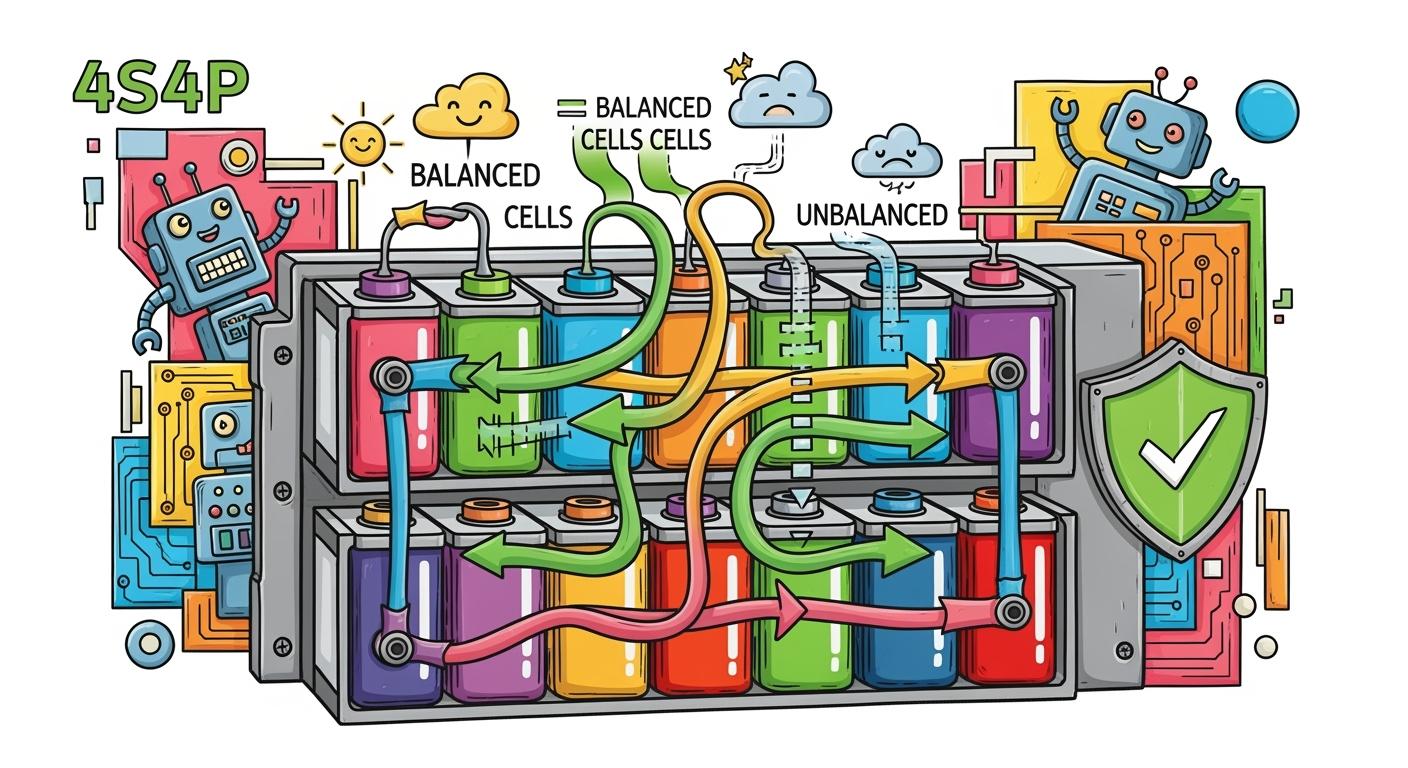
You benefit from multi-level cell balancing in a 4S4P lithium battery pack because it keeps each cell’s charge and voltage uniform. This process reduces stress on individual cells and protects your investment from early failure. In commercial settings, you see longer battery life and greater reliability. The following table shows how a well-optimized battery management system can increase estimated lifespan compared to unmanaged systems:
Battery Management System (BMS) Type | Estimated Lifespan |
|---|---|
Unmanaged | 3-5 years |
Well-optimized BMS | 10-15 years |
Multi-level cell balancing improves safety for your critical operations and ensures consistent performance.
Key Takeaways
Multi-level cell balancing keeps all cells in a 4S4P lithium battery pack at similar voltage, preventing premature failure and extending battery life.
A well-optimized battery management system (BMS) can increase the lifespan of lithium battery packs from 3-5 years to 10-15 years, saving costs and reducing downtime.
Balancing cells at both series and parallel levels ensures consistent performance, reduces risks of overheating, and enhances overall reliability in critical applications.
Active balancing methods are more efficient than passive methods, transferring energy between cells to maximize performance and minimize energy loss.
Implementing multi-level cell balancing improves safety by preventing dangerous conditions like thermal runaway, ensuring safe operation in commercial and industrial settings.
Part1: 4S4P Pack Basics and Balancing Need
1.1 4S4P Pack Structure
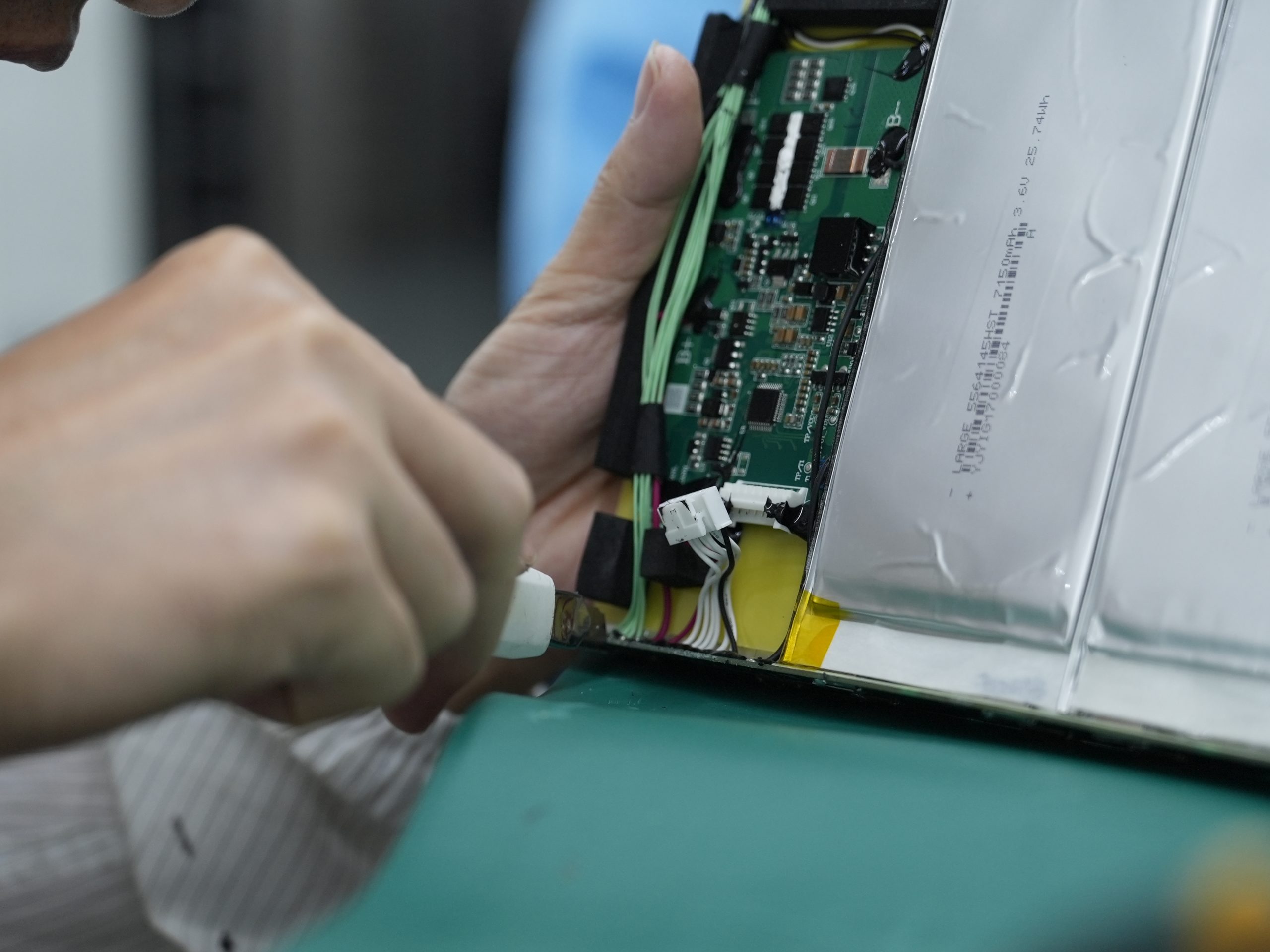
You often see the 4S4P lithium battery pack in commercial and industrial applications. This configuration means you have four cells connected in series, and each series group contains four cells in parallel. The result is a pack that combines higher voltage with increased capacity and current capability. Here is a summary of typical specifications:
Feature | Specification |
|---|---|
Nominal Voltage | 14.4V |
Nominal Capacity | 10Ah – 20Ah |
Continuous Discharge Rating | 10A – 100A |
Charging Voltage | 16.8V |
Minimum Voltage | 10V – 10.6V |
Watt Hours | 288Wh |
Energy Density | 243 Wh/kg |
Applications | E-bikes, power tools, medical devices, backup power, industrial systems |
You benefit from this structure because it delivers both the voltage and the runtime needed for demanding equipment.
1.2 Why Balancing is Essential
In a 4S4P pack, you rely on both series and parallel connections. If one cell in a series string becomes weaker, it can cause the entire string to overcharge or over-discharge. In parallel groups, a weak cell reduces the total runtime. You need cell balancing to ensure every cell charges and discharges evenly. Cells in a multi-pack often have different internal resistance, which leads to unequal charging and discharging rates. As you add more cells in parallel, balancing becomes more challenging. Without proper balancing, your battery pack cannot deliver consistent performance.
A balanced battery is one in which all the cells remain the same voltage. Batteries will inevitably wear out at slightly different rates. If one cell charges to a lower voltage, the charger may overcharge the other cells to compensate, leading to potential damage. Balance chargers prevent this by ensuring no cell exceeds 4.2 volts and can identify cells that do not charge fully.
1.3 Risks of Imbalance
When your battery pack becomes unbalanced, you face several risks:
Unbalanced batteries degrade faster and may fail prematurely.
Uneven heat distribution creates temperature gradients, which can increase the risk of thermal runaway.
Cells degrade at different rates, causing imbalances in capacity, voltage, and internal resistance.
Lithium cells experience voltage drift due to variations in resistance, temperature, or charging current.
Stronger cells become underutilized, while weaker cells face excessive stress, leading to system instability and early failure.
A capacity imbalance of just 5% can reduce your battery’s lifespan by 30% or more. The weakest cell determines the lifespan of the entire pack. Persistent imbalance can force you to retire healthy cells along with the damaged ones, increasing costs and reducing reliability.
Part2: Problems from Cell Imbalance
2.1 Reduced Capacity
When your battery pack becomes unbalanced, you lose usable capacity. In a 4S4P pack, the weakest cell or group limits the performance of the entire system. If one cell in a series string drops below the safe voltage, the battery management system will cut off the discharge to protect the pack. This means you cannot access the full energy stored in the other cells. Over time, you notice shorter runtimes and more frequent charging cycles. Multi-Level Cell Balancing helps you avoid this problem by ensuring each cell group maintains similar voltage and state of charge. You get the most out of your investment and keep your equipment running longer.
2.2 Accelerated Aging
Cell imbalance speeds up the aging process in your lithium battery pack. When cells operate at different voltages and currents, they experience uneven stress. This leads to faster degradation and shorter lifespan. The following table shows how imbalance affects cell aging:
Mechanism | Description |
|---|---|
Cell-to-cell variations | Variations in capacity and impedance among cells lead to different current distributions. |
Heterogeneous current distribution | Uneven current flow results in varying heat generation across cells. |
Temperature gradients | Heat transfer between cells due to temperature differences can exacerbate aging effects. |
State of health trajectories | Different aging stress factors result in varied state of health trajectories for each cell. |
You can see that Multi-Level Cell Balancing addresses these issues by equalizing current and voltage across all cells. This reduces heat buildup and keeps each cell aging at a similar rate. As a result, you extend the service life of your battery pack and avoid costly replacements.
2.3 Safety Hazards
Imbalanced cells create serious safety risks in commercial battery systems. When one cell overcharges or over-discharges, it can trigger dangerous conditions such as thermal runaway. The table below highlights common hazards linked to cell imbalance:
Hazard | Description |
|---|---|
Over-charge/Under-discharge | Defective cells may exceed safe voltage limits, increasing the risk of failure. |
Deep discharge and sensor errors | Weak cells or faulty sensors can allow cells to drop below safe voltage, leading to runaway. |
Fire and explosion | Compromised cells may overheat or short-circuit, causing fires or explosions. |
Multi-Level Cell Balancing plays a critical role in preventing these hazards. By keeping all cells within safe operating limits, you protect your assets and ensure the safety of your operations. You also reduce the risk of downtime and liability from battery failures.
Part3: Multi-Level Cell Balancing Mechanisms
3.1 Passive vs. Active Methods
You have two main options for balancing cells in your lithium battery pack: passive and active methods. Passive balancing uses resistors to bleed off excess energy from cells that reach full charge before others. This method is simple and cost-effective, but it wastes energy as heat. In a 4S4P pack, passive balancing can waste between 10–30% of energy during charge cycles. This energy loss becomes significant in larger battery systems, making passive balancing less efficient for high-capacity applications.
Active balancing, on the other hand, transfers excess energy from higher-charged cells to those with lower charge. This method uses electronic circuits to move energy efficiently, often achieving transfer efficiencies of 90–95%. Active balancing works faster and wastes less energy, which is especially important for commercial and industrial battery packs.
Here is a comparison of the two methods:
Feature | Passive Balancing | Active Balancing |
|---|---|---|
Efficiency | Low (Wastes energy) | High (Typically >90%) |
Balancing Speed | Slow (mA range) | Fast (A range) |
Energy Loss | High (as heat) | Minimal |
Complexity | Simple | More complex |
Cost | Lower | Higher |
You should choose active balancing for large-scale or mission-critical applications, as it maximizes efficiency and extends battery life. Multi-Level Cell Balancing often combines both methods to optimize performance and cost.
Tip: Active balancing reduces heat buildup and improves overall energy efficiency, making it the preferred choice for high-value lithium battery packs.
3.2 Role of BMS
Your battery management system (BMS) acts as the brain of your lithium battery pack. It monitors each cell’s voltage, temperature, and state of charge. Advanced BMS solutions support Multi-Level Cell Balancing by managing both series and parallel groups within the pack. The BMS uses algorithms to decide when and how to balance cells, either by shunting excess energy (passive) or transferring it (active).
Key features of advanced BMS systems include:
Feature | Description |
|---|---|
Intelligent Charging | Manages charging and discharging through complex algorithms to minimize degradation mechanisms. |
Active Balancing | Transfers charge between cells with high efficiency (up to 90%), ideal for high-capacity systems. |
Passive Balancing | Uses shunt resistors to dissipate excess charge, simpler and cost-effective but less efficient. |
Uniform Voltage Levels | Ensures all cells maintain equal voltage and charge levels, maximizing battery performance and safety. |
A robust BMS protects your investment by preventing overcharge, over-discharge, and overheating. It also maximizes usable capacity and prolongs the lifespan of your battery pack. You can learn more about advanced BMS features and their importance for lithium battery packs here.
Cell balancing maintains the health and efficiency of lithium batteries.
Prevents imbalances that can lead to overheating or failure.
Maximizes battery capacity and prolongs lifespan.
Multi-Level Cell Balancing relies on the BMS to coordinate balancing actions at every level, ensuring safe and reliable operation.
3.3 Series and Parallel Balancing
You need to balance cells at both the series and parallel levels in a 4S4P pack. Series balancing ensures that each string of cells receives the same charge and discharge current. If one cell in a series string becomes unbalanced, it can limit the performance and safety of the entire pack. Parallel balancing manages the current flow within each group of parallel cells, equalizing their voltage and state of charge.
Balancing at both levels prevents premature failure by:
Ensuring all batteries in a series string receive the same charge or discharge current.
Reducing the risk of one weak cell causing the entire pack to fail.
Allowing independent management of parallel groups, which improves current distribution and reduces stress on individual cells.
Supporting internal balancers that equalize voltage, especially near full charge, but also throughout the battery’s use.
Multi-Level Cell Balancing addresses the unique challenges of series-parallel configurations. By maintaining uniform voltage and charge across all cells, you avoid the risks of overcharge, deep discharge, and uneven aging. This approach keeps your lithium battery pack performing at its best, even in demanding commercial environments.
Note: The weakest cell in your pack determines the overall lifespan and reliability. Consistent balancing at every level protects your investment and ensures long-term performance.
Part4: Benefits for Battery Life and Safety
4.1 Longer Lifespan
You want your lithium battery packs to last as long as possible. Multi-level cell balancing helps you achieve this by keeping all cells at similar voltage and charge levels. When you use proper balancing, you increase the usable capacity of your batteries and slow down the aging process. This means you do not need to replace your battery packs as often, which saves you money and reduces downtime.
You extend the lifetime of your batteries, which is crucial for reducing the frequency of replacements in commercial applications.
You benefit from enhanced usable capacity, so your equipment runs longer between charges.
You see the value of cell balancing in industrial and automotive settings, where reliability matters most.
A well-optimized battery management system (BMS) can extend the lifespan of lithium battery packs from about 3-5 years to 10-15 years. This improvement makes a big difference for your business operations.
4.2 Improved Reliability
You rely on your battery systems for critical tasks in medical devices, robotics, security cameras, and industrial equipment. Multi-level cell balancing ensures that every cell in your pack works together, maximizing overall capacity and reducing the risk of unexpected failures. When all cells maintain uniform voltage and charge, you avoid weak links that can cause shutdowns or safety issues.
Benefit | Impact on B2B Users |
|---|---|
Uniform cell voltage | Fewer warranty claims |
Maximized pack capacity | Lower maintenance costs |
Extended battery lifespan | Reduced total cost of ownership |
Accurate BMS control | Improved system uptime |
A well-optimized BMS significantly enhances battery lifespan and performance through precise management of charging and discharging.
You experience fewer maintenance issues and lower costs over the life of your battery packs.
4.3 Real-World Applications
You see the benefits of multi-level cell balancing in many industries. In medical equipment, balanced battery packs ensure reliable operation for life-saving devices. Robotics systems use balanced packs to maintain consistent power during complex tasks. Security systems depend on stable batteries for uninterrupted surveillance. Infrastructure and industrial sectors require long-lasting, safe energy storage for backup and automation.
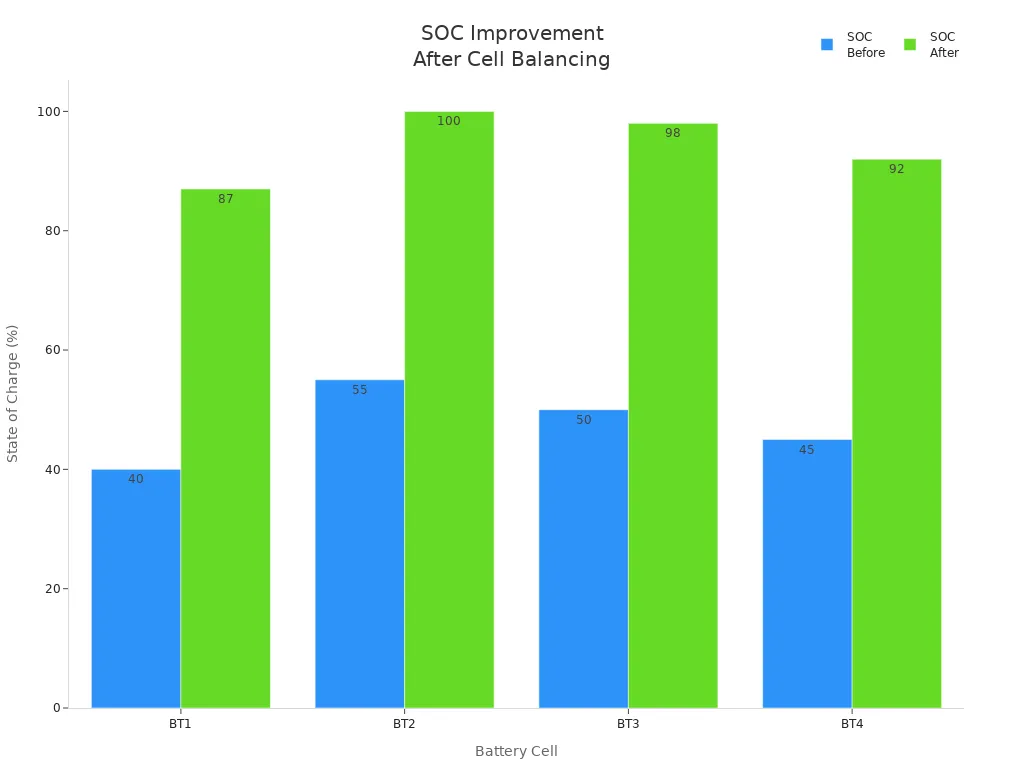
Case studies show clear improvements in battery performance after implementing multi-level cell balancing. For example, the state of charge (SOC) for four battery cells improved dramatically:
Battery Cell | SOC Before (%) | SOC After (%) |
|---|---|---|
BT1 | 40 | 87 |
BT2 | 55 | 100 |
BT3 | 50 | 98 |
BT4 | 45 | 92 |
Tip: When you use multi-level cell balancing, you maximize the value of your lithium battery packs and ensure safe, reliable performance in every application.
Multi-level cell balancing in your 4S4P lithium battery pack keeps every cell at similar voltage. You prevent premature failure by reducing cell stress and improving safety. Advanced balancing solutions help you maximize usable capacity and extend battery lifespan.
You protect your investment with longer-lasting, safer battery systems.
You improve reliability for commercial and industrial applications.
Adopting robust multi-level cell balancing ensures your lithium battery packs deliver consistent performance and support your business growth.
FAQ
What is multi-level cell balancing in lithium battery packs?
You use multi-level cell balancing to keep all cells in your battery pack at similar voltage and charge. This process works at both series and parallel levels. It helps you prevent early failure and maintain safe, reliable operation.
Why does my 4S4P pack need both series and parallel balancing?
You need both series and parallel balancing because each group can develop different voltages. Series balancing protects the whole string. Parallel balancing keeps each group healthy. This dual approach ensures your pack delivers maximum performance and safety.
How does a BMS support multi-level cell balancing?
Your battery management system (BMS) monitors each cell’s voltage and temperature. It uses algorithms to balance cells actively or passively. This system helps you avoid overcharge, deep discharge, and overheating in your lithium battery pack.
Can multi-level cell balancing extend battery lifespan?
You can extend your battery’s lifespan with multi-level cell balancing. This method reduces stress on individual cells. It also prevents weak cells from limiting the pack’s overall performance. You get more cycles and better value from your investment.


