

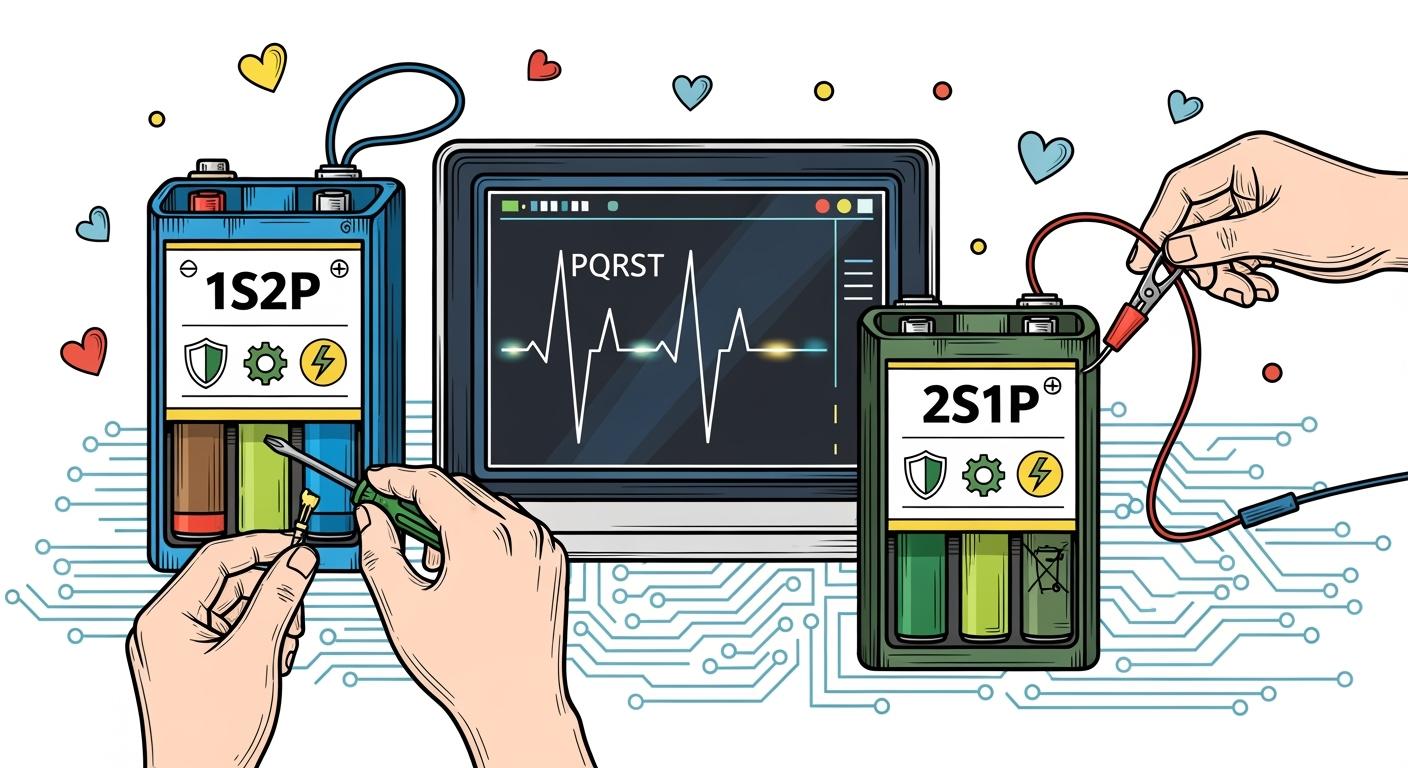
You improve safety and reliability in ECG monitors by choosing battery solutions that match electrical load and medical standards. Custom lithium battery packs, such as 1S2P and 2S1P, help you build compact devices and support best practices for ecg monitor batteries. Miniaturization and higher energy density drive lighter, more efficient medical devices.
Key Takeaways
Choose the right battery configuration (1S2P or 2S1P) based on your ECG monitor’s voltage and runtime needs to enhance performance.
Prioritize safety by implementing thermal protection and regular inspections of Battery Management Systems (BMS) to prevent failures and extend battery life.
Maintain battery health through routine checks and proper charging practices to ensure continuous operation and protect sensitive patient data.
Part1: Battery Solutions for ECG Monitor Batteries

1.1 1S2P vs 2S1P Configurations
You face a critical decision when selecting battery solutions for ECG monitor batteries. The choice between 1S2P (one cell in series, two in parallel) and 2S1P (two cells in series, one in parallel) configurations directly impacts device performance. 1S2P offers higher capacity at a lower voltage, while 2S1P provides higher voltage with less capacity. You must match the configuration to the voltage and runtime requirements of your ecg monitor batteries.
Configuration | Voltage (Nominal, Li-ion) | Capacity | Typical Use Case |
|---|---|---|---|
1S2P | 3.7V | High | Long runtime, low voltage devices |
2S1P | 7.4V | Moderate | Devices needing higher voltage |
You should always consider battery chemistry, such as NMC or LiFePO4, to ensure compatibility with your device’s power profile. Performance testing and size optimization help you select the right battery solutions for ecg monitor batteries.
1.2 Impact on Handheld Medical Devices
Battery configuration shapes the size, weight, and usability of handheld medical devices. You want lightweight, compact ecg monitor batteries that do not compromise safety or runtime. The right battery solutions support miniaturization and enhance user comfort.
Tip: Always verify that your battery solutions meet IEC 62133 and UN38.3 standards for safety and transport. These standards set benchmarks for future regulations and ensure compliance in medical applications. For more details, see medical battery solution.
When you choose battery solutions for ecg monitor batteries, focus on these factors:
Safety features (alarm, balancer, electrical and thermal protection)
Battery management systems
Regulatory compliance
Energy density
You can request a custom consultation for your next project with Large Power custom battery solution.
Part2: Safety & Compliance Best Practices
2.1 Overcharge & Thermal Protection
You must prioritize safety when designing high-performance lithium-ion batteries for ECG monitors. Overcharge protection stands as a critical line of defense in medical battery applications. Real-time voltage monitoring allows you to track battery voltage continuously. If the voltage exceeds a safe threshold, the charging circuit disconnects instantly. This practice prevents overcharging and extends battery life. Rapid load switching offers another layer of safety. When the system detects an overcharge, it disconnects the load from the battery, protecting both the device and the patient.
Thermal protection systems play a vital role in maintaining safety and reliability. Effective thermal management ensures that batteries operate within safe temperature ranges. You can use active or passive cooling methods, both internally and externally, to manage heat. These practices prevent overheating, short-circuiting, and chemical leakage. Companies that implement comprehensive safety management systems report a 60-80% reduction in battery-related incidents. This approach leads to significant cost savings and improved battery life.
You should select battery chemistries such as LiFePO4, NMC, or LCO based on your device’s requirements. Heat-resistant electrolytes and solid-state lithium-ion batteries further reduce the risk of thermal runaway. These practices support the reliability of medical battery applications and ensure compliance with international safety standards.
Tip: Always verify that your battery packs comply with IEC 62133, UN38.3, and RoHS standards. For conflict minerals compliance, review the conflict minerals statement.
2.2 BMS Inspections & Diagnostics
Battery Management Systems (BMS) form the backbone of safety and reliability in high-performance lithium-ion batteries. You need to schedule regular BMS inspections to detect early signs of failure. These inspections help you maintain battery life and prevent unexpected downtime in medical battery applications. Advanced BMS can anticipate failures by monitoring voltage, current, and temperature in real time. This proactive approach ensures safety and extends battery life.
Routine diagnostics and testing allow you to identify issues before they impact device performance. You should document all testing results and follow up with corrective actions. This practice supports regulatory compliance and enhances reliability. For ECG monitors, you must use BMS with built-in diagnostics and protection features. These systems should include alarms, balancers, and thermal cutoffs.
Feature | Purpose | Benefit for ECG Monitors |
|---|---|---|
Real-time Monitoring | Tracks voltage, current, temperature | Maximizes battery life and safety |
Fault Detection | Identifies abnormal conditions | Prevents device failure |
Data Logging | Records battery performance | Supports compliance and auditing |
Balancing | Ensures even cell charge/discharge | Extends battery life |
You should always use standardized terminology for battery chemistries and follow strict data output for battery specifications. For more information on BMS and PCM, visit BMS and PCM. If you require a custom solution for your application in medical, robotics, security, infrastructure, or industrial sectors, request a consultation at Large Power custom battery solution.
Note: Regular testing and maintenance of your BMS are essential practices for ensuring safety, reliability, and long battery life in all medical battery applications.
Part3: Performance & Maintenance of ECG Monitor Batteries
3.1 Battery Life & Reliability
You need to maximize battery life and reliability to ensure continuous operation of ECG monitors in clinical environments. The reliability of lithium battery packs directly affects the performance of medical equipment. When you select medical-grade lithium-ion cells, you typically achieve a cycle life of 300–500 cycles under standard conditions. Fast-charging can shorten this lifespan, leading to earlier battery replacements and reduced device uptime.
Reliability Factor | Impact on ECG Monitors |
|---|---|
Cycle Life | 300–500 cycles for medical-grade lithium-ion cells; fast-charging reduces lifespan |
Capacity Loss | Charging at 2C rates causes 20–28% more capacity loss after 300 cycles |
Real-World Performance | Hospitals using rapid-charging docks replace batteries 6–12 months earlier |
Device Symptoms | Shorter runtime, longer calibration times, increased maintenance frequency |
You should choose battery chemistries such as LiFePO4, NMC, LCO, LMO, or LTO based on your device requirements. Standardized terminology and strict data output for battery specifications help you compare options and select the best solution for your application. Power supply reliability ensures that your devices deliver consistent results in medical, robotics, security, infrastructure, and industrial sectors.
Tip: Always use a battery management system to monitor cell health and prevent unexpected failures. This practice supports long-term reliability and compliance with medical standards.
3.2 Routine Checks & Charging Cycles
Routine maintenance checks play a vital role in maximizing the lifespan of ECG monitor batteries. You should regularly check the battery status of all battery-operated devices. Replace batteries within three years to prevent unexpected power loss. Avoid overcharging, especially with lithium-ion batteries, and follow the manufacturer’s guidelines for charging rechargeable units.
Check battery status frequently on all devices.
Replace batteries as needed to maintain operational uptime.
Avoid overcharging and full discharges to extend battery life.
Maintain charge levels between 20% and 80% for optimal performance.
Schedule preventive maintenance to address minor issues before they escalate.
Each charge cycle contributes to the degradation of lithium-ion batteries. Energy storage capacity diminishes over time, especially if you use rapid charging or allow batteries to discharge completely. Maintaining proper charging cycles and scheduling regular maintenance reduces unplanned downtime and improves the reliability of medical equipment.
Note: Preventive maintenance increases the average annual uptime of medical equipment to over 94%. Negligent maintenance leads to higher Mean Time to Repair (MTTR) and reduced device availability.
3.3 Advanced Power Supply Solutions
You can enhance the performance of ECG monitor batteries by adopting advanced power supply solutions. Modern lithium battery packs offer features that support clinical and emergency use, ensuring safety and reliability for all devices.
Feature | Description |
|---|---|
Medical-Grade Safety | ISO13485-compliant, IEC60601-1 certified for clinical and emergency environments |
Extended Runtime | High-energy-density batteries support 6–12 hours of continuous monitoring |
Multiple Safety Protections | Overcharge, over-discharge, overcurrent, short-circuit, and temperature protection |
Smart Power Management | Accurate remaining-power indication and intelligent alarms prevent unexpected shutdowns |
Fast Charging Technology | Full capacity achieved in 2–3 hours for rapid turnaround in emergency and ICU settings |
Low Noise & EMC Compatibility | Optimized circuitry reduces electromagnetic interference, ensuring safe operation with sensors |
You should always integrate a battery management system to monitor voltage, current, and temperature in real time. This system helps you prevent failures and maintain power supply reliability across all devices. Advanced solutions also support low noise and electromagnetic compatibility, which is critical for sensitive medical equipment.
If you need a custom battery solution for your next project in medical, robotics, security, infrastructure, consumer electronics, or industrial sectors, request a consultation with Large Power custom battery solution.
Tip: Advanced lithium battery packs with smart power management and multiple safety protections help you meet the highest standards for medical equipment and ensure continuous operation of all devices.
Part4: Data Security & Device Stability in Handheld Medical Devices
4.1 Battery Health & Data Integrity
You must prioritize battery health to maintain data security and patient safety in handheld medical devices. Lithium-ion batteries power ECG monitors that store and transmit sensitive health data. If you neglect battery health, you risk device failure and loss of patient data.
Power loss in lithium-ion batteries can lead to sudden device failure. In medical devices, this risk can interrupt patient monitoring, delay treatment, or cause life-threatening situations. You need to select lithium-ion batteries with reliable safety features to minimize the risk of unexpected shutdowns.
You protect patient safety by monitoring battery health and replacing batteries before they degrade. This approach ensures continuous access to sensitive health data and supports data security. You should use lithium-ion batteries with advanced management systems to track battery health and prevent data corruption. These solutions help you meet strict regulatory requirements for protecting data and patient safety. You can request a custom solution for your application at Large Power custom battery solution.
4.2 Ensuring Continuous Operation
You ensure device stability and patient safety by adopting effective strategies for continuous operation. Lithium-ion batteries with high reliability support uninterrupted monitoring of patient conditions. You must focus on solutions that address both device uptime and data security.
Maintain batteries at an acceptable capacity level (usually 80%) to ensure optimal performance.
Determine the capacity level at which a battery should be replaced in ECG monitors.
Perform spot checks and cycle tests on batteries from new vendors to verify their performance.
Utilize battery analyzers to assess battery health.
Backup power systems, such as uninterruptible power supplies (UPS), play a key role in maintaining device stability during power outages. These solutions provide a reliable power source for medical, security, and industrial applications. You should standardize terminology for battery chemistries, such as LiFePO4, NMC, LCO, LMO, and LTO, and follow strict data output for battery specifications.
You support patient safety and data security by preventing downtime and protecting data in all environments. You must monitor battery health and use solutions designed for sensitive health data in medical, robotics, infrastructure, and consumer electronics sectors.
You improve device reliability and patient outcomes by prioritizing battery maintenance and safety in ECG monitors.
Routine checks and advanced battery management systems, including thermal protection, minimize downtime and operational costs.
Ongoing education, such as webinars on battery risk mitigation, helps you meet regulatory expectations.
For custom lithium battery solutions in medical, robotics, security, and industrial sectors, consult Large Power custom battery solution.
FAQ
What is the difference between 1S2P and 2S1P battery packs for ECG monitors?
You select 1S2P for longer runtime. You choose 2S1P for higher voltage devices.
How do you ensure compliance and safety for lithium battery packs in medical devices?
You use battery packs from Large Power with IEC 62133 and UN38.3 certifications. You schedule regular BMS inspections and select chemistries like LiFePO4 or NMC for safety.
For custom solutions, visit Large Power custom battery solution.
Which battery chemistry should you choose for ECG monitors in clinical and industrial environments?
You select NMC for reliability and safety. You use LCO or LMO for higher energy density. You always standardize terminology and data output for specifications.


