

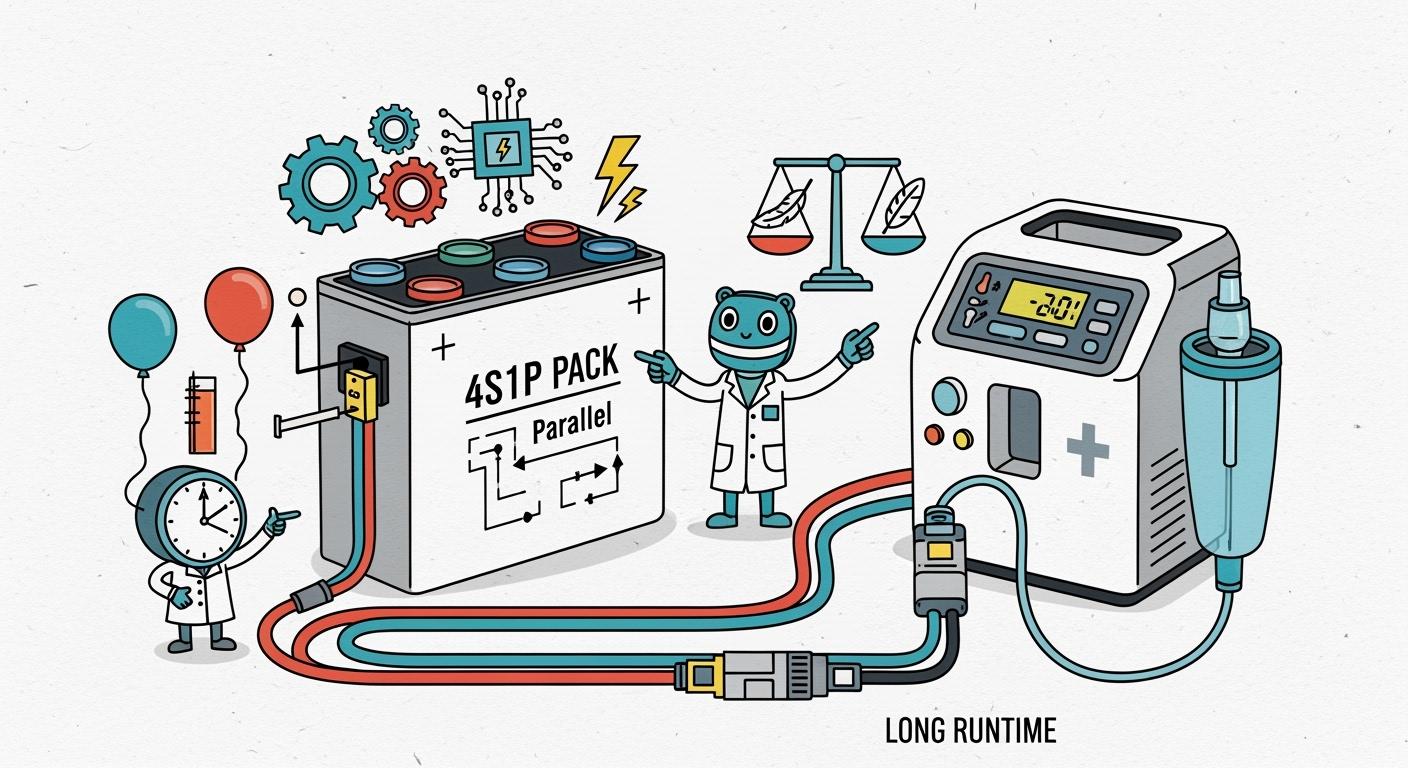
You face a constant challenge when designing a Lithium Battery Pack for portable oxygen concentrators. A 4S1P setup provides 14.4V and supports longer runtimes, while a 3S1P delivers lower voltage and shorter runtimes:
High energy density and reliability remain critical for medical devices where every ounce and minute count.
Key Takeaways
The 4S1P configuration offers high voltage and extended runtimes, making it ideal for portable oxygen concentrators.
Prioritize energy density and safety in battery design to ensure reliable performance and compliance with medical standards.
Implement regular maintenance and smart battery management systems to enhance battery life and prevent failures.
Part1: 4S1P Lithium Battery Pack Design Essentials

1.1 4S1P Configuration for Portable Oxygen Concentrators
You need a battery pack design that delivers consistent performance and reliability in portable medical devices. The 4S1P configuration stands out as the preferred choice for portable oxygen concentrators. This setup connects four cells in series, providing a stable voltage output that matches the requirements of most concentrator electronics. You benefit from a compact form factor, which supports both portability and ease of integration into lightweight battery packs.
Key advantages of the 4S1P lithium battery pack configuration include:
Reliability and longevity, which are essential for medical applications.
Extended runtime, making it suitable for travel and home care.
Seamless integration with smart Battery Management Systems (BMS), enhancing safety and diagnostics.
You can see how the 4S1P configuration compares to other options in terms of size, voltage, and weight:
Feature | Details |
|---|---|
Configuration | 4S1P |
Voltage Output | 12.8V – 14.8V |
Capacity | 2600 – 3500 mAh |
Dimensions | 67.0 mm – 108 mm (L) |
27 mm – 76 mm (W/H) | |
Weight | 380g |
Comparison with Lead-Acid | Twice bigger and heavier |
This configuration allows you to achieve a balance between energy density, runtime, and portability, which is critical for medical device applications.
1.2 Energy Density and Runtime Optimization
You must prioritize energy density when designing a lithium battery pack for portable oxygen concentrators. Higher energy density means you can store more energy in a smaller, lighter package, directly impacting runtime. For example, a 3.7V / 6000mAh lithium polymer cell can deliver up to 8 hours of runtime at a 15W power demand. Chemistries like Nickel Manganese Cobalt (NMC) and Lithium Cobalt Oxide (LCO) offer high energy density, with NMC reaching ≥220 Wh/kg. This level of density extends operational time and supports runtime optimization without increasing weight.
You can further enhance runtime optimization by using advanced balancing strategies. Machine learning-driven battery pack reconfiguration improves cell balancing, which redistributes energy among cells. Active balancing transfers energy from cells with higher charge to those with lower charge, maximizing usable capacity and extending runtime per charge. These techniques allow you to achieve longer runtime without adding significant weight.
The trade-off between energy density and safety requires careful consideration. High energy density batteries store more energy, but they may not release it as quickly as high power density batteries. You must balance these factors to ensure both performance and safety.
Thermal runaway represents the most severe safety concern for lithium battery packs, occurring when internal heat generation exceeds dissipation capabilities, creating a dangerous positive feedback loop that can lead to fire or explosion.
You should always integrate advanced safety systems to manage these risks, especially in medical applications.
1.3 Reliability and Safety in Battery Pack Design
You cannot compromise on reliability and safety in battery pack design for medical devices. Charging below 0°C can cause metallic lithium plating on the anode, which compromises safety. Repeated cold temperature charging increases the risk of failure. Mechanical damage from drops, vibration, or moisture exposure also threatens reliability. You must provide suitable mechanical protection to ensure consistent operation.
Protection circuits require robust design to prevent damage from static electricity or faulty chargers. Charging at cold temperatures can permanently damage lithium-ion batteries, so you need to implement strict charging protocols.
You must comply with international safety standards for medical battery pack design:
Standard | Description |
|---|---|
ANSI/AAMI ES 60601-1 | General requirements for the safety and performance of medical devices powered by batteries. |
IEC 62133 | Safety requirements for portable sealed secondary cells and batteries. |
IEC 60086 Part 4 | Safety of primary batteries. |
UL 1642 | Safety standard for lithium batteries. |
You should also use rigorous reliability testing methods, such as:
Quality assurance systems to meet regulatory and industry standards.
Environmental testing, including temperature cycling and humidity exposure.
Endurance testing to evaluate performance over repeated charge-discharge cycles.
Process failure modes, effects, and criticality analysis (P-FMECA) for risk assessment.
100 percent quality control testing and random sample testing at each production step.
A smart Battery Management System (BMS) plays a vital role in safety. It continuously monitors voltage and current, detects potential malfunctions, and enables remote monitoring. This real-time data allows you to intervene before issues escalate, preventing dangerous situations such as thermal runaway.
By focusing on energy density, robust battery pack design, and advanced safety features, you ensure that your lithium battery pack delivers reliable, long-lasting performance in portable oxygen concentrators.
Part2: Strategies to Optimize Weight and Runtime
2.1 Cell Selection for Lightweight Battery Packs
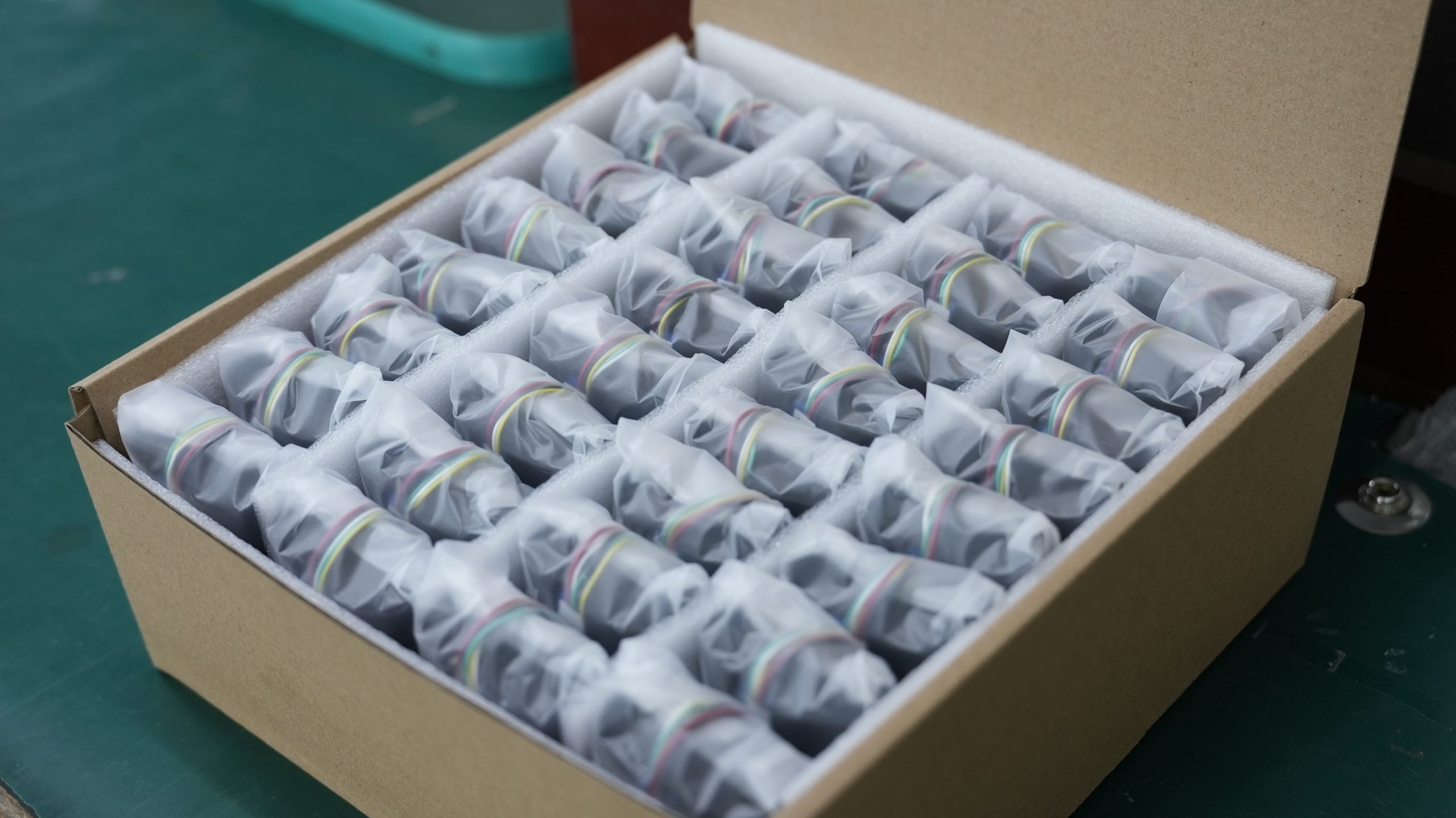
You must select the right lithium-ion battery cells to achieve the best balance of weight, runtime, and performance in a portable oxygen concentrator. The choice of cell chemistry and form factor directly impacts the overall weight and battery capacity. For medical applications, you need high energy density and reliable performance to ensure the concentrator delivers consistent power.
Manufacturers often develop custom battery packs to meet specific size, weight, and performance needs. This approach allows you to maximize runtime while keeping the design compact and portable. When selecting cells, consider the following criteria:
Criteria | Description |
|---|---|
Watt-hour limit | Lithium-ion batteries must not exceed 100 Wh to comply with FAA regulations. |
Testing standards | Batteries must pass tests like Test T.7 (Overcharge) per UN Manual of Tests. |
You should also compare different cell types to understand their impact on weight:
Cell Type | Weight per Cell | Example Configuration | Total Weight for 4S1P |
|---|---|---|---|
Prismatic Cell | 1.5 kg | 4 cells in series | 6 kg |
Pouch Cell | 0.1 kg | 6 cells in series | 0.6 kg (not 4S1P) |
For a portable oxygen concentrator, pouch cells offer a significant reduction in weight compared to prismatic cells. However, you must ensure the configuration matches the concentrator’s voltage and battery capacity requirements. Always select lithium-ion battery cells that provide high energy density, long cycle life, and stable performance under varying loads.
2.2 Pack Layout and Physical Design
The physical design and layout of your lithium-ion battery pack play a crucial role in both safety and performance. The arrangement of cells affects heat dissipation, which is vital for medical devices like portable oxygen concentrators. Proper spacing between cells and thoughtful internal structure help prevent localized overheating and reduce the risk of thermal runaway.
The position of heating within the pack can change how quickly thermal events spread. Side heating may accelerate thermal runaway, especially if you increase cell spacing. Central heating can delay the onset, as uneven heat flow paths slow down the process. You must design the pack to manage heat effectively, using materials and layouts that support safe operation.
Cell balancing is another key factor. By ensuring all cells operate at similar charge levels, you maximize battery capacity and improve efficiency. This leads to longer runtime and more reliable performance for your concentrator. Custom battery packs designed for medical use must meet strict safety standards and provide consistent power delivery.
Tip: Use advanced cell balancing techniques and thermal management materials to enhance the durability and reliability of your lithium-ion battery pack.
2.3 Safety Features and Compliance
Safety remains a top priority in the design of lithium-ion battery packs for portable oxygen concentrators. You must integrate essential safety features and comply with international standards to ensure reliable performance in medical environments.
Safety Feature | Description |
|---|---|
Safe Storage and Disposal | Store in a cool, dry place; avoid sunlight and extreme temperatures; dispose of batteries properly. |
Proper Charging Techniques | Follow manufacturer guidelines; use the correct charger; avoid overcharging and over-discharging. |
Regular Inspections of Charger | Check cables and contacts monthly; clean battery contacts to maintain safety and functionality. |
You must also meet the following compliance standards:
Standard | Description |
|---|---|
UL 2054 | Standard for Household and Commercial Batteries, recognized by FDA |
UL 1642 | Standard for Lithium Batteries (Cells), recognized by FDA |
IEC 62133-2:2017 | Safety requirements for portable sealed secondary lithium cells |
UN/DOT 38.3 | Recommendations on the Transport of Dangerous Goods |
Integrating a battery management system (BMS) further improves safety and reliability. The BMS monitors each cell’s performance, maintains system integrity, and reduces the risk of sudden failures. It ensures consistent power output, which is critical for medical devices. Learn more about BMS in medical applications.
Note: Battery management systems are critical for battery performance and safety. They help monitor state of charge, state of health, and thermal management, which enhances reliability and interoperability.
2.4 Maintenance and Integration Tips
Proper maintenance and thoughtful integration ensure your lithium-ion battery pack delivers reliable performance and long runtime in a portable oxygen concentrator. You should address common causes of failure, such as non-charging batteries, short battery life, and overheating. These issues often result from faulty chargers, battery degradation, or poor component quality.
Follow these tips for optimal maintenance and integration:
Balance energy density and power delivery to meet the concentrator’s high current demands.
Use smart battery management systems to monitor voltage and temperature.
Implement modular designs to enhance reliability and prevent moisture ingress.
Perform regular inspections and clean battery contacts to maintain safe operation.
Store batteries in a cool, dry place and avoid exposure to extreme temperatures.
When integrating a lithium-ion battery pack into a portable oxygen concentrator, consider the following criteria:
Criteria | Description |
|---|---|
Voltage (V) | Ensure the battery voltage matches your device’s requirements. |
Capacity (mAh) | Opt for higher capacity for extended runtime. |
Discharge Rate | Confirm the battery supports the oxygen flow needs of the concentrator. |
Chemistry | Lithium-ion batteries offer high energy density and reliability. |
Cycle Life | Select batteries with a longer cycle life to minimize replacements. |
Compatibility | Verify the battery fits the voltage and connector specifications. |
Portability | Consider weight and size for ease of transport. |
Operating Environment | Choose batteries rated for extreme conditions if necessary. |
Integrating lithium-ion battery packs into portable oxygen concentrators requires careful attention to thermal management and structural integrity. Advanced materials and designs help dissipate heat and enhance safety, which is crucial for medical applications. By following these strategies, you ensure your concentrator delivers reliable performance, long runtime, and optimal power for patients in any setting.
You can optimize lithium battery pack weight and runtime by storing batteries in a cool, dry place, rotating labeled batteries, and avoiding extreme temperatures. Prioritize energy density, reliability, and safety for stable voltage, long cycle life, and compliance with IEC 62133 and UL standards.
Aspect | Importance |
|---|---|
Safety Assurance | Protects against overcharging and short circuits |
Quality & Reliability | Ensures performance and durability through compliance |
For custom battery solutions, contact our technical team to discuss your project needs.
FAQ
What makes 4S1P lithium battery packs ideal for portable oxygen concentrators?
You gain high energy output, long life, and enhanced safety. The 4S1P configuration delivers stable energy, supports safety, and extends life. This setup ensures reliable energy and safety for medical use.
How do you maximize safety, energy, and life in lithium battery packs?
You must select cells with proven safety, high energy density, and long life. Regular safety checks, energy monitoring, and life cycle testing improve safety, energy efficiency, and life expectancy.
Why choose Large Power for custom lithium battery pack solutions?
Large Power provides advanced safety features, high energy density, and long life. You receive expert consultation for safety, energy, and life optimization. Request a custom battery consultation for your project.
For safety, always follow manufacturer guidelines.
To extend life, store batteries properly.
Monitor energy usage to maintain safety and life.
Feature | Safety | Energy | Life |
|---|---|---|---|
Large Power | ✔️ | ✔️ | ✔️ |
Custom Packs | ✔️ | ✔️ | ✔️ |
Tip: Prioritize safety, energy, and life in every lithium battery pack decision.


