

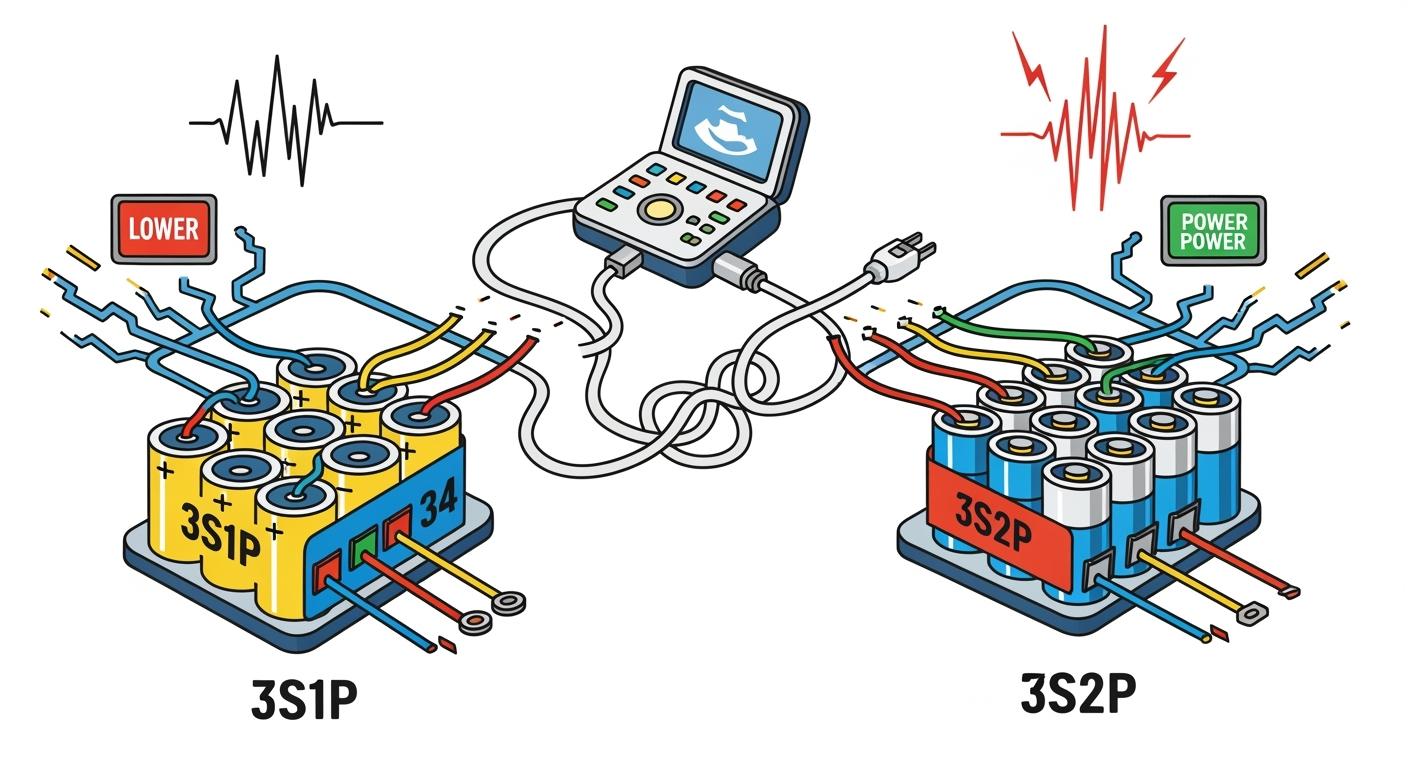
Selecting the right battery configuration for your handheld ultrasound device determines its battery life differences, reliability, and usability in clinical settings.
Lithium-ion batteries deliver high energy density, supporting consistent imaging performance.
Their lightweight design improves portability for handheld applications.
Reliable batteries safeguard medical operations, preventing interruptions and ensuring patient safety.
Key Takeaways
Choose a 3S2P battery for longer runtime and reliability in busy clinical settings. It supports extended procedures without frequent recharging.
Opt for a 3S1P battery when portability and compactness are priorities. This configuration is lighter and ideal for quick scans.
Prioritize safety features in battery packs. Both configurations offer protections that ensure reliable operation and patient safety.
Part1: Battery Life Differences in 3S1P vs 3S2P

1.1 Runtime and Usage Time
You need to understand how battery configuration impacts runtime in portable ultrasound devices. A 3S1P battery pack consists of three cells in series, providing higher voltage but limited capacity. A 3S2P battery pack uses six cells—three in series, two in parallel—doubling the capacity while maintaining the same voltage. This difference directly affects how long your device operates between charges.
3S1P: Delivers standard runtime suitable for short examinations or quick scans.
3S2P: Offers extended usage time, supporting longer procedures and higher patient throughput.
Configuration | Voltage (V) | Capacity (Ah) | Typical Runtime (hours) |
|---|---|---|---|
3S1P | 10.8-11.1 | 3-3.5 | 3-4 |
3S2P | 10.8-11.1 | 6-7 | 6-8 |
You gain more flexibility with a 3S2P battery pack, especially in busy clinical environments. Longer runtime reduces the need for frequent charging, which can improve workflow and patient care. For more on lithium-ion battery performance, see Large Power’s review on lithium-ion batteries.
1.2 Reliability and Consistency
Reliability is critical in medical imaging. You must ensure your ultrasound device delivers consistent power throughout its operation. Both 3S1P and 3S2P packs use lithium-ion cells, known for high energy density and stable output. However, the parallel structure in 3S2P enhances reliability by distributing the load across more cells. This design minimizes voltage drops and maintains consistent imaging quality.
Tip: A 3S2P pack can continue operating even if one cell fails, thanks to its parallel redundancy. This feature increases uptime and reduces the risk of unexpected shutdowns during critical procedures.
Lithium-ion batteries typically maintain over 800 charge-discharge cycles at 80% capacity, ensuring longevity and reliability for professional use.
1.3 Suitability for Portable Ultrasound Devices
Selecting the right battery configuration depends on your device’s mobility requirements and operational demands. Portable ultrasound devices benefit from lightweight, high-capacity batteries. Both 3S1P and 3S2P packs use lithium-ion chemistry, which delivers up to 270 Wh/kg energy density. This specification supports high-performance imaging while keeping the device easy to carry.
Here’s a comparison of key factors that determine suitability:
Factor | Description |
|---|---|
Energy Density | Lithium-ion batteries can deliver up to 270 Wh/kg, making them suitable for high-performance devices. |
Weight | Lightweight batteries are crucial for portable devices to enhance mobility and ease of use. |
Cycle Life | These batteries maintain over 800 charge-discharge cycles at 80% capacity, ensuring longevity. |
Safety Features | Advanced safety mechanisms are essential to prevent failures in critical medical applications. |
Consistent Power | Reliable power delivery is vital for the uninterrupted operation of medical imaging equipment. |
You should choose a 3S2P pack if your workflow demands longer runtime and higher reliability. A 3S1P pack suits applications where weight and compactness are top priorities. For more information on medical applications for lithium-ion batteries, visit our medical battery solutions.
Battery Life Differences between these configurations influence not only how long your device operates but also how reliably it performs in demanding environments. You must weigh these factors to optimize device usability and patient outcomes.
Part2: Technical Comparison and Device Impact

2.1 Voltage and Power Output
You need to understand how voltage and power output affect your ultrasound device’s performance. Both 3S1P and 3S2P battery packs deliver a nominal voltage of 11.1V, which matches the requirements for most portable medical equipment. However, the maximum discharge current differs. The 3S2P configuration supports higher current draw, making it suitable for devices that demand more power during intensive imaging sessions.
Battery Pack | Nominal Voltage | Nominal Capacity | Max. Discharge Current |
|---|---|---|---|
3S1P | 10.8-11.1V | 3350mAh | 1.0C |
3S2P | 10.8-11.1V | 6700mAh | 1.0C |
Note: Higher discharge current in 3S2P packs ensures stable operation during peak loads, reducing the risk of voltage drops that can disrupt imaging quality.
2.2 Capacity and Charging Time
Capacity determines how long your device can operate before needing a recharge. The 3S2P battery pack offers a larger capacity, which translates to longer usage time. Charging time increases with capacity, so you must plan for longer charging cycles with 3S2P packs. This trade-off benefits high-throughput environments where extended operation outweighs the need for rapid recharging.
3S1P: Faster charging, shorter runtime.
3S2P: Longer runtime, increased charging time.
You can learn more about lithium battery types and their impact on device performance in our lithium battery types guide.
2.3 Size, Weight, and Portability
Size and weight play a crucial role in handheld ultrasound devices. The 3S1P configuration remains lighter and more compact, making it ideal for applications where portability is essential. The 3S2P pack, while heavier, provides greater energy reserves. You must balance these factors based on your workflow and device requirements.
Configuration | Weight (approx.) | Size (approx.) | Portability |
|---|---|---|---|
3S1P | Lower | Smaller | High |
3S2P | Higher | Larger | Moderate |
Battery Life Differences between these configurations influence not only runtime but also how easily you can transport and deploy your ultrasound device in various clinical settings.
Part3: Safety and Maintenance Factors
3.1 Safety Features and Redundancy
You must prioritize safety when selecting lithium-ion battery packs for medical devices. Both 3S1P and 3S2P configurations include advanced protection features that help prevent failures and ensure reliable operation. These features protect your device from electrical faults and thermal risks. The parallel structure in 3S2P packs adds redundancy, allowing continued operation if one cell fails. This design supports uninterrupted imaging and patient safety.
Safety Feature | Description |
|---|---|
Short circuit protection | Prevents damage from short circuits. |
Overcharge protection | Prevents battery from overcharging. |
Over-discharge protection | Prevents battery from discharging too much. |
Over-current protection | Protects against excessive current. |
Temperature protection | Monitors and manages temperature. |
Equalization | Balances charge across cells. |
Tip: You reduce downtime and risk by choosing battery packs with robust safety features and redundancy.
3.2 Maintenance and Replacement
You need to plan for regular maintenance and timely replacement to keep your ultrasound devices running efficiently. The replacement process for 3S1P packs is straightforward due to their compact size and standard capacity. For 3S2P packs, you handle higher capacity and discharge rates, which may require more careful handling during replacement. You should always follow manufacturer guidelines to maintain safety and performance.
Battery Configuration | Voltage | Capacity | Application | Discharge Current |
|---|---|---|---|---|
3S1P 21700 | 11.1V | 4500mAh | Medical Devices | Standard |
3S2P 21700 | 11.1V | 10000mAh | High-Power Medical Devices | High Discharge |
You extend device lifespan and maintain consistent performance by scheduling routine checks and using approved replacement packs. Battery Life Differences between these configurations also affect how often you need to perform maintenance.
Part4: Choosing the Right Battery Pack
4.1 When to Choose 3S1P
You should select a 3S1P battery pack when your device requires a balance of moderate voltage, compact size, and lightweight design. This configuration works best for portable ultrasound devices that need to stay small and easy to handle. You benefit from high energy density, which allows you to integrate the battery into space-constrained equipment. The long cycle life and advanced safety features also support reliable operation in medical environments.
Moderate voltage and compact size fit portable devices.
High energy density and lightweight design suit space-limited equipment.
Long cycle life and advanced safety features meet medical standards.
If you need a custom battery solution for your specific device, visit our custom battery solution page.
4.2 When to Choose 3S2P
You should choose a 3S2P battery pack if your application demands extended runtime and stable, long-lasting power. This configuration uses high-capacity cells, making it ideal for devices that operate for long periods without interruption. Common use cases include portable ventilators, infusion pumps, and other medical equipment that require consistent performance over many hours. For more details on medical battery applications, see our medical battery solutions.
High-capacity cells deliver extended runtime.
Suitable for devices needing stable, long-lasting power.
Common in portable ventilators, infusion pumps, and similar equipment.
4.3 Cost and Application Scenarios
You must consider both cost and application when selecting a battery pack. The 3S1P option offers lower upfront costs and works well for lightweight, portable devices. The 3S2P pack costs more but provides greater capacity and reliability for demanding applications.
Configuration | Best For | Runtime | Weight | Cost | Typical Applications |
|---|---|---|---|---|---|
3S1P | Compact, portable devices | 2–3 hours | Lower | Lower | Handheld ultrasound, mobile scanners |
3S2P | High-demand, long-use devices | 4–6 hours | Higher | Higher | Portable ventilators, infusion pumps |
Tip: Always match your battery choice to your device’s operational needs and workflow. For custom consultation, reach out to our custom battery solution team.
You improve ultrasound device performance by selecting the right battery configuration.
You enhance reliability and efficiency in clinical operations.
Custom battery solutions support high-quality imaging and flexible deployment.
You ensure effective operation in diverse environments.
Review the summary table to guide your battery pack selection.
FAQ
What is the main difference between 3S1P and 3S2P lithium battery packs?
How do you select the right lithium battery pack for your ultrasound device?
You should assess runtime needs, device size, and reliability. Large Power offers custom battery solutions for specialized requirements.


