

Lithium battery safety remains a top priority for you in every application. Recent incidents, such as e-bike fires in New York and apartment fires in London, prove the dangers of poor battery design.
Location | Date | Incident Description | Consequences |
|---|---|---|---|
New York City | Jan-May 2024 | Over 100 lithium-ion battery fires | 13 deaths |
London, UK | Sep 15, 2023 | Overheating mobility device battery | Property damage, injuries |
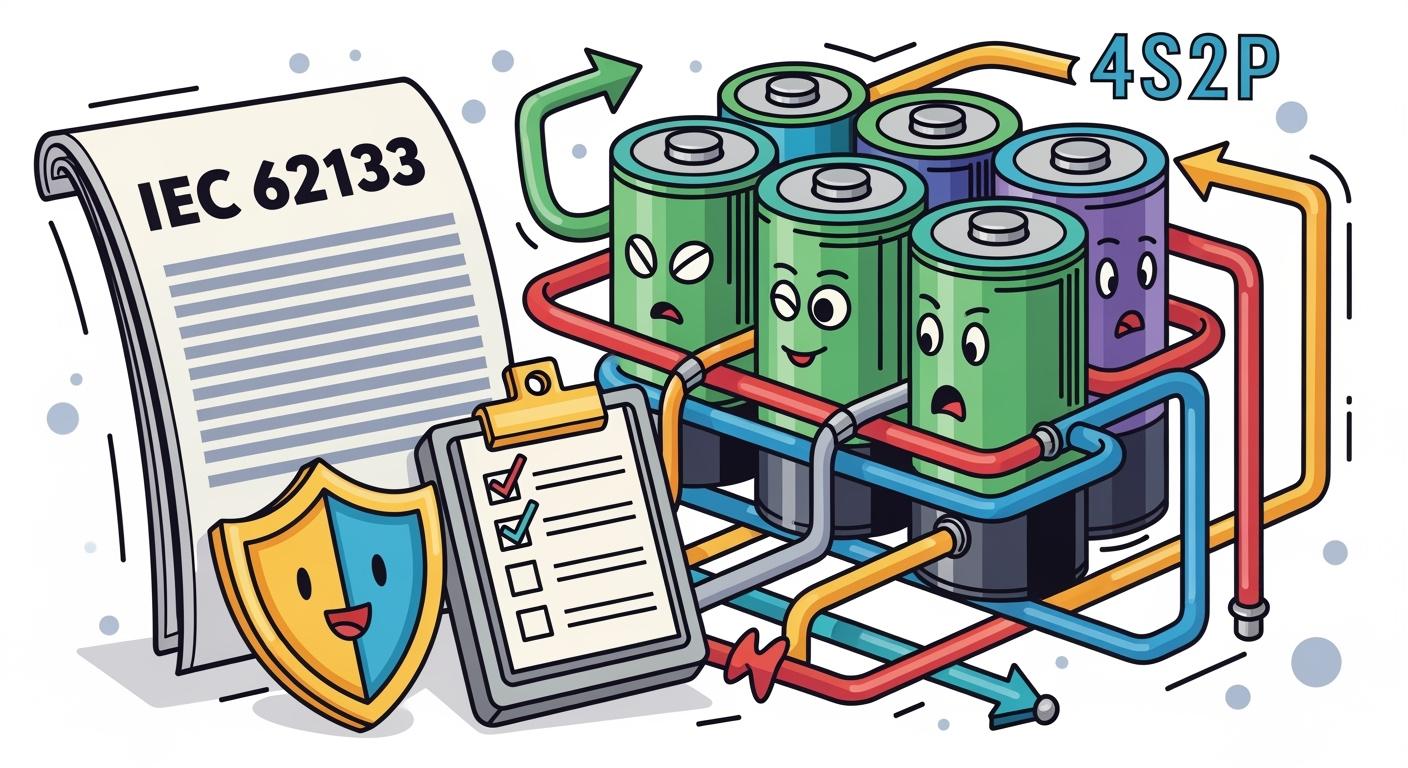
International standards like IEC 62133 protect you and your business by enforcing battery safety requirements, enabling access to global markets. Rigorous safety tests and compliant configurations, such as 4S2P, help you deliver reliable battery solutions and safeguard your reputation.
Key Takeaways
Prioritize battery safety by adhering to IEC 62133 standards. Compliance protects your business and enhances market access.
Implement the 4S2P design configuration to improve battery safety and reliability. This setup balances voltage and capacity, supporting compliance with safety regulations.
Conduct rigorous safety tests to identify design flaws before market release. Testing helps prevent incidents like fires and ensures product reliability.
Part 1: Battery Safety Risks and Industry Demands
1.1 Real-World Battery Safety Incidents
You face significant risks when working with lithium battery packs in B2B applications. Common hazards include:
Thermal runaway
Internal short circuits
Overcharging
External heat exposure
Battery degradation
Improper storage
These risks can lead to severe consequences, such as fires, explosions, and toxic leaks. Over half of surveyed businesses have reported incidents involving lithium-ion batteries. You may encounter sparking, fires, or explosions, especially in sectors like medical, robotics, security, infrastructure, consumer electronics, and industrial applications. Experts note that increased awareness among emergency responders and the public has driven updates in safety standards. This proactive approach helps you mitigate risks and protect your operations.
Incident Description | Regulatory Response |
|---|---|
Virgin Australia flight mid-air fire due to power bank | Urgent safety investigation initiated by Australian Transport Safety Bureau |
Over 50 lithium battery incidents logged by FAA in 2025 | Issued safety alerts and visibility rules for power banks |
Proliferation of consumer electronics increasing risk | IATA launched ‘Travel Smart with Lithium Batteries’ campaign to educate passengers |
1.2 Regulatory Pressures and Market Expectations
You must navigate a complex regulatory landscape to ensure battery safety and maintain market access. Regulatory requirements vary by region:
Region | Regulatory Requirements |
|---|---|
United States | UL 1642 & UL 2054, UN/DOT 38.3, FCC and OSHA Compliance |
European Union | CE Marking, EN Standards, UN 38.3, IEC 62619, Battery Passport & Documentation Requirements |
China | GB 31241-2014 & GB/T 31485, China Compulsory Certification (CCC), Transport Safety Measures (UN 38.3 Adoption) |
Market expectations drive demand for compliance solutions. You must prioritize safety and reliability to meet regulatory standards and earn consumer trust. Adhering to IEC standards, including IEC 62133, supports cross-border trade and positions your business for global success. The evolution of safety standards reflects the industry’s response to past incidents, emphasizing rigorous protocols and ongoing compliance.
Part 2: IEC 62133 Standard and Safety Tests for Lithium Packs

2.1 Overview of IEC 62133 and Its Global Role
You must understand the importance of the IEC 62133 standard when designing lithium-ion batteries for Medical, Robotics, Security, Infrastructure, Consumer Electronics, and Industrial applications. IEC 62133 outlines safety requirements for portable sealed secondary lithium cells and batteries in electronic devices. This standard helps you mitigate risks such as thermal runaway, short circuits, and overcharging. IEC 62133 harmonizes with other safety standards, including EN 62133, UL 62133, and UN 38.3. UN 38.3 focuses on transportation safety, while UL 62133 covers lithium battery safety across various applications. You gain global market access by meeting these harmonized requirements.
IEC 62133 applies to portable sealed secondary lithium-ion batteries.
The standard addresses thermal runaway, short-circuit, and overcharge risks.
Harmonization with UN 38.3, UL 62133, and EN 62133 streamlines regulatory approval for international shipments and product launches.
2.2 Key Safety Tests Required by IEC 62133
You must conduct rigorous safety tests to achieve IEC 62133 compliance. These tests verify that your lithium-ion battery packs meet strict safety requirements. The following table summarizes the main safety tests required by IEC 62133:
Test Type | Description |
|---|---|
Internal Short Circuit Test | Assessment of internal design to prevent short circuits. |
Overcharge Test | Evaluates the battery’s response to excessive charging conditions. |
Overdischarge Test | Tests the battery’s performance under excessive discharge conditions. |
Mechanical Abuse Tests | Includes vibration and shock tests to assess durability under stress. |
You must also perform crush test, impact test, vibration test, and thermal abuse test to ensure your lithium-ion batteries withstand real-world conditions. Safety testing helps you identify design flaws and process defects before your products reach the market. You protect patient safety in medical devices and maintain reliability in robotics and industrial systems by following these protocols.
2.3 4S2P Design for Battery Safety and Compliance
You can enhance battery safety and meet IEC 62133 standard requirements by adopting the 4S2P configuration. This design arranges four cells in series and two in parallel, balancing voltage and capacity. The 4S2P configuration supports compliance with UN38.3, IEC62133-2, UL1642, and UL2054. These certifications ensure your lithium-ion battery packs meet safety standards for air transport, shipping, and market entry.
Certification / Test | Purpose |
|---|---|
UN38.3 | Ensures air transport and shipping safety |
IEC62133-2 | Establishes safety standards for portable batteries |
UL1642 / UL2054 | Conducts safety and flammability tests, particularly in the US market |
You benefit from technical features such as:
Over-charge protection (≈4.25V/cell)
Over-discharge protection (≈2.5–3.0V/cell)
Cell balancing (passive or active)
Overcurrent and short-circuit protection
Temperature sensing and thermal cutoff
Optional communication: SMBus, CAN, UART, Bluetooth
These features help you prevent thermal runaway, short circuits, and overcharging. You improve patient safety in medical devices and reliability in robotics, security, and industrial applications. You also support sustainability goals by integrating advanced battery management systems (BMS) and conflict minerals tracking.
2.4 Benefits of Compliance and Risks of Non-Compliance
You gain significant advantages by achieving IEC 62133 compliance for your lithium-ion battery packs. The following table highlights the documented benefits for manufacturers:
Benefit | Description |
|---|---|
Enhanced Safety | Compliance leads to safer lithium battery packs. |
Reduced Legal Risks | Meeting standards protects against potential lawsuits. |
Improved Brand Reputation | Compliance enhances the market image of manufacturers. |
Alignment with Sustainability Goals | Supports environmental initiatives and goals. |
You also improve long-term reliability and regulatory approval for your products:
Aspect | Description |
|---|---|
Regulatory Compliance | Compliance with IEC 62133 is essential for ensuring safety and reliability in lithium battery packs. |
Testing Protocols | Involves electrical, mechanical, and thermal overstress tests to identify design or process defects. |
Risk Mitigation Strategy | Regulatory approval acts as a layer of risk mitigation, ensuring that safety risks are addressed early. |
Post-Market Inspection | Periodic inspections ensure ongoing compliance with original design specifications. |
Certified LiFePO4 lithium battery solutions reduce frictions and support a stronger investment story, indicating that certification can alleviate insurance questions and legal concerns.
If you ignore IEC 62133 standard requirements, you face serious risks:
Risks of personal injury and property damage due to inadequate safety measures.
Significant financial losses from negative publicity and legal repercussions.
Non-compliance with testing standards can lead to failures in critical areas such as vibration, shock, and thermal performance.
Common failures during IEC 62133 safety testing include batteries not tested for vibration, thermal shock, or altitude simulation, and chargers failing insulation or overheating under continuous load. You must invest in safety features, quality control processes, and documentation to achieve and maintain compliance. These investments increase development and operational costs, but they protect your business and reputation.
You must prioritize battery safety, regulatory approval, and ongoing compliance to succeed in the global market. You safeguard patient safety, support sustainability, and deliver reliable lithium-ion battery solutions for medical, robotics, security, infrastructure, consumer electronics, and industrial applications.
You strengthen your business by integrating IEC 62133 compliance into every battery design. Safety tests and the 4S2P configuration help you meet regulatory demands and boost market reputation. To maintain compliance, follow best practices:
Best Practice | Description |
|---|---|
Design for safety | Use thermal management and proper cell spacing. |
Comprehensive BMS | Monitor battery performance and safety. |
For custom consultation, contact our battery experts.
FAQ
What makes IEC 62133 compliance essential for lithium battery packs in B2B sectors?
You meet global safety standards and gain market access. IEC 62133 compliance protects your business in Medical, Robotics, and Industrial applications.
Learn more about Medical battery solutions.
How does the 4S2P configuration improve safety and reliability?
You achieve balanced voltage and capacity. 4S2P design supports advanced protection features and ensures compliance with IEC 62133.
For custom battery consultation, contact Large Power.
Which lithium battery chemistry offers the best cycle life for industrial use?
Chemistry | Platform Voltage | Energy Density | Cycle Life |
|---|---|---|---|
LiFePO4 | 3.2V | 120 Wh/kg | 2000+ cycles |
NMC | 3.7V | 180 Wh/kg | 1000–1500 |
LCO | 3.6V | 150 Wh/kg | 500–800 |
You select LiFePO4 for long cycle life and stable performance in Industrial battery packs.


