

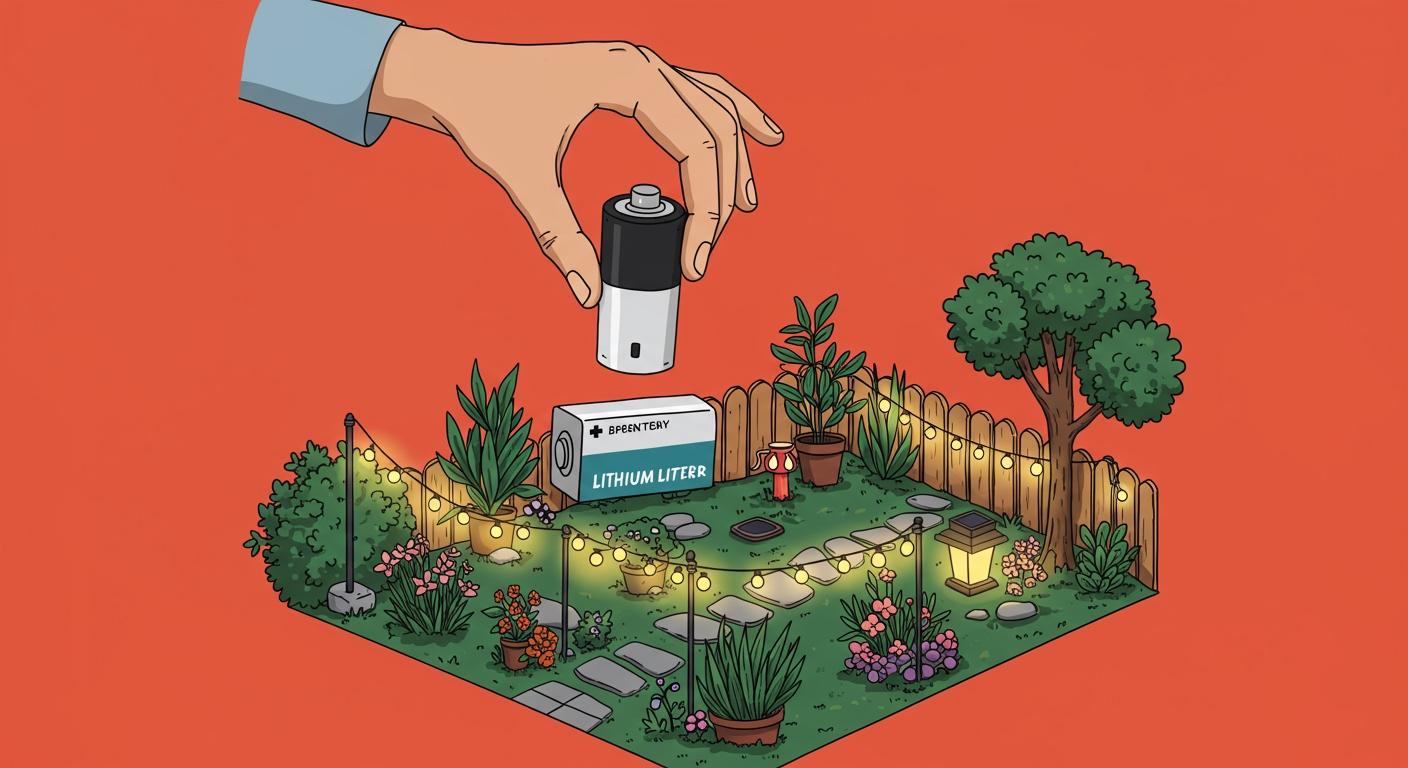
LiFePO4 stands out as the best choice for garden and solar lighting because of its unmatched safety, long lifespan, and reliability. When you select the lithium battery of lawn lighting lamp, you must consider your unique outdoor lighting needs.
LiFePO4 batteries can last over 6,000 cycles and deliver stable performance from 50°F to 104°F.
Most provide 5–10 years of service, often exceeding 2,500 cycles.
You will find straightforward guidance here for confident decision-making.
Key Takeaways
Choose LiFePO4 batteries for garden lighting due to their long lifespan and safety features. They can last over 6,000 cycles, ensuring reliable performance.
Match the battery capacity to your lighting needs. Higher capacity batteries support longer runtimes, essential for security and infrastructure applications.
Ensure compatibility between the battery and lighting system. Check voltage, connector types, and size to avoid performance issues and safety hazards.
Part1: Factors to Consider When Choosing a Lithium Battery
Selecting the right lithium battery of lawn lighting lamp requires a clear understanding of several critical factors. These factors directly impact the performance, reliability, and longevity of your outdoor lighting systems. As a B2B buyer, you must evaluate each aspect to ensure your investment delivers optimal results in demanding environments, such as infrastructure, security, and industrial applications.
1.1 Battery Capacity & Runtime
Capacity determines how long your lighting system will operate before needing a recharge. For the lithium battery of lawn lighting lamp, you should match the battery’s ampere-hour (Ah) rating to the expected runtime of your lighting fixtures. High-capacity batteries support longer runtime, which is essential for applications like security lighting or infrastructure projects that require consistent illumination throughout the night.
Tip: Municipalities and industrial users often select lithium battery packs with high energy density and low self-discharge rates to minimize maintenance and maximize uptime.
Battery Configuration | Total Capacity (Ah) | Runtime (hours) |
|---|---|---|
1 Battery | 100 | 10 |
2 Batteries | 200 | 20 |
4 Batteries | 400 | 40 |
For frequent-use scenarios, such as in security or infrastructure lighting, lithium-ion batteries with higher capacity ensure uninterrupted service. The table below outlines typical battery types and their expected runtime for LED lights:
Battery Type | Expected Runtime for LED Lights (approx.) | Usage Pattern |
|---|---|---|
AA (1.5V) | 10-50 hours | Occasional use |
9V | 20-80 hours | Short-term use |
Li-ion (Rechargeable) | 200-500 hours | Frequent use |
You should always align the battery capacity with your operational requirements to avoid underperformance and ensure reliable lighting.
1.2 Lifespan & Durability
Longevity is a top priority for any lithium battery of lawn lighting lamp, especially in sectors like medical, robotics, and industrial where downtime can be costly. LiFePO4 batteries offer a significant advantage, lasting thousands of cycles—far outpacing standard lithium-ion batteries, which typically last around 500 cycles. This extended battery life reduces replacement frequency and lowers total cost of ownership.
Battery Type | Capacity (mAh) | Lifespan | Best For |
|---|---|---|---|
LiFePO4 | 1,000–3,000 | 5+ years | Solar landscape lights |
NiMH | 600–2,800 | 2–3 years | Garden lights |
Li-ion | 1,000–3,500 | 3–4 years | Decorative fixtures |
Note: Investing in high-quality lithium-ion batteries with proven longevity ensures your lighting systems remain operational for years, even in harsh outdoor conditions.
1.3 Safety & Weather Resistance
Safety and weather resistance are non-negotiable for the lithium battery of lawn lighting lamp, especially in outdoor and mission-critical environments like security and infrastructure. LiFePO4 batteries provide exceptional thermal and chemical stability, which greatly reduces the risk of overheating or thermal runaway. These batteries operate efficiently across a wide temperature range (-20°C to 60°C), making them suitable for diverse climates.
Temperature Range | Effect on Performance |
|---|---|
-20°C to 60°C | Reduced efficiency outside optimal range |
0°C to 45°C | Safe charging range |
Below -20°C | Irreversible capacity loss, increased resistance |
Above 60°C | Heightened safety risks, potential damage |
Environmental factors such as humidity and UV exposure can also impact battery longevity. High humidity may cause corrosion, while UV rays can degrade enclosures. You should select batteries with robust enclosures and consider sustainability and conflict minerals compliance to support responsible sourcing and environmental stewardship.
Alert: Always verify that your lithium-ion batteries meet industry certifications such as UL, IEC, UN38.3, and CE for safety and performance.
1.4 Compatibility with Lawn Lighting Lamp
Compatibility is crucial for maximizing the performance and safety of the lithium battery of lawn lighting lamp. The battery’s voltage must match the lamp’s rated voltage to prevent underperformance or damage. Proper wiring, connector types, and physical fit are essential for efficient installation and maintenance. Incompatible batteries can lead to uneven charging, reduced runtime, and increased risk of failure.
Compatibility Factor | Description |
|---|---|
Voltage Compatibility | Must match the lamp’s rated voltage |
Wiring/Connection | Ensure interfaces are compatible for easy assembly and maintenance |
Size/Connector Type | Battery must fit housing and use correct connectors |
Efficiency | Choose batteries with at least 80% efficiency |
Discharge Current | Higher discharge rates support high-drain LEDs |
Weight | Lighter batteries ease installation, especially for modular systems |
Tip: Integrate a battery management system (BMS) to monitor and protect your lithium-ion batteries, further enhancing safety and battery longevity.
Improper compatibility can result in shorter operating hours, inconsistent lighting, and even safety hazards such as overheating or leakage. Always confirm that your lithium battery packs are designed for your specific lighting application.
By considering these factors—capacity, runtime, longevity, safety, weather resistance, and compatibility—you ensure the lithium battery of lawn lighting lamp delivers reliable, long-term performance for your outdoor lighting projects.
Part2: Best Lithium Battery Types for Solar Light Batteries

2.1 LiFePO4 vs. Li-ion
When you evaluate solar light batteries for demanding outdoor applications, you must compare the two leading chemistries: LiFePO4 (lithium iron phosphate) and lithium-ion. Both types of rechargeable batteries power high-efficiency solar lights in sectors such as security, infrastructure, and industrial lighting. However, their chemical composition and performance differ significantly.
Feature | LiFePO4 Batteries | Lithium-Ion Batteries |
|---|---|---|
Chemical Composition | Lithium iron phosphate cathodes | Cobalt- or nickel-based cathodes |
Energy Density | 40-55 Wh per lb (90-120 Wh per kg) | 45-120 Wh per lb (100-265 Wh per kg) |
Safety | Highly stable, low risk of thermal runaway | Prone to thermal runaway, requires safety systems |
Lifespan | Thousands of cycles | About 500 charge cycles |
Operating Temperature | -4°F to 140°F (-20°C to 60°C) | 32°F to 113°F (0°C to 45°C) |
Self-Discharge Rate | 1-3% per month | N/A |
Nominal Voltage | ~3.2V per cell | 3.6V to 3.7V per cell |
You will notice that LiFePO4 batteries offer a longer lifespan and greater safety, which is essential for solar lighting batteries in critical environments. Lithium-ion batteries provide higher energy density, making them suitable for compact installations in consumer electronics and robotics. LiFePO4 batteries operate efficiently in a wider temperature range, which supports reliable performance in outdoor security and infrastructure lighting.
Tip: Choose LiFePO4 for solar light batteries in medical, security, and industrial projects where safety and extending battery life are top priorities. Select lithium-ion for applications where high energy density and compact size matter most.
2.2 Recommended Solar Light Batteries
Selecting the best lithium battery for solar light batteries requires you to consider both brand reputation and technical features. Industry experts frequently recommend the following rechargeable battery models for high-efficiency solar lights:
Tesla Powerwall3: Delivers high energy density and robust efficiency for infrastructure and industrial solar lighting batteries.
Enphase IQ 5P: Offers advanced battery management and long cycle life, ideal for security and robotics lighting systems.
Frankling aPower2: Provides reliable performance and extending battery life for medical and consumer electronics solar lighting batteries.
Top brands like RELiON and Gama Sonic design their rechargeable batteries for solar light batteries with features that support efficiency and longevity:
Feature | Description |
|---|---|
Enhanced Performance | Engineered for bright, consistent lighting in high-efficiency solar lights. |
Longevity | Withstands numerous charge-discharge cycles, extending battery life. |
Easy Installation | Connector plugs simplify replacement and maintenance. |
Consistent Voltage | Maintains stable voltage output for peak efficiency of solar lighting batteries. |
User reviews and field tests show that lithium batteries outperform Ni-MH batteries in solar garden lighting. You will benefit from a lifespan that is twice as long, better cold resistance, and advanced protection features such as overcharge and over-discharge safeguards. These features directly improve the efficiency and reliability of your solar light batteries.
2.3 Installation & Maintenance Tips
Proper installation and maintenance of rechargeable batteries in solar lighting batteries maximize safety, efficiency, and extending battery life. You should follow these best practices:
Wear protective gear, including safety glasses and flame-resistant clothing, during installation.
Use a multimeter to measure voltage and current, and circuit testers to verify connections.
Always disconnect the solar battery before working on it.
Ensure proper ventilation in the battery storage area to prevent overheating.
Handle rechargeable batteries carefully and keep them away from heat sources.
Use the correct tools for installation and avoid modifying or repairing batteries yourself.
Alert: Never fully discharge lithium-ion or LiFePO4 batteries. Recharge before they are completely drained to maintain efficiency and extending battery life.
Common mistakes can reduce the efficiency of your solar lighting batteries. The table below highlights issues to avoid:
Mistake | Description |
|---|---|
Insufficient backup power | Not enough stored power can cause failures during cloudy weather. Aim for three nights of backup with lithium batteries. |
Incorrect battery sizing | Sizing the battery too small for temperature variations can cause failures, especially in cold climates. Lithium batteries operate best between 0°C – 55°C. |
Additional tips for maintaining high-efficiency solar lights and solar lighting batteries:
Avoid exposing rechargeable batteries to extreme temperatures, especially heat.
Do not store batteries at full charge for long periods; aim for around 50% charge.
Refrain from overcharging, even if devices have built-in protection.
Select rechargeable batteries with overcharge and over-discharge protection for maximum efficiency.
By following these guidelines, you ensure your solar light batteries deliver reliable, long-term performance in demanding B2B environments. You also support sustainability by reducing e-waste and maximizing the efficiency of your solar lighting batteries.
LiFePO4 batteries deliver unmatched safety, long life, and reliable performance for outdoor solar lights in medical, robotics, security, and industrial sectors. You benefit from non-toxic materials, built-in safety, and over 3,000 cycles. For outdoor solar lights, review this checklist:
Cost and total ownership
Supplier reliability
Sustainability
Compliance
Custom solutions
Consult reputable suppliers for tailored outdoor solar lights solutions and maximize your investment.
FAQ
What makes LiFePO4 batteries ideal for outdoor lighting in industrial and security sectors?
How do you ensure compatibility between lithium battery packs and your lighting systems?
You must match voltage, connector type, and size. Large Power provides custom battery solutions to fit your specific application requirements.
Can you compare LiFePO4 and standard lithium-ion batteries for medical and robotics applications?
LiFePO4 | Lithium-Ion | |
|---|---|---|
Lifespan | 3,000+ cycles | 500 cycles |
Safety | High | Moderate |
Temp. Range | -20°C to 60°C | 0°C to 45°C |


