

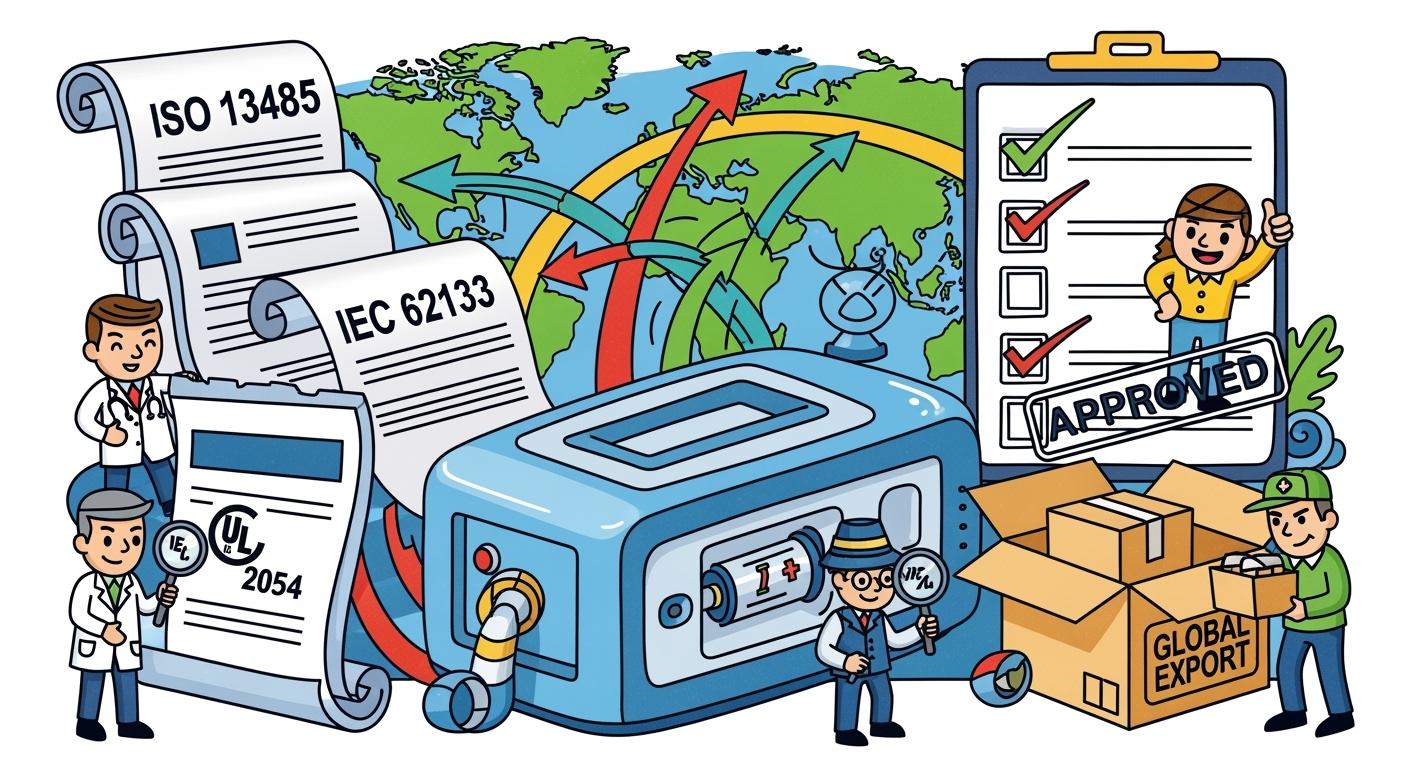
You face strict requirements when exporting lithium ion batteries for medical devices. Global compliance guide processes help you meet regulatory standards and avoid costly issues. Standards like ISO 13485, IEC 62133, and UL 2054 protect medical devices and ensure battery safety. These standards cover lithium ion batteries used in medical devices such as LiFePO4, NMC, LCO, and LMO chemistries. Non-compliance with regulatory standards can result in shipment delays, recalls, or market bans. You must understand ISO requirements and apply them to every battery pack for medical devices. Each battery export depends on clear documentation and compliance with standards.
Tip: Always verify your battery specifications and certifications before shipping medical devices containing lithium ion batteries.
Key Takeaways
Understand ISO 13485 certification to ensure quality management for medical batteries. This certification boosts your credibility and helps you access global markets.
Comply with IEC 62133 to ensure the safety of lithium ion batteries. This standard prevents hazards like fire and leakage, protecting patients and devices.
Follow UL 2054 standards for battery pack safety. Passing required tests reduces the risk of recalls and demonstrates your commitment to safety.
Conduct a thorough gap analysis of your processes to identify compliance issues early. This step helps avoid costly delays in your export journey.
Maintain accurate documentation and traceability for every battery pack. Proper records support compliance and help you respond quickly to regulatory inquiries.
Part 1: Key Medical Battery Standards
1.1 ISO 13485: Quality Management for Medical Devices
You must understand ISO 13485 certification when exporting lithium ion batteries for medical devices. This standard sets strict requirements for quality management systems. It ensures that battery packs, including LiFePO4, NMC, LCO, and LMO chemistries, meet regulatory guidelines and function safely in medical applications. ISO 13485 certification covers design, validation, traceability, record keeping, cleanliness, and timely delivery. These requirements help you maintain reliability and accountability in your supply chain.
Requirement Type | Description |
|---|---|
Quality Management Systems (QMS) | Must meet regulatory guidelines for medical devices. |
Design and Validation | Battery packs must ensure safe and reliable function of the end application. |
Traceability | Key requirement for components to ensure reliability and accountability. |
Record Keeping | Essential for maintaining ISO 13485 certification. |
Cleanliness | Important for the production of medical batteries. |
Timely Delivery | Critical to avoid supply chain disruptions in the medical device field. |
ISO 13485 certification acts as a passport for global MedTech markets. You gain easier access to regulatory approval pathways in regions like Europe and the United States. Hospitals and healthcare providers often require this certification, which boosts your credibility. The standard embeds risk management and continuous improvement, reducing recalls and protecting your brand reputation.
1.2 IEC 62133: Lithium Battery Safety Standards
IEC 62133 is the primary international safety standard for lithium ion batteries in medical devices. You must comply with IEC 62133 to prevent hazards such as fire, explosion, or leakage. IEC 62133-2 specifically addresses lithium systems, which are critical for modern medical devices. Regulatory bodies like the FDA require compliance with IEC standards for market approval.
IEC 62133 focuses on battery safety testing for patient safety and device reliability.
Testing prevents failures that could cause overheating, leakage, or explosion.
You must follow additional IEC standards, including 60086 Part 4 and UL 1642, for comprehensive safety.
The design of medical devices using lithium ion batteries must also meet ANSI/AAMI ES 60601-1 for safety and performance.
1.3 UL 2054: Safety for Battery Packs
UL 2054 sets safety standards for battery packs used in medical devices. You must pass electrical, mechanical, and environmental tests to ensure safety under various conditions. UL 2054 requires evaluation of the battery management system and protective components.
Testing Category | Specific Tests and Purpose |
|---|---|
Electrical Tests | Short-circuit test, Overcharge test, Abnormal charge test to ensure safety under misuse. |
Mechanical Tests | Impact test, Vibration and shock tests, Mold stress test to check for fire hazards. |
Environmental Tests | Temperature cycling, Humidity test, Altitude test to evaluate performance under conditions. |
Safety Circuit Evaluation | Review of battery management system (BMS) and protective components for safety measures. |
Compliance with UL 2054 and UL 1642 lowers the risk of product recalls. You demonstrate a commitment to safety and reliability, which reduces legal risks and supports market access. In 2023, over 3,300 recalls occurred due to non-compliance with safety standards, highlighting the importance of UL standards.
Note: Understanding ISO 13485 certification, IEC 62133, and UL 2054 helps you achieve global compliance and ensures the safety of medical lithium ion batteries.
Part 2: Global Compliance Guide – Step-by-Step
Exporting lithium ion batteries for medical devices requires a clear, actionable approach. This global compliance guide gives you the steps to achieve regulatory compliance with ISO 13485, IEC 62133, and UL 2054. You will learn how to assess your current status, document every process, test your products, secure approvals, and maintain ongoing compliance.
2.1 Initial Assessment and Gap Analysis
Start your compliance journey by evaluating your current processes against global safety standards. You need to compare your existing documentation, quality systems, and testing results with the requirements set by regulatory bodies such as the FDA and UN 38.3. This initial gap analysis helps you identify missing elements in your compliance plan.
You can use several tools and frameworks to support your assessment:
Process Failure Modes, Effects, and Criticality Analysis (P-FMECA) helps you assess risks at both the cell and pack level for medical applications.
Material Flow Analysis Software ensures quality assurance during material qualification.
In-Process Quality Control (IPQC) uses random sample testing to monitor production quality.
Outgoing Quality Control (OQC) inspects all materials before they leave the production line.
A Complaint Management System, as required by ISO 13485, analyzes market complaints and guides corrective actions.
Tip: A thorough gap analysis at the start of your project reduces costly delays and ensures you meet all regulatory compliance requirements for lithium ion batteries.
2.2 Documentation and Traceability Requirements
Accurate documentation and traceability form the backbone of regulatory compliance for medical lithium ion batteries. You must maintain detailed records for every battery pack, including LiFePO4, NMC, LCO, and LMO chemistries. These records support your ISO 13485 certification and help you demonstrate compliance during audits.
Requirement | Description |
|---|---|
ISO 13485 Certification | Mandatory for battery manufacturers of medical device batteries, ensuring compliance with standards. |
Traceability | Critical for ensuring safety, reliability, and uniformity in battery production. |
Documentation and Record Keeping | Necessary for maintaining ISO 13485 certification and supporting regulatory compliance. |
You should also document the specifications of each battery, such as platform voltage, energy density, and cycle life. For example, LiFePO4 batteries typically offer a platform voltage of 3.2V, energy density of 90-120 Wh/kg, and cycle life exceeding 2000 cycles. NMC batteries provide higher energy density, around 150-220 Wh/kg, but may have a shorter cycle life.
Battery Management Systems (BMS) play a vital role in traceability and safety. You must document BMS features, including protection against overcharge, over-discharge, and short circuits.
Note: Proper documentation and traceability help you respond quickly to regulatory inquiries and reduce the risk of recalls.
2.3 Product Testing and Certification Process
Testing and certification are essential steps in the global compliance guide for medical lithium ion batteries. You must follow the procedures outlined in IEC 62133 and UL 2054 to ensure product safety and regulatory acceptance.
Standard | Type of Test | Description |
|---|---|---|
IEC 62133-2 | Safety Tests | Tests for external short circuit, incorrect installation, overcharging, forced discharge. |
IEC 62133-2 | Performance Tests | Evaluations for vibration, mechanical shock, low-pressure simulation, and cycling for capacity. |
UL 1642 | Cell Safety | Abuse tests including projectile, forced-internal short circuit, and crushing. |
UL 2054 | Battery Pack Safety | Tests for electrical faults, mechanical stress, environmental exposure, and fire exposure. |
These tests ensure your batteries meet global safety standards and reduce the risk of accidents. Certification also builds trust with your customers and regulatory authorities. The typical certification process takes between 4 and 12 weeks, depending on the level of testing required.
You must also keep records of all battery certification documents, including test reports and certificates. This documentation supports your regulatory compliance and helps you address any questions from authorities.
2.4 Regulatory Approvals and Export Documentation
Securing regulatory approvals and preparing export documentation are critical steps in the global compliance guide. You must provide evidence of compliance with international regulations for every shipment of medical lithium ion batteries.
Stakeholder | Documentation Required |
|---|---|
Regulatory Authorities | Certifications such as UN38.3, DGD, and IMO for safe transportation of li-ion batteries. |
Customs | Packaging list, invoice, country of origin, and proof of company registration for compliance checks. |
Battery-Related Documents | Information on safety requirements and compliance with international regulations. |
MSDS | Details on chemical composition, hazards, and safety precautions for handling and transportation. |
Dangerous Goods Declaration (DGD) | Information on the risks associated with battery substances and necessary precautions. |
For exports to the European Union, you must also include:
Requirement | Description |
|---|---|
CE Marking | Compliance with Battery Directive 2013/56/EU |
REACH Registration | Registration of chemicals used in the batteries |
Waste Receptacle Labeling | Proper labeling for disposal and recycling |
In the United States, agencies such as the Pipeline and Hazardous Materials Safety Administration (PHMSA) and the Federal Aviation Administration (FAA) oversee the regulatory approval process for transporting medical lithium ion batteries. You must ensure your shipments meet all hazmat standards and obtain any necessary permits.
2.5 Ongoing Compliance and Monitoring
Ongoing compliance is not a one-time task. You must continuously monitor your processes, update your documentation, and stay informed about changes in safety standards and regulations. Regular audits and internal reviews help you identify gaps and maintain your global compliance guide.
You should implement a robust complaint management system to track and resolve any issues reported in the field. This system supports continuous improvement and helps you maintain regulatory compliance. You must also update your BMS documentation as new features or updates are introduced, ensuring ongoing safety and traceability.
Reminder: Continuous monitoring and timely updates to your compliance processes protect your business from regulatory risks and support long-term success in the medical battery export market.
Part 3: Safety and Compliance Challenges

3.1 Common Documentation Pitfalls
You face many documentation pitfalls when exporting medical lithium ion batteries. Incomplete or inaccurate paperwork often causes shipment delays and regulatory issues. Common errors include:
Inaccurate Dangerous Goods Declaration (DGD), which can lead to audit failures.
Missing or incorrect shipping names and UN numbers on labels.
Incomplete or wrong weight and quantity data.
Lack of a 24-hour emergency contact number.
Missing required documents such as UN38.3 certification and MSDS.
Proper documentation, including invoices, packing lists, and certificates of origin, is essential. You must identify battery types and specifications accurately. Stay aware of customs regulations in each destination country to avoid disruptions. Missing paperwork or errors can result in shipment delays, fines, or even bans. Accurate documentation supports compliance and ensures lithium ion battery safety.
3.2 Testing Delays and Lab Coordination
Testing delays can disrupt your export timeline and affect regulatory approval. Several factors contribute to these delays:
Challenge | Risk | Mitigation / Tip |
|---|---|---|
Overreliance on battery manufacturer specs | Real use conditions may differ | Conduct your own testing under worst-case loads |
Non-compliance with consensus standards | Regulatory delays or rejections | Use recognized standards and document conformity |
Battery aging and drift over time | Device failure in the field | Monitor battery health; design fail-safe discharge cutoffs |
You should expect to provide about 16 battery packs for testing, with costs around $2,500 and a timeline of 6-8 weeks. Compliance with UN 38.3 is essential for legal transport and lithium ion battery safety. Non-compliance can cause project delays and regulatory penalties. Working with accredited labs offers benefits:
Benefit | Description |
|---|---|
Integrated Approach | Reduces coordination issues and expedites project timelines |
Tailored Test Plans | Aligns with product features and intended use for compliance |
Global Regulatory Insight | Ensures adherence to international standards for faster approvals |
3.3 Supply Chain and Traceability Issues
Supply chain disruptions can impact compliance and lithium ion battery safety for medical devices. New shipping requirements, such as transporting batteries at low charge, affect device readiness and compliance. Decreased shelf life and risk of battery damage can delay patient care and increase the chance of device malfunction.
Issue | Impact on Compliance and Patient Care |
|---|---|
Shipping batteries at low charge | Affects readiness of life-saving medical devices |
Decreased shelf life | Delays in patient care due to unavailable devices |
Risk of battery damage | Higher chance of malfunction, complicating safety compliance |
You must maintain traceability for every battery pack, including LiFePO4, NMC, LCO, and LMO chemistries. Use a robust Battery Management System (BMS) to track battery history and ensure lithium ion battery safety.
3.4 Adapting to Changing Standards
Regulatory requirements and safety standards for medical lithium ion batteries change often. IEC 62133 now ensures batteries can withstand overcharging, short circuits, drops, vibrations, and extreme temperatures. ISO 13485 requires strict quality control, documentation, and testing for battery safety and reliability.
To adapt, you should:
Integrate compliance into product development from the start.
Use a compliance-first approach to improve efficiency and reduce costs.
Employ automation and AI tools to track regulatory changes and streamline compliance.
Harmonize your regulatory strategies to avoid compliance gaps and duplicated efforts.
Consider sustainability and end-of-life obligations as part of your compliance plan.
Staying updated on regulations and requirements helps you maintain lithium ion battery safety and meet global market demands.
Part 4: Best Practices for Medical Battery Compliance
4.1 Building a Compliance Team
You need a dedicated compliance team to manage the requirements for medical lithium battery packs. Assign roles for regulatory affairs, quality assurance, and documentation. Your team should understand the safety standards and regulations for LiFePO4, NMC, LCO, and LMO chemistries. Regular training helps your staff stay updated on changing requirements and regulatory expectations. A strong compliance team reduces the risk of errors and supports safety in every stage of battery production and export.
Tip: Schedule monthly meetings to review regulatory changes and safety updates for medical battery requirements.
4.2 Using Technology for Traceability
Technology improves traceability and compliance for medical battery exports. You can use digital product passports to track materials and ensure safety throughout the supply chain. Laboratory Information Management Systems (LIMS) help you organize and retrieve battery manufacturing data. LIMS supports data integrity, which is essential for regulatory compliance and safety. Advanced informatics systems aggregate battery quality management data, making it easier to meet requirements and respond to audits.
Aspect | Description |
|---|---|
Regulatory Compliance | Technology helps you meet safety, environmental, and performance standards. |
Quality Control | Digital tools monitor and maintain medical lithium battery quality. |
Data Management | LIMS improves organization and retrieval of battery manufacturing data. |
Digital product passports enhance traceability for battery materials.
LIMS supports tracking data integrity for reliable decision-making.
Informatics systems aggregate battery quality management data.
4.3 Staying Updated on Safety Standards
You must stay informed about new safety standards and regulations for medical lithium battery packs. Subscribe to regulatory bulletins and join industry associations. Attend webinars and conferences focused on battery safety and compliance requirements. Regular updates help you adapt your processes to meet changing regulatory requirements and maintain safety in your products.
4.4 Consulting Experts and Auditors
Consulting with experts and auditors strengthens your compliance strategy. You can hire third-party auditors to review your safety documentation and regulatory processes. Experts help you interpret complex requirements and standards for medical battery exports. Auditors identify gaps in your compliance plan and recommend improvements. Their guidance ensures you meet all regulatory requirements and maintain safety for medical lithium battery packs.
Note: Expert advice and regular audits help you avoid costly mistakes and keep your compliance program effective.
Part 5: Resources for Global Export
5.1 Compliance Checklists
You need a clear compliance checklist to manage global export of lithium battery packs for medical devices. A checklist helps you track every step, from documentation to regulatory approval. You should include requirements for ISO 13485, IEC 62133 compliance, UL 2054, and medical device battery certification. Use the checklist to verify traceability, record keeping, and safety features for LiFePO4, NMC, LCO, and LMO chemistries.
Sample Compliance Checklist:
Step | Description | Required For |
|---|---|---|
Documentation | Maintain records for each battery pack | All chemistries |
Traceability | Track components and manufacturing history | Medical applications |
Certification | Obtain IEC 62133 compliance and UL 2054 | Export approval |
Testing | Complete safety and performance testing | Regulatory authorities |
Export Documentation | Prepare MSDS, DGD, and CE marking | International markets |
Tip: Review your checklist before every shipment to avoid compliance gaps.
5.2 Online Platforms and Databases
You can access online platforms and databases to stay updated on compliance and regulatory changes. Authoritative sites provide guidance on lithium battery safety, certification, and export requirements. For example, Nature offers research on battery technology and safety. The U.S. Food & Drug Administration shares regulatory updates for medical devices. You can use ScienceDirect to find articles on battery testing and certification.
Recommended Platforms:
Nature: Research on lithium battery safety and chemistries.
FDA Medical Devices: Regulatory updates and export requirements.
ScienceDirect: Articles on battery testing and certification.
5.3 Finding Qualified Consultants
You should work with qualified consultants to strengthen your compliance strategy. Consultants help you interpret regulatory standards and prepare documentation for medical device battery certification. They guide you through IEC 62133 compliance, UL 2054, and export procedures. You can find experts through industry associations or professional networks. Look for consultants with experience in lithium battery packs for medical, robotics, and industrial sectors.
Note: A qualified consultant improves your compliance and reduces export risks.
You can achieve global compliance for medical battery export by following a clear process. Focus on quality management, safety standards, and proper documentation. Use ongoing monitoring to keep your products up to date. Refer to the checklist before each shipment. The table below highlights essential standards for exporters:
Standard | Description |
|---|---|
IEC 60601 | Governs safety and performance of medical electrical equipment. |
ISO 13485 | Defines quality management system requirements for medical device design. |
UN 38.3 | Requires testing for lithium batteries before transport. |
Stay proactive with compliance to protect your business and support market access.
FAQ
What are the main battery chemistries for medical device export?
You use LiFePO4, NMC, LCO, and LMO chemistries for medical device battery packs. Each chemistry offers different platform voltage, energy density, and cycle life. The table below compares key specifications.
Chemistry | Platform Voltage | Energy Density (Wh/kg) | Cycle Life (cycles) |
|---|---|---|---|
LiFePO4 | 3.2V | 90-120 | >2000 |
NMC | 3.7V | 150-220 | 1000-2000 |
LCO | 3.7V | 150-200 | 500-1000 |
LMO | 4.0V | 100-150 | 300-700 |
How does fda approval impact lithium battery export for medical devices?
You must secure fda approval for medical device battery packs before export. fda reviews your documentation, safety data, and compliance with ISO 13485, IEC 62133, and UL 2054. fda approval ensures your batteries meet safety standards and regulatory requirements for medical applications.
What documentation do you need for fda compliance?
You prepare a complete set of documents for fda compliance. You include ISO 13485 certification, IEC 62133 and UL 2054 test reports, MSDS, Dangerous Goods Declaration, and traceability records. fda requires accurate labeling, battery specifications, and emergency contact information for every shipment.
Why is fda testing important for medical battery packs?
You rely on fda testing to verify the safety and reliability of lithium battery packs. fda testing checks for hazards such as overheating, leakage, and fire risk. You must pass fda testing to ensure your batteries meet strict safety standards for medical devices.
How do you maintain ongoing fda compliance for exported batteries?
You monitor regulatory updates from fda and conduct regular audits. You update documentation and traceability records for each battery pack. You train your compliance team to follow fda guidelines and respond quickly to changes in safety standards for medical lithium battery packs.


