

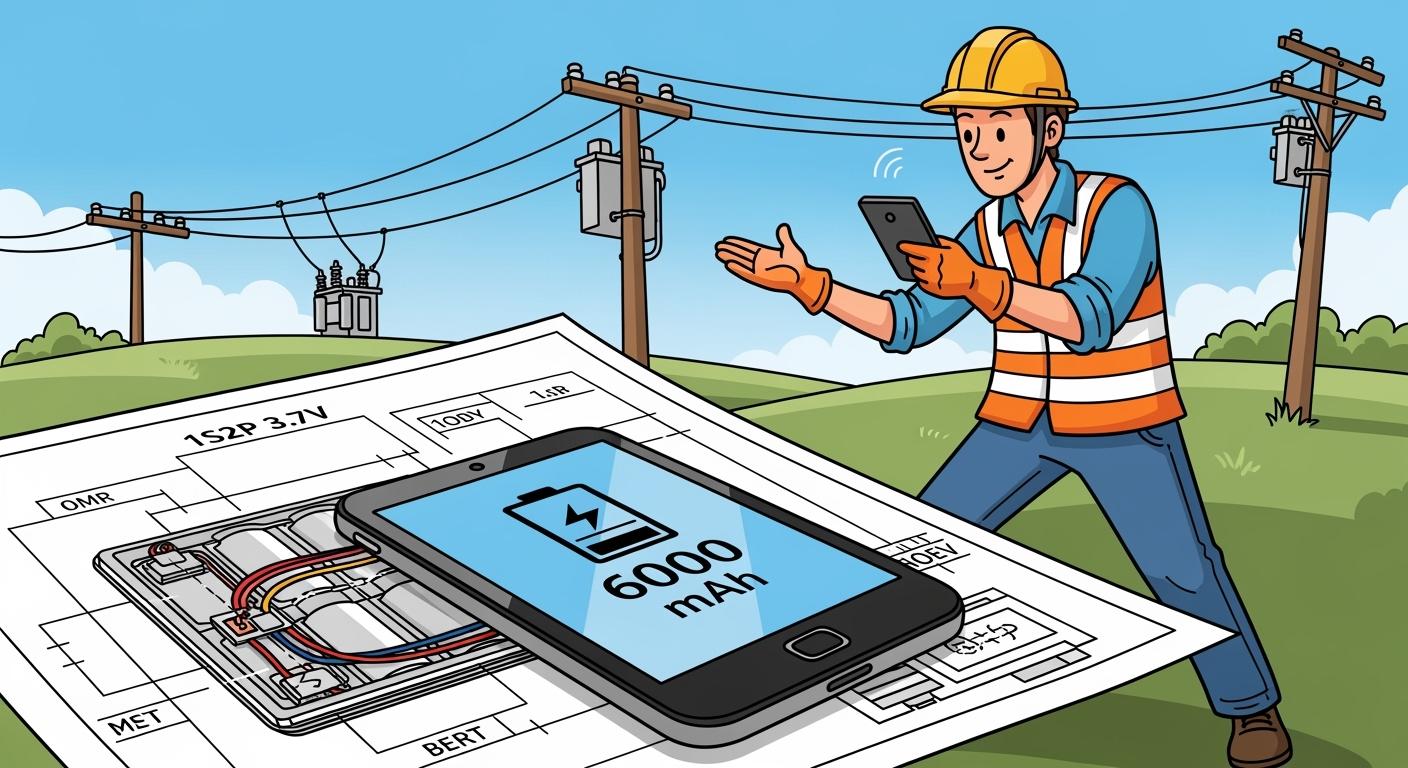
Selecting the Ideal mAh Capacity for your 1S2P 3.6V smart PDA ensures reliable performance in utility field work. Most professionals choose a battery range between 6,000mAh and 7,000mAh to balance work duration and device power needs. Lithium-ion batteries offer stable voltage and high reliability, as shown in the table below:
Specification | Details |
|---|---|
Nominal Voltage | 3.6V |
Nominated Capacity | 6.7AH |
Combination Method | 1S2P (2pcs 18650) |
Max Discharging Current | Max 26A (short time) |
End of Charging Voltage | 4.2V |
End of Discharging Voltage | 3V |
Without enough battery capacity, you risk workflow interruptions, device malfunctions, and reduced productivity. Always match your battery choice to your specific field requirements.
Key Takeaways
Choose a battery capacity between 6,000mAh and 7,000mAh for reliable performance in utility field work.
Calculate your Ideal mAh Capacity by considering your device’s power consumption and your daily usage time.
Select a battery with higher capacity if you work in areas with limited charging access or during long shifts.
Maintain your battery by keeping it charged between 20% and 80% and avoiding extreme temperatures.
Use power-saving settings on your smart PDA to extend battery life during long work hours.
Part1: Factors for Ideal mAh Capacity
1.1 Work Duration
You need to estimate how long you use your smart PDA during a typical utility field shift. Longer work hours demand higher battery capacity. If your tasks require continuous device operation, you should select a battery with enough charge to last the entire shift. For example, a technician working an eight-hour day in remote areas will need a higher Ideal mAh Capacity than someone working shorter, intermittent periods.
1.2 Device Power Needs
Every smart PDA model has unique power consumption rates. You should check your device’s specifications to understand its average discharge rate. Here is a table showing typical power consumption for 1S2P 3.6V smart PDAs:
Specification | Value |
|---|---|
Normal Voltage | 3.6V |
Normal Capacity | 6700mAh |
Standard Discharge | 0.2C |
Maximum Discharge | 2C |
Devices with higher processing power, larger screens, or advanced sensors will drain batteries faster. You should match your Ideal mAh Capacity to your device’s needs to avoid interruptions.
1.3 Environment Impact
Field conditions can affect battery performance. You may face temperature extremes, which can damage batteries or reduce their lifespan. Consider these environmental factors:
Temperature extremes can cause malfunctions.
Charging habits, such as frequent full charges or deep discharges, speed up battery wear.
High ambient temperatures increase battery degradation.
Temperature changes also impact lithium-ion batteries. Cold weather slows chemical reactions, reducing capacity. Hot weather accelerates aging and can shorten battery life. You should plan for these conditions when choosing your Ideal mAh Capacity.
1.4 Charging Access
Your access to charging stations influences your battery choice. If you work in areas with limited charging options, you need a higher capacity battery to last through your shift. In urban settings with frequent charging opportunities, you may choose a lower capacity. Always consider your daily routine and field environment before deciding.
Tip: Reliable lithium-ion batteries with stable voltage, such as NMC or LiFePO4, offer better performance in harsh environments. These chemistries are common in medical, robotics, and industrial applications due to their long cycle life and energy density.
Part2: Calculating Your Ideal mAh Capacity
2.1 Calculation Steps
You can determine the Ideal mAh Capacity for your 1S2P 3.6V smart PDA by following a clear calculation process. This method helps you match your battery to your actual work needs and device specifications.
Check Device Power Consumption:
Find the average current draw of your smart PDA. Manufacturers usually list this in milliamps (mA) or amps (A) in the technical specifications.Estimate Daily Usage Time:
Record how many hours you use the device during a typical field shift. For example, if you use your PDA for 8 hours each day, note this value.Calculate Required Capacity:
Multiply the device’s current draw (in amps) by the number of hours you need the device to run.Formula:
Required Capacity (Ah) = Device Current (A) × Usage Time (h)To convert amp-hours (Ah) to milliamp-hours (mAh), multiply by 1,000.
Adjust for Battery Efficiency and Depth of Discharge (DoD):
Lithium-ion batteries, such as NMC or LiFePO4, do not always deliver 100% of their rated capacity. You should divide your calculated capacity by the battery’s efficiency (usually 0.9 for 90%) and the recommended DoD (often 0.8 for 80%).
Battery Capacity (Ah) = (Daily Energy Consumption ÷ Efficiency) ÷ DoD
For example, if your device uses 2Ah per day, with 90% efficiency and 80% DoD:
Battery Capacity = (2 ÷ 0.9) ÷ 0.8 ≈ 2.78Ah (or 2,780mAh)
Select the Closest Standard Battery Size:
Choose a battery pack with a capacity equal to or greater than your calculated Ideal mAh Capacity. Standard sizes for 1S2P 3.6V lithium battery packs range from 6,000mAh to 7,000mAh.
Tip: Always round up to the next available battery size to ensure reliable operation throughout your shift.
2.2 Utility Field Examples
You can apply these steps to different utility field scenarios. Here are some examples that show how to calculate the Ideal mAh Capacity for various work environments and device types.
Example 1: Infrastructure Inspection Technician
Device: 1S2P 3.6V PDA (NMC chemistry)
Average Current Draw: 400mA (0.4A)
Usage Time: 10 hours
Efficiency: 90% (0.9)
DoD: 80% (0.8)
Calculation:
Required Capacity = 0.4A × 10h = 4Ah (4,000mAh)
Adjusted Capacity = (4 ÷ 0.9) ÷ 0.8 ≈ 5.56Ah (5,560mAh)
You should select a battery pack with at least 5,600mAh for this scenario.
Example 2: Security System Field Engineer
Device: 1S2P 3.2V PDA (LiFePO4 chemistry)
Average Current Draw: 250mA (0.25A)
Usage Time: 8 hours
Efficiency: 90% (0.9)
DoD: 80% (0.8)
Calculation:
Required Capacity = 0.25A × 8h = 2Ah (2,000mAh)
Adjusted Capacity = (2 ÷ 0.9) ÷ 0.8 ≈ 2.78Ah (2,780mAh)
A 2,800mAh battery pack will meet your needs for a full shift.
Example 3: Medical Device Technician
Device: 1S2P 3.7V PDA (LCO chemistry)
Average Current Draw: 180mA (0.18A)
Usage Time: 6 hours
Efficiency: 90% (0.9)
DoD: 80% (0.8)
Calculation:
Required Capacity = 0.18A × 6h = 1.08Ah (1,080mAh)
Adjusted Capacity = (1.08 ÷ 0.9) ÷ 0.8 ≈ 1.5Ah (1,500mAh)
A 1,500mAh battery pack will support your daily tasks.
Application Scenario | Chemistry | Current Draw (A) | Usage Time (h) | Adjusted Capacity (mAh) |
|---|---|---|---|---|
Infrastructure Inspection | NMC | 0.4 | 10 | 5,560 |
Security System Field Work | LiFePO4 | 0.25 | 8 | 2,780 |
Medical Device Support | LCO | 0.18 | 6 | 1,500 |
You can use this table to compare different lithium battery chemistries and application scenarios. Each chemistry, such as NMC, LiFePO4, or LCO, offers unique advantages in energy density and cycle life. For example, NMC batteries provide high energy density for long shifts, while LiFePO4 batteries deliver excellent cycle life for frequent use.
Note: Always confirm the platform voltage and energy density requirements for your specific device before finalizing your Ideal mAh Capacity.
Part3: Recommended mAh Ranges for Utility Work
Choosing the right battery capacity for your 1S2P 3.6V smart PDA is essential for uninterrupted field operations. You must match your battery to your work intensity and device requirements. Below, you will find recommended mAh ranges for light, moderate, and heavy utility field work. These guidelines help you maintain productivity and reliability in demanding environments.
3.1 Light Usage: 1,500–2,200mAh
You may classify your work as light usage if you use your smart PDA for short tasks, such as quick data entry, barcode scanning, or brief inspections. These activities often occur in controlled environments like medical facilities, robotics labs, or consumer electronics testing areas. Devices in these settings usually have lower power demands and shorter active periods.
Recommended Range: 1,500–2,200mAh
Typical Application Sectors: Medical device support, robotics diagnostics, consumer electronics QA
Note: For light usage, you can rely on smaller battery packs. However, you should not go below 1,500mAh, as this may lead to unexpected shutdowns during longer tasks.
Usage Level | mAh Range | Common Chemistries | Platform Voltage | Energy Density (Wh/kg) | Typical Cycle Life (cycles) |
|---|---|---|---|---|---|
Light | 1,500–2,200 | LCO, NMC | 3.6-3.7V | 150–200 | 500–1,000 |
3.2 Moderate Usage: 2,200–3,000mAh
Moderate usage applies when you use your PDA for several hours each day, such as in security system maintenance, infrastructure monitoring, or industrial inspections. These tasks require more frequent device operation and may involve data logging, wireless communication, or sensor integration.
Recommended Range: 2,200–3,000mAh
Typical Application Sectors: Security system field work, infrastructure inspection, industrial automation
Tip: You should consider 2,200mAh as the minimum recommended capacity for reliable performance in most B2B field applications. This threshold helps prevent workflow interruptions and supports longer device uptime.
Usage Level | mAh Range | Common Chemistries | Platform Voltage | Energy Density (Wh/kg) | Typical Cycle Life (cycles) |
|---|---|---|---|---|---|
Moderate | 2,200–3,000 | NMC, LCO | 3.6-3.7V | 120–180 | 1,000–2,000 |
3.3 Heavy Usage: 3,000–4,000mAh
Heavy usage describes situations where you operate your PDA continuously for long shifts or in remote locations. Examples include infrastructure inspection, industrial robotics, and emergency medical response. These scenarios demand high battery reliability and extended runtime.
Recommended Range: 3,000–4,000mAh
Typical Application Sectors: Industrial robotics, infrastructure field work, emergency medical support
Alert: For heavy usage, always select a battery at the upper end of the range. This ensures your device will last through long shifts, even in harsh environments.
Usage Level | mAh Range | Common Chemistries | Platform Voltage | Energy Density (Wh/kg) | Typical Cycle Life (cycles) |
|---|---|---|---|---|---|
Heavy | 3,000–4,000 | NMC, LCO | 3.6-3.7V | 120–180 | 1,500–2,500 |
Comparative Overview
You can use the table below to compare recommended mAh ranges, battery chemistries, and reliability features for different usage levels:
Usage Scenario | mAh Range | Recommended Chemistries | Key Reliability Features | Application Sectors |
|---|---|---|---|---|
Light | 1,500–2,200 | LCO, NMC | High energy density, stable voltage | Medical, robotics, consumer electronics |
Moderate | 2,200–3,000 | NMC, LCO | Long cycle life, balanced performance | Security, infrastructure, industrial |
Heavy | 3,000–4,000 | NMC, LCO | Extended runtime, robust under load | Industrial, infrastructure, medical |
Selecting the Ideal mAh Capacity within these ranges will help you achieve reliable performance and maximize device uptime. You should always consider your work environment, device specifications, and battery chemistry to ensure the best fit for your B2B application.
Part4: Maximizing Battery Life and Reliability
4.1 Maintenance Tips
You can extend the lifespan of lithium-ion batteries in your smart PDAs by following a few proven maintenance practices. These steps help you avoid unexpected downtime and keep your devices reliable in the field:
Charge your battery smartly. Keep the charge between 20% and 80% to reduce stress on battery cells.
Manage temperature. Avoid exposing batteries to high heat. Charge and discharge them in moderate temperatures, ideally between 15°C and 35°C.
Discharge wisely. Recharge your battery when it drops to 10%–20%. Avoid deep discharges.
Monitor battery health. Check internal resistance and temperature regularly. This helps you spot problems before they cause failures.
Schedule routine checks. Regular maintenance prevents failures and extends battery life.
Neglecting battery monitoring can lead to unexpected downtime and financial losses, especially in critical sectors like medical, robotics, and infrastructure.
4.2 Power-Saving Settings
You can use power-saving features to get more runtime from your lithium battery packs. Smart PDAs often include settings that help you conserve energy during long shifts:
Lower the screen brightness and reduce screen timeout.
Turn off unused wireless features, such as Bluetooth or Wi-Fi.
Use battery saver apps, but choose ones with a strong track record.
Limit background activity and automatic syncing.
The table below shows how power-saving features can affect device performance:
Limitation Type | Impact on Performance |
|---|---|
Reduced Performance | Slower app loading, less responsive animations, lag during heavy tasks |
Background Activity Restrictions | Delayed notifications, paused syncing, less frequent data updates |
Location Services Limitations | Reduced GPS accuracy, which can affect navigation and tracking |
Visual Adjustments | Dimmer screen, less responsive display |
Network Activity Constraints | Fewer background downloads, lower streaming quality |
You should balance power savings with your work needs. In security system or industrial field work, always test settings to ensure you do not miss critical alerts.
4.3 Backup Solutions
Reliable backup solutions keep your operations running even when your main battery fails. You can choose from several options based on your application and budget:
Feature | Description |
|---|---|
Built-In Ping Logic | Automatically reboots devices if pings fail, reducing manual intervention |
SNMP Integration | Works with monitoring systems for real-time updates |
Telecom-Grade Reliability | Withstands extreme conditions, ideal for mission-critical field sites |
Scalable | Supports multiple devices and grows with your needs |
You can also compare backup battery options by reliability and cost:
System Type | Capacity | Equipment Cost | Installation Cost | Total Initial Investment |
|---|---|---|---|---|
Portable Generator | 5–7 kW | $800–1,500 | $200–500 | $1,000–2,000 |
Standby Generator | 10–20 kW | $3,000–6,000 | $2,000–4,000 | $5,000–10,000 |
Battery System | 10–15 kWh | $12,000–18,000 | $3,000–5,000 | $15,000–23,000 |
Solar + Battery | 8 kW + 15 kWh | $20,000–28,000 | $4,000–6,000 | $24,000–34,000 |
Battery systems provide clean, stable power for sensitive electronics in medical, robotics, and industrial sectors. Generators may cost less upfront but can produce power fluctuations that harm your devices.
Plan for backup power to prevent downtime and protect your investment in smart PDAs.
You can choose the Ideal mAh Capacity for your 1S2P 3.6V smart PDA by considering your work duration, device power needs, and field environment. Use the calculation steps and recommended ranges to match your battery to your daily tasks. For future reliability, evaluate your current battery setups with these strategies:
Monitor battery performance in real time.
Use fleet data to improve battery design.
Develop proactive charging plans to prevent failures.
FAQ
What does 1S2P mean in lithium battery packs?
1S2P stands for one series, two parallel. You connect two cells in parallel to increase capacity while keeping the voltage at 3.6V. This setup works well for smart PDAs in industrial, medical, and security applications.
How do I choose the right battery chemistry for my PDA?
You should match chemistry to your needs.
NMC: High energy density, long shifts
LiFePO4: Long cycle life, frequent use
LCO: Stable voltage, light tasks
LMO: High discharge, short bursts
Can temperature affect lithium battery performance?
Yes. High heat can speed up battery aging. Cold can reduce capacity. You should operate and charge batteries between 15°C and 35°C for best results in robotics, infrastructure, and medical sectors.
How often should I replace my PDA battery?
Replace your battery when you notice shorter runtimes or if cycle life drops below 80%. Most NMC lithium batteries last 800–1,000 cycles, depending on chemistry and usage.
What is the minimum recommended mAh for reliable field work?
You should use at least 6,000mAh for most B2B field applications.


