

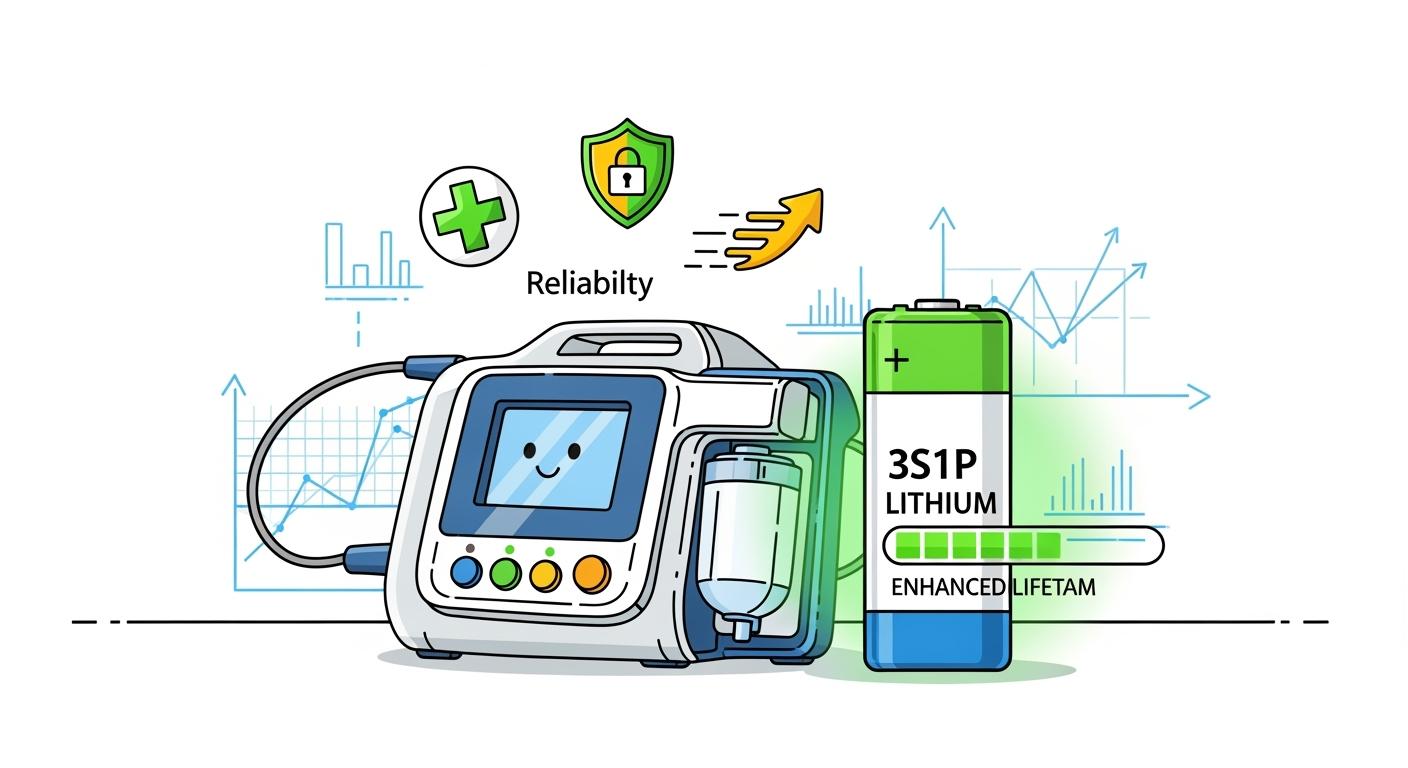
You benefit from using 3S1P lithium battery packs in infusion pumps due to their high energy density, compact size, and reliable performance. Clinical data shows NMC and LCO chemistries deliver up to 620 Wh/L, fast recharge, and long operational life. Medical-grade battery solutions ensure compliance and safety for your critical applications. Battery dependability directly impacts infusion accuracy and device portability. Lifespan Optimization enhances operational reliability and reduces maintenance costs.
Benefit | Description |
|---|---|
High Energy Density | Up to 620 Wh/L for extended infusion operation |
Compactness and Weight | Ergonomic design supports mobile clinical workflows |
Long Battery Life | Minimizes downtime and replacement needs |
Fast Recharge Capability | Essential for emergency and high-demand medical environments |
Safety and Compliance | Meets strict medical certification standards |
Smart Monitoring | Real-time battery management improves device reliability |
Key Takeaways
3S1P lithium batteries offer high energy density, allowing for longer operation of infusion pumps without frequent recharging.
Proper charging and discharging practices can significantly extend the lifespan of your battery, ensuring reliable performance in medical settings.
Regular maintenance and monitoring of battery health are essential to prevent issues and enhance the safety and efficiency of infusion devices.
Part1: 3S1P Battery Advantages in Infusion Pumps

1.1 Reliable Power for Infusion Accuracy
You rely on precise medication delivery in every infusion procedure. The 3s1p 21700 battery pack provides consistent voltage and current, which supports accurate dosing in your pump. Medical-grade lithium battery technology ensures that your surgical infusion equipment operates without interruption. You minimize the risk of dosage errors and maintain patient safety.
Note: Consistent battery performance directly impacts infusion accuracy. You avoid fluctuations that could compromise therapy outcomes.
You see that even after extended use, the 3s1p 21700 battery pack maintains a high accuracy ratio, supporting reliable infusion therapy. You benefit from a robust power supply that reduces maintenance and replacement cycles.
1.2 High Energy Density and Lightweight Design
You need infusion devices that are easy to transport and handle. The 3s1p 21700 battery pack offers exceptional energy density, which allows you to use compact and lightweight infusion pumps. You improve workflow efficiency in clinical environments, especially during emergency transport or bedside care.
High energy density enables longer infusion operation without frequent recharging.
Lightweight design supports portability for ambulatory and EMT scenarios.
Flexible system parameters allow you to tailor infusion settings for specific patient needs.
Easy-to-use pole clamp improves bedside organization and device accessibility.
You can compare the features and benefits in the table below:
Feature | Benefit |
|---|---|
Lightweight design | Enhances portability for easy transport in various clinical settings. |
Ideal for ambulatory and EMT use | Facilitates efficient workflows in emergency and transport situations. |
Flexible system parameters | Can be tailored to meet specific clinical needs of patients. |
Easy-to-use pole clamp | Allows for versatile attachment options, improving bedside organization. |
You experience reduced fatigue and improved mobility when using infusion devices powered by the 3s1p 21700 battery pack. You also see fewer interruptions in therapy due to extended battery runtime.
1.3 Stable Voltage and Fast Charging
You require stable voltage to maintain consistent infusion rates. The 3s1p 21700 battery pack delivers steady output, which supports uninterrupted operation of your infusion pump. You avoid voltage drops that could affect medication delivery.
Fast charging capability allows you to quickly restore battery power during high-demand situations. You minimize downtime and ensure readiness for emergency procedures. The 3s1p 21700 battery pack supports rapid recharge cycles, which is essential for busy clinical environments.
You benefit from long cycle life and low internal resistance, which are critical for medical device reliability. You see fewer replacements and lower maintenance costs over time.
Battery Chemistry | Energy Density (Wh/L) | Cycle Life (cycles) | Internal Resistance (mΩ) |
|---|---|---|---|
NMC | 620 | 800 | 18 |
LCO | 610 | 600 | 20 |
LMO | 520 | 700 | 22 |
LiFePO4 | 480 | 2000 | 15 |
LTO | 350 | 7000 | 10 |
You can select the optimal battery chemistry for your infusion application, balancing energy density, cycle life, and reliability. You also find these battery packs suitable for other sectors, including robotics, security, infrastructure, consumer electronics, and industrial applications. For more information on lithium-ion and LiFePO4 technologies, visit our internal resource on lithium-ion batteries and LiFePO4 batteries.
Tip: You can request a custom consultation to match your infusion device requirements with the best 3s1p 21700 battery pack configuration.
You ensure that your infusion devices deliver safe, reliable, and efficient therapy with the right battery solution.
Part2: Lifespan Optimization for 3S1P 21700 Battery Pack
2.1 Proper Charging and Discharging Practices
You can maximize the cycle life of your 3S1P 21700 battery pack by following industry-recommended charging and discharging protocols. These practices directly impact battery life and runtime in portable infusion pumps, surgical infusion devices, and automated syringe pumps. Consistent adherence to these strategies ensures reliable performance and reduces operational costs for healthcare providers.
Charge each lithium-ion cell to 4.2V for full capacity or limit to 4.1V to extend cycle life.
Use a standard charging current of 0.5C for routine operations. Fast charging up to 1C is acceptable for urgent needs but should not be routine.
Always use a high-quality charger with a battery management system. This prevents overcharging and thermal events. For advanced monitoring, integrate a smart battery management system.
Implement partial charging cycles, maintaining the state of charge between 20% and 80%. This reduces internal stress and extends cycle life.
Avoid deep discharges below 2.5V per cell. Use higher-capacity packs and low-voltage protection to prevent complete discharge.
Tip: You should schedule regular reviews of your charging infrastructure to ensure compliance with the latest safety standards.
Improper charging and discharging cycles can shorten cycle life and compromise device safety. The table below summarizes the impact of key factors on battery longevity:
Key Factor | Details |
|---|---|
Depth of Discharge (DoD) | Recommended DoD is 80–90% for optimal lifespan. Avoiding full discharges (below 20% SoC) reduces stress on cells and prolongs cycle life. |
Cycle Life | Rated for 500–1000 charge/discharge cycles when properly maintained. Cycle count improves with moderate DoD and temperature control. |
Charging | Use 3S-specific CC/CV charger with auto-cutoff to prevent overcharging and thermal runaway. |
Safety Warning | Lithium-ion batteries can pose fire or explosion risks if mishandled. Always follow manufacturer guidelines. |
You can request a custom consultation to match your charging protocols with your specific infusion device requirements.
2.2 Temperature and Environmental Management
You must control environmental conditions to achieve optimal cycle life for your lithium-ion cells. Temperature extremes can accelerate chemical degradation and reduce battery performance in portable infusion pumps and surgical infusion devices. Proper management ensures long-lasting batteries and consistent runtime.
Condition | Temperature Range |
|---|---|
Charging | 0°C ~ 45°C |
Discharging | -20°C ~ 60°C |
Storage | -20°C ~ 45°C |
Store and operate battery packs within the recommended temperature ranges.
Avoid exposing lithium-ion cells to direct sunlight, heaters, or freezing conditions.
Use insulated and cushioned containers to protect battery packs from mechanical shocks and environmental stress.
Monitor ambient temperature in storage and operating areas, especially in mobile healthcare settings.
Note: Consistent temperature management not only extends cycle life but also improves safety and reliability for all medical applications.
You can further enhance sustainability by adopting best practices outlined in our sustainability blog.
2.3 Maintenance and Monitoring for Medical-Grade Lithium Battery
You need a robust maintenance protocol to preserve the health of your battery packs and maximize cycle life. Routine inspections and real-time monitoring are essential for medical-grade lithium-ion cells used in healthcare environments.
Conduct regular visual inspections for signs of wear, swelling, leaks, or corrosion.
Use the correct battery chemistry (NMC, LCO, LMO, LiFePO4, LTO) for your application. Refer to the earlier table for comparison data.
Protect battery housing from mechanical shocks by using cushioned containers.
Integrate a battery management system for real-time health monitoring and fault detection. Upgrade to a smart battery management system for advanced analytics and predictive maintenance.
Maintain stable charging habits, keeping the state of charge between 20% and 80%.
Reduce exposure to heat and environmental stress.
Schedule preventive testing and performance audits every 6–12 months to detect early degradation and optimize cycle life.
Alert: Routine monitoring can prevent fire incidents by addressing risks before they escalate.
You should also invest in staff training and education programs. Effective fleet management enables you to evaluate staff interactions with equipment, identify areas for improvement, and implement targeted training. By analyzing performance metrics, you can optimize maintenance schedules and extend battery life and runtime across your healthcare facility.
You can request a custom consultation to develop a tailored maintenance and monitoring plan for your medical battery fleet.
You gain reliable, safe, and cost-effective operation with 3S1P medical-grade lithium batteries in infusion pumps. Lifespan optimization strategies—such as preventive maintenance, proper charging, and staff training—improve device performance. For tailored solutions, explore our custom battery solution.
Regular battery checks and replacements
Staff education for best practices
Battery Chemistry | Lifespan (cycles) | Toxicity | Recyclability |
|---|---|---|---|
NMC | 800 | Moderate | Moderate |
LCO | 600 | High | Complex |
LMO | 700 | Moderate | Moderate |
2000 | None | Easy | |
LTO | 7000 | None | Easy |
FAQ
What makes Large Power’s 3s1p 21700 battery pack ideal for infusion pump applications?
You benefit from high energy density, stable voltage, and long cycle life. Large Power ensures reliable battery performance for your pump. Request a custom battery consultation.
How do you maximize battery life and runtime in portable infusion pumps?
You follow proper charging protocols, maintain optimal temperature, and use a battery management system. These steps extend battery life and runtime for your pump.
Which battery chemistry offers the longest cycle life?
You select LTO or LiFePO4 chemistry for your battery.
Chemistry | Cycle Life (cycles) | Energy Density (Wh/L) |
|---|---|---|
NMC | 800 | 620 |
LCO | 600 | 610 |
LMO | 700 | 520 |
LiFePO4 | 2000 | 480 |
LTO | 7000 | 350 |
Tip: You can optimize battery selection for your medical equipment by consulting with Large Power.


