

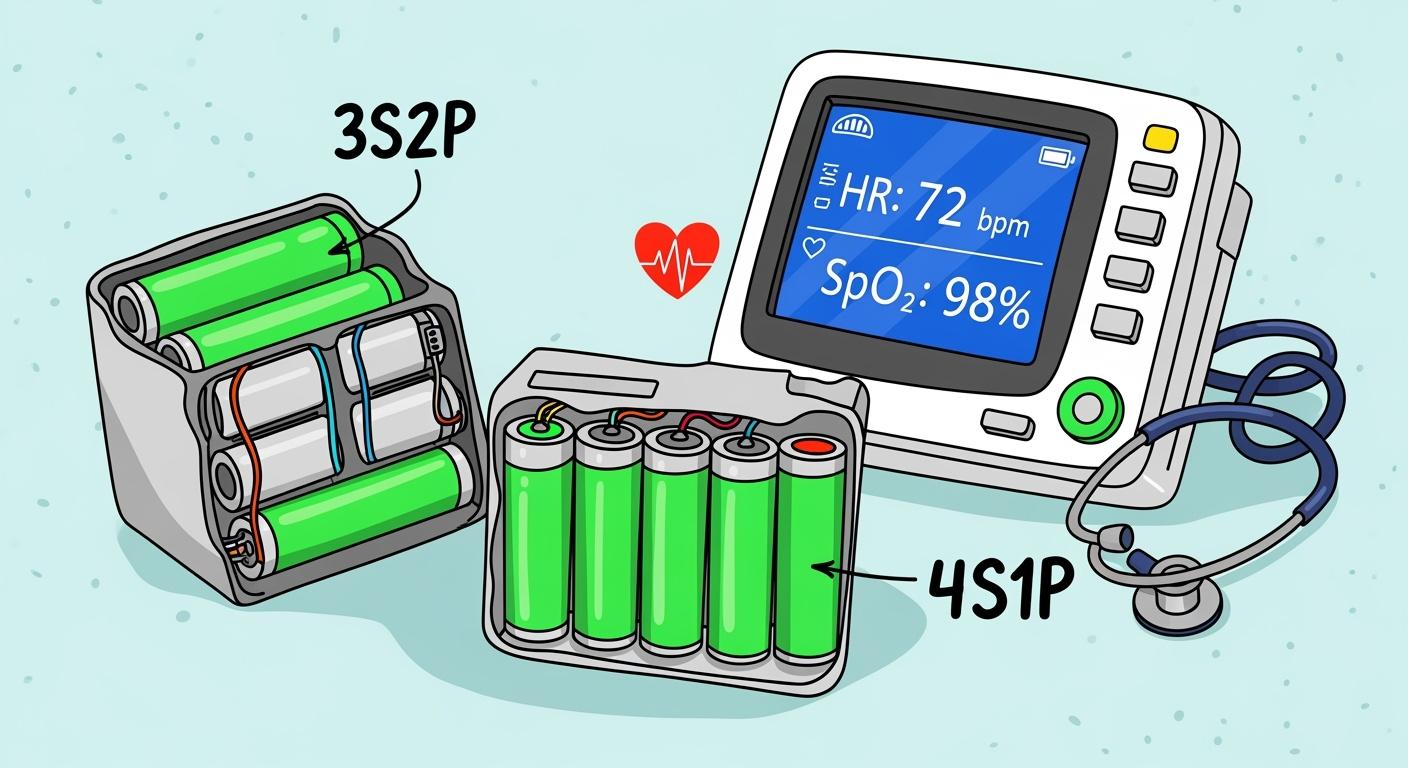
You rely on lithium battery packs to power portable patient monitors in demanding clinical environments. The configuration you select, such as 3S2P or 4S1P, affects device reliability, operating time, and safety. Consider your monitor’s power needs and required safety features when evaluating battery options.
Choose the configuration that aligns with your device’s electrical specifications and operational standards.
Key Takeaways
Choose 3S2P configurations for longer operating times and stable power delivery in portable patient monitors. This setup is ideal for critical care environments.
Opt for 4S1P configurations when higher voltage is needed in a compact design. This choice suits devices with short bursts of high power demand.
Always match the battery pack’s voltage and capacity to your device’s requirements. Consider safety features like Battery Management Systems to enhance reliability.
Part1: 3S2P vs 4S1P Lithium Battery Packs

1.1 3S2P Configuration Explained
You encounter the 3S2P configuration frequently when evaluating Lithium Battery Packs for portable patient monitors. In this setup, three cells connect in series (3S), and two strings of these series-connected cells run in parallel (2P). This arrangement increases both voltage and capacity, making it suitable for devices that demand extended uptime and stable power delivery.
Parameter | Specification |
|---|---|
Product Name | 10.8V 6.7Ah Li-ion Battery |
Configuration | 3S2P |
Cell Type | 18650 3.6V 3350mAh |
2A | |
Dimension | PVC 385870 mm |
Common Applications | Backup Power Systems for medical equipment |
You benefit from the higher capacity and moderate voltage range, which supports longer operation between charges. Typical voltage ratings for 3S2P Lithium Battery Packs (using 18650 or 21700 cells) range from 10.8V to 11.1V, with capacities between 6Ah and 10Ah. The following table summarizes common ratings:
Voltage | Capacity |
|---|---|
10.8V | 6.7Ah |
11.1V | 10Ah |
You also gain from the robust energy content, which can reach up to 66.6Wh. The cycle life often exceeds 500 cycles at 25ºC, ensuring reliability in clinical settings. The integrated BMS enhances safety by monitoring cell health and preventing overcharge or deep discharge.
Tip: Choose 3S2P Lithium Battery Packs for patient monitors that require high capacity and consistent voltage output, especially in environments where uninterrupted operation is critical.
1.2 4S1P Configuration Explained
You may consider the 4S1P configuration for applications that prioritize higher voltage over capacity. In this setup, four cells connect in series (4S), and there is only one parallel string (1P). This design delivers increased voltage, which can be essential for devices with higher power requirements but limited space for additional cells.
Parameter | Specification |
|---|---|
Configuration | 4S1P |
Cell Type | 18650 3.6V 3350mAh |
Nominal Voltage | 14.4V |
Nominal Capacity | 3.35Ah |
Energy Content | 48.24Wh |
Typical Weight | 210g |
Common Applications | Medical, robotics, security, industrial devices |
You achieve a higher voltage output, typically around 14.4V, which supports devices that need more power in a compact form factor. However, the capacity is lower compared to 3S2P, which may reduce operating time between charges. The 4S1P configuration is ideal for patient monitors with short bursts of high power demand or where size constraints limit battery volume.
Note: Select 4S1P Lithium Battery Packs for devices that require higher voltage and can operate efficiently with lower capacity.
1.3 Technical Differences
You must understand the technical differences between 3S2P and 4S1P Lithium Battery Packs to make informed decisions for your medical devices. The following table compares key specifications:
Feature | 3S2P Configuration | 4S1P Configuration |
|---|---|---|
Voltage | 10.8V | 14.4V |
Capacity | 6Ah – 10Ah | 3Ah-3.5Ah |
Energy Density | Moderate to High | Moderate to High |
Cycle Life | 500+ cycles | 500+ cycles |
Weight | ~310g | ~210g |
Typical Application | Extended uptime, backup | High power, compact size |
You should also consider battery chemistry when selecting Lithium Battery Packs. The most common chemistries include:
Chemistry | Platform Voltage | Energy Density (Wh/kg) | Cycle Life (cycles) |
|---|---|---|---|
LCO | 3.6V | 150–200 | 500–1000 |
NMC | 3.7V | 200–250 | 1000–2000 |
3.2V | 90–120 | 2000–5000 | |
LMO | 3.7V | 100–150 | 300–700 |
LTO | 2.4V | 70–80 | 7000–20000 |
You find that NMC and LiFePO4 chemistries are popular in medical devices due to their balance of energy density, safety, and cycle life. Lithium-ion batteries offer high energy density and long cycle life, making them suitable for portable patient monitors.
Alert: Always verify the compatibility of Lithium Battery Packs with your device’s voltage and current requirements. Ensure the BMS supports the intended application to maximize safety and reliability.
You optimize device performance and safety by selecting the right configuration and chemistry for your portable patient monitors.
Part2: Performance & Selection Guide
2.1 Device Performance Impact
You must evaluate how battery configuration influences the performance of portable patient monitors. The 3S2P setup delivers longer operating time due to its higher capacity. This configuration supports continuous monitoring, which is essential in clinical environments. You gain reliable uptime, reducing the risk of device shutdown during critical care.
The 4S1P configuration provides higher voltage, which benefits devices that require more power in short bursts. You may notice a reduction in operating time compared to 3S2P, but you achieve a compact design and lighter weight. Both configurations integrate a Battery Management System (BMS), which protects against overcharging, overheating, and deep discharge. This safety feature ensures stable operation and extends battery life.
Tip: Select the configuration that matches your device’s voltage and capacity needs to maximize uptime and reliability.
2.2 Application Scenarios
You encounter Lithium Battery Packs in a variety of sectors. The 3S2P configuration excels in medical environments, especially for portable patient monitors. You find these packs in:
Emergency Care: Ambulances and accident scenes require continuous vital sign monitoring.
Resource-strained emergency departments: Quick relocation and immediate startup help screen large numbers of patients.
Disaster zones: Long-lasting batteries enable uninterrupted care where electricity is limited.
Inter-hospital transfers: Stable medical support during patient transport ensures vital sign tracking and data transmission.
You also see 4S1P packs in other industries:
Robotics: Compact, high-voltage batteries power mobile robots and automation systems.
Security systems: Devices such as surveillance cameras and access control units benefit from higher voltage in a small footprint.
Infrastructure: Remote sensors and monitoring equipment require reliable power sources.
Consumer electronics: Portable devices demand lightweight, high-voltage batteries.
Industrial: Equipment such as handheld diagnostic tools and portable meters rely on robust battery packs.
Note: You can request a custom battery solution to match your specific application scenario.
2.3 Choosing Lithium Battery Packs
You must consider several factors when selecting Lithium Battery Packs for portable patient monitors:
Device Voltage Requirement: Match the pack’s nominal voltage to your device’s specifications.
Capacity Needs: Estimate the required operating time and select a configuration that meets or exceeds this duration.
Size and Weight Constraints: Choose a pack that fits within your device’s physical limits.
Safety Features: Ensure the pack includes a reliable BMS for protection and compliance.
Cycle Life: Evaluate the expected number of charge-discharge cycles to minimize maintenance and replacement costs.
Chemistry Selection: Use standardized chemistries such as NMC or LiFePO4 for optimal balance of energy density and safety.
Alert: Consult with your supplier for custom configurations that address unique power, size, and safety requirements.
You need to select the right battery configuration for portable patient monitors by comparing voltage, capacity, and safety features. 3S2P offers extended uptime and robust performance, while 4S1P provides higher voltage and compact design. Review supplier recommendations:
Configuration | Nominal Voltage | Capacity | Chemistry | Features | Application |
|---|---|---|---|---|---|
3S2P | 11.1V | 10000mAh | NMC | High discharge, waterproof | Outdoor medical devices |
4S1P | 12.8V | 35Ah | LiFePO4 | Enhanced safety, long cycle life | Emergency power, portable equipment |
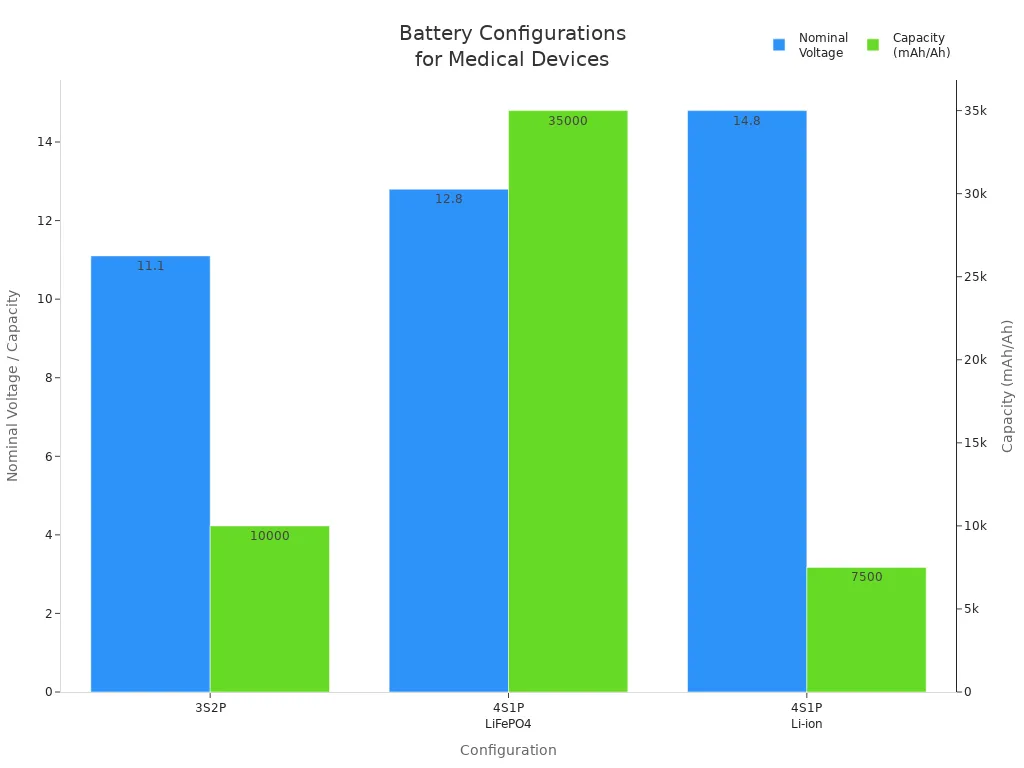
Evaluate energy density, cycle life, and compliance with ANSI/AAMI ES 60601-1 and IEC standards. Consult with battery suppliers or request a custom battery solution to meet your device’s needs.
FAQ
What advantages do 3S2P and 4S1P lithium battery packs offer for portable patient monitors?
You gain reliable uptime and stable voltage. Both configurations support medical-grade safety standards and integrate advanced Battery Management Systems for enhanced protection.
How does Large Power support custom lithium battery solutions for medical devices?
You can request a tailored battery pack from Large Power. Visit custom battery solution for expert engineering and compliance with medical device requirements.
Which battery chemistry should you select for patient monitors?
You should choose NMC or LiFePO4 chemistries. These options provide high energy density, long cycle life, and robust safety features for clinical environments.


