

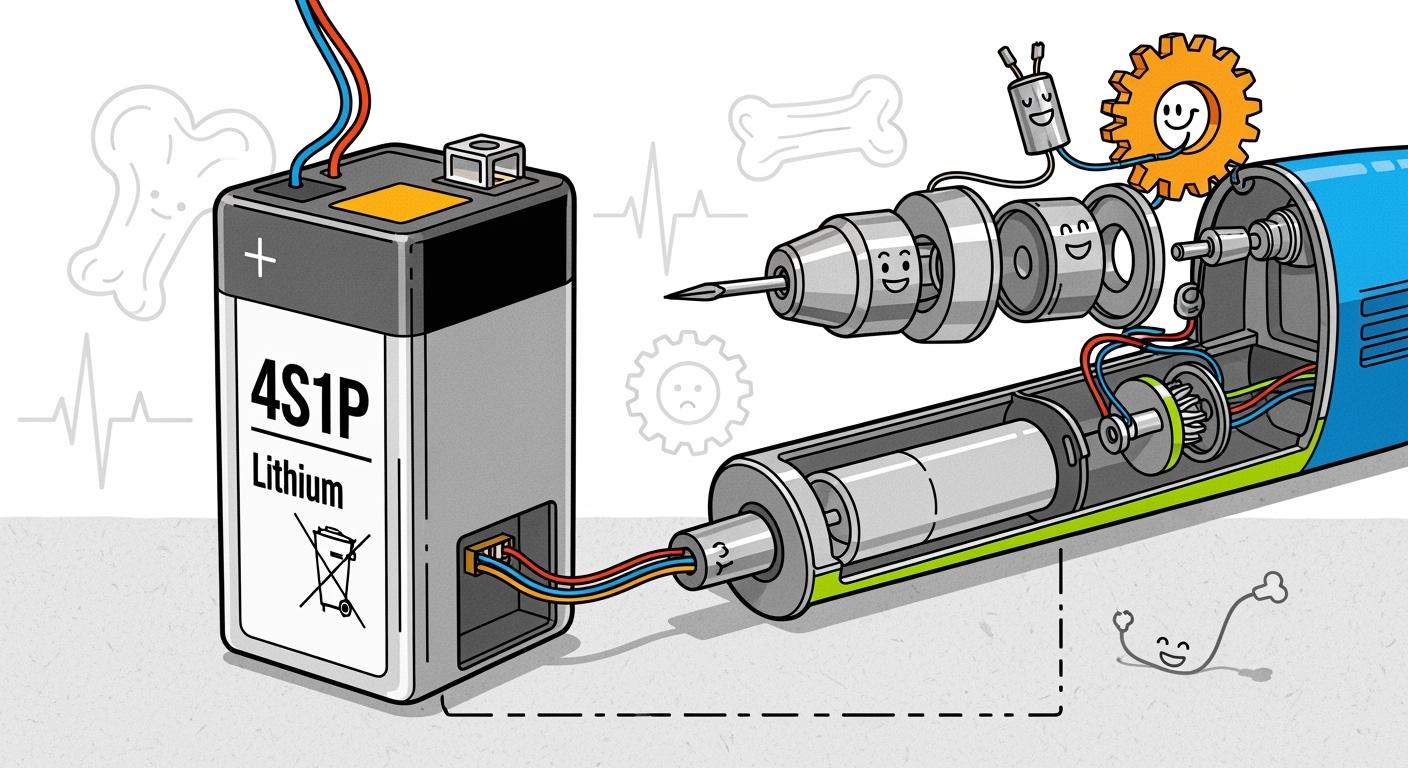
You need a power source that delivers consistent, high torque for demanding orthopedic tools. A 4S1P lithium battery provides high energy density, longer runtime, and reliable startup current control. Lightweight design and quick charging enhance surgical efficiency. For successful Lithium Battery Selection, these features ensure optimal performance in clinical settings.
Quick charging and lightweight design help reduce downtime, keeping procedures on schedule.
Key Takeaways
4S1P lithium batteries deliver high voltage and energy density, making them ideal for high-torque orthopedic tools. This ensures reliable performance during critical procedures.
Quick charging and lightweight design of 4S1P batteries reduce downtime and improve ergonomics for medical staff, enhancing surgical efficiency.
Always verify that your battery supplier meets international safety standards to ensure patient safety and compliance in clinical settings.
Part1: Technical Demands
1.1 High-Torque and Startup Current
Orthopedic drills demand high torque and rapid response. When you activate these tools, the motor draws a significant startup current. This surge ensures the drill reaches operational speed instantly, which is critical for precise bone cutting and fixation. Lithium-ion battery packs, especially in a 4S1P configuration, deliver the voltage and current needed for these demanding moments. You benefit from stable power output, which prevents tool stalling and supports consistent performance throughout the procedure.
Modern surgical environments require battery packs that can handle repeated high-load cycles. The battery must maintain efficiency even after multiple sterilization processes, such as autoclaving. Lithium-ion chemistry stands out for its high energy density and fast recharge rates, making it the preferred choice for high-torque surgical tools.
1.2 Battery Needs in Surgery
You must prioritize reliability, efficiency, and safety when selecting a battery for surgical applications. Battery packs in medical devices must meet strict international standards to ensure patient and operator safety. The table below outlines key standards for surgical battery packs:
Standard | Description |
|---|---|
ISO 13485 | Ensures a quality management system for safe and reliable battery production. |
IEC 62133 | Safety standard for secondary cells and batteries, including biocompatibility. |
UL 2054 | Covers safety requirements for household and commercial batteries, applicable to medical devices. |
IEC 60601-1 | General requirements for the safety and performance of medical electrical equipment. |
ISO 10993-1 | Guidelines for evaluating biological safety of medical devices, including batteries. |
Tip: Always verify that your battery supplier complies with these standards to minimize risk in clinical settings.
You should also look for these essential safety features:
Overcharge protection and thermal shutdown
Biocompatible materials for patient safety
Integrated battery management systems to monitor and control performance
Efficient battery packs support long surgeries and reduce the risk of power loss during critical procedures. By choosing a battery that meets these technical demands, you ensure both safety and operational excellence in the operating room.
Part2: 4S1P Configuration Benefits

2.1 What is 4S1P?
You encounter the 4S1P configuration frequently in high-performance lithium battery packs. This setup connects four cells in series and one in parallel, resulting in a compact structure that maximizes voltage output. The 4S1P design delivers approximately 14.8V when using lithium-ion cells, which is ideal for high-torque orthopedic tools. Compared to configurations like 3S2P or 4S2P, 4S1P prioritizes voltage over capacity, making it suitable for applications where space and weight matter. You should always ensure proper battery management systems (BMS) are in place to monitor cell balance and safety.
Note: Safety remains critical in 4S1P packs due to higher voltage and the risk of cell imbalance. Always select packs with robust monitoring systems.
2.2 Voltage, Capacity, and Runtime
The 4S1P configuration provides a higher voltage output than 3S1P or single-cell designs. You benefit from stable power delivery, which supports the demanding startup currents of surgical drills. While the single parallel branch limits total capacity, the configuration still offers sufficient runtime for most orthopedic procedures. For Lithium Battery Selection, you should evaluate the balance between voltage and capacity based on your tool’s requirements. This approach ensures reliable performance during long surgeries.
2.3 Lightweight and Quick Charging
You gain significant advantages with 4S1P packs in terms of weight and charging speed. The compact design reduces the overall mass of your surgical tools, improving ergonomics and reducing fatigue for medical staff. Quick charging capabilities minimize downtime between procedures, supporting higher throughput in busy clinical environments. When you compare lithium-ion, LiFePO4, lithium-polymer, and solid-state battery chemistries, you find that 4S1P packs consistently deliver the best combination of energy density and recharge efficiency for high-torque applications.
Tip: Lightweight, fast-charging batteries help you maintain surgical schedules and improve patient outcomes.
Part3: Lithium Battery Selection Guide
3.1 Key Criteria for Orthopedic Tools
When you approach lithium battery selection for high-torque orthopedic tools, you must focus on criteria that directly impact safety, performance, and reliability. These factors also apply to other demanding sectors such as robotics, security systems, infrastructure, consumer electronics, and industrial applications (see application scenarios). For orthopedic tools, the following criteria are essential:
Reliability: You need batteries that deliver consistent performance to ensure patient safety and successful surgical outcomes.
High power-to-size ratio: Compact, lightweight batteries improve ergonomics and reduce fatigue for surgeons.
Long shelf life: Devices must remain ready for use after extended storage without frequent recharging.
High temperature survivability: Batteries must withstand repeated sterilization cycles, such as autoclaving.
Cold temperature operability: Devices transported through cold chains require batteries that function reliably in low temperatures.
Ability to supply high pulses: Motors and communication circuits in surgical tools demand batteries capable of delivering high current pulses.
You should always match these criteria to your specific application. For example, in the medical sector, reliability and sterilization resilience take priority, while in robotics or industrial settings, power-to-size ratio and pulse capability may be more critical.
3.2 Safety and Compliance
Safety and regulatory compliance form the backbone of lithium battery selection for surgical and other mission-critical applications. You must ensure that every battery pack meets international standards and local regulations. In the medical field, compliance with ISO 13485, IEC 62133, UL 2054, IEC 60601-1, and ISO 10993-1 is mandatory. These standards guarantee quality management, electrical safety, and biocompatibility.
Recent regulatory changes, such as the EU Battery Regulation 2023/1542, have introduced stricter requirements for sustainability, safety, and performance. You must now select batteries designed for easy removability and replaceability, which affects both the battery and device design. The regulation also restricts harmful substances and requires manufacturers to declare the carbon footprint of each battery. You can find more details in our sustainability statement and conflict minerals policy.
Tip: Always request documentation for certifications and regulatory compliance from your battery supplier. This step helps you avoid costly recalls and ensures patient and operator safety.
In addition, you should implement robust battery management systems (BMS) to monitor cell balance, temperature, and charging cycles. BMS integration prevents overcharging, thermal runaway, and cell imbalance, which are critical for both safety and battery longevity.
3.3 Real-World Application Tips
You can avoid common pitfalls in lithium battery selection by following best practices and learning from real-world scenarios. The table below highlights frequent issues and strategies to prevent them:
Common Pitfalls in Lithium Battery Selection | Avoidance Strategies |
|---|---|
Poor installation and connection | Ensure secure and appropriately sized connections to handle charging current. |
Undersized cables | Follow electrical codes and manufacturer recommendations for cable sizing. |
Lack of temperature monitoring | Monitor battery temperature during charging and suspend if it exceeds 45°C. |
Overcharging risks | Implement battery management systems to prevent overcharging and thermal runaway. |
In clinical use, you must prioritize batteries that deliver consistent voltage and withstand repeated sterilization. Poor quality or expired batteries can interrupt procedures and increase patient risk. High-quality lithium battery packs ensure your surgical tools perform reliably, supporting optimal patient outcomes.
Battery-powered surgical instruments have transformed modern healthcare by providing portability, precision, and ease of use. You will also find similar benefits in robotics, security systems, and industrial automation, where reliable battery performance is essential for safety and efficiency.
Note: Always evaluate the supplier’s track record in your sector. Request references from medical, robotics, or industrial clients to verify real-world performance.
When you select a 4S1P lithium battery pack, consider the chemistry (such as lithium-ion, LiFePO4, or lithium-polymer), voltage (typically 14.8V for lithium-ion), energy density, and cycle life. Standardized data for these chemistries ensures you make informed decisions tailored to your application.
By following these guidelines, you can optimize lithium battery selection for your orthopedic tools and other high-demand applications, ensuring safety, compliance, and long-term performance.
Part4: 4S1P vs Other Setups
4.1 4S1P vs 3S1P
When you evaluate lithium battery packs for high-torque orthopedic tools, you must compare the 4S1P and 3S1P configurations. The 4S1P setup connects four cells in series, while the 3S1P uses three. This difference directly impacts voltage and performance. The table below summarizes the key differences:
Feature | 3S1P Battery | 4S1P Battery |
|---|---|---|
Voltage | 11.1V | 14.8V |
Capacity | 2.2Ah | 2.5Ah |
Runtime | Depends on device discharge rate | Depends on device discharge rate |
You see that the 4S1P battery delivers a higher voltage and slightly greater capacity. This higher voltage ensures your orthopedic drills maintain torque and speed, especially during demanding procedures. The increased capacity also supports longer operation between charges, which is essential in busy surgical environments.
Note: Higher voltage in 4S1P packs reduces current draw for the same power output, which can improve efficiency and reduce heat buildup in your tools.
4.2 Unique Value for High-Torque
You need reliable startup power and sustained torque for orthopedic, robotics, and industrial applications. The 4S1P configuration stands out because it provides the voltage necessary to drive high-torque motors without excessive current. This setup minimizes voltage sag under load, so your tools perform consistently even during intensive use.
When you focus on Lithium Battery Selection, prioritize 4S1P packs for high-torque, power-hungry devices. The configuration’s balance of voltage and capacity supports both performance and safety. You also benefit from reduced tool weight and faster charging, which help maintain workflow in clinical and industrial settings.
Tip: For surgical drills and other mission-critical tools, always choose a battery configuration that matches your torque and runtime requirements.
You gain the best results for high-torque orthopedic drills with 4S1P lithium batteries. These packs deliver high voltage, lightweight design, and quick charging. You must select batteries that meet safety standards, support rugged performance, and withstand repeated sterilization. Always match battery features to your tool’s technical demands.
FAQ
What makes a 4S1P lithium battery pack suitable for high-torque orthopedic tools?
You get stable 14.8V output, high energy density, and reliable startup current. This configuration supports demanding medical, robotics, and industrial applications with consistent performance.
Can Large Power provide custom lithium battery solutions for my application?
Absolutely. Large Power specializes in custom lithium battery packs for medical, security, and industrial sectors.
How do you ensure safety and compliance in lithium battery packs?
You should select packs certified to ISO 13485, IEC 62133, and UL 2054. Integrated battery management systems protect against overcharge, overheating, and cell imbalance.


