

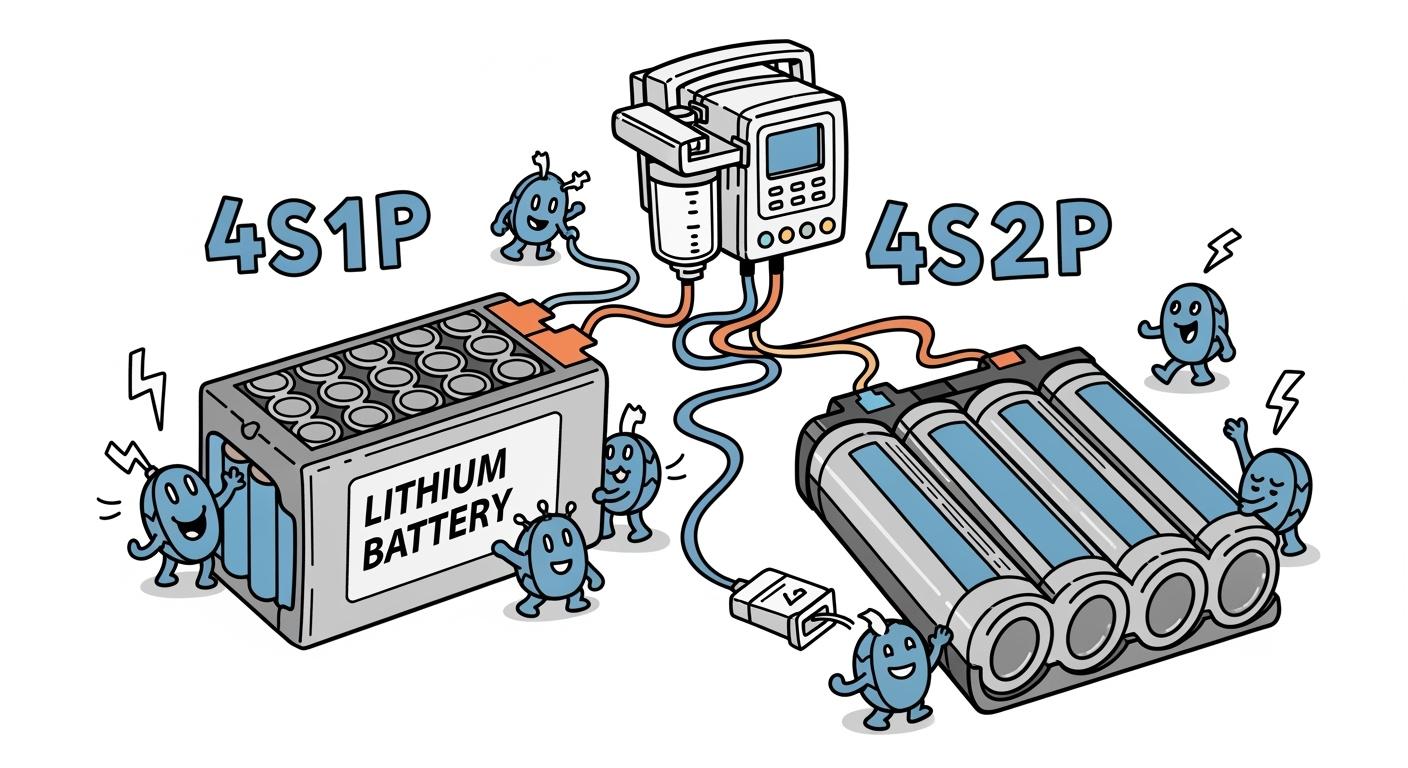
For long-running medical pumps, you should select 4S2P lithium battery solutions. This configuration delivers higher capacity and extended runtime, which are essential for reliable healthcare operation. Lithium battery solutions with robust protection features prevent issues like power reduction, which can cause up to 20% error rates and impact performance. You need lithium battery solutions that offer redundant detection and execution, precise control, and real-time monitoring. Up to 50% of hospital service calls relate to battery problems, so choosing advanced lithium battery solutions directly supports safety and reduces downtime in medical pumps.
Key Takeaways
Choose 4S2P lithium battery packs for medical infusion pumps to ensure longer runtime and higher reliability.
The 4S2P configuration offers redundancy, meaning if one cell fails, others continue to provide power, enhancing safety.
Select battery packs with robust management systems and certifications to guarantee safety and compliance in healthcare settings.
Part1: Lithium Battery Solutions Comparison
1.1 4S1P vs. 4S2P Overview
You often face a choice between 4S1P and 4S2P when selecting lithium battery packs for medical infusion pumps. The 4S1P configuration uses four 18650 cells in series to deliver 14.4v, but only one cell per string. The 4S2P configuration connects two parallel strings of four 18650 cells each, also providing 14.4v but doubling the capacity. You gain longer runtime and higher reliability with 4S2P, which is critical for continuous operation in healthcare. The 4S2P configuration also supports portable infusion devices for emergency and field use, home healthcare, and critical care in hospitals. It ensures uninterrupted medication delivery, even during power outages. Oncology treatments and veterinary applications also benefit from the long cycle life and stable output of 4S2P packs.
1.2 Key Specs and Pros/Cons
You need to consider several factors when comparing 4S1P and 4S2P. The table below summarizes the main differences:
Feature | 4S1P (14.8v, 4×18650) | 4S2P (14.8v, 8×18650) |
|---|---|---|
Voltage | 14.4v | 14.4v |
Capacity | Standard (1x cell) | Double (2x cell) |
Runtime | Moderate | Extended |
Size/Weight | Compact, lighter | Larger, heavier |
Redundancy | None | High (parallel cells) |
Long Cycle Life | Good | Excellent |
Reliability | Standard | Superior |
Application | Short-term, portable | Long-term, critical care |
18650 Li-ion Cells Used | 4 | 8 |
Smart Protection Systems | Yes | Yes |
Certification | Required | Required |
Manufacturers use strict quality control for both configurations. You see testing and certification to standards like UN 38.3, IEC 62133, UL 1642/UL 2054, and CE Marking. Smart protection systems in both 4S1P and 4S2P packs prevent failures and ensure safety. The 4S2P configuration stands out in 4S2P vs other pack configurations for medical, robotics, and industrial applications, especially when you need long cycle life and high reliability. You benefit from the robust performance of 18650 cells, which power devices across healthcare, security, and research sectors.
Tip: Choose 4S2P when you require maximum uptime, redundancy, and safety for your 14.4v medical infusion pumps.
Part2: Runtime and Performance in Healthcare
2.1 Runtime Analysis
You need reliable power for infusion pumps in every clinical setting. The 4S2P lithium battery configuration stands out because it doubles the capacity compared to a 4S1P pack. Each 4S2P pack uses eight 18650 cells, which means you get twice the energy storage at the same 14.8v output. This design directly impacts runtime, allowing your infusion pumps to operate for extended periods without interruption.
When you perform a runtime calculation, you see the clear advantage. For example, if each 18650 cell provides 2,600mAh, a 4S1P pack delivers 2,600mAh at 14.8v. A 4S2P pack, however, offers 5,200mAh at 14.8v. This increase means your devices can run longer between charges, which is critical in medical environments where continuous therapy is required.
You also benefit from the consistent voltage output of lithium-ion batteries. These batteries maintain stable performance under demanding conditions. You avoid sudden drops in power, which can disrupt sensitive infusion pump operations. The lightweight and high energy density of 18650 lithium-ion cells make them ideal for portable and stationary medical devices. You can trust these packs to deliver reliable power for both short-term and long-term applications.
Note: Longer runtime reduces the frequency of battery changes, which lowers maintenance costs and minimizes the risk of therapy interruption.
2.2 Impact on Infusion Pump Operation
You see a direct link between battery configuration and the performance of your infusion pumps. The 4S2P setup not only extends runtime but also enhances reliability. Parallel cell design in 4S2P packs provides redundancy. If one cell fails, the remaining cells continue to supply power, which is essential for critical care scenarios.
In clinical practice, you need infusion pumps that deliver medication with precision and consistency. The 4S2P configuration supports this by ensuring stable voltage and current output. You avoid dosing errors caused by voltage fluctuations. This stability is especially important during long infusions or when pumps operate in remote or emergency settings.
You also gain operational flexibility. The higher capacity of 4S2P packs means you can use the same battery for a wider range of devices, from portable infusion pumps to larger stationary units. The robust design of 18650 lithium-ion cells ensures long cycle life, reducing the need for frequent replacements.
Key benefits of 4S2P lithium battery packs for infusion pumps:
Extended runtime for uninterrupted therapy
Redundancy for enhanced safety
Consistent voltage output for accurate medication delivery
Reduced maintenance and downtime
You can compare lithium-ion batteries to other chemistries used in healthcare. Lithium-ion offers high energy density, lightweight construction, and long cycle life. Nickel-Metal Hydride batteries tolerate deep discharge cycles and are cost-effective, but they are heavier and less energy-dense. Lead Acid batteries provide stable voltage and are maintenance-free, but they are heavier and have a shorter lifespan. For infusion pumps, lithium-ion 4S2P packs deliver the best balance of performance, safety, and reliability.
Tip: Choose 4S2P lithium battery packs for your 14.8v infusion pumps to maximize uptime and ensure consistent operation in demanding healthcare environments.
Part3: Size, Weight, and Safety Factors

3.1 Size and Weight Comparison
You must consider size and weight when selecting lithium battery packs for infusion pumps. The 4S2P configuration uses eight 18650 cells, which increases both size and weight compared to the 4S1P setup. This difference impacts portability and usability in healthcare environments. You want a battery pack that does not burden the patient and allows for mobility during treatment. The following table highlights how these factors affect usability:
Factor | Impact on Usability and Portability |
|---|---|
Size | Should not burden the patient, enabling other activities. |
Weight | Must be manageable for patients to enhance mobility. |
You see that battery power is essential for patient transport and extended use. Rechargeable packs allow you to operate infusion pumps without being tethered to a power source. The 4S2P design supports portable medical devices, robotics, and security systems where mobility is critical.
Requirement | Importance for Healthcare Environments |
|---|---|
Battery Power | Essential for operation during patient transport. |
Rechargeable Packs | Necessary for extended use without being tethered. |
3.2 Safety and Redundancy
You need advanced safety features in lithium battery packs for medical applications. The 4S2P configuration offers redundancy by connecting cells in parallel, which ensures continued operation if one cell fails. You rely on a battery management system to monitor and protect each cell. The system prevents over-charge, over-discharge, and overheating, which are vital for patient safety. The table below summarizes key safety features:
Safety Feature | Description |
|---|---|
Over-charge protection | Prevents cells from exceeding 4.25V |
Over-discharge protection | Prevents cells from dropping below 2.5–3.0V |
Cell balancing | Ensures all cells are at the same voltage |
Overcurrent protection | Protects against excessive current flow |
Temperature sensing | Monitors temperature to prevent overheating |
Certification tests | Ensures compliance with safety standards |
You must select battery packs that meet strict certification requirements, such as UN38.3, IEC62133-2, and UL1642/UL2054. These certifications guarantee safe operation in medical, industrial, and infrastructure applications. You also benefit from global electrical safety recognition and chemical safety documentation. The battery management system enhances reliability and supports real-time monitoring, which is essential for infusion pumps and other critical devices.
Tip: Choose 4S2P lithium battery packs with robust battery management system and full certification for maximum safety, redundancy, and operational reliability.
Part4: Expert Recommendations
4.1 Selection Advice
You should prioritize reliability, energy density, and compliance when selecting lithium battery packs for infusion pumps. Medical device experts recommend 4S2P lithium-ion battery configurations for long-running applications. These packs deliver high power-to-size ratios, which allow you to design smaller, lighter devices. You can see this advantage in hospital-grade breast pumps and portable patient monitors, where ergonomic design and extended runtime are critical.
The following table summarizes the main criteria experts use for battery selection:
Criteria | Description |
|---|---|
Reliability | Patient wellness depends on consistent device operation. |
High power-to-size ratio | Enables compact, lightweight medical devices. |
Long shelf life | Ensures readiness after storage. |
High temperature survivability | Supports sterilization processes. |
Cold temperature operability | Maintains function during cold chain transport. |
High pulse capability | Powers motors and communication circuits. |
You benefit from lithium-ion batteries because they offer up to 250 Wh/kg energy density and last over 500 cycles at 80% capacity. These features outperform NiMH batteries, which are heavier and have fewer cycles. You must also ensure compliance with ANSI/AAMI ES 60601-1, UL2054, and FDA requirements for medical battery packs.
Tip: For custom battery solutions tailored to your device, click here for a custom battery consultation.
7.2 Special Healthcare Considerations
You must consider unique healthcare requirements when choosing battery packs. Devices such as infusion pumps, hospital-grade breast pumps, and portable patient monitors demand long shelf life and high reliability. You need batteries that survive sterilization and operate in cold environments. Custom lithium ion battery packs can address these needs for medical, robotics, and security applications.
You should always select battery packs with robust management systems and full certification. This approach ensures safety and uninterrupted operation in critical care. You can request custom lithium ion battery designs to meet specific requirements for infrastructure or industrial use.
Key considerations:
Certification to medical standards
Redundant safety features
Adaptability for specialized devices
You can enhance device performance and patient safety by choosing the right lithium battery configuration.
You should choose 4S2P lithium battery packs for most long-running infusion pumps. This configuration delivers superior runtime and reliability, supporting clinical infusion rates between 2.0 and 2.4 mL/hr for optimal therapy. For specialized needs, custom lithium-ion solutions offer advanced safety, fast charging, and smart management:
Feature | Description |
|---|---|
Medical-Grade Safety | Certified to ISO13485 and compliant with IEC60601-1 safety requirements for clinical applications. |
Extended Runtime | High-energy-density batteries support 8–14 hours of continuous operation based on settings. |
Multiple Safety Protections | Protection against overcharge, over-discharge, overcurrent, short circuit, and temperature. |
Smart Power Management | Accurate power display and alarms to prevent infusion interruptions. |
Fast Charging Technology | Full charge in 2–3 hours, suitable for high-use environments. |
Low Noise & EMC Optimization | Optimized circuitry to minimize interference and ensure accurate pump operation. |
FAQ
What advantages does a 4S2P lithium-ion battery pack offer for medical infusion pumps?
You gain double the capacity and extended runtime with a 4S2P lithium-ion battery pack. This configuration ensures reliable operation for medical, robotics, and industrial applications.
How does Large Power ensure safety and compliance for lithium battery packs?
Large Power uses advanced battery management systems and certifies all packs to standards like UN38.3, IEC 62133, and UL 2054. You receive safe, compliant solutions for critical sectors.
Can you request custom lithium battery solutions for specialized devices?
Yes. You can request custom lithium battery packs for medical, security, or infrastructure devices. Contact Large Power for a custom battery consultation.


