

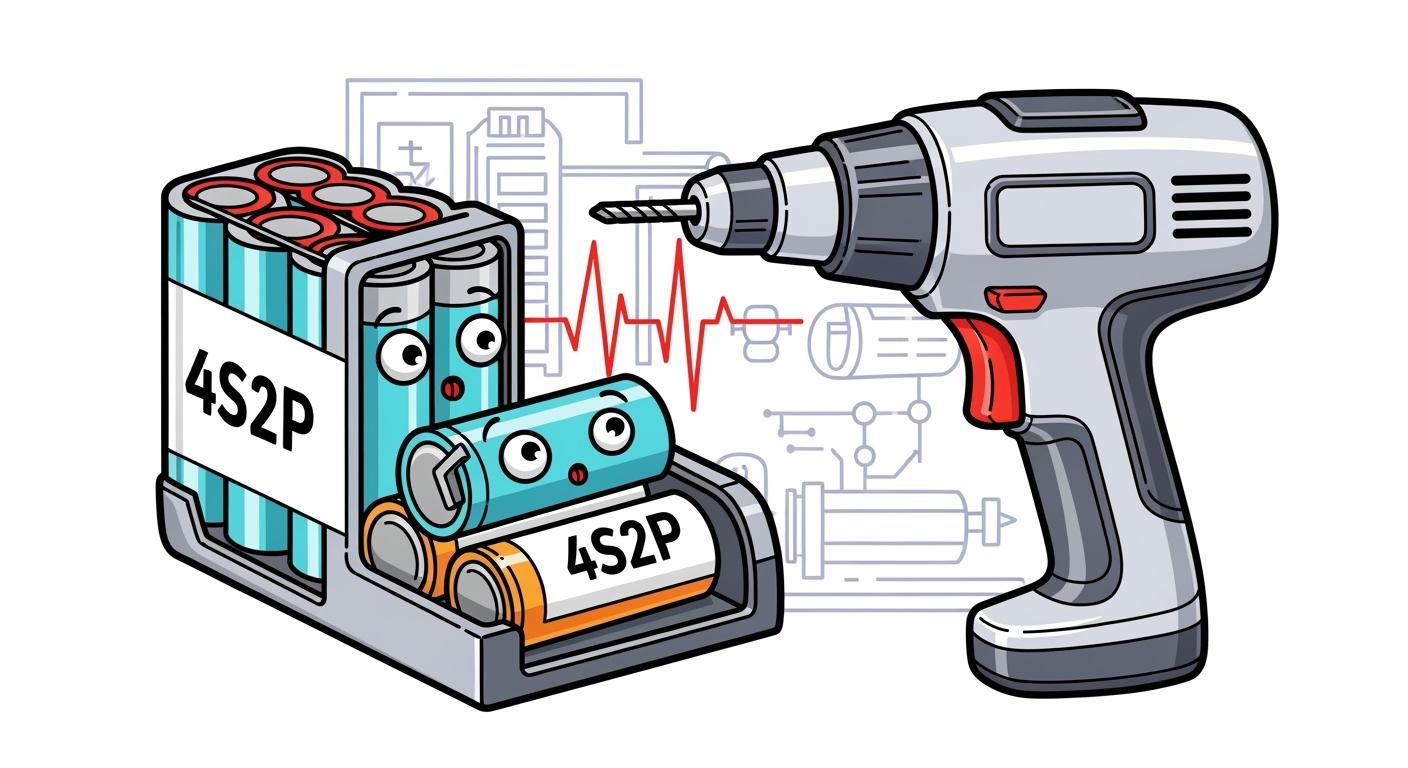
When you design a battery pack for surgical power tools, you must prioritize the ability to meet Peak Current Demands. The 4S2P configuration, which combines four cells in series and two in parallel, delivers a nominal voltage of 14.8V and supports up to 8.8A discharge current. You need to select cells with high discharge rates and include advanced safety features. The following table shows how the 4S2P structure supports reliable, high-performance operation in demanding medical environments:
Feature | Details |
|---|---|
Configuration | 4S2P (4 series, 2 parallel) |
Nominal Voltage | 14.8V |
Capacity | 5200mAh (Min. 5000mAh) |
Max Discharge Current | Up to 8.8A |
Safety Features | Over charge, over discharge, over current, short-circuit protection |
Key Takeaways
Understand Peak Current Demands to ensure your battery pack can handle the highest current needed during intense operations. This prevents tool failure during critical procedures.
Choose cells with high C-rate performance. A 2C rating or higher is often necessary for surgical tools to deliver quick bursts of energy.
Utilize a 4S2P configuration for your battery pack. This setup provides stable voltage, increased capacity, and enhanced safety for reliable operation.
Incorporate robust safety features in your design. Overcharge, over-discharge, and short-circuit protections are essential for safe operation in demanding environments.
Ensure compliance with medical standards and design for sterilization. This guarantees your battery packs remain reliable and safe for use in surgical settings.
Part 1: Understanding Peak Current Demands
1.1 Defining Peak Current for Surgical Tools
You must understand Peak Current Demands when designing battery packs for surgical power tools. These demands refer to the highest amount of current the tool requires during short bursts of intense operation, such as drilling or cutting. Surgical tools often need rapid power delivery to maintain precision and reliability. If you select a battery pack that cannot meet these demands, the tool may stall or fail during critical procedures.
Peak Current Demands differ across applications. For example, medical devices like bone saws or drills may require currents above 8A for short periods. In robotics or industrial sectors, tools may need similar or even higher peak currents. You should always check the manufacturer’s specifications for each tool to determine the exact requirements.
Tip: Always measure the actual peak current during real-world operation. Lab tests may not reflect the true demands of a surgical environment.
1.2 Importance of High C-Rate Performance
You must choose cells with high C-rate performance to meet Peak Current Demands. The C-rate indicates how quickly a battery can discharge its stored energy. For instance, a 1C rate means the battery can discharge its entire capacity in one hour. Surgical power tools often require cells rated at 2C or higher to deliver fast bursts of energy.
Different battery chemistries offer varying C-rate capabilities. The table below compares common Li-ion chemistries used in medical and industrial sectors:
Chemistry | Typical C-Rate | Application Scenario |
|---|---|---|
NMC | 1C – 2C | Medical, robotics |
LCO | 0.5C – 1C | Consumer electronics |
LMO | 1C – 2C | Security systems, industry |
LiFePO4 | 2C – 3C | Infrastructure, medical |
You should select a chemistry that matches your application’s peak current needs. For surgical tools, NMC and LiFePO4 cells often provide the best balance of safety and performance.
Part 2: 4S2P Configuration and Discharge Performance

2.1 4S2P Structure and Voltage Output
You need to understand the 4S2P configuration to design a battery pack that meets the demands of surgical power tools. In this setup, you connect four lithium-ion cells in series (4S) to increase the voltage. You then connect two of these series strings in parallel (2P) to double the available current and capacity. This structure gives you a nominal voltage of 14.8V, which matches the requirements of many medical and industrial devices.
The 4S2P configuration offers several advantages:
Stable Voltage Output: Four cells in series provide a consistent voltage platform, which is essential for tools that require reliable performance.
Increased Capacity: Two parallel strings allow you to double the current output and extend runtime.
Enhanced Safety: Parallel connections help distribute the load, reducing stress on individual cells.
Note: Always balance the cells in both series and parallel groups. This practice ensures even charging and discharging, which extends battery life and improves safety.
You should also consider the battery chemistry when designing your pack. The table below compares the most common lithium-ion chemistries used in medical, robotics, security systems, infrastructure, consumer electronics, and industrial sectors. Each chemistry offers different platform voltages, energy densities, and cycle lives.
Chemistry | Platform Voltage | Typical C-Rate | Energy Density (Wh/kg) | Cycle Life (cycles) | Application Scenario |
|---|---|---|---|---|---|
NMC | 3.7V | 1C – 2C | 150-220 | 1000-2000 | Medical, robotics |
LCO | 3.7V | 0.5C – 1C | 150-200 | 500-1000 | Consumer electronics |
LMO | 3.7V | 1C – 2C | 100-150 | 300-700 | Security systems, industry |
LiFePO4 | 3.2V | 2C – 3C | 90-120 | 2000+ | Infrastructure, medical |
2.2 Discharge Rates and Peak Current Demands
You must analyze discharge performance at different C-rates to ensure your battery pack can handle Peak Current Demands. The C-rate tells you how quickly a battery can deliver its stored energy. For example, a 1C rate means the battery can discharge its full capacity in one hour. Higher C-rates allow for faster energy delivery, which is critical for surgical power tools that require rapid bursts of power.
Let’s break down how the 4S2P configuration affects discharge performance:
0.5C Discharge: At this rate, the battery delivers half its capacity per hour. This setting works well for low-power devices but may not meet the Peak Current Demands of surgical tools.
1C Discharge: The battery can supply its full rated current for one hour. Most medical tools require at least this level of performance.
2C Discharge: The battery delivers twice its rated current, emptying in 30 minutes. This rate supports short, intense bursts of power.
3C Discharge: The battery can provide three times its rated current, discharging in 20 minutes. This rate is suitable for tools with very high Peak Current Demands.
For a 4S2P pack with 5200mAh capacity, the maximum continuous current at different C-rates is:
C-Rate | Current Output (A) | Typical Use Case |
|---|---|---|
0.5C | 2.6 | Low-power monitoring devices |
1C | 5.2 | Standard surgical handpieces |
2C | 10.4 | High-torque drills, bone saws |
3C | 15.6 | Short bursts, emergency tools |
Tip: Always select cells that can safely handle the highest expected C-rate. This approach ensures your battery pack will not overheat or fail during critical procedures.
You should match the discharge rate to the tool’s requirements. If your application demands frequent high-current bursts, choose cells with higher C-rate ratings and robust thermal management. This strategy helps you meet Peak Current Demands without compromising safety or performance.
Part 3: High-C Rate Cell Selection
3.1 Evaluating Cell Discharge Capability
You must select Li-ion cells that deliver reliable performance under high load. The discharge capability of each cell determines how much current your battery pack can supply during demanding procedures. When you evaluate cells, focus on three main criteria: discharge rate, safety features, and cycle life. These factors ensure your battery pack meets the operational needs of surgical power tools and other high-demand devices.
Criteria | Description |
|---|---|
Discharge Rate | Indicates how much current a battery can provide continuously or in bursts, crucial for high-demand applications. |
Safety Features | Essential built-in protections like overcharge, over-discharge, and short-circuit protection to ensure safe operation. |
Cycle Life | Refers to the number of charge-discharge cycles a battery can undergo before capacity diminishes, important for longevity. |
You should compare cell models based on their maximum discharge current and capacity. For medical devices, robotics, and industrial tools, manufacturers often recommend cells such as IFR-26650-25B and IFR-26650-30B. These models offer high discharge rates and robust safety features.
Model | Max. Discharge Current | Max. Continuous Discharge Current | Max. Charging Current | Capacity |
|---|---|---|---|---|
IFR-26650-25B | 50 C | 75000mA | 5C | 2500mAh |
IFR-26650-30B | 20 C | 30000mA | 3C | 3000mAh |
Tip: Always verify the cell’s discharge rate under real-world conditions. Laboratory ratings may differ from actual performance in medical or industrial environments.
You must also consider the battery chemistry. LiFePO4 cells provide high cycle life and safety, while NMC cells balance energy density and discharge capability. LCO and LMO cells suit consumer electronics and security systems but may not meet the rigorous demands of surgical power tools.
3.2 Safety Margins and Manufacturer Specs
You need to build safety margins into your battery design. Never operate cells at their absolute maximum ratings. Instead, use manufacturer specifications as a guide and set your operational limits below these values. This practice reduces the risk of overheating, cell degradation, and failure during critical procedures.
Follow these steps to ensure safe operation:
Review the manufacturer’s datasheet for each cell model.
Set your pack’s maximum discharge current at least 10-20% below the cell’s rated maximum.
Monitor cell temperature during peak load to prevent thermal runaway.
Integrate protection circuits for overcurrent, overcharge, and short-circuit events.
⚡ Alert: Exceeding manufacturer specs can lead to rapid capacity loss and compromise safety. Always design with a buffer for unexpected spikes in current.
You must match the cell’s discharge capability to the tool’s Peak Current Demands. For surgical power tools, select cells with proven performance in medical environments. Prioritize models with robust safety features and long cycle life. This approach ensures your battery pack delivers reliable power and meets regulatory standards for medical devices.
Part 4: Electrical, Thermal, and Safety Design

4.1 Minimizing Resistance and Heat
You must minimize electrical resistance in your battery pack to reduce heat generation during high-current operation. Use thick copper busbars and high-quality connectors to ensure low-resistance pathways. Select materials with high conductivity for all interconnections. Poor connections increase resistance, which leads to excessive heat and can damage cells. You should also design the layout to avoid sharp bends and long wire runs. This approach keeps the temperature stable and supports reliable performance during Peak Current Demands.
Tip: Regularly inspect and maintain all connections. Corrosion or loose terminals can increase resistance and cause overheating.
4.2 Thermal Management for High Current
Managing heat is critical when your battery pack operates at high discharge rates. Surgical power tool batteries often experience temperature ranges from -40 to 85 °C during operation and charging. You must implement effective thermal management strategies to prevent overheating and extend battery life.
Heat pipes and forced convection methods help control temperature rise during intense use.
Heat pipes can lower battery core temperature by 18–20 °C, which protects cells during high energy demands.
Combining heat pipe cooling devices with forced convection provides better temperature regulation and reduces strain on the battery system.
You should select a thermal management solution based on your application scenario. Medical and industrial sectors benefit from advanced cooling systems that maintain safe operating temperatures.
4.3 Protection Circuits and BMS
You need robust protection circuits and a reliable Battery Management System (BMS) to safeguard your Li-ion battery pack. The BMS monitors cell voltage, temperature, and current, providing real-time protection against overcharge, over-discharge, and short-circuit events. For more information about BMS, visit this resource.
The table below lists recommended protection circuits and battery management systems for high-C rate Li-ion packs:
Product Name | Description |
|---|---|
BQ40Z50-R2 | 1-4 series Li-ion battery pack manager supporting Turbo Mode 2.0 |
BQ25731 | I2C 1-5 cell NVDC buck-boost battery charge controller with USB type-C PD support |
BQ2982 | High-side protector for single-cell Li-ion and Li-polymer batteries with 0-V charge disabled |
BQ76952 | 3-s to 16-s high-accuracy battery monitor and protector for Li-ion, Li-polymer and LiFePO4 |
BQ79616-Q1 | 16-S automotive precision battery monitor, balancer and integrated protector with ASIL-D compliance |
BQ25756 | Stand-alone or I²C-controlled 70-V bidirectional buck-boost charge controller with MPPT |
BQ76942 | 3-series to 10-series multicell battery monitor and protector |
BQ27Z746 | Pack-side, single-cell Impedance Track™ technology fuel gauge with integrated protector |
You should choose a solution that matches your battery configuration and application needs. Medical, robotics, and industrial sectors require advanced monitoring and protection to ensure safety and compliance.
Part 5: Sterilization and Regulatory Compliance
5.1 Designing for Autoclaving
You must design battery packs for surgical power tools to survive repeated sterilization cycles. Autoclaving uses high-pressure steam at temperatures of 121°C or higher. Most lithium-ion batteries, including LiFePO4, NMC, LCO, and LMO chemistries, start to degrade above 55°C. Exposure to 130°C can cause rapid capacity loss and safety risks. Steam and dry heat sterilization, common in medical settings, often exceed these thresholds.
Steam sterilization operates at 121°C to 132°C.
Dry heat sterilization can reach 170°C for long periods.
Lithium-ion batteries may lose reliability or fail after repeated exposure.
To address these challenges, you should select materials and design features that improve heat resistance. The table below outlines key components and their properties for autoclave-ready battery packs:
Component | Material/Feature Description |
|---|---|
Separator | Material with a melt temperature greater than 150°C |
Electrolyte | Organic solvent with a boiling point below 140°C, lithium salt (LiTFSI) |
Positive Electrode | Aluminum current collector, lithium-containing metal oxide or phosphate, binder, conductive carbon |
Negative Electrode | Copper, aluminum, titanium, or carbon current collector; lithium titanium oxide or carbon material, binder, conductive carbon |
Performance After Heat | Retains at least 80% capacity after exposure to 100°C for at least 4 minutes |
⚠️ Note: Even with advanced materials, you should avoid exposing battery packs to repeated high-temperature cycles. Consider alternative sterilization methods or protective housings to extend battery life.
5.2 Meeting Medical Standards
You must ensure your battery packs comply with strict medical device regulations. Regulatory bodies require that battery packs meet safety, performance, and environmental standards. For medical, robotics, and industrial applications, you should focus on the following:
IEC 62133: Specifies safety requirements for portable sealed secondary cells and batteries.
ISO 13485: Sets quality management standards for medical device manufacturing.
UN 38.3: Requires batteries to pass transport safety tests, including thermal, vibration, and impact.
RoHS and REACH: Restrict hazardous substances and require chemical safety compliance.
You should also address sustainability and responsible sourcing. Many organizations now require documentation on conflict minerals and environmental impact. For more on these topics, review our approach to sustainability and our conflict minerals statement.
✅ Tip: Always document compliance with each standard. This practice ensures your battery packs meet regulatory approval and support safe operation under Peak Current Demands.
Part 6: Testing and Practical Tips
6.1 Validating Peak Current Performance
You need to validate the battery pack’s ability to deliver reliable power under real-world conditions. Start by simulating the operational environment of surgical power tools. Use programmable electronic loads to replicate the rapid bursts of current these devices require. Measure voltage stability and temperature rise during peak discharge. Record data for each test cycle to identify any drop in performance.
You should also perform in-house testing using ISO-certified processes. This approach ensures consistency and reliability. Test each battery chemistry—LiFePO4, NMC, LCO, and LMO—under identical conditions. Compare results in a table to highlight differences in discharge rates and thermal behavior.
Chemistry | Discharge Rate (C) | Voltage Stability | Temperature Rise (°C) | Cycle Life (cycles) |
|---|---|---|---|---|
LiFePO4 | 2C – 3C | High | Low | 2000+ |
NMC | 1C – 2C | Moderate | Moderate | 1000-2000 |
LCO | Moderate | High | 500-1000 | |
LMO | 1C – 2C | Moderate | Moderate | 300-700 |
✅ Tip: Always validate Peak Current Demands using both continuous and burst discharge tests. This practice helps you identify weaknesses before deployment in medical or industrial settings.
6.2 Common Pitfalls in High-C Rate Design
You can avoid many reliability issues by following strict maintenance protocols and handling batteries with care. Neglecting regular checks or improper storage often leads to reduced performance and safety risks. You should recharge batteries periodically, even when not in use, and store them in non-conductive containers with proper ventilation.
Consider these practical tips to improve reliability and safety:
Check and recharge batteries regularly.
Perform occasional charging cycles for unused packs.
Handle batteries gently and use protective covers.
Store packs in ventilated, non-conductive containers.
You should also focus on careful component selection and robust chemistry. Always consider capacity, discharge rate, cycle life, safety features, and customization options. Utilize in-house testing and ISO-certified processes to enhance reliability. Strict regulatory compliance protects patient safety and ensures medical devices perform as expected.
You can achieve reliable, safe, and high-performance battery packs for surgical power tools by focusing on key design steps. Select the right configuration, choose cells with stable chemistry, and optimize discharge performance. Ensure compliance with medical standards and design for sterilization. The table below highlights how each aspect supports reliability and safety:
Aspect | |
|---|---|
Configuration | Ensures optimal performance and compatibility with medical devices, enhancing reliability. |
Cell Selection | High energy density and stable chemistry improve performance and reduce failure rates. |
Discharge Performance | Affects how long devices can operate and ensures consistent power delivery for critical applications. |
Compliance with Standards | Adherence to safety standards prevents hazards and ensures devices meet regulatory requirements for safety and reliability. |
Apply these principles to deliver battery packs that meet the demands of medical, robotics, and industrial sectors.
FAQ
What is the main advantage of a 4S2P configuration for surgical power tools?
You gain higher voltage and increased current capacity. The 4S2P setup delivers 14.8V and doubles the available current, supporting reliable operation in medical, robotics, and industrial sectors.
How do LiFePO4, NMC, LCO, and LMO batteries compare for high-C rate applications?
Chemistry | Typical C-Rate | Cycle Life | Application Scenario |
|---|---|---|---|
LiFePO4 | 2C – 3C | 2000+ | Medical, infrastructure |
NMC | 1C – 2C | 1000-2000 | Medical, robotics |
LCO | 0.5C – 1C | 500-1000 | Consumer electronics |
LMO | 1C – 2C | 300-700 | Security systems, industry |
What safety features should you include in a high-C rate Li-ion battery pack?
You should integrate overcharge, over-discharge, overcurrent, and short-circuit protection. These features help prevent overheating and ensure safe operation in demanding environments.
Can Li-ion battery packs withstand autoclaving for medical use?
Most Li-ion chemistries degrade above 55°C. Autoclaving reaches 121°C or higher. You should use protective housings or alternative sterilization methods to maintain battery reliability.
How do you validate peak current performance in your battery pack?
You should test with programmable electronic loads. Measure voltage stability and temperature rise during peak discharge. Record results to confirm the pack meets the demands of medical and industrial tools.


