

You face strict safety requirements when designing lithium-ion battery packs for ICU monitors. Patient safety demands robust battery safety and reliable operation under regulatory oversight. Common incidents include leaks, fumes, and blasts:
Incident Type | Description |
|---|---|
Leaks | Batteries can leak corrosive and toxic chemicals, leading to serious health risks such as burns and blindness. |
Fumes | Lithium-ion batteries can off-gas combustible and toxic fumes, potentially requiring evacuation of hospital areas. |
Blasts | Explosions due to thermal runaway can occur, posing severe risks, especially to patients with implantable devices. |
Uncontrolled fires present life-threatening risks, especially since patients in ICUs often cannot evacuate quickly.
Key Takeaways
Prioritize safety by integrating advanced features like Battery Management Systems (BMS) to prevent overheating and leaks in lithium-ion battery packs.
Follow strict maintenance protocols, including regular inspections and timely battery replacements, to ensure reliable operation in ICU monitors.
Understand the importance of compliance with standards like IEC 62133 and UL 2054 to guarantee patient safety and device approval.
Part 1: Battery Requirements for ICU Monitors
1.1 5S1P / 5S2P Configuration Basics
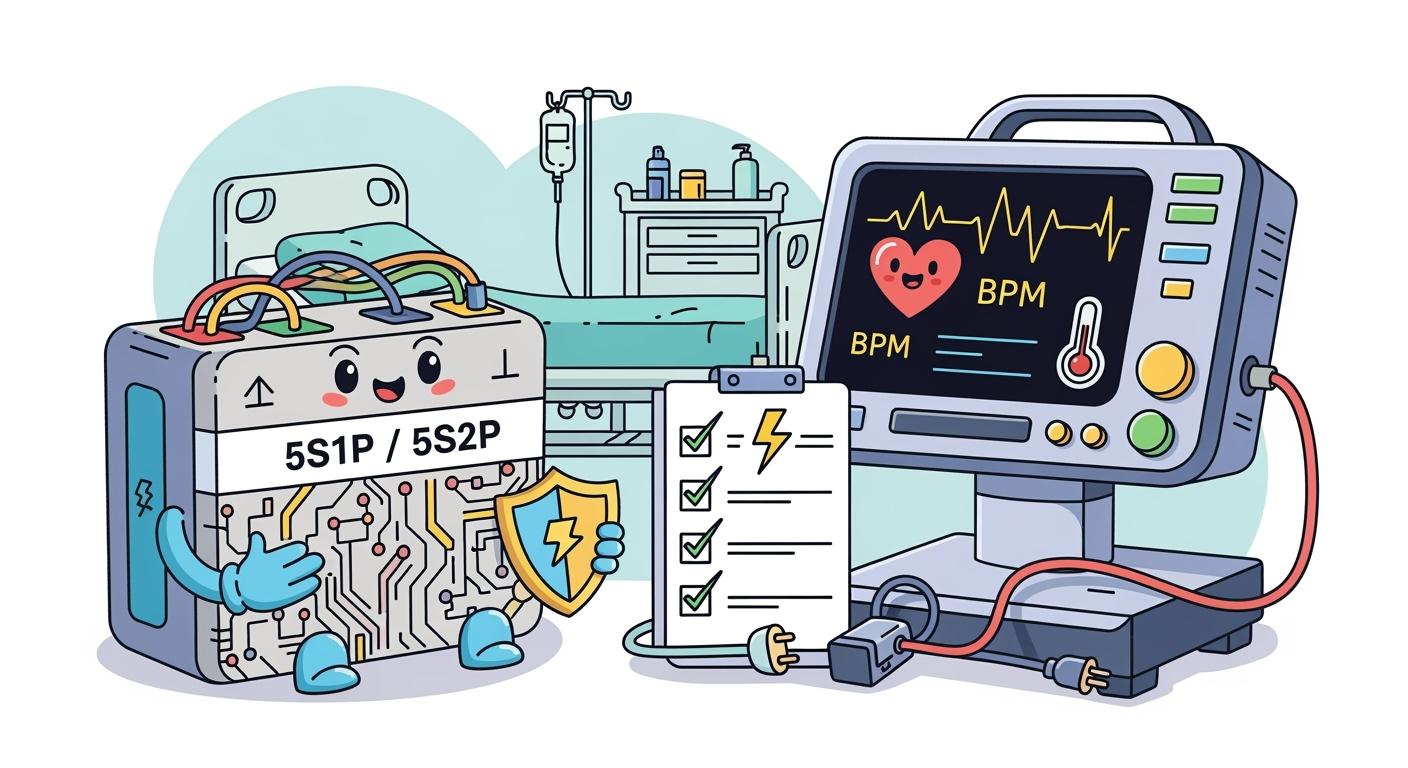
You must understand the 5S1P and 5S2P configurations when addressing battery requirements for ICU monitors. In a 5S1P setup, five cells connect in series, forming a single string. This arrangement delivers a nominal voltage of 18.5V, which matches the platform voltage needed for most ICU monitors. The 5S2P configuration uses two parallel strings of five series-connected cells. This design doubles the capacity while maintaining the same voltage, supporting longer runtimes and higher energy demands.
When you select a lithium-ion battery pack for medical applications, such as ICU monitors, you must prioritize reliability and safety. Learn more about lithium-ion batteries and explore our medical battery solution.
1.2 Key Lithium-Ion Battery Pack Features
Meeting battery requirements for ICU monitors involves more than just voltage and capacity. You must ensure the lithium-ion battery pack includes advanced safety features and meets medical device battery requirements. The following table summarizes essential safety features:
Safety Feature | Description |
|---|---|
Ensures safety requirements for rechargeable lithium-ion batteries in medical devices, addressing hazards like overcharging and thermal runaway. | |
Evolution of Standards | IEC 62133 is replacing UL 1642, indicating an evolution in safety requirements in healthcare. |
You should also look for these critical features in lithium-ion battery packs:
Built-in Battery Management System (BMS) to prevent overcharging, overheating, and short circuits.
Robust BMS to optimize efficiency and extend battery lifespan.
Design that supports regular maintenance and replacement cycles.
To meet medical device battery requirements, you must follow strict maintenance protocols:
Avoid extreme temperatures above 40°C or below 0°C.
Replace the battery every three years or if performance drops.
Charge when the battery reaches 20% and stop at 90%.
Store at 50% charge in a dry environment below 25°C, recharging every three months.
By following these battery requirements, you ensure ICU monitors operate safely and reliably, protecting both patients and equipment.
Part 2: Patient Safety and Risk Management

2.1 ICU Monitor Safety Requirements
You must address safety requirements for lithium battery packs in ICU monitors to protect patient safety and meet stringent safety standards. Learn more about safety requirements for medical devices. ICU environments demand battery safety and reliability because hazards can lead to loss of life support or device failure. You need to follow safety standards such as IEC, FDA, and ISO to ensure compliance. Patient safety depends on your ability to prevent hazards like overheating, leakage, and electrical faults.
You should implement a structured battery management program. This includes inventory control for all battery-powered equipment and safe charging practices in designated areas with proper ventilation. You must establish strict storage and handling protocols, such as temperature control and immediate removal of damaged batteries. Staff education is essential for battery safety, helping your team recognize failure signs and respond to emergencies. Preventive maintenance checks and a strong incident response framework help you document and investigate battery-related hazards.
Risk Type | Hazard Impact | Safety Considerations |
|---|---|---|
Overheating | Device shutdown, fire | Thermal management, BMS |
Leakage | Chemical exposure, burns | Encapsulation, isolation |
Electrical Faults | Loss of life support, shock | Redundancy, fault tolerance |
Tip: Regular training and maintenance reduce risk and improve battery safety in critical care settings.
2.2 Hazard Controls in Battery Design
You must integrate safety into lithium batteries by focusing on hazard controls during battery pack design. Patient safety requires you to use built-in safety features such as Battery Management Systems for monitoring and protection. You should design for redundancy and fault tolerance to minimize risk from single points of failure. Encapsulation and isolation prevent leakage currents and chemical hazards.
You need to consider usability and human factors in battery design to reduce misuse. Lifecycle testing helps you assess hazards and performance over time. Clear labeling and instructions support safe usage and disposal. You should use non-flammable electrolytes and advanced cooling systems to mitigate thermal runaway hazards. Gas sensors and robust monitoring systems provide early warnings, allowing rapid response to hazards.
Integrate pressure relief vents to release gases during thermal runaway.
Use thermal barriers and active cooling to prevent hazard propagation.
Design for field replaceability and traceability to manage hazards efficiently.
You must meet stringent safety standards and requirements to ensure battery safety and patient safety in ICU monitors. Built-in safety features and safety considerations in battery pack design protect against hazards and reduce risk.
Part 3: Design Essentials for Lithium-Ion Battery Packs
3.1 Cell Selection and Chemistry
You must select the right cell chemistry to meet the strict requirements of ICU monitor battery packs. The most suitable lithium-ion chemistries include Nickel Manganese Cobalt (NMC), Lithium Cobalt Oxide (LCO), Lithium Iron Phosphate (LiFePO4), and Lithium Titanate Oxide (LTO). Each chemistry offers unique advantages for medical applications. The table below compares key properties:
Chemistry | Platform Voltage | Energy Density (Wh/kg) | Cycle Life (cycles) | Application Scenario |
|---|---|---|---|---|
NMC | 3.6–3.7 V | 150–220 | 1000–2000 | Medical, robotics, security |
LCO | 3.7 V | 150–200 | 500–1000 | Medical, consumer electronics |
LiFePO4 | 3.2 V | 90–140 | 2000–4000 | Medical, infrastructure |
LTO | 2.4 V | 60–110 | 5000–15000 | Industrial |
You should evaluate cells based on technical specifications, industry compliance, performance, cost-efficiency, quality assurance, integration, and after-sales support. The following table summarizes these criteria:
Criteria | Description |
|---|---|
Technical Specifications | Nominal voltage, capacity, discharge current, charge voltage, and operating temperature range. |
Industry Compliance Requirements | Certifications like UN38.3, IEC 62133, CE, FCC, KC, PSE, and RoHS compliance. |
Performance Metrics | Cycle life, internal resistance, self-discharge rate, and consistency across cells. |
Cost-Efficiency Factors | Consider MOQ, volume discounts, total cost of ownership, and logistics costs. |
Quality Assurance Considerations | Supplier certifications, quality control processes, and track record. |
Integration Capabilities | Compatibility of physical dimensions, weight, connectors, and BMS communication protocols. |
After-Sales Support Evaluation | Warranty terms, technical support availability, and responsiveness for troubleshooting. |
3.2 Series-Parallel Design Considerations
You must design the series-parallel configuration to maximize reliability and safety. Parallel connections increase capacity and improve reliability by distributing the load. If one cell fails in a parallel arrangement, the others continue to provide power. Series connections increase voltage but require careful matching of cells to prevent failures. You should consider these best practices:
Use series connections to achieve higher voltage and reduce wire thickness.
Apply parallel arrangements for redundancy and longer runtimes.
Combine series and parallel (such as 5S2P) to meet voltage and capacity requirements.
Monitor for capacity and resistance differences, as these can impact safety and energy utilization.
Note: Electrical shorts in series configurations can pose fire hazards, so you must implement robust protection.
3.3 Battery Management System Integration
You need to integrate a Battery Management System (BMS) to ensure safety and performance. The BMS balances cells using active or passive methods, monitors voltage, current, and temperature, and provides real-time data on state of health and charge. The table below outlines key BMS functions:
Function | Description |
|---|---|
Lifespan Assurance | Ensures all cells work in harmony, preventing premature aging. |
State Transparency | Provides real-time data on battery state of health and charge. |
Performance Assurance | Monitors and balances cell performance to optimize usage. |
Safety Management | Protects against thermal issues and other hazards. |
Thermal Management | Manages temperature variations to prevent overheating. |
Data Communication | Facilitates data storage and transmission for diagnostics. |
Continuous monitoring and protection circuitry help you meet medical device standards and compliance requirements.
3.4 Thermal Management and Enclosure
You must implement effective thermal management to prevent overheating and ensure compliance with medical device standards. For smaller battery packs, passive air cooling with fins and channels works well. For moderate heat output, forced air cooling with fans is suitable. In high-performance applications, liquid cooling or phase change materials provide stability. The enclosure should include a thermal safety system, such as a bladder structure, that activates automatically at high temperatures. This design adds minimal cost and weight but provides a fail-safe barrier against thermal injury.
Tip: Always verify that your enclosure design meets all relevant standards and certifications for physical and thermal protection.
By following these design essentials, you ensure your lithium-ion battery packs meet the highest standards for safety, reliability, and compliance in ICU monitors.
Part 4: Compliance and Certification Standards
4.1 IEC, ASTM, ANSI/AAMI, UL Standards
You must navigate a complex regulatory landscape when designing lithium battery packs for ICU monitors. Each standard addresses unique aspects of safety, performance, and quality. The table below compares the most relevant standards for medical device battery packs:
Standard | Focus Area | Key Requirements |
|---|---|---|
IEC 60601-1 | Medical electrical equipment | General safety, essential performance, and risk management for medical devices. |
UL 2054 | Household, commercial, and medical batteries | Safety standards for battery packs, including production in UL-certified facilities. |
IEC 62133 | Rechargeable battery safety | Requirements for safe operation, overcharge, and thermal runaway prevention. |
ANSI/AAMI ES 60601-1 | Medical device safety | U.S. adaptation of IEC 60601-1, with additional requirements for the American market. |
ASTM Standards | Testing and performance | Methods for evaluating battery reliability, shock, and vibration resistance. |
You must ensure strict adherence to these regulatory standards. IEC 60601-1 emphasizes general safety and essential performance for medical electrical equipment. UL 2054 focuses on safety for household, commercial, and medical batteries, requiring production in UL-certified facilities. IEC 62133 addresses rechargeable battery safety, while ANSI/AAMI ES 60601-1 adapts IEC 60601-1 for the U.S. market. ASTM standards provide methods for testing reliability, including shock and vibration resistance. You must integrate these requirements into your design and production processes to achieve regulatory compliance.
Note: Regulatory compliance is not optional. You must meet all applicable standards to ensure patient safety and device approval.
4.2 Documentation and Device Approval
You must follow a structured process to achieve regulatory approval for lithium battery packs in ICU monitors. The certification process involves several critical steps:
Select pre-certified components to reduce testing requirements.
Design thermal management systems with safety margins.
Prepare technical documentation that aligns with regulatory standards.
Plan your project to account for certification timelines and costs.
Choose between custom and standard battery packs, as this impacts compliance strategies.
Integrate safety requirements from the start for custom designs.
Develop detailed technical documentation, including mechanical drawings, electrical schematics, and safety protocols.
Complete all required testing, such as UN 38.3, UL 2054, and IEC 62133.
You must document shock and vibration resistance, as these factors are critical for regulatory approval. Proper documentation supports traceability and ongoing quality assurance. Regulatory bodies require you to maintain records of all test results, certifications, and compliance statements.
Tip: You should update your documentation regularly to reflect changes in regulatory requirements and advancements in battery technology.
Recent advancements in lithium-ion battery technology have improved safety features, increased energy density, and enhanced the mobility of medical devices. These improvements support compliance with evolving regulatory standards and help you deliver safer, more reliable solutions for critical care environments.
You ensure patient safety and compliance by integrating robust battery safety mechanisms into medical devices. You must follow strict battery maintenance for all medical devices.
Replace the battery holder in medical devices yearly.
Test battery life in medical devices regularly.
Store medical batteries with fire safety systems.
Use certified battery management systems in medical devices.
Inspect medical device batteries for damage.
Calibrate smart batteries in medical devices.
Educate users on medical battery risks.
Adhere to medical device safety standards.
Prepare emergency medical monitoring supplies.
Choose custom battery solutions for medical devices.
Consult our custom battery solution team for your medical device needs.
FAQ
What makes Large Power batteries suitable for ICU monitors?
Large Power designs batteries for medical use. You get batteries with platform voltage, energy density, and cycle life that meet ICU monitor requirements. Explore our custom battery solution.
How do batteries in 5S1P and 5S2P configurations compare for medical applications?
Configuration | Platform Voltage | Energy Density (Wh/kg) | Cycle Life (cycles) | Application Scenario |
|---|---|---|---|---|
18-18.5V | 150–220 | 1000–2000 | Medical, robotics | |
18-18.5V | 150–220 | 2000–4000 | Medical, security |
You select batteries based on runtime and reliability needs.
What maintenance practices ensure batteries remain safe and compliant in ICU monitors?
You inspect batteries regularly. You replace batteries every three years. You store batteries at 50% charge. You use certified battery management systems. You educate staff about batteries.


