

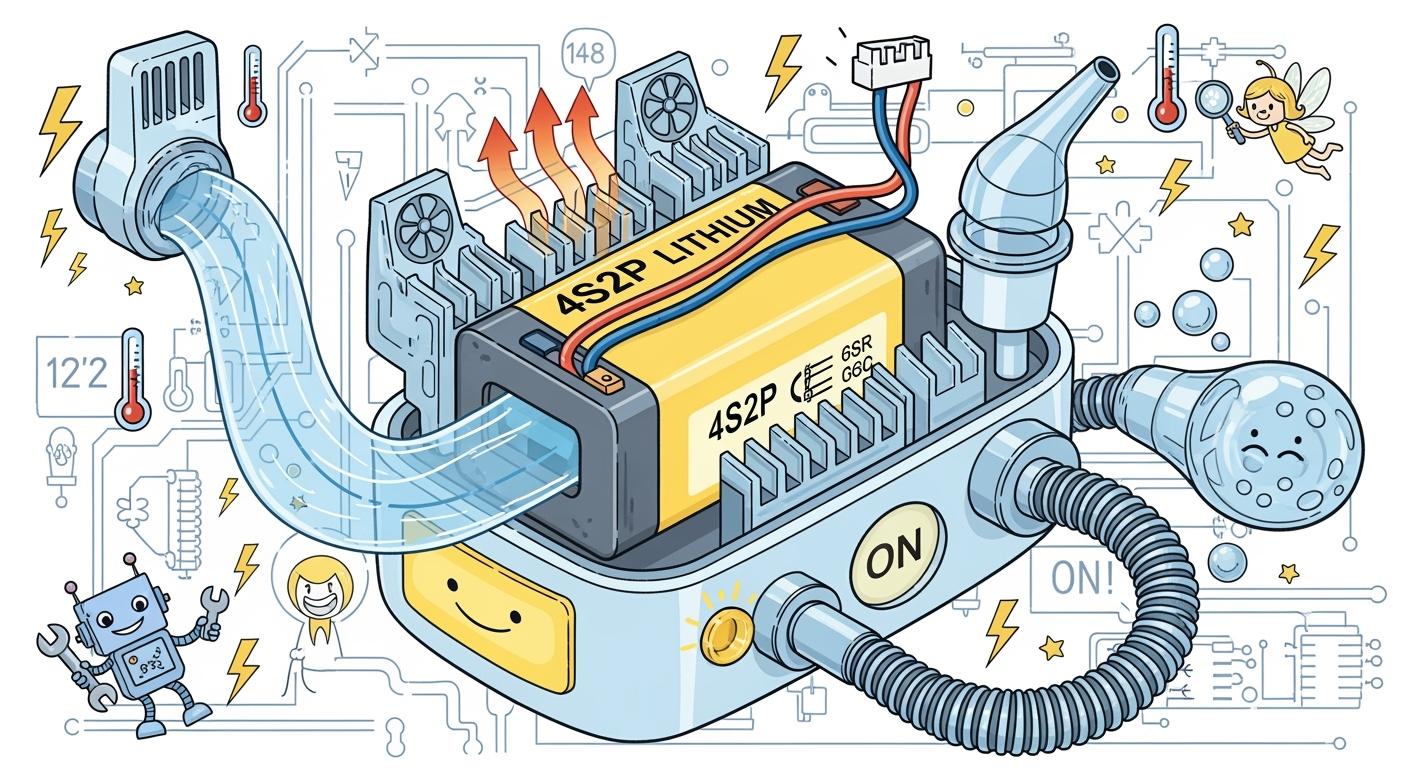
You face critical challenges when managing thermal management for 4S2P lithium ion batteries in medical devices. Poor thermal management can trigger fires, explosions, or rapid performance decay in lithium-ion batteries due to high energy density and fast charging demands.
Batteries often experience:
Thermal runaway from improper charging
Irreversible structural changes after high temperatures
Increased fire incidents with rising energy density
Aspect | Details |
|---|---|
Innovations in Heat Sink Design | Advanced systems improve safety features for batteries in medical devices. |
Safety Standards | Devices must meet IEC 62619 and UL 1973 for battery thermal management and power monitoring. |
Research in battery thermal management shows smart BMS, airflow, and environmental adaptability improve safety, battery life, and power delivery. You must prioritize robust design to support energy storage in portable medical solutions.
Key Takeaways
Prioritize thermal management in 4S2P lithium batteries to prevent overheating and ensure safety in medical devices.
Implement a smart Battery Management System (BMS) for real-time temperature monitoring and automatic shut-off to enhance battery reliability.
Integrate thermal management strategies early in the design process to comply with safety standards and improve device performance.
Part1: Importance of Battery Thermal Management in Medical Devices

1.1 Safety and Reliability of 4S2P Batteries
You must prioritize battery thermal management when designing 4S2P lithium ion batteries for Medical devices. These batteries power continuous oxygen concentrators, where safety and reliability are non-negotiable. High energy density and fast charging increase the risk of overheating, which can lead to thermal runaway or device failure. You need to address these risks by integrating advanced safety features and robust battery management systems.
Temperature management represents one of the most critical challenges in medical BMS applications, leading to reduced capacity, shortened lifespan, and potential safety hazards.
You should evaluate reliability using key metrics:
Metric | Description |
|---|---|
Cycle Life | Number of complete charge and discharge cycles before capacity drops below a set level. |
Depth of Discharge (DoD) | Amount of battery capacity used per cycle, impacting overall lifespan. |
Battery Management System (BMS) | Protects the battery from damage and ensures optimal performance through various protection functions. |
Regulatory standards also guide your design process:
Standard | Description |
|---|---|
IEC 60601-1 | Specifies temperature limits for medical device surfaces, ensuring safety for patients and operators. |
IEC 62133 | Outlines safety requirements for batteries, including measures to prevent thermal runaway. |
1.2 Performance and Longevity in Medical Applications
You rely on polymer lithium ion batteries to deliver consistent power and reliable performance in portable devices. Effective thermal management helps maintain optimal operating temperatures, prevents thermal runaway, and enhances battery safety and energy efficiency. Passive strategies, such as thermal insulation and phase change materials, manage heat during operation. Active thermal management systems provide precise temperature control, which is vital for high-demand medical devices.
Medical devices require battery thermal management systems that prioritize reliability and safety. Unlike consumer electronics, failures in these devices can lead to life-threatening situations. You must design for varying environmental conditions, using thermal insulation, phase change materials, and thermally conductive paths to manage heat. In portable medical devices, you balance miniaturization, battery life, and safety, focusing on maintaining optimal temperatures during operation.
You must also consider practical steps:
Store batteries in temperature-controlled environments to prevent overheating.
Avoid covering air intakes and outlets to ensure proper airflow.
Keep devices at least 3 inches from walls for ventilation.
By focusing on these strategies, you support energy storage needs and extend battery life, ensuring your technology meets the demands of modern medical applications.
Part2: Design Strategies for Thermal Management in 4S2P Batteries
2.1 Smart BMS and Cell Balancing
You must equip your polymer lithium ion batteries with a smart Battery Management System (BMS) to achieve precise thermal management. A smart BMS monitors and controls the temperature of each cell, which is critical for safety in medical devices. The most effective BMS features for 4S2P batteries include:
Feature | Description |
|---|---|
Thermal Management Controls | Regulate current flow to prevent overheating during discharge, keeping temperatures below 45°C in high-power applications. |
Real-time Temperature Monitoring | Use precision sensors to maintain battery cells within 0°C to 45°C. If temperatures exceed 60°C, the BMS can shut down the system or activate cooling. |
Safety Alerts | Provide immediate warnings to prevent overheating and ensure safe operation. |
You should also focus on cell balancing to improve thermal stability in your battery packs. Cell balancing ensures that all cells in your 4S2P configuration maintain uniform voltage, which reduces the risk of localized overheating. The BMS integrates both passive and active balancing methods:
Passive balancing dissipates excess charge as heat, which helps manage temperature in lower-power applications.
Active balancing redistributes energy from higher-voltage cells to lower-voltage cells, which is especially useful in high-capacity systems.
By implementing these features, you can extend battery life, maintain consistent power delivery, and reduce the risk of thermal runaway in your polymer lithium ion batteries.
2.2 Integration with Medical Device Architecture
You must integrate thermal management strategies early in the design process for medical devices. Early integration allows you to select the best materials and align your thermal management approach with manufacturing processes. This ensures that your batteries operate safely and efficiently in portable devices.
Consider these best practices for integration:
Choose materials that optimize thermal performance and support the compact design of medical devices.
Use layered heater technologies for precise temperature control and rapid response.
Integrate temperature sensors to enhance accuracy in thermal regulation.
Select high-efficiency, ultra-thin heaters to support miniaturization and energy efficiency.
Pay attention to component placement and spacing to improve thermal distribution.
Design efficient thermal pathways for effective heat transfer.
Ensure proper thermal interface design for consistent performance.
You must also address constraints unique to medical device architecture:
Regulatory compliance is complex due to standards like IEC 60601-1, which sets strict temperature limits for device surfaces.
Operational scenarios require your batteries to perform in environments with ambient temperatures from 0°C to 40°C.
Effective heat dissipation is essential during charging and discharging cycles to keep battery temperatures within the optimal range of 15-35°C.
Temperature management becomes even more challenging in portable polymer lithium ion batteries because internal heat generation can vary with usage. Traditional solutions may not maintain optimal performance across all temperature ranges, so you need advanced strategies to prevent hotspots and ensure reliability.
2.5 Common Pitfalls in Battery Thermal Design
You must avoid several common pitfalls when designing thermal management systems for polymer lithium ion batteries in medical devices. Inadequate thermal management can cause overheating, device failure, and even patient harm. Failing to comply with regulatory standards can introduce safety hazards and delay product approval.
Some frequent mistakes include:
Underestimating the importance of uniform temperature distribution across all battery cells.
Neglecting the impact of heat sink design, which can lead to localized overheating.
Overlooking the need for biocompatibility and sterilization, which can affect both safety and device effectiveness.
Delaying thermal management considerations until late in the design process, which limits your options and increases costs.
You should always prioritize effective thermal management systems to maintain optimal operating temperatures. These systems prevent overheating and ensure uniform temperature distribution, which is critical for device reliability and safety. Every design decision, from material selection to component placement, impacts both performance and compliance with safety regulations. Address thermal management early to avoid costly redesigns and ensure your polymer lithium ion batteries deliver safe, reliable power in portable medical devices.
You can achieve safe, reliable performance in medical devices by following key steps for thermal management in polymer lithium ion batteries.
Use smart BMS with real-time temperature monitoring and automatic shut-off.
Optimize airflow and ensure uniform temperature across batteries.
Select robust designs that meet regulatory standards and extend device lifespan.
FAQ
What makes thermal management critical for batteries in medical devices?
You must manage batteries carefully in medical devices. Proper thermal management prevents overheating, extends battery life, and ensures safe operation for patients and healthcare professionals.
How do you select the right batteries for continuous oxygen concentrators?
You should choose batteries with high energy density, reliable thermal management, and compliance with medical standards. Consult Large Power for expert guidance on custom battery solutions.
Where can you get technical support for batteries in medical applications?
You can contact Large Power for consultation. Their team provides technical support and custom solutions for batteries used in medical, robotics, and industrial applications.


