

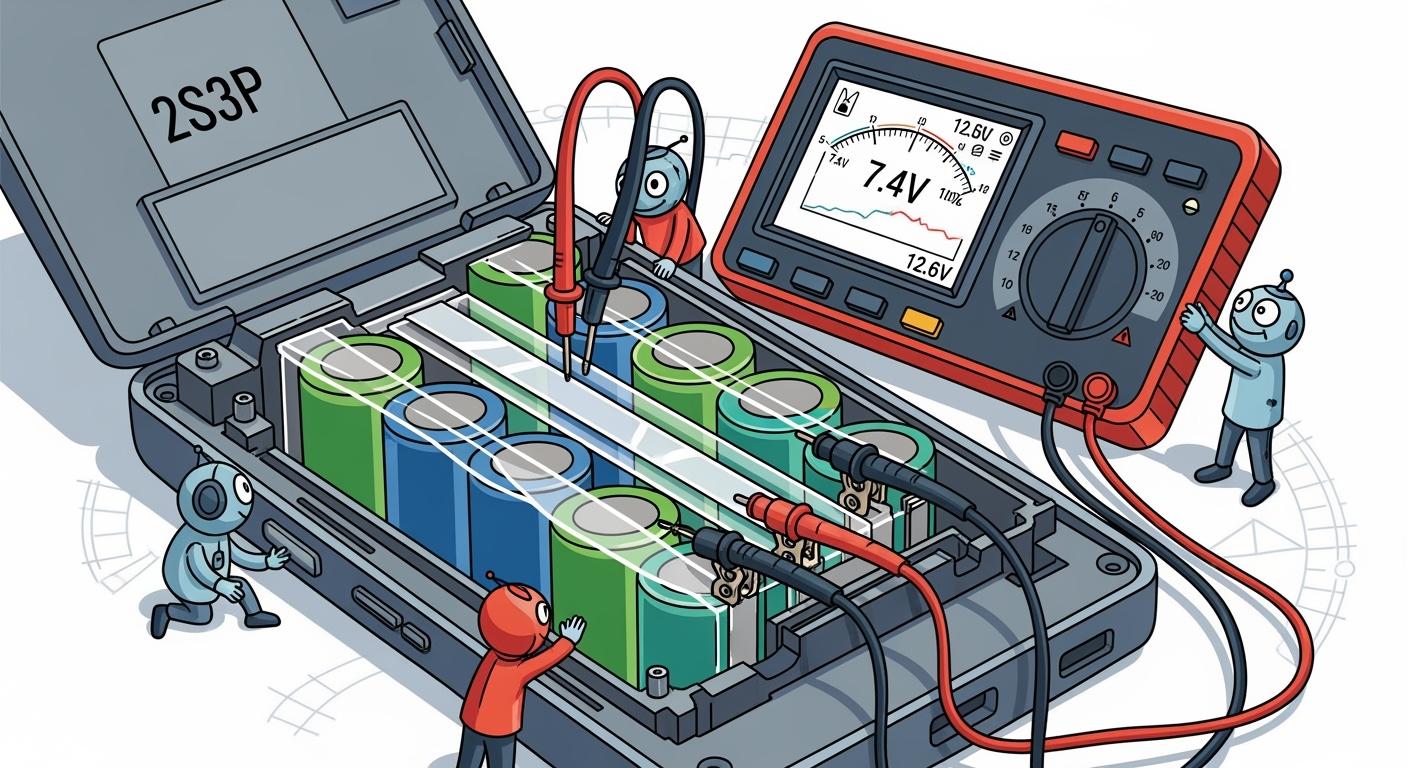
You want to maximize performance and reliability in portable multi-parameter testers. The 2S3P configuration helps you address impedance analysis and cell variation challenges by using advanced diagnostics. Electrochemical impedance spectroscopy (EIS) captures both electronic and ionic processes, allowing you to assess cell quality and safety. Battery management systems (BMS) enable rapid EIS testing, minimizing risks from underperforming cells. You can follow best practices for Li-ion Pack Strategies to ensure consistent measurements and interpret data accurately.
EIS provides a comprehensive view of battery health.
BMS supports real-time monitoring for safer operation.
EIS uses a non-destructive approach for battery assessment.
Experts recommend reproducible EIS measurements for reliable results.
Key Takeaways
The 2S3P configuration balances voltage and capacity, ensuring reliable power for portable testers.
Electrochemical impedance spectroscopy (EIS) allows for non-destructive battery health assessments, helping to identify weak cells early.
Real-time monitoring with a battery management system (BMS) enhances safety by tracking cell performance and preventing failures.
Maintaining charge levels between 20% and 80% extends battery life and improves reliability in demanding applications.
Automated monitoring and active balancing are key strategies to catch issues early and ensure consistent performance.
Part 1: 2S3P Configuration

1.1 Why 2S3P for Portable Testers
You need a battery pack that delivers reliable power for portable multi-parameter testers. The 2S3P configuration stands out because it balances voltage, capacity, and power delivery. You can see the technical advantages in the table below:
Feature | Description |
|---|---|
Voltage Output | Provides sufficient voltage (7.4V) for low-voltage DC motors and controllers. |
Amp-Hour Capacity | Parallel arrangement increases capacity, supporting longer operation times. |
Power Delivery | Balances voltage and energy storage for sustained power needs. |
You benefit from a stable voltage platform, which supports sensitive electronics in medical, robotics, and security devices. The parallel cells extend runtime, so you avoid frequent charging interruptions. You also gain consistent power delivery, which is essential for infrastructure and industrial testers that require steady performance.
Tip: Choose 2S3P when you want to maximize uptime and ensure your device operates safely in demanding environments.
1.2 Benefits for Impedance and Cell Monitoring
You gain several advantages when you use 2S3P for impedance analysis and cell monitoring. This configuration offers maximum design flexibility. Paralleling the cells helps you manage voltage effectively. You can monitor each cell in real time, which improves safety and reliability.
The 2S3P configuration offers maximum design flexibility.
Paralleling the cells aids in effective voltage management.
You also protect your pack with a battery management system. The BMS prevents overcharging and overdischarging. It protects against short circuits and limits maximum charge and discharge current. These features support Li-ion Pack Strategies that extend battery life and reduce maintenance.
The BMS prevents overcharging and overdischarging.
It protects against short circuits and limits maximum charge and discharge current.
You can apply these benefits across medical, consumer electronics, and industrial testers. You ensure accurate impedance analysis and cell monitoring, which helps you maintain device reliability and safety.
Part 2: Impedance Analysis
2.1 EIS and Impedance Measurement in 2S3P
You use electrochemical impedance spectroscopy (EIS) to analyze the health of your 2S3P Li-ion battery pack. EIS helps you detect changes in resistance and reactance inside each cell. You can spot early signs of cell degradation or imbalance. This method gives you real-time data, so you make quick decisions about maintenance or replacement.
You connect your EIS equipment to the battery terminals. You apply a small AC signal and measure the response. You see how each cell reacts to the signal. You identify weak cells before they cause problems. You improve safety and reliability in your portable tester.
Note: You can integrate EIS with your battery management system (BMS). For more information about BMS, visit BMS and PCM.
You compare different battery chemistries to choose the best option for your application. The table below shows key data for LiFePO4, NMC, LCO, and LMO cells. You see differences in platform voltage, energy density, and cycle life.
Chemistry | Platform Voltage | Energy Density (Wh/kg) | Cycle Life (cycles) |
|---|---|---|---|
LiFePO4 | 3.2 V | 90-120 | 2000+ |
NMC | 3.7 V | 150-220 | 1000-2000 |
LCO | 3.7 V | 150-200 | 500-1000 |
LMO | 3.7 V | 100-150 | 700-1500 |
You select the chemistry that matches your needs for medical, robotics, security, infrastructure, consumer electronics, or industrial testers. You use EIS to monitor impedance and ensure your pack stays within safe limits.
2.2 Simulation and Practical Strategies
You simulate impedance response before you build your pack. You use software tools to model how each cell will behave in a 2S3P configuration. You predict voltage drops and resistance changes. You adjust your design to avoid weak spots.
You follow these practical steps for impedance measurement:
Set up your EIS equipment with clear connections to each cell.
Run tests at different frequencies to capture both high-frequency and low-frequency responses.
Record the impedance data for each cell and compare it to baseline values.
Use your BMS to track real-time changes and alert you to abnormal readings.
You apply Li-ion Pack Strategies to improve measurement accuracy. You keep your pack balanced and protected. You monitor temperature and charge levels. You use these strategies to extend battery life and reduce downtime.
Tip: You can automate impedance analysis with your BMS. This saves time and helps you catch problems early.
You use impedance analysis to optimize your pack for demanding environments. You ensure your portable tester delivers reliable performance. You reduce risks and improve safety with real-time monitoring.
You use simulation results to guide your design. You apply Li-ion Pack Strategies to maintain consistent impedance and protect your pack from failure.
Part 3: Cell Variation Monitoring
3.1 Real-Time Data with BMS
You need to monitor cell variation in your 2S3P Li-ion battery pack to maintain reliability and safety. Battery management systems (BMS) give you real-time data that helps you detect issues before they affect your portable tester. You can track individual cell voltages, pack current, and temperature with high precision. These parameters show you how each cell performs under load and during charging.
Parameter | Description |
|---|---|
Cell Voltage | Monitors the voltage of individual cells with high accuracy (4 mV typical). |
Pack Current | Measures the current flowing through the battery pack with low input offset error. |
Temperature | Supports temperature sensing using an internal sensor and external thermistor. |
You use this data to spot abnormal cell behavior. If you see a cell voltage drop or a temperature spike, you can act quickly. You prevent failures and extend battery life. You also improve device uptime in medical, robotics, and industrial testers.
Li-ion Pack Strategies recommend using BMS for continuous monitoring. You gain confidence that your pack operates within safe limits. You reduce maintenance costs and avoid unexpected downtime.
3.2 Monitoring Tools and Techniques
You have several tools and techniques to monitor cell variation in real time. You can use digital voltmeters, thermal sensors, and specialized software. These tools help you collect and analyze data from each cell in your 2S3P pack.
Digital voltmeters measure cell voltage with high accuracy.
Thermal sensors track temperature changes and alert you to overheating.
Software platforms visualize data trends and highlight anomalies.
You can set up automated monitoring routines. You configure your system to record voltage, current, and temperature at regular intervals. You use this information to compare cell performance and identify weak cells early.
Note: Automated monitoring improves safety and reduces manual inspection time.
Li-ion Pack Strategies encourage you to combine hardware and software tools. You create a robust monitoring system that adapts to different industry needs. You support applications in security, infrastructure, and consumer electronics by ensuring consistent battery performance.
You can also use code to automate data collection and analysis. For example:
# Example: Logging cell voltage and temperature in a 2S3P pack
cell_voltages = [4.12, 4.10, 4.09]
cell_temperatures = [32.5, 33.0, 31.8]
for i in range(len(cell_voltages)):
    print(f"Cell {i+1}: Voltage = {cell_voltages[i]} V, Temperature = {cell_temperatures[i]} °C")
You use these techniques to maintain high standards in battery management. You ensure your portable tester delivers reliable results in demanding environments.
Part 4: Li-ion Pack Strategies for Management
4.1 Balancing and Protection
You need to manage balancing and protection in your 2S3P Li-ion battery pack to prevent failures and extend service life. Balancing ensures that each cell in the pack maintains similar voltage and charge levels. You use a battery management system (BMS) to monitor and correct imbalances. Protection strategies help you avoid dangerous situations like thermal runaway and overcharge.
Thermal runaway can occur in 2S3P battery modules because energy transfers between parallel submodules.
Propagation of thermal runaway may affect adjacent batteries in series, even without direct heat transfer.
Voltage imbalances between parallel submodules can cause spontaneous overcharge, increasing the risk of thermal runaway.
The severity of these effects depends on the voltage differences between neighboring batteries.
You reduce these risks by using active balancing circuits and robust protection features in your BMS. You monitor voltage differences and temperature in real time. You set thresholds for safe operation and trigger alerts or shutdowns when needed. These Li-ion Pack Strategies help you maintain reliability in medical, robotics, security, infrastructure, consumer electronics, and industrial testers.
Tip: Always check for voltage imbalances and temperature spikes during routine maintenance.
4.2 Charge Range and Temperature Control
You improve battery longevity by keeping the charge between 20% and 80%. Discharging below 20% or charging above 80% shortens the cycle life of your pack. You set charge limits in your BMS to protect the cells. You also monitor temperature closely. High temperatures accelerate cell aging and increase the risk of failure.
Parameter | Recommended Range | Impact on Battery Life |
|---|---|---|
Charge Level | 20% – 80% | Extends cycle life, improves reliability |
Operating Temp | 15°C – 35°C | Reduces aging, prevents failures |
You use thermal sensors and cooling solutions to keep your pack within the safe temperature range. You log temperature data and adjust charging rates if the pack gets too warm. These Li-ion Pack Strategies help you avoid downtime and maintain consistent performance.
Note: Maintaining proper charge and temperature control is essential for maximizing battery life and safety.
You apply these management strategies to ensure your portable tester operates safely and efficiently in demanding environments.
Part 5: Applications and Insights
5.1 Case Studies in Portable Testers
You see the impact of 2S3P Li-ion pack strategies across many industries. In medical devices, you rely on stable voltage and real-time monitoring to ensure patient safety. Robotics teams use 2S3P packs for consistent power during complex maneuvers. Security systems benefit from extended runtime and quick detection of cell imbalances. Infrastructure testers need reliable energy delivery for field diagnostics. Consumer electronics and industrial testers require accurate impedance analysis to maintain performance.
A recent study shows that cell-to-cell variations, often caused by manufacturing tolerances, can reduce battery performance. Packs with cross-connections tend to deliver less energy than string-connected designs. When the standard deviation of cell parameters increases, you notice a drop in energy output. String-connected packs perform better in these situations, especially when you need consistent results in demanding environments.
Sector | Key Benefit of 2S3P Strategy | Typical Application Example |
|---|---|---|
Medical | Stable voltage, safety monitoring | Portable ECG, infusion pumps |
Robotics | Consistent power, cell balancing | Mobile robots, drones |
Security | Extended runtime, quick fault detection | Surveillance, access control |
Infrastructure | Reliable energy, field diagnostics | Power grid testers, analyzers |
Consumer Electronics | Accurate impedance, long battery life | Handheld meters, smart devices |
Industrial | Real-time monitoring, robust design | Process testers, automation tools |
5.2 Lessons and Recommendations
You learn several important lessons from advanced Li-ion pack strategies:
Robust testing ensures the safety and reliability of your battery packs.
Effective battery management systems help you monitor and control performance.
Understanding failure modes lets you reduce risks like thermal runaway.
Common issues include balancing difficulties, wiring challenges, and system monitoring. You can address these with clear steps:
Inspect all wiring for secure, insulated, and labeled connections.
Use a multimeter to check continuity and correct polarity.
Pre-balance each 2S pack before paralleling.
Install dedicated BMS units for each 2S pack.
Use terminal blocks or bus bars to manage large cables.
Add battery monitors to track performance and detect early issues.
Include resettable breakers and fuses for safety.
Perform regular maintenance to check for corrosion or overheating.
Looking ahead, you will see more online algorithms that evaluate cell variation as batteries age. Advanced calibration models will compensate for temperature and resistance changes. AI-driven algorithms will analyze large datasets, helping you optimize battery performance and enable remote monitoring through IoT-enabled testers.
Tip: Regular maintenance and smart monitoring keep your 2S3P Li-ion packs safe and reliable in every application.
You can optimize 2S3P Li-ion packs by using real-time impedance analysis, monitoring cell variation, and applying advanced management strategies. These methods help you boost reliability, improve safety, and extend battery life in your portable testers.
Tip: Set up automated monitoring and active balancing to catch issues early and keep your devices running smoothly. Always follow best practices for charge range and temperature control.
FAQ
What makes the 2S3P configuration ideal for portable testers?
You get balanced voltage and extended runtime. The 2S3P setup supports sensitive electronics in medical, robotics, and industrial testers. Parallel cells increase capacity, while series connections provide stable voltage. Contact Large Power for your portable tester battery design.
How does EIS improve battery pack reliability?
EIS lets you detect cell degradation early. You measure impedance in real time and spot weak cells before they fail. This method helps you maintain safe operation in security and infrastructure devices.
Which Li-ion chemistries suit portable testers best?
Chemistry | Platform Voltage | Energy Density (Wh/kg) | Cycle Life (cycles) |
|---|---|---|---|
LiFePO4 | 3.2 V | 90-120 | 2000+ |
NMC | 3.7 V | 150-220 | 1000-2000 |
LCO | 3.7 V | 150-200 | 500-1000 |
LMO | 3.7 V | 100-150 | 700-1500 |
You select chemistry based on your application’s need for voltage, energy, and cycle life.
How do you monitor cell variation in real time?
You use a battery management system (BMS) to track voltage, current, and temperature. Automated alerts help you catch abnormal cell behavior quickly. This approach keeps your pack safe in consumer electronics and industrial testers.
What are the best practices for battery pack management?
You keep charge levels between 20% and 80%. You monitor temperature and use active balancing. These steps extend battery life and improve reliability in medical and robotics applications.


