

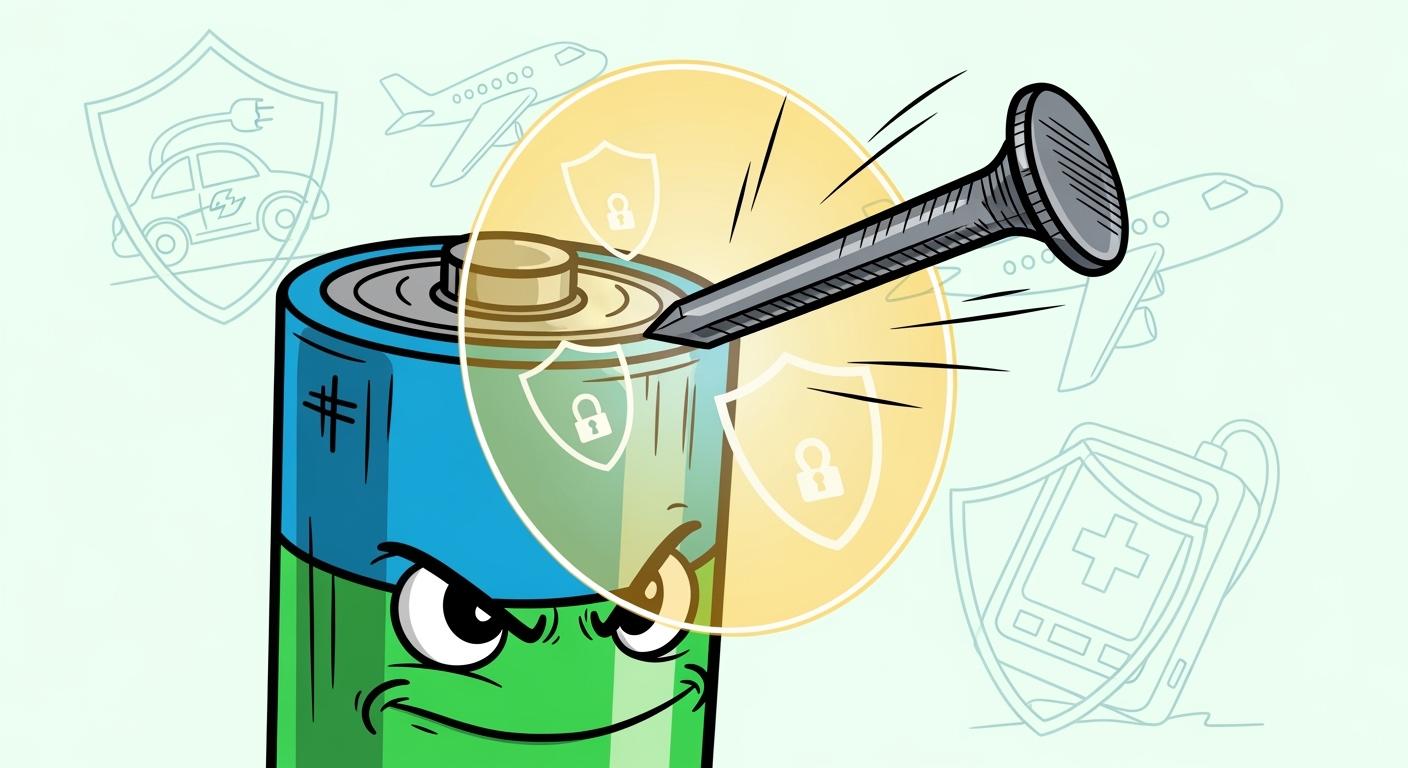
You see growing demand for reliable energy in industrial sectors like power inspection and testing. Recent fires caused by lithium-ion battery failures show how much risk appears when energy management goes wrong. You need to meet strict safety regulations and keep operations running without interruption. Nail penetration resistant lithium batteries offer stronger protection for demanding energy storage applications. Companies now rely on better safety testing to reduce the risks that come with high-energy lithium-ion battery packs.
Key Takeaways
Nail penetration resistant lithium batteries enhance safety by preventing fires and explosions during mechanical abuse, making them ideal for critical applications.
Understanding battery chemistry is crucial; LiFePO4 and advanced solid-state NMC cells offer the best safety profiles against nail penetration risks.
Regular testing using the nail penetration method helps ensure battery reliability and compliance with safety standards, protecting personnel and assets.
Adopting these batteries can lead to improved energy density and longer cycle life, which are essential for sectors like medical, automotive, and aerospace.
Stay informed about evolving safety standards and testing methods to ensure your energy storage solutions meet the highest safety expectations.
Part1: Battery Safety Risks
1.1 Traditional Lithium Battery Hazards
You rely on lithium ion battery packs for critical applications in medical devices, robotics, security systems, infrastructure, and industrial equipment. These batteries deliver high energy, but they also introduce significant risks. Different chemistries, such as LiFePO4, NMC, LCO, and LMO, each have unique safety profiles. NMC cells, for example, show higher thermal instability under extreme conditions. You must understand these risks to protect your operations and personnel.
Fires from lithium ion battery packs burn extremely hot and can be difficult to extinguish. Smoke and vent-gases from battery fires pose inhalation hazards. Overcharging or overheating can cause dangerous incidents, including chemical exposure from volatile electrolytes. Ejection of batteries during incidents can spread fire or trigger secondary ignitions.
Here is a comparison of common lithium battery chemistries used in safety-critical sectors:
Chemistry | Typical Applications | Safety Profile |
|---|---|---|
LiFePO4 | Medical, Industrial, Security | Stable, lower fire risk |
NMC | Automotive, Robotics | Higher energy, more unstable |
LCO | Consumer Electronics | Moderate risk |
LMO | Infrastructure, Industrial | Lower energy, moderate risk |
You see real-world incidents that highlight these hazards:
A semi-trailer truck carrying lithium ion battery packs crashed and caught fire.
A fire broke out at the Fenix battery recycling plant.
A lithium ion battery container exploded, injuring firefighters and closing a highway.
A tractor trailer with 5900 lbs of lithium ion batteries caught fire, leading to evacuation.
22 workers died and 8 were injured in a fire caused by lithium batteries.
A battery fire at an engineering center caused €700,000 in damages.
1.2 Nail Penetration Test Failures
You need to assess battery safety using rigorous methods. The nail penetration test simulates a cell failure caused by a rogue metal particle entering the cell during production. This particle creates an internal short circuit between the anode and cathode, leading to thermal runaway. The metal nail causes a short circuit between active layers, resulting in rapid electrical heating. You find that the nail penetration test is one of the most severe abuse tests for lithium ion battery packs. Thermal runaway propagation is highest during this test. However, achieving repeatable results remains difficult. You must consider these challenges when evaluating battery safety for high energy applications.
Part2: Nail Penetration Resistant Lithium Batteries Overview

2.1 What Is Nail Penetration Resistance
You need to understand nail penetration resistance when you evaluate lithium ion battery packs for safety-critical applications. Nail penetration resistance describes a battery’s ability to withstand mechanical abuse, such as a steel nail piercing the cell, without causing fire, smoke, or explosion. This feature is essential for maintaining safety in environments where accidental damage can occur.
You see that industry standards define nail penetration resistance using strict parameters. The test uses a high-temperature resistant steel needle with a diameter between 5 and 8 mm and a tip angle of 60 degrees. The needle penetrates the battery at a speed of 25 ± 5 mm/s, targeting the geometric center of the cell. You consider a battery to have passed the test if it does not catch fire, smoke, or explode. The table below summarizes these parameters:
Parameter | Description |
|---|---|
Needle Diameter | φ 5~ φ 8 mm high-temperature resistant steel needle |
Needle Tip Angle | 60 ° |
Insertion Speed | (25 ± 5) mm/s |
Penetration Position | Close to the geometric center of the battery’s nail penetration surface |
Test Outcome | Battery passes if it does not catch fire, smoke, or explode after the test |
Factors Studied | Nail penetration rate, position, state of charge, battery capacity, etc. |
You rely on advanced materials and design features to achieve nail penetration resistance. The separator inside lithium ion batteries plays a critical role. It must conduct ions efficiently while blocking electron flow, which ensures both safety and performance. You look for separators with low resistance, uniform pore structure, and strong oxidation resistance. The separator’s ability to shut down during rapid internal increases caused by nail penetration helps prevent thermal runaway. You also need separators that block lithium-metal dendrites, which can cause internal shorts. These features improve reliability and safety in high energy density battery packs.
2.2 Importance for Safety-Critical Applications
You recognize that nail penetration resistant lithium batteries deliver critical safety advantages in sectors where reliability matters most. Medical devices, automotive systems, and aerospace equipment depend on stable energy storage. You cannot afford failures that risk lives or disrupt essential operations.
You see that nail penetration resistance is especially important in applications with high energy density requirements. Medical devices often operate in unpredictable environments. Automotive batteries face mechanical shocks and collisions. Aerospace systems demand consistent performance under extreme conditions. Nail penetration resistant lithium batteries help you meet these challenges by reducing the risk of fire and thermal runaway.
You observe documented safety improvements in industries that have adopted nail penetration resistant lithium batteries:
ALD cells show resilience in standard safety tests, including nail penetration, which simulates internal short circuits in fully charged cells.
Improved heat dissipation after penetration is safer than localized heating.
Lower reactivity during thermal runaway and overvoltage testing means enhanced safety during extreme conditions.
Consistent performance across multiple cells demonstrates reliability in safety measures.
Picoshield materials reduce the likelihood of thermal events during catastrophic failures.
You benefit from these improvements because they protect your personnel, assets, and reputation. You also gain confidence in the energy density and reliability of your lithium ion battery packs. Nail penetration resistance supports your compliance with safety standards and helps you maintain uninterrupted operations in demanding environments.
You see that nail penetration resistant lithium batteries are not just a technical upgrade. They represent a shift toward safer, more reliable energy solutions for industries where every decision impacts safety and performance.
Part3: Testing Standards and Advances
3.1 Nail Penetration Test Methods
You rely on the nail penetration test as a core part of safety testing for lithium battery packs. This test helps you understand how a battery responds to severe mechanical abuse, which can happen during transport, installation, or operation. The nail penetration test simulates a sharp object piercing the cell, triggering an internal short circuit. You use this method to evaluate the risk of fire, smoke, or explosion when energy is released suddenly inside the battery.
You follow strict parameters to ensure accurate testing validation. The table below outlines the main factors you consider during the nail penetration safety test:
Parameter | Description |
|---|---|
Needle Diameter | φ 5~ φ 8 mm high-temperature resistant steel needle |
Needle Tip Angle | 60 ° |
Insertion Speed | (25 ± 5) mm/s |
Penetration Direction | Perpendicular to the battery electrode plate |
Penetration Position | Close to the geometric center of the nail penetration surface |
Short Circuit Observation | The internal short circuit should be artificially triggered and observed for a period of time. |
Test Outcome | The battery passes if it does not catch fire, smoke, or explode; otherwise, it fails. |
Factors Studied | Nail penetration rate, nail penetration position, state of charge, battery capacity, etc. |
You see that advanced lithium battery designs, such as those using solid-state electrolytes, show much lower hazard levels in this test compared to traditional lithium-ion cells. The table below compares the results:
Battery Type | Nail Penetration Test Result | Hazard Level | Thermal Runaway Risk |
|---|---|---|---|
Advanced Lithium (QuantumScape) | Induces internal short-circuit without thermal runaway | 2 | Low |
Traditional Lithium-ion | Susceptible to catastrophic failure | High | High |
You use these results to guide your selection of battery packs for high energy applications. You know that passing the nail penetration test is a strong indicator of improved safety.
3.2 Evolution of Testing Standards
You have seen significant changes in safety standards for lithium battery packs. Early nail penetration tests used 3mm nails, but you now follow updated guidelines that require 5mm to 8mm nails. This shift reflects the need for more rigorous safety testing as energy density increases in modern battery chemistries like NMC and LCO.
You recognize that standardized methodologies help you compare results across different battery types and manufacturers. Consistent test parameters ensure that you can trust the outcomes of safety testing. You also see industry groups and regulatory bodies pushing for harmonized safety standards worldwide. This movement supports your efforts to validate battery safety and meet strict compliance requirements.
Tip: Always check that your battery supplier follows the latest safety standards and provides clear documentation of testing validation.
You understand that advances in nail penetration test methods and evolving safety standards play a key role in protecting your operations, assets, and personnel. You stay informed about these changes to ensure your energy storage solutions meet the highest safety expectations.
Part4: Technology Behind Nail Penetration Resistant Lithium Batteries

4.1 Solid-State and Multi-Layer Barriers
You see a major shift in lithium battery technology with the rise of solid-state battery designs. These batteries replace the traditional liquid electrolyte with a solid material. This change brings a new level of safety to your energy storage systems. Solid-state electrolytes act as both a conductor for ions and a physical barrier. You gain better control over power flow and reduce the risk of internal short circuit events.
Solid-state battery packs use advanced materials that do not burn or release flammable gases. You can see the safety advantages in the table below:
Safety Mechanism | Description |
|---|---|
Localized Heat Confinement | Heat generation is restricted to a small radius (2-5mm) around the nail entry point. |
Non-Flammable Solid Electrolyte | The solid electrolyte does not provide an ignition source, even at high temperatures. |
Zero Gas Generation | No flammable gases are produced, preventing pressure buildup and explosion risks. |
Controlled Short Circuit | The high impedance of the solid electrolyte limits the short circuit current to safe levels. |
Thermal Barrier | Acts as a thermal insulator, preventing heat from spreading beyond the localized area. |
No Oxygen Release | Stable interfaces prevent decomposition reactions that could lead to fire or thermal runaway. |
You benefit from these features because they keep the energy confined and prevent dangerous reactions. Multi-layer safety barriers add another layer of protection. These barriers use several thin films or coatings inside the cell. Each layer blocks heat, stops dendrite growth, and prevents the spread of an internal short circuit. You can trust these barriers to protect your lithium ion battery packs during mechanical abuse, such as nail penetration.
You also notice that solid-state battery packs support higher energy density and longer cycle life. You can store more power in the same space and use the battery for more charging cycles. This improvement helps you meet the demands of fast charging infrastructure and high-power applications. You see that multi-layer safety barriers and solid-state electrolytes work together to deliver both safety and performance.
4.2 Mitigating Thermal Runaway
You know that thermal runaway is the most serious risk in high-energy lithium battery packs. This event happens when heat from an internal short circuit triggers a chain reaction. The temperature rises quickly, and the battery can catch fire or explode. You need to prevent this at all costs.
Solid-state battery technology gives you powerful tools to stop thermal runaway. The solid electrolyte does not burn, even at high temperatures. You do not see any flammable gas generation, which means no pressure buildup or explosion risk. The high impedance of the solid electrolyte keeps the short circuit current low. This control stops the battery from releasing too much power at once.
You also see that multi-layer safety barriers act as thermal insulators. They keep the heat from spreading beyond the nail entry point. This localized heat confinement means that only a small part of the cell gets hot. The rest of the battery stays safe and continues to deliver power. You do not have to worry about fire spreading through the entire pack.
Here are the main ways these technologies reduce fire risk:
Localized heat confinement keeps damage small and controlled.
Non-flammable solid electrolyte removes ignition sources.
Zero gas generation means no explosions.
Controlled short circuit limits power release.
Thermal barriers stop heat from spreading.
No oxygen release prevents dangerous chemical reactions.
You can rely on these features to protect your energy storage systems in safety-critical environments. You also get longer cycle life and better charging capability. Your battery packs can handle more charging cycles without losing power or safety. This reliability is key for sectors that need high energy density and consistent power output.
You see that nail penetration resistant lithium batteries set a new standard for safety. You can use them in medical, automotive, and aerospace applications with confidence. You get the energy, power, and cycle life you need, while reducing the risk of thermal runaway and internal short circuit failures. Multi-layer safety barriers and solid-state battery technology give you the resistance and performance required for the future of high-power energy storage.
Part5: Validation and Industry Adoption
5.1 Test Results and Case Studies
You need to see how nail penetration resistant lithium battery packs perform in real-world conditions. The nail penetration test and nail penetration safety test reveal important trends. Higher battery capacity often leads to worse safety outcomes during thermal runaway. Lower state of charge improves the chance of passing safety testing because the internal short circuit current drops. The position of penetration matters as well. The middle edge of the battery shows the highest temperature rise and the worst thermal runaway performance.
Key Finding | Description |
|---|---|
Battery Capacity Impact | Higher battery capacity correlates with worse safety outcomes during nail penetration tests. |
SOC Influence | Lower state of charge increases the likelihood of passing safety tests. |
Penetration Position | Middle edge shows highest temperature rise and worst safety performance. |
Case studies show how different battery types respond to thermal runaway. For example, solid-state battery packs do not catch fire or explode during the nail penetration test. The maximum temperature rise is only 65°C. Multi-cell module testing shows no thermal propagation between cells after penetration. This result means you can prevent chain reactions in electric vehicles and energy storage systems.
Test Type | Findings | Implications |
|---|---|---|
Solid-State Battery Nail Penetration Test | No fire or explosion; max temp rise 65°C | Confirms safety in critical environments |
Multi-Cell Module Testing | No thermal propagation between cells | Ensures safety in EVs and storage, prevents chain reactions |
5.2 Adoption in Key Sectors
You see rapid adoption of nail penetration resistant lithium battery packs in medical, automotive, and aerospace sectors. Medical devices require stable power and long cycle life. Automotive systems need high energy density and must prevent thermal runaway during collisions. Aerospace applications demand reliable power, long cycle life, and resistance to internal short circuit events. Solid-state battery technology and advanced safety barriers help you meet these needs. You benefit from improved charging safety, better power delivery, and longer battery life. These features support your operations and protect your assets.
5.3 Current Challenges
You face several challenges when you implement nail penetration resistant lithium battery packs. Manufacturing scalability remains a major issue. Many solutions work in the lab but struggle to scale up, which can increase costs by 20-35%. Regulatory and safety certification processes lag behind new technology, creating uncertainty for manufacturers. You also deal with unclear mechanisms of internal short circuit and poor repeatability in thermal runaway safety testing. Higher battery capacity can worsen safety outcomes in the nail penetration test. Variability in battery structure and nail penetration speed affects real-world performance and testing validation. You must focus on quality control and continuous improvement to ensure safe, high-power, and long-life battery packs for your industry.
You gain significant safety benefits with nail penetration resistant lithium batteries. These batteries help you control thermal runaway by limiting temperature rise and ensuring predictable failure modes. You see their role expanding in safety-critical industries as testing protocols evolve. Ongoing improvements focus on cycle life, temperature resilience, and enhanced energy performance. Future trends point to solid-state and gel polymer electrolytes, which reduce fire risk and improve stability.
Choose certified batteries, understand pack design, and use advanced monitoring to protect your energy systems.
FAQ
What makes nail penetration resistant lithium batteries safer for your operations?
Nail penetration resistant lithium batteries improve safety through safer cell design, reinforced separators, and multi-layer protective structures. These features help reduce fire, smoke, and explosion risks during mechanical abuse. You protect equipment, assets, and personnel in high-risk industrial environments. Need a safer pack for demanding equipment? Contact Large Power for a custom lithium battery solution.
Which lithium battery chemistries offer the best nail penetration resistance?
LiFePO4 and advanced NMC cells can provide strong nail penetration resistance when paired with the right cell structure and protection design. LiFePO4 Lithium battery options offer stable platform voltage, long cycle life, and high safety, while NMC cells provide higher energy density. Large Power can help you select the right chemistry for safety-critical applications.
How does the nail penetration test simulate real-world hazards?
The nail penetration test uses a steel nail to pierce the battery and create an internal short circuit. This process shows how the battery responds to sudden mechanical damage during transport, installation, or harsh field use. For industrial power systems, this test helps verify whether a pack can reduce thermal runaway risk under abuse conditions.
Why do medical, automotive, and aerospace sectors prefer these batteries?
Medical, automotive, and aerospace sectors need stable power, predictable safety behavior, and strict compliance. Nail penetration resistant lithium batteries reduce fire and thermal runaway risks, helping support uninterrupted operation in demanding environments. For applications that require certified reliability, explore Large Power’s custom battery solution.
What challenges should you expect when adopting nail penetration resistant lithium batteries?
You may face higher manufacturing complexity, certification delays, and variability in test results. You need strong quality control, cell matching, and safety validation before deployment. Large Power supports custom pack design, testing, and integration for safe, high-power battery systems in industrial, medical, and infrastructure applications.


