

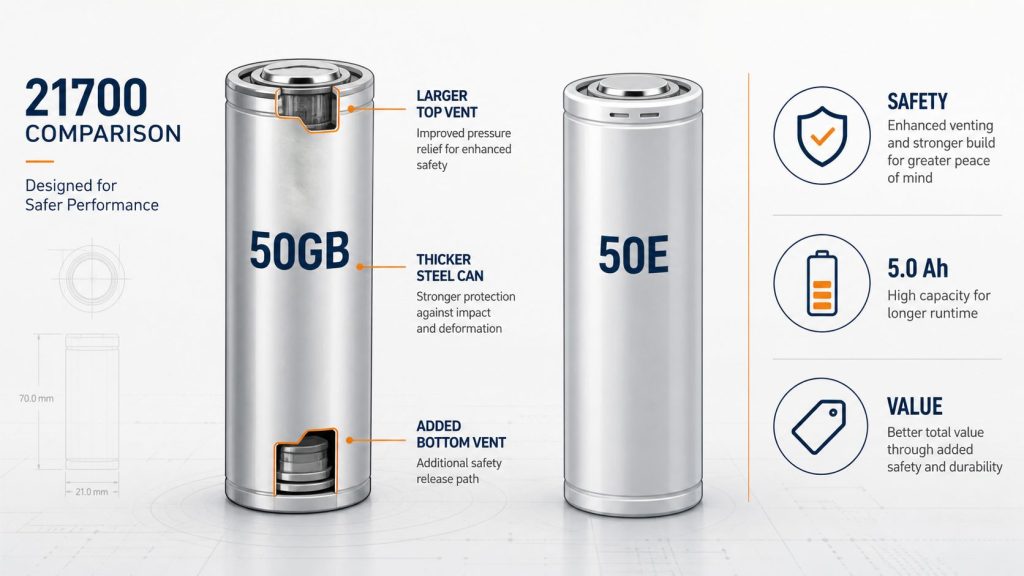
Quick Answer: Samsung INR21700-50GB and 50E are both approximately 5.0 Ah, 21700-format lithium-ion cells designed for energy-oriented applications. Their capacity, charging, discharge, and cycle-life specifications are similar. The 50GB adds a larger top venting area, a thicker steel can, and an additional bottom vent, providing stronger safety performance and better overall cost-effectiveness. It is especially suitable for mobility, AGV, AMR, robotics, and large multi-cell battery packs. The lighter 50E remains useful for existing validated designs and portable equipment where weight and continuity are priorities.
Selecting between Samsung SDI INR21700-50GB and INR21700-50E cells requires more than comparing capacity.
Both cells provide approximately 5 Ah capacity and support similar charge and discharge currents. However, Samsung SDI’s technical roadmap positions the 50GB as a safety-enhanced and cost-effective option for mobility applications.
Its main differentiator is not higher capacity or power. It is improved mechanical safety, pressure-release design, and total project value.
This article compares the electrical specifications, mechanical structures, safety characteristics, battery management requirements, cost-effectiveness, and suitable applications of the Samsung 50GB and 50E.
Part 1: Samsung INR21700-50GB and 50E Overview
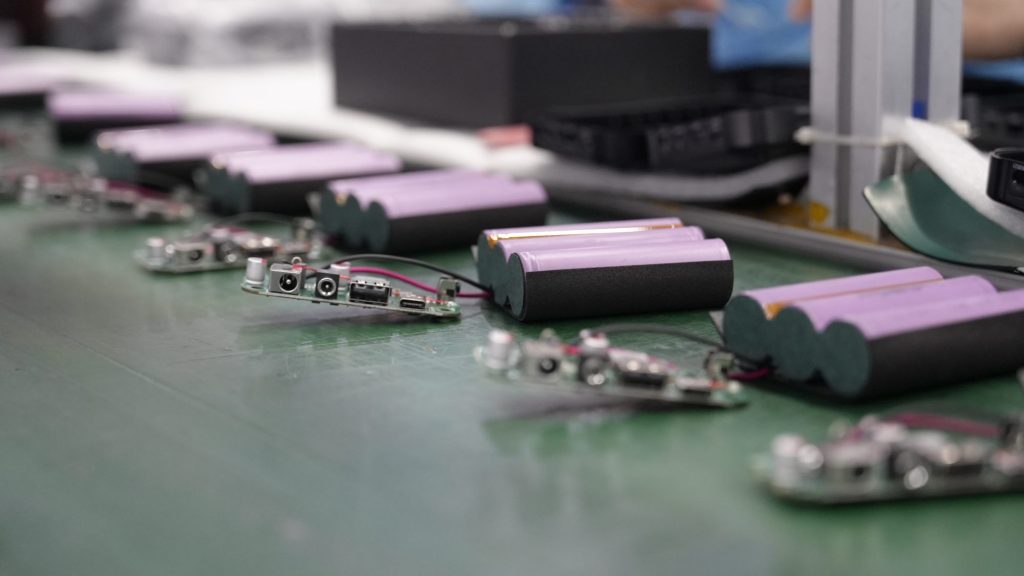
The INR21700-50E is an energy-oriented cylindrical lithium-ion cell intended for equipment that requires long runtime at moderate discharge rates.
Samsung technical documentation uses both “INR21700-50G Version B” and “50GB” terminology. The supplied 50G document is a draft specification, while Samsung’s later roadmap and structural comparison materials refer to the safety-enhanced product as 50GB.
Before approving a production design, engineers should confirm the exact manufacturer part number, cell revision, production factory, application authorization, and approved specification with the authorized supplier.
Samsung SDI’s roadmap describes the 50GB as a 5.0 Ah, 18.15 Wh cell designed to provide enhanced safety for mobility applications. Its main differentiators are improved mechanical construction, better pressure release, stronger thermal propagation performance, and competitive project pricing.
Part 2: Samsung 50GB vs 50E Specifications
The following comparison is based on the supplied Samsung SDI INR21700-50G Version B draft specification, INR21700-50E Version 2 specification, 50GB structural comparison, and Samsung SDI product roadmap.
| Specification | INR21700-50GB / 50G Version B | INR21700-50E Version 2 |
|---|---|---|
| Cell format | 21700 cylindrical | 21700 cylindrical |
| Standard discharge capacity | Minimum 4,900 mAh | Minimum 4,900 mAh |
| Rated discharge capacity | Approximately 4,750 mAh | Minimum 4,753 mAh |
| Typical energy in roadmap | 18.15 Wh | 18.15 Wh |
| Maximum charge voltage | 4.2 V | 4.2 V |
| Standard charge current | 2,450 mA | 2,450 mA |
| Maximum charge current | 4,900 mA | 4,900 mA |
| Maximum continuous discharge | 9,800 mA | 9,800 mA |
| Non-continuous discharge limit | 14,700 mA | 14,700 mA |
| Discharge cutoff voltage | 2.5 V | 2.5 V |
| Cycle-life reference | At least 80% after 500 cycles | At least 80% after 500 cycles |
| Charge temperature | 0°C to 45°C | 0°C to 45°C |
| Discharge temperature | -20°C to 60°C | -20°C to 60°C |
| Initial AC impedance | Up to 18 mΩ | 14 ± 5 mΩ |
| Maximum cell weight | 72.5 g | 69.5 g |
The electrical specifications are extremely close. Both cells support approximately 2C continuous discharge and should be classified as high-energy cells rather than dedicated high-power cells.
The 50GB weighs up to approximately 3 g more per cell. In a 100-cell battery pack, this could add up to approximately 300 g before considering differences in holders, busbars, insulation, and enclosure design.
However, the additional weight supports meaningful structural safety improvements.
Part 3: What Makes the Samsung 50GB Safer?
3.1 Larger Top Venting Area
Samsung’s comparison document states that the 50GB increases the cap-up venting area from approximately 25 mm² in the 50E2 to 44 mm².
This represents an increase of approximately 76%.
A larger venting area improves the cell’s ability to release internal gas when pressure rises because of overcharge, overcurrent, overheating, or internal damage.
Controlled venting does not eliminate thermal runaway. However, it can influence how quickly pressure is released and how hot gases leave the cell.
Samsung SDI also explains that cylindrical cells developed for micromobility can combine a conventional top Current Interrupt Device with an additional bottom vent to enhance safety.
3.2 Thicker Steel Can
The 50GB increases the side-wall can thickness from approximately 0.22 mm to 0.25 mm, an increase of about 14%.
A thicker steel can can improve resistance to deformation and mechanical damage. This is relevant in battery packs exposed to:
- Road vibration
- Repeated shock
- Drops and impacts
- Cell-holder stress
- Assembly compression
- Long-term mechanical fatigue
The thicker can does not replace a properly designed battery enclosure. Pack-level impact protection, cell holders, spacing, insulation, and structural support remain essential.
3.3 Additional Bottom Vent
The 50E2 comparison shows no bottom vent, while the 50GB adds one.
This creates an additional pressure-release path during abnormal cell conditions. In a large multi-cell battery pack, vent direction can influence adjacent-cell heating, gas accumulation, and thermal propagation.
Battery pack engineers must therefore consider the orientation of both vents. Holders, busbars, insulation, adhesive, foam, and enclosure walls should not obstruct the intended gas-release path.
3.4 Thermal Propagation Performance
Samsung’s internal comparison presents 50GB results using a heater-triggered propagation test. The supplied material reports successful results for four out of four samples under a 100 W trigger condition.
This demonstrates the safety-oriented design direction of the 50GB. It does not mean that every 50GB battery pack will automatically prevent thermal propagation.
Pack-level behavior still depends on:
- Cell spacing
- Electrical interconnection
- Thermal barriers
- Cooling design
- Enclosure pressure management
- Cell state of charge
- BMS response
- Pack capacity and configuration
UL Solutions evaluates thermal propagation progressively at cell, module, and pack levels because cell performance alone cannot determine complete battery-system behavior.
Part 4: Why the Samsung 50GB Offers Better Cost-Effectiveness
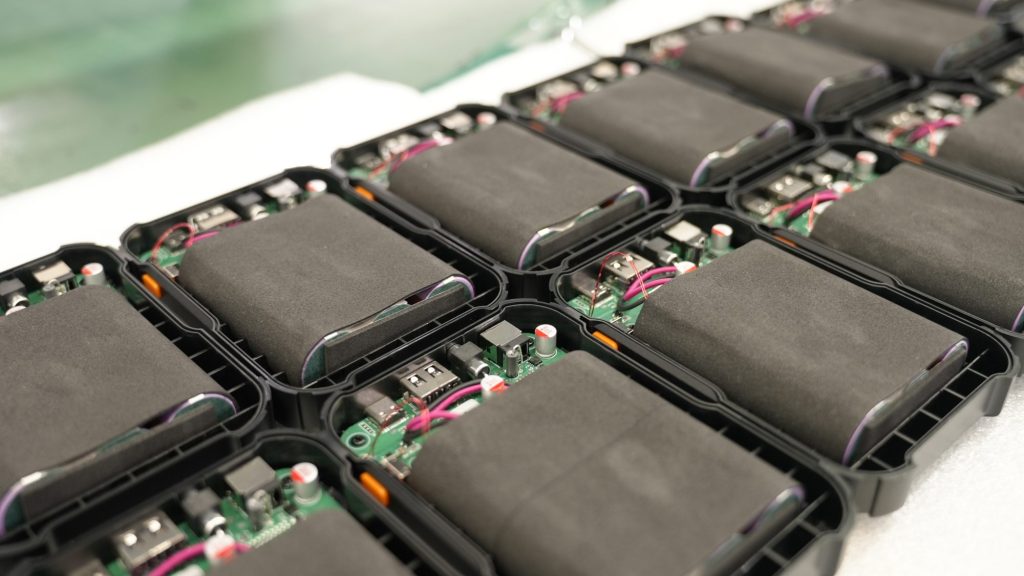
In addition to its safety improvements, the Samsung 50GB offers a stronger overall value proposition for many current battery pack projects.
The 50GB provides approximately the same 5.0 Ah capacity, 18.15 Wh energy, 9.8 A continuous discharge capability, and 500-cycle reference as the 50E. However, it adds a larger top venting area, a thicker cell can, and an additional bottom vent without requiring designers to move to a lower-capacity cell.
The 50GB is also competitively priced for current project procurement. This combination makes it more cost-effective than the 50E for many new battery pack designs.
Its value is particularly clear in mobility and robotics battery packs containing many closely arranged cells. Enhanced cell-level safety can reduce engineering risk and support the pack’s thermal propagation strategy.
The 50GB provides:
- Approximately the same energy and runtime as the 50E
- Comparable charge and discharge capability
- Stronger mechanical protection
- Improved pressure-release design
- Better suitability for mobility battery packs
- Competitive project pricing
- Lower safety-related engineering risk
- Better overall performance-to-cost value
The 50E remains useful for existing validated designs, approved platforms, and applications where its lower weight or validation history is important.
For new projects without a locked cell specification, the 50GB should generally be evaluated first.
Engineering Note: Cell prices vary according to purchase volume, delivery schedule, production batch, commercial channel, and supply conditions. Cost-effectiveness should be evaluated using an authorized project quotation rather than a fixed online unit price.
Part 5: Does 50GB Deliver More Power Than 50E?
Not according to the supplied cell specifications.
Both cells list:
- 4.9 A maximum charge current
- 9.8 A maximum continuous discharge current
- 14.7 A non-continuous discharge limit
The 50GB should therefore not automatically be considered a high-power replacement for Samsung cells developed specifically for power applications.
Its main advantage is improved safety architecture and cost-effectiveness, not a higher continuous current rating.
For equipment with high pulse loads, engineers must calculate:
- Peak current per parallel cell
- Voltage sag at minimum state of charge
- Cell temperature during repeated pulses
- Busbar and nickel-strip resistance
- Connector current rating
- BMS MOSFET losses
- Pack-level thermal accumulation
Adding parallel strings or selecting another cell family may be necessary when the load exceeds the recommended operating window of the individual cell.
Part 6: Which Applications Are Better for the Samsung 50GB?
6.1 E-Bikes and Micromobility
The 50GB is particularly relevant to e-bikes, electric scooters, and other light electric vehicles.
These battery packs contain many cells close to the rider and frequently experience vibration, outdoor temperatures, charging variation, and mechanical impacts.
Samsung SDI identifies safety and cost competitiveness as critical requirements for micromobility batteries. The 50GB addresses both priorities through enhanced venting, a stronger can structure, and competitive project pricing.
Cell selection alone is not sufficient. The battery pack also requires an appropriate BMS, mechanical enclosure, charger, connectors, thermal design, and applicable product evaluation.
6.2 AGV and AMR Battery Packs
Automated guided vehicles and autonomous mobile robots operate repeatedly in warehouses, factories, hospitals, and logistics facilities.
A 50GB-based pack is suitable when the application requires:
- Long runtime
- Moderate continuous current
- Frequent movement and vibration
- Large multi-cell configurations
- High priority on thermal propagation control
- Reliable pressure-release paths
- Competitive battery pack cost
For higher-current robots, additional parallel cells or another cell family may be necessary.
Large Power develops custom AGV battery solutions with cell matching, mechanical protection, smart communication, charging integration, and pack-level safety engineering.
6.3 Service Robots and Mobility Equipment
The 50GB can support service robots, delivery robots, inspection platforms, and selected mobility equipment where battery packs operate close to users or valuable equipment.
A custom robotics battery solution should coordinate cell selection with:
- Drive-motor current
- Regenerative charging current
- Charging frequency
- CANBus or RS485 communication
- Emergency shutdown
- Enclosure ventilation
- Pack replacement strategy
6.4 Large Multi-Cell Battery Packs
The 50GB is also valuable in large series-parallel configurations where a single-cell failure could expose many adjacent cells to heat.
The safety benefit becomes increasingly relevant as total pack energy and cell count increase.
The 50GB’s competitive pricing also helps manufacturers improve cell-level safety without creating an excessive increase in battery pack cost.
Part 7: Which Applications Are Better for the Samsung 50E?
7.1 Existing Validated Products
The strongest reason to continue using the 50E is often design continuity.
An existing product may already have:
- Approved mechanical drawings
- Validated welding parameters
- Established BMS limits
- Completed safety testing
- Certified charger compatibility
- Approved supplier documentation
- Completed medical or industrial device validation
Changing cells may trigger engineering verification, certification updates, or device revalidation. In these cases, continuing with the 50E may be more economical than redesigning the complete battery system.
7.2 Portable Medical Equipment
The lighter 50E remains suitable for portable medical and diagnostic equipment requiring high capacity and moderate current.
Potential applications include:
- Portable oxygen concentrators
- Patient monitors
- Portable imaging equipment
- Diagnostic analyzers
- Rehabilitation equipment
- Medical carts
The lower cell weight can improve device portability when many cells are used.
Explore Large Power’s medical battery solutions.
7.3 Industrial Inspection and Measurement Equipment
The 50E can support long runtime in equipment such as:
- Thermal imaging cameras
- Portable spectrometers
- Pipeline inspection tools
- Particle counters
- Portable testing instruments
- Environmental monitoring equipment
These devices typically value energy density and runtime more than high discharge current.
Large Power designs custom industrial battery solutions with rugged enclosures, IP protection, reliable connectors, thermal monitoring, and application-specific communication.
Part 8: BMS Requirements for 50GB and 50E Battery Packs
Neither cell should be used as an unprotected battery pack.
A properly engineered Battery Management System should provide:
- Cell-group voltage monitoring
- Charge overvoltage protection
- Discharge undervoltage protection
- Charge and discharge overcurrent protection
- Short-circuit protection
- Cell balancing
- Temperature monitoring
- State-of-charge estimation
- Fault logging where required
- CANBus, SMBus, UART, or RS485 communication where required
The cell specifications state that the battery pack or system should monitor each cell block and provide warnings for overtemperature, overvoltage, and overcurrent conditions.
BMS operating limits should remain within the cell manufacturer’s specified limits. Designers should not use the absolute maximum ratings as normal protection thresholds.
For mobility packs, the BMS should also account for:
- Acceleration current
- Regenerative charging
- Charger compatibility
- Connector disconnection
- Temperature gradients
- Cell imbalance
- Long-term standby current
- Emergency shutdown behavior
Part 9: Pack-Level Safety Design Still Matters
The 50GB’s safety improvements do not make pack engineering optional.
A reliable pack design must coordinate:
- Cell authenticity and batch traceability
- Incoming cell inspection and grading
- Cell spacing and holder design
- Vent path clearance
- Busbar and welding design
- Electrical insulation
- Thermal barriers
- BMS protection
- Enclosure strength
- Applicable safety and transport testing
UL Solutions notes that battery evaluation may include electrical, mechanical, environmental, abuse, fire, and thermal propagation testing at cell, module, and pack levels.
Large Power’s CNAS-accredited testing center supports standardized verification and engineering validation for custom battery pack projects.
Part 10: Samsung 50GB or 50E – Which Should You Choose?
Choose the Samsung 50GB when:
- You want the stronger overall cost-performance option for a new project.
- The application is an e-bike, scooter, AGV, AMR, or service robot.
- Thermal propagation and mechanical safety are major concerns.
- The pack contains many closely arranged cells.
- You require approximately 5 Ah capacity and moderate discharge capability.
- Improved venting provides greater value than the small weight increase.
- Competitive pricing and lower engineering risk are important.
Choose the Samsung 50E when:
- The product is an existing validated design that specifies the 50E.
- Changing cells would trigger significant recertification or revalidation.
- The approximately 3 g per-cell weight difference is critical.
- Compatibility with an existing holder, welding process, BMS, and approved supply chain is more important than changing cells.
Choose a different cell family when:
- Continuous current substantially exceeds 9.8 A per cell.
- The application requires repeated high-power pulses.
- Charging below 0°C is required without battery heating.
- The project requires substantially longer cycle life.
- The cell does not have the necessary application authorization or traceability.
Part 11: Final Engineering Recommendation
The Samsung INR21700-50GB and 50E provide similar capacity, energy, and current capability, but the 50GB delivers a stronger combination of safety and cost-effectiveness.
The 50E remains practical for existing products and applications operating at moderate power. The 50GB builds on a similar electrical platform with a thicker can, a larger top venting area, and an additional bottom vent.
It also offers competitive project pricing, making it an attractive first-choice candidate for new mobility, robotics, industrial, and other multi-cell battery pack designs.
For new projects, Large Power generally recommends evaluating the 50GB first when its qualification status, supply channel, and exact production revision meet the application requirements.
The final decision should consider more than unit price. Engineers should compare total battery pack cost, BMS requirements, thermal protection, mechanical design, certification work, supply continuity, and lifecycle risk.
Before freezing the design, confirm the exact cell revision, approved supplier, production factory, pack configuration, BMS limits, certification plan, annual volume, and current quotation.
Contact Large Power or request a custom lithium battery pack consultation for cell selection, BMS development, mechanical integration, prototyping, testing, and OEM/ODM production.
FAQ
Is Samsung INR21700-50GB a higher-power cell than the 50E?
No. The supplied specifications list the same 9.8 A maximum continuous discharge current and 14.7 A non-continuous discharge limit. The main advantages of the 50GB are its safety-oriented mechanical design and cost-effectiveness.
What is the main structural difference between 50GB and 50E?
The 50GB comparison documentation identifies a 76% larger top venting area, a 14% thicker side-wall can, and an additional bottom vent. These changes improve pressure-release and thermal propagation behavior.
Is the Samsung 50GB cheaper than the 50E?
Project pricing depends on volume, delivery schedule, batch, supply channel, and market conditions. Under current project procurement conditions, the 50GB offers stronger overall cost-effectiveness because it combines competitive pricing with enhanced safety and similar electrical performance.
Can Samsung 50GB and 50E cells be mixed in one battery pack?
No. Do not mix different models, revisions, production batches, capacities, or impedance groups in one battery pack. Use matched cells with consistent traceability and electrical characteristics.
Which cell is better for an e-bike battery?
The 50GB is generally the stronger candidate because it combines approximately 5 Ah capacity with improved venting, mechanical safety, and competitive pricing. Pack current, certification, enclosure design, BMS protection, and charger compatibility must still be evaluated.
Which cell is better for portable medical and industrial equipment?
For new projects, the 50GB should be evaluated because of its safety and value advantages. The 50E remains appropriate for existing validated products or weight-sensitive equipment where changing cells would create substantial revalidation work.
Does using 50GB cells guarantee UL 2580 certification?
No. Samsung’s comparison material discusses the cell’s ability to support UL 2580-related evaluation, but the status must be confirmed for the exact cell revision. The completed battery pack and end product require their own applicable testing.


