

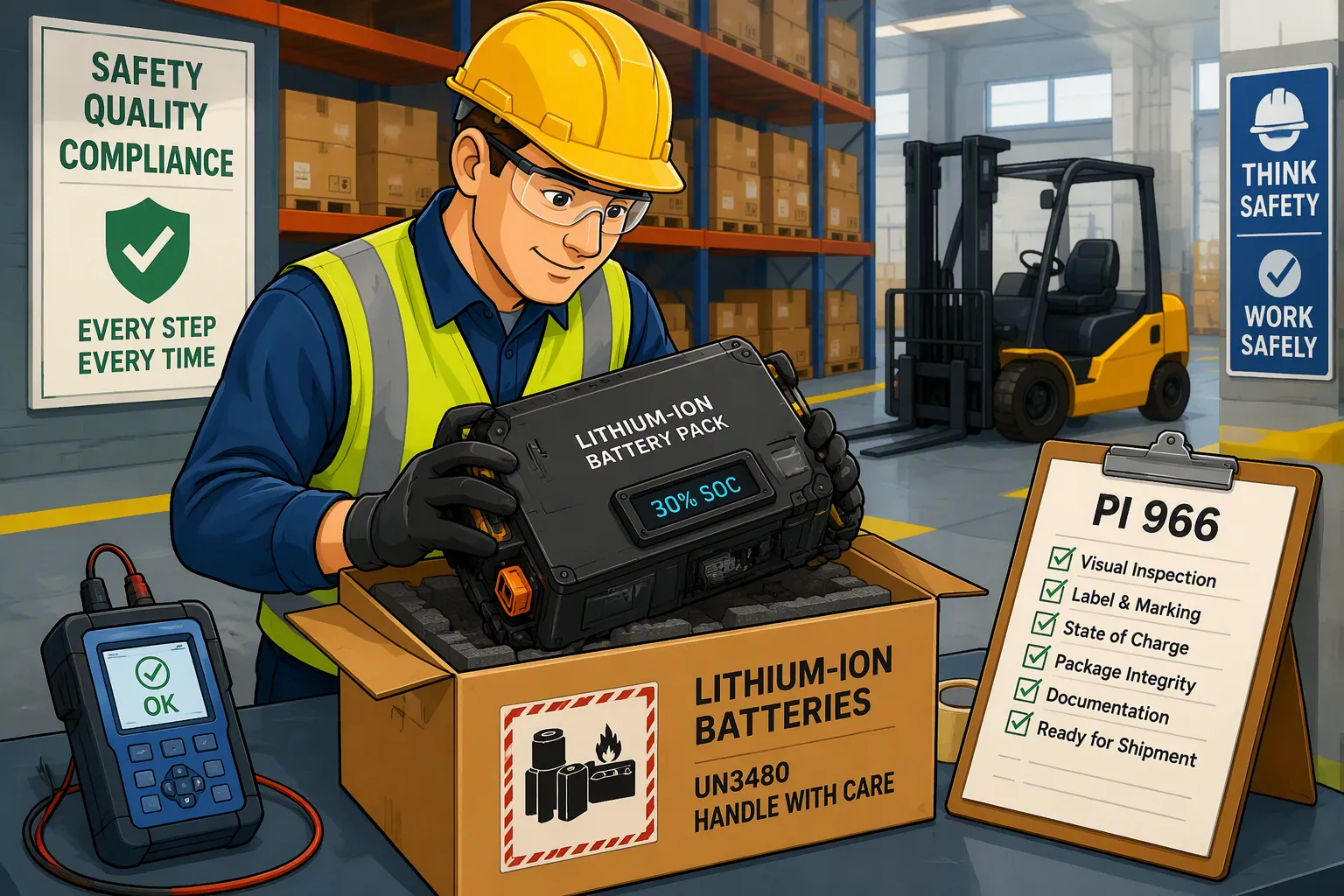
Quick Answer: From January 1, 2026, lithium-ion cells and batteries shipped by air under IATA Packing Instruction 966 are subject to new state-of-charge limits. Section I batteries must be offered for transport at no more than 30% of rated capacity. Under Section II, the same limit applies when the cell or battery exceeds 2.7 Wh. Batteries above 30% SOC require the approvals specified by IATA and must be offered under the applicable Section I conditions.
Key Takeaways
PI 966 covers UN 3481 lithium-ion batteries packed with equipment but not installed in it.
From January 1, 2026, Section I batteries must not exceed 30% SOC.
For PI 966 Section II, the mandatory 30% limit applies to cells and batteries above 2.7 Wh.
A battery installed in the equipment is normally handled under PI 967, not PI 966.
UN 38.3 test-summary availability, packaging, marks, labels and documentation must be assessed separately for the applicable section and carrier.
Part 1: What PI 966 Covers
1.1 Packed With Equipment vs. Contained in Equipment
PI 966 applies when a lithium-ion battery is packed in the same outer package as the equipment it powers but is not installed in that equipment. A portable medical monitor shipped with a separate replacement pack is a typical example. The proper shipping name is Lithium ion batteries packed with equipment, and the UN number is UN 3481.
If the battery is installed in the device during transport, PI 967 normally applies. Batteries shipped without equipment are UN 3480 and generally follow PI 965. This physical configuration must be confirmed before selecting packaging, marks, labels or documentation. Review our UN 3480 vs. UN 3481 guide for the basic distinction.
1.2 Section I and Section II
Section II can apply to lithium-ion cells rated at no more than 20 Wh and batteries rated at no more than 100 Wh, subject to all applicable conditions. Larger cells and batteries are handled under Section I. The section affects packaging performance, hazard communication, documentation and operator acceptance.
Configuration | Packing Instruction | 2026 SOC Treatment |
|---|---|---|
Batteries shipped alone | PI 965, UN 3480 | 30% limit applies, subject to the applicable provisions and approvals |
Batteries packed with equipment | PI 966, UN 3481 | Section I: maximum 30%; Section II: maximum 30% when above 2.7 Wh |
Batteries contained in equipment | PI 967, UN 3481 | Different provisions apply; verify the current IATA DGR and operator variations |
Part 2: Understanding the 30% SOC Requirement
2.1 Effective Date and Scope
The revised PI 966 SOC provisions take effect on January 1, 2026. For Section I, lithium-ion cells and batteries must be offered for air transport at a state of charge not exceeding 30% of rated capacity.
For Section II, cells and batteries with a Watt-hour rating above 2.7 Wh must also be offered at no more than 30% SOC. The opening statement should therefore not be simplified to say that every PI 966 cell, regardless of size, is subject to exactly the same condition.
2.2 Shipping Above 30% SOC
A PI 966 shipment above 30% SOC cannot proceed merely because a carrier informally accepts it. Under the 2026 IATA guidance, the shipper must use the applicable Section I provisions and obtain approval from the State of Origin and the State of the Operator under the written conditions established by those authorities.
Because approvals and operator variations can add time and uncertainty, manufacturers should normally plan production discharge, inspection and storage so that qualifying packs are at or below 30% before packing.
2.3 Why Lower SOC Matters
A higher SOC means more stored energy is available during an internal short circuit, crushing event or thermal runaway. Reducing SOC does not eliminate battery risk, but it reduces the energy available to support heat release and propagation. The same regulatory rule applies to NMC, LCO, LMO and LiFePO4 lithium-ion batteries when they fall within PI 966.
Part 3: A Defensible SOC-Control Process
3.1 Define the Measurement Method
IATA establishes the transport limit but does not prescribe one universal photo-and-serial-number record for every shipment. The shipper should nevertheless maintain a documented quality process that demonstrates how the limit is achieved.
The method may use a validated BMS reading, coulomb-counting data, charger or discharger output, or another engineering method appropriate to the pack. Voltage alone may be insufficient for chemistries with a flat open-circuit-voltage curve, aged packs or recently charged batteries. Define the rest period, temperature range, tester accuracy and acceptance criteria.
3.2 Production and Warehouse Controls
Identify the battery model, Watt-hour rating and applicable packing instruction.
Discharge the battery using controlled equipment and approved limits.
Verify SOC using the documented method.
Prevent unintended recharge after verification.
Protect terminals and pack the battery to prevent movement and accidental activation.
Record the batch or shipment result according to the company’s quality system.
Confirm airline and freight-forwarder variations before tender.
A smart battery management system can support SOC verification, but its displayed value should be validated across temperature, age and load conditions. A BMS estimate is only as reliable as its algorithm, calibration and available cell data.
Part 4: Packaging, Marks and Documentation
4.1 UN 38.3 Test Summary
Cells and batteries offered for transport must meet the applicable UN 38.3 requirements unless a specific exception applies. Manufacturers and subsequent distributors must make the UN 38.3 test summary available. This does not mean that a complete test report must automatically accompany every package.
4.2 Package Requirements Depend on the Section
The batteries must be protected against short circuits, damage and movement inside the outer packaging. The equipment and batteries must be packed so that accidental operation cannot create a dangerous condition. Exact marks, labels, documentation and quantity limits depend on whether Section I or Section II applies and on the current IATA Dangerous Goods Regulations.
Do not treat a Safety Data Sheet, a generic safe-transport certificate or a Class 9 label as a universal requirement for every PI 966 shipment. Section I and Section II have different hazard-communication requirements. National rules and operator variations may also be more restrictive.
4.3 Confirm Operator Variations
IATA requirements form the baseline, but airlines may impose additional acceptance conditions. Before shipping, verify the current IATA DGR, the state variations, the operator variations and the freight forwarder’s acceptance procedure. This is especially important for medical devices, robotics and industrial equipment that include multiple spare packs.
Part 5: Manufacturer Readiness Checklist
Confirm whether the battery is alone, packed with equipment or contained in equipment.
Verify the cell and battery Watt-hour rating.
Select PI 965, PI 966 or PI 967 and the correct section.
Apply the 30% SOC requirement where mandated from January 1, 2026.
Validate the SOC measurement and discharge process.
Keep the UN 38.3 test summary available.
Use packaging that protects against short circuit, damage, movement and accidental activation.
Apply the marks, labels and documentation required for the applicable section.
Check state and operator variations before each shipping program.
Train production, quality and logistics personnel on the revised procedure.
For manufacturers, the most useful response is not to add unsupported paperwork. It is to build a repeatable process linking the battery specification, SOC-control method, UN 38.3 evidence, packaging instruction and carrier acceptance check.
FAQ
Does the 30% SOC rule apply to every PI 966 battery?
Section I batteries must not exceed 30% SOC. In Section II, the mandatory limit applies to lithium-ion cells and batteries above 2.7 Wh. Always verify the current IATA DGR and operator variations.
Does PI 966 apply when the battery is installed in the device?
No. A battery installed in the equipment is normally classified under PI 967. PI 966 applies when the battery is packed with, but not installed in, the equipment.
Can a battery above 30% SOC ship with airline permission alone?
No. The 2026 guidance requires the shipment to follow the applicable Section I provisions and obtain approval from both the State of Origin and the State of the Operator.
Must the UN 38.3 test report be included in every shipment?
No. The applicable test summary must be made available, but it is not automatically a document that must physically accompany every package. Carriers or authorities may request supporting evidence.
Is an MSDS mandatory for every PI 966 air shipment?
IATA does not make an MSDS a universal dangerous-goods shipping document for every PI 966 package. A carrier, customer or local authority may request one, so confirm the commercial and operator requirements separately.


