

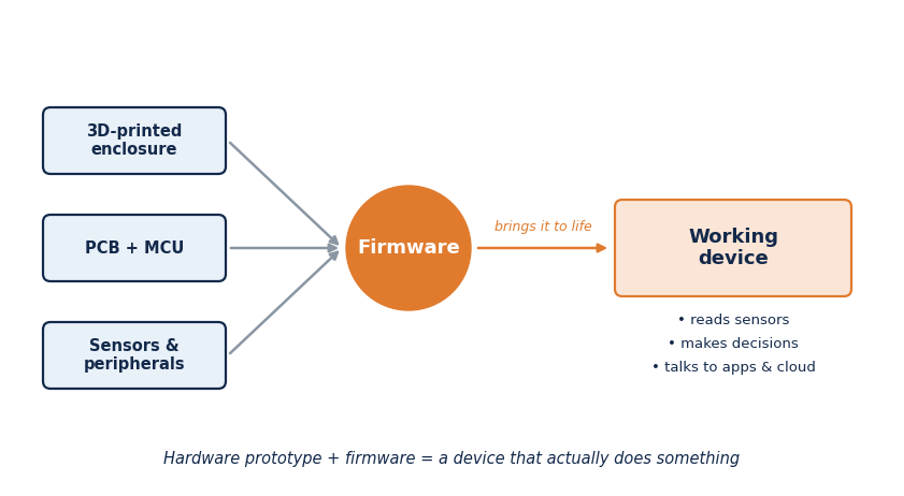
Firmware is the layer that turns an enclosure, a board, and a handful of sensors into a device that responds.
A typical hardware prototype starts with the physical parts: a case modeled in CAD and 3D-printed, a PCB that fits the mounting posts, and a set of sensors, buttons, and LEDs placed according to the design. Once assembled, the prototype can look close to a finished product. Without firmware, however, the device cannot read the sensors, respond to input, or communicate with other systems.
Firmware is the code that runs on the device's microcontroller. Some teams write the chip's code themselves, while many others bring in a firmware development company once the mechanical design is stable, because making a microcontroller work reliably with sensors, radios, and a limited battery requires specific experience. Firmware defines what the hardware does, in what order, and how the device recovers from errors.
The sections below explain what firmware work involves during prototyping, which services are usually needed, and when outsourcing firmware makes sense.
From Hardware Prototype to a Working Product
Designing the enclosure, the mechanical assembly, and the 3D model is an important part of product development. A well-tested housing shows whether the device is comfortable to hold, whether the vents are placed correctly, and how durable moving parts like hinges are. However, a prototype that only has the right shape remains a physical model. Reading a temperature or sending data to a phone requires software running on the processor inside the device.
Software running on the device's processor is called firmware. Firmware is usually written in C or C++ and connects the physical electronics with the functions the user interacts with. Memory and power limits vary by platform, so firmware must be designed around the selected hardware and its operating modes. When the team replaces a sensor, the firmware has to be updated as well. Switching to a cheaper microcontroller to reduce unit cost may require driver, toolchain and application changes, depending on the software architecture.
Since a change in the hardware often requires a change in the firmware, hardware and firmware are best developed in parallel rather than one after the other. Mechanical decisions directly affect the code. An antenna placed behind a metal bracket leaves the firmware with weaker signals and more retransmissions to handle, and a smaller battery compartment requires more aggressive power-saving modes. When mechanical and firmware engineers coordinate early, the first assembled units have fewer problems during testing.
What Does a Firmware Development Company Do for Hardware Prototypes?
During prototyping, a firmware development company is responsible for getting the board to work and keeping the board working as the hardware design changes. The work usually includes several stages.
The first stage is often the choice of silicon. Most prototypes run on a microcontroller (MCU) such as an STM32, ESP32, or nRF52. Devices that need a display, more processing power, or embedded Linux use a system-on-chip (SoC) instead. An experienced firmware engineering company can advise on the chip selection, since the chip determines which development tools and wireless options will be available later.
The next stage is hardware bring-up, during which engineers check that the clock is stable, the power rails deliver the correct voltages, the debugger can connect, and each peripheral responds. The process requires tools such as an oscilloscope and a logic analyzer. Bring-up also often reveals schematic errors, such as swapped pins or missing pull-up resistors, that were not caught during the design review.
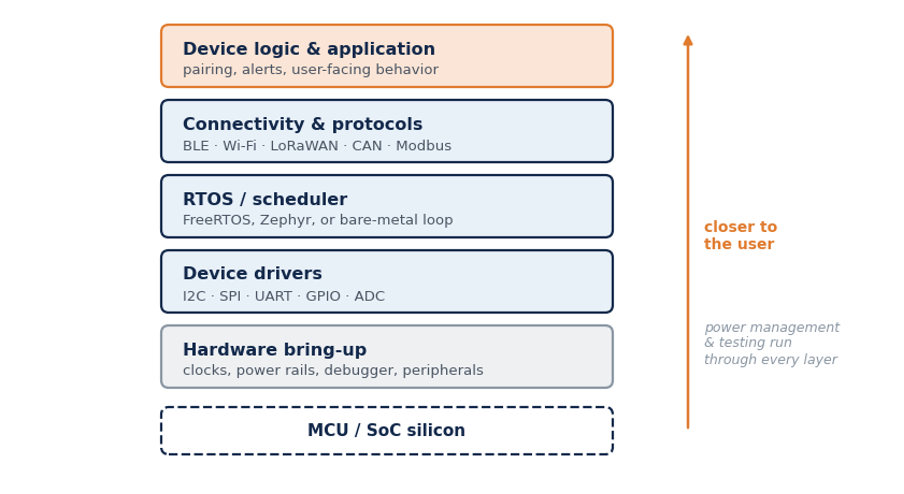
A typical prototype firmware stack, from the silicon up to the behavior the user sees.
After bring-up, the team writes drivers for the sensors and peripherals on the board, including accelerometers, temperature sensors, displays, motor controllers, and external flash memory. Each component communicates over a bus such as I2C, SPI, or UART, and each has datasheet specifics that become visible only in real operating conditions. Communication protocols are added next: a device that works with a mobile app usually uses Bluetooth Low Energy, while cloud reporting requires Wi-Fi or cellular. Vehicles commonly use CAN, and industrial equipment often relies on Modbus.
The final stage is the device's basic logic, which defines the behavior the user sees. For example, holding the power button for three seconds puts the device into pairing mode, and a battery level below 15% triggers a warning and dims the LED. Rules like pairing and low-battery alerts turn a working circuit into a usable product.
Key Firmware Development Services During Prototyping
The scope of firmware work depends on the product. A single-sensor data logger requires far less firmware than a connected medical wearable. Most firmware development services at the prototyping stage, however, fall into the following groups:
- Embedded firmware. The core application on the MCU, including startup code, the main loop, and the state machine that defines how the device behaves.
- Device drivers. Low-level code that allows the processor to read from and write to each component on the board. Vendors provide drivers for popular parts, but vendor code rarely covers every use case, so some custom development is usually required.
- RTOS. When a device needs to sample a sensor, update a screen, and listen for radio packets at the same time, a real-time operating system such as FreeRTOS or Zephyr schedules all three tasks predictably.
- Connectivity. Integration of BLE, Wi-Fi, LoRaWAN, cellular, or wired buses, along with pairing, encryption, and over-the-air (OTA) updates.
- Power management. Sleep modes, clock scaling, and switching off unused peripherals. On battery-powered devices, power management determines whether a charge lasts a week or a year. The work also includes measuring actual current consumption instead of relying only on datasheet values.
- Debugging. Finding and fixing crashes, timing issues, and hardware-software conflicts, usually with a JTAG or SWD debugger connected to the board.
- Firmware testing. Unit tests, hardware-in-the-loop setups, and stress tests at low voltage, high temperature, or with an unstable connection.
Debugging and testing are often shortened when deadlines get close, which tends to increase costs later. Fixing a bug on a hand-assembled prototype may take a few hours, while the same bug found after a production run of several thousand units requires a field update or, in some cases, a recall.
Why Work With a Firmware Development Partner During Product Development?
For a proof of concept, a single engineer can often handle the schematic, the enclosure model, and the code. The workload increases significantly when the device needs reliable wireless connectivity, long battery life, and safe firmware updates in the field.
Dependable wireless and long battery life are areas where hiring a firmware development partner pays off. Engineers who have brought up many boards know common chip errata and the limitations of specific vendor SDKs. Experienced firmware engineers also structure code so that moving from a development kit to a custom PCB does not require starting over. Most firmware teams already have lab equipment such as power analyzers and RF test tools, so the client does not need to buy expensive test gear for a single project.
Working with a partner can also shorten the timeline. Firmware development can start on evaluation boards that use the same chip, so the team does not have to wait for the final hardware, and firmware and mechanical design can progress in parallel.
The cost of outside help depends on the device: a firmware development agency adds a separate item to the budget, and for a very simple device, an in-house generalist may be enough. For connected, battery-powered, or regulated devices, outside expertise usually reduces the number of board revisions, and each PCB revision adds several weeks to the schedule as well as direct costs.
When choosing a partner, ask which MCU families the team has shipped products on, how the team handles OTA updates, and whether the engineers have experience with devices certified for your market (FCC, CE, or medical standards, where relevant). A short paid discovery phase of one or two weeks, spent reviewing your schematic and requirements, usually gives a clearer picture than a sales call.
Keep in mind that an external team needs detailed context about your product, and briefing the engineers takes time on your side. Agree on documentation standards and source code ownership at the start so the firmware remains your property after the engagement ends.
Turning Hardware Ideas Into Functional Devices
Consider a hypothetical soil-moisture sensor for a greenhouse. The following example illustrates a possible development process, not a documented customer case study. The first version is a 3D-printed shell with a development board inside, and the firmware only sends a moisture reading to a laptop over USB. The first version is enough to confirm that the concept works.
The second version uses a custom PCB that fits the enclosure's mounting posts. The firmware now reads the probe every ten minutes, stays in sleep mode between readings, and sends each result over LoRaWAN to a gateway in another part of the building. Duty cycling and a suitable radio strategy can extend runtime, but the result must be calculated and verified using measured current, battery capacity and the actual reporting conditions.
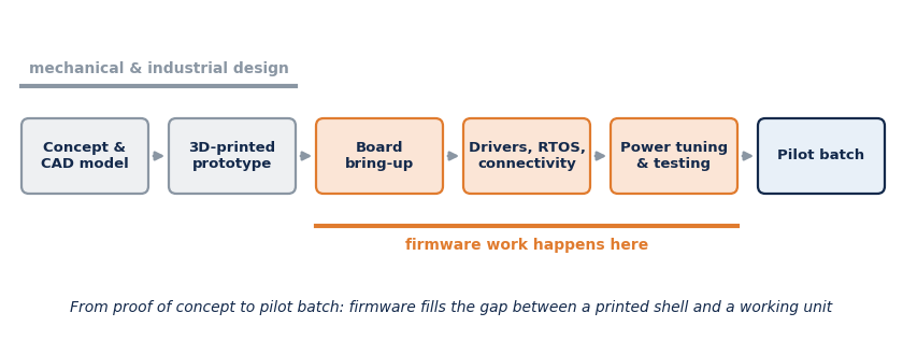
Where firmware work fits between the first printed enclosure and a pilot production batch.
By the pilot batch, remaining work may span firmware, electronics, mechanical design and production validation. Firmware engineering services at the pilot stage focus on making the code stable, tuning power consumption, adding secure boot and OTA updates, and writing the self-test each unit runs before leaving the assembly line. The early version had to work on one bench unit under an engineer's supervision, while the production version has to work consistently on hundreds of units in the field.
In this illustrative workflow, both enclosure and firmware evolve as the team validates the device. Many hardware projects follow the same pattern, with more firmware revisions than enclosure revisions. When planning a hardware project, budget firmware work according to complexity, integration and verification needs, and involve firmware engineers while the CAD files are still being finalized.


