

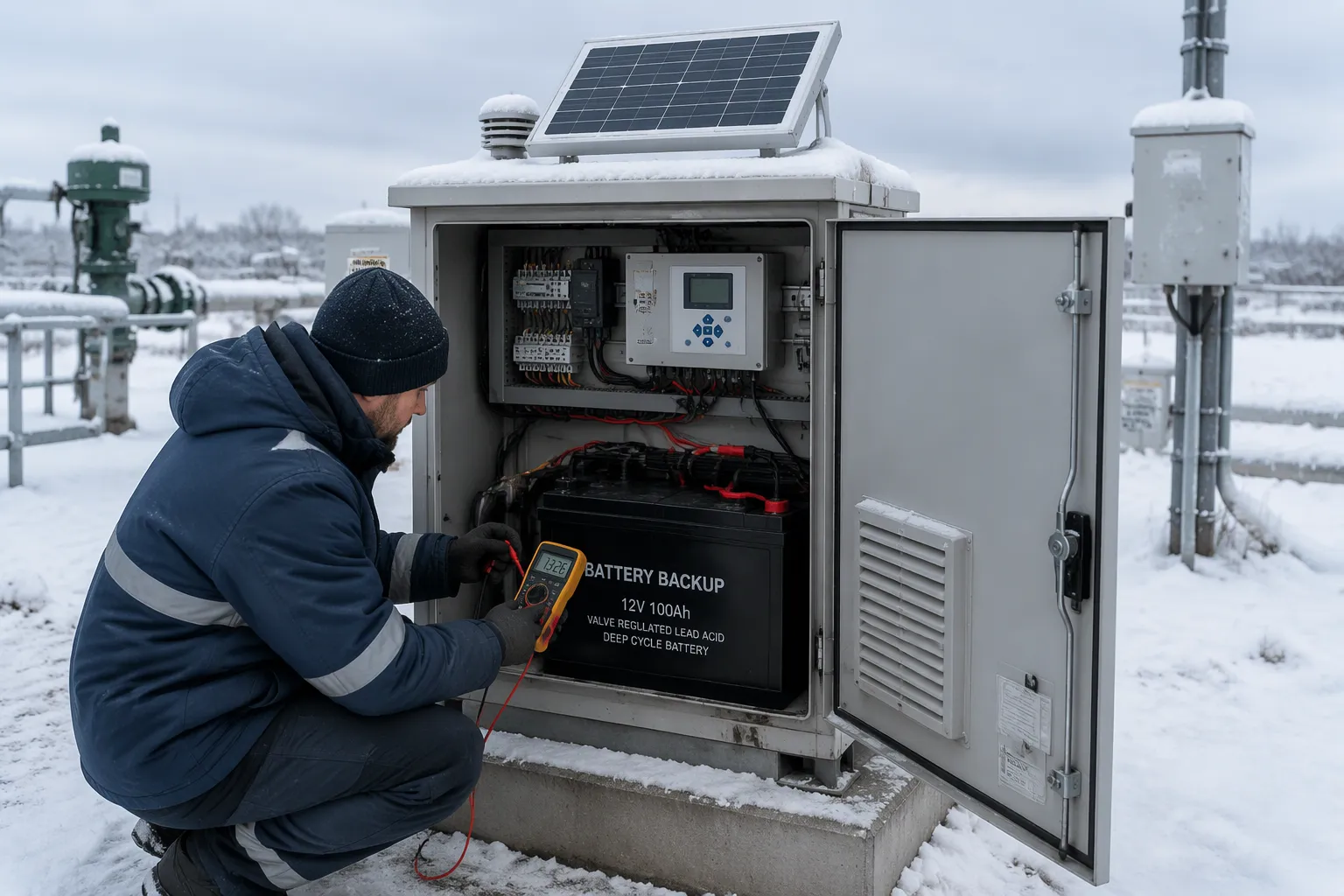
Quick Answer: Size the cabinet battery using the essential load, required outage duration and usable pack energy after cold soak, including any battery heater draw. Separately verify how quickly charging can resume and restore enough reserve for a second outage.
Key Takeaways
Cold weather lowers battery capacity. Use a derating factor based on your site’s lowest temperature.
Heaters keep batteries warm, but they use extra energy. Add heater power to your total energy budget.
Most lithium batteries can’t charge when it’s below freezing. So plan for a delayed recharge after an outage.
Check your battery for outages that happen more than once. One discharge test does not show that it can recover.
Pick LiFePO4 for a long cycle life in cold outdoor cabinets. Match the chemistry to what your site needs.
Part 1: Load Profile and Runtime
1.1 Continuous, Peak, and Quiescent Loads
The numbers on a label rarely match the real power draw. A traffic signal cabinet may list a controller, a radio, and a camera at their label values, but the measured current tells a different story. Engineers should record the actual current at the cabinet over a full duty cycle. This record sorts loads into three classes: continuous loads that run every hour, peak loads that show up briefly, and quiescent loads that stay on while the cabinet sits idle.
Peak and surge behavior need their own measurement. EnergyDawnice notes that a motor running at 5 kW can pull 12–15 kW for seconds at startup. A security cabinet with a pan-tilt-zoom camera and a heater shows a similar inrush pattern. The battery pack, the BMS, and the wiring must all handle that surge. Sizing for the average load alone leaves the system at risk at the worst moment.
1.2 From Site Requirements to Outage Energy
The outage energy math is simple in form. EnergyCalcSuite gives the method: multiply the essential daily load in kWh by the number of outage days, then add a 20% buffer for inefficiencies and unexpected loads. A cabinet drawing 2 kWh per day across a 3-day outage needs about 7.2 kWh of usable storage. That number covers the outage only; recharge recovery is a separate check.
Two corrections keep the number honest. First, change nominal capacity to usable capacity. EnergyDawnice warns that a 100 kWh pack at 80% depth of discharge gives 80 kWh, and inverter efficiency near 95% cuts the AC output further. Second, apply the cold derating factor from Part 2. CE Innovators also notes that two packs labeled 10 kWh can differ in usable capacity because of internal buffer settings. Compare systems on usable energy, not on the label.
Part 2: Cold-Weather Battery Backup Capacity
2.1 Cold Soak and Usable Capacity
A lithium pack works best near 77°F (25°C). Below that, it gives less power and takes longer to charge. Cold soak means the pack stays at a low temperature long enough for the inside to even out. Then the usable capacity drops well below its room-temperature rating.
Battery University reports that a cell at 27°C (80°F) gives 100 percent capacity as the reference point. At –18°C (0°F), that same cell usually gives only 50 percent. At –20°C (–4°F), most batteries sit near the 50 percent level. Battery University also notes that cold raises internal resistance and lowers capacity, and the loss goes away once the cell warms up again.
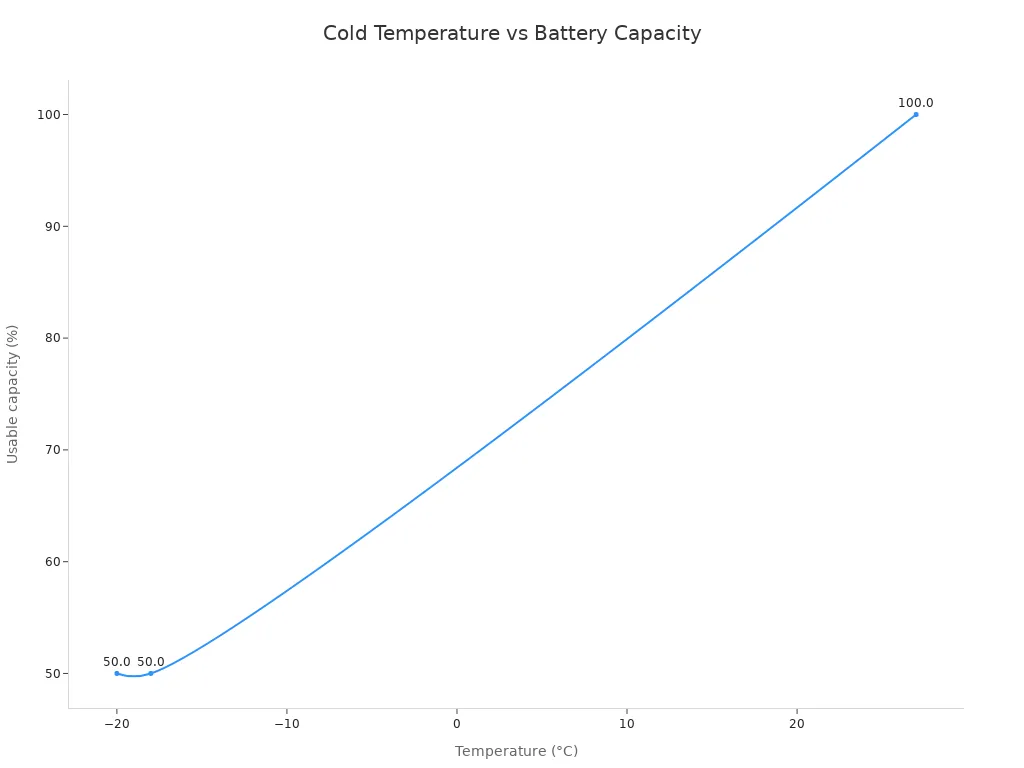
Milder cold still costs energy. Grepow reports about 75 percent of the 25°C value at –10°C, and about 60 percent at –50°C under a 0.2C condition. Grepow adds that the exact loss depends on chemistry, construction, load, and thermal conditions. So a Cold-Weather Battery Backup design uses a derating factor tied to the site’s lowest expected soak temperature, not to a mild winter average.
2.2 Heater Loads and Enclosure Thermal Budget
A heater protects capacity, but it also drains the pack. Emergency Lights notes that heaters draw standby power and usually need continuous AC to pre-warm packs. Thermostatically controlled pads keep the battery near its best temperature and work well for deep-freeze sites or long sub-zero exposure. Oupes makes the same point from the load side: heating now and then beats a big heater running nonstop. A heated blanket in the 60–120 W range, plus weather-stripping and draft stoppers, cuts energy draw sharply compared with a 1,500 W heater.
The thermal budget must count the heater as a continuous load during the coldest hours. Emergency Lights advises sizing with margin and checking winter runtime, and it recommends an indoor battery with remote heads for severe winter conditions from –20 to –40°F.
Enclosure layout matters as much as heater wattage. Yake Climate recommends separating the battery compartment and ventilating it, with dehumidified incoming air where possible. Yake Climate also warns against cutting safety ventilation to save dehumidification, and it calls for spark-safe equipment where a hazardous atmosphere is possible. An outdoor battery cabinet can use small vents or a sealed design with cooling, paired with a cabinet dehumidifier.
Part 3: Recovery and Recharge Planning
3.1 Low-Temperature Charging Constraints
Outage energy is only half of the plan. A Cold-Weather Battery Backup must also recover after the event, and cold weather makes recovery harder. Most lithium packs stop charging at 32°F (0°C). Savolture states that LiFePO4 cells cannot take a charge below this point. The BMS opens the charge path and waits for the pack to warm up.
This cutoff changes the recovery timeline. A cabinet that loses power at night in freezing weather may sit at a low charge until sunrise. It may also wait until the heater warms the cells above the threshold. The pack then charges at a slower rate while it warms. A design that expects a full recharge in a few hours will miss its target. Engineers should treat the charge cutoff as a hard gate, not a soft limit, and plan the recovery window around it.
Solar-assisted cabinets face a second problem. Snow on the panels can cut output to near zero during a winter outage. The battery then carries the full load with no recharge path until the snow clears. A panel that works well in summer tells the designer little about January performance. Site records of snow depth and panel tilt matter more than the nameplate wattage.
3.2 Recharge Time and Repeat Outages
A single discharge test proves runtime. It does not prove recovery. Winter storms often bring a second outage before the pack has recharged from the first. The design must survive that sequence, not just one event.
Repeat-outage validation closes this gap. The test should follow a fixed sequence:
Cold-soak the pack at the site’s lowest expected temperature.
Run a full outage discharge at the measured load, including heater draw.
Recharge under the same cold conditions and record the time to full state of charge.
Trigger a second discharge before the pack reaches full charge.
Confirm the pack still meets the runtime target on the second event.
A pack that passes step 2 but fails step 5 is too small for the site. The fix may be more usable capacity, a larger heater, or a warmer battery compartment. Each option carries its own energy cost, so the designer should compare them on the same thermal budget.
The recovery check also sets the charger rating. A charger sized for room-temperature charging may stall at the cold cutoff. It may leave the pack partly charged for hours. Matching the charger and the heater to the coldest expected condition keeps the recovery window short and predictable.
Part4: Lithium Chemistry Comparison

4.1 Cold-Weather Battery Backup Chemistry Fit
The battery chemistry sets the cold-weather starting point before any heater or derating factor is added to the design. Cell-level reference ranges help engineers understand the trade-offs, but they are never a guarantee for a full pack. The table below sums up typical platform voltage, specific energy, and cycle life at the cell level.
Chemistry | Platform voltage | Specific energy (Wh/kg) | Cycle life |
|---|---|---|---|
LCO | 3.7 V | 180–230 | 500–1,000 |
NMC | 3.6–3.7 V | 160–270 | 500–1,000 |
LiFePO4 | 3.2 V | 100–180 | 2,000–5,000 |
LMO | 3.7 V | 120–170 | 300–700 |
LiFePO4 works well for cold-weather sites that cycle often and need a long service life. Its flat voltage curve and high cycle count make it a good match for outdoor control cabinets in Infrastructure/Transportation and Security Systems. NMC gives higher specific energy when enclosure space is tight, like on compact camera poles. LCO fits consumer-grade electronics with light cycling. LMO suits cost-sensitive applications with moderate cycling. A C1D2-rated LiFePO4 pack is a strong choice for cold-weather oil and gas industrial UPS duty, where the hazardous-location rating and cycle life both matter.
4.2 Compliance, Cost, and BMS Considerations
Compliance and cost depend on the application. Hazardous-location cabinets need a rated pack, and the C1D2 example above shows how LiFePO4 meets that standard. Transportation sites may face extra listing requirements. LiFePO4 costs more per kWh upfront than LMO in many markets, but its cycle life spreads that cost over more outages.
The BMS carries much of the cold-weather load. Epever notes that low-temperature charging protection blocks charge below 0°C (32°F), which prevents lithium plating, and that some systems heat the pack before charging starts. PatSnap Eureka adds that accurate state estimation, cell balancing, and lithium plating detection all need temperature-aware algorithms.
Part5: Step-by-Step Sizing Example
5.1 Worked Runtime-Plus-Recovery Calculation
A security cabinet uses 2 kWh per day, and the site needs to ride out a 3-day outage. The basic outage energy is 2 kWh per day times 3 days, or 6 kWh. A 20% buffer brings the figure to 7.2 kWh of usable energy at room temperature. This is the starting point, not the final answer.
Cold derating and heater draw now change the numbers. At 0°C (32°F), the pack gives about 80% of rated capacity, so the room-temperature figure divides by 0.8 and climbs to 9 kWh. A colder site makes the penalty worse; Battery University reports roughly 50% capacity at –18°C (0°F). A 100 W thermostatic heater running through a 72-hour outage adds 7.2 kWh, which nearly doubles the demand. The designer then checks recovery: the BMS blocks charge below 32°F (0°C), so the recharge clock starts only after the heater warms the cells. A Cold-Weather Battery Backup therefore needs a pack sized for outage energy plus heater energy, and a charger rated for the cold window.
5.2 Validating with Repeat-Outage Testing
A bench calculation proves nothing until the pack survives the site. Validation follows a fixed sequence:
Cold-soak the pack at the lowest expected site temperature.
Discharge at the measured load, including heater draw, for the full outage window.
Recharge under the same cold conditions and log the time to full charge.
Start a second discharge before the pack reaches full charge.
Confirm the runtime target still holds on the second event.
A pack that passes step 2 but fails step 5 needs more usable capacity, a larger heater, or a warmer compartment. Each fix carries its own energy cost, so compare them on one thermal budget.
The sizing formula stays the same from the first draft to the final build: usable energy equals load power times runtime, divided by the cold derating factor, plus a buffer. A Cold-Weather Battery Backup also needs the second factor, recovery verification. Cold derating covers the outage. Recovery planning covers the hours after it, when the charge cutoff at 32°F (0°C) delays the next full charge.
Engineers should treat runtime and recovery as two separate design checks. A pack that passes a single discharge test may still fail a second outage. Repeat-outage testing before deployment closes that gap. Chemistry choice should follow the site’s temperature, cycle life, and compliance needs, not a single default.
FAQ
How does cold temperature change the usable capacity of a lithium pack?
A lithium pack gives less energy as the temperature drops. The article says a pack may give only about 80% of its rated capacity at 0°C (32°F) and about 50% at –18°C (0°F). Designers should use a derating factor based on the site’s lowest expected soak temperature, not a mild winter average.
Why does a single discharge test fail to prove cold-weather readiness?
One discharge test only confirms runtime. Winter storms often bring a second outage before the pack recharges. A valid test cold-soaks the pack, discharges it at the measured load, recharges it in the cold, then starts a second discharge before full charge.
How do heater loads affect the energy budget?
A thermostatic heater counts as a continuous load during the coldest hours. In the worked example, a 100 W heater over a 72-hour outage adds 7.2 kWh, which nearly doubles the demand. Designers should size the pack for outage energy plus heater energy.
What role does the 32°F (0°C) charge cutoff play in recovery?
Most lithium packs block charging at 32°F (0°C). The recharge clock starts only after the heater warms the cells above that point. Engineers should treat the cutoff as a hard gate and rate the charger for the cold window.
Which lithium chemistry suits a cold-weather control cabinet?
Chemistry should follow the site’s temperature, cycle life, and compliance needs. LiFePO4 offers a high cycle count for outdoor cabinets that cycle often, while NMC gives higher specific energy when space is tight. A C1D2-rated LiFePO4 pack fits hazardous-location industrial UPS duty.


