

Quick Answer
The EU Battery Regulation 2023/1542 introduces phased requirements for sustainability, labeling, conformity assessment, recycled content, waste management, and digital traceability. From 18 February 2027, a Battery Passport will be required for every electric-vehicle battery, every light-means-of-transport battery, and every industrial battery above 2 kWh. Manufacturers serving the EU market should prepare product, supply-chain, BMS, lifecycle, and compliance data during 2026.
Key Takeaways
The EU Battery Regulation 2023/1542 applies across the battery lifecycle, but individual obligations depend on the battery category, capacity, application, and implementation timetable.
From 18 February 2027, a digital battery passport is required for every EV battery, every LMT battery, and every industrial battery with a capacity above 2 kWh.
Manufacturers and economic operators should prepare product identification, technical, performance, durability, carbon-footprint, recycled-content, repair, and end-of-life data before the relevant deadlines.
A suitable Battery Management System can support lifecycle data collection, but regulatory responsibility remains with the economic operator placing the finished battery on the EU market.
Part 1: Interpretation of the EU Battery Regulations
1.1 Scope and Coverage
You need a clear interpretation of the EU battery regulations to navigate compliance and seize new opportunities in the energy sector. The EU Battery Regulation 2023/1542 sets a unified legal framework for all batteries placed on the EU market, with a strong focus on lithium battery packs used in medical, robotics, security, infrastructure, consumer electronics, and industrial applications. This new batteries regulation aims to harmonize standards, drive sustainability, and support the European Green Deal.
Key objectives of the regulation include:
Strengthening the EU internal market by regulating battery products, processes, and waste management.
Promoting a circular economy by encouraging reuse, recycling, and responsible battery production.
Reducing environmental and social impacts throughout the battery lifecycle.
The scope of the new batteries regulation covers nearly all battery types except those for military, space, or nuclear use. You must pay special attention to lithium battery packs, as they fall under several categories depending on their application and weight. The regulation applies to:
Battery Category | Key Characteristics |
|---|---|
Portable battery | Sealed, ≤5 kg, not classified as other types |
Starting, Lighting, Ignition (SLI) | Used for vehicle ignition, lighting, or starting; auxiliary or backup for vehicles/mechanical transport |
Light Means of Transport (LMT) | Sealed, ≤25 kg, powers L-type vehicles (e-bikes, scooters), not classified as EV batteries |
Industrial battery | Designed for industrial use, >5 kg, not LMT/SLI/EV |
Electric Vehicle (EV) battery | Used for hybrid or battery electric vehicle traction, for L-type vehicles >25 kg |
Lithium battery packs are included in these categories, especially as portable, EV, or industrial batteries. The regulation covers both rechargeable and non-rechargeable batteries, as well as cells, modules, and complete battery systems.
You must also comply with mandatory requirements for sustainability, safety, labeling, due diligence, waste management, and the digital battery passport. These requirements ensure transparency and traceability across the entire battery value chain.
1.2 Circular Economy Goals
The interpretation of the EU battery regulations reveals a strong commitment to the circular economy and sustainability. The regulation covers the entire lifecycle of batteries, from raw material extraction to end-of-life recycling and repurposing. You must design and produce batteries that meet strict performance, durability, and labeling standards, including QR codes and digital passports for traceability.
The regulation sets ambitious recycling targets and efficient take-back systems for waste batteries. For example, you must achieve a 63% collection rate for portable batteries by 2027 and 73% by 2030. For light means of transport batteries, the targets are 51% by 2028 and 61% by 2031.
You must also meet minimum recycled content levels for critical materials such as cobalt, lead, lithium, and nickel. This supports the circular economy by reducing reliance on virgin resources and minimizing environmental impact.
The regulation enforces extended producer responsibility, holding you accountable for the environmental impacts of your batteries throughout their lifecycle.
You need to implement supply chain due diligence to ensure ethical sourcing of battery materials. For more on conflict minerals, see our conflict minerals statement.
The new batteries regulation encourages you to adopt low-carbon technologies and responsible recycling practices. This aligns with the European Green Deal and the EU Circular Economy Action Plan, making sustainable battery production the norm.
The regulation also introduces digital solutions such as the battery passport, which enhances transparency and supports circular business models. You can leverage these tools to differentiate your products and demonstrate compliance to customers and regulators.
If you want to learn more about how to integrate sustainability into your battery production and supply chain, visit Our Approach to Sustainability.
The interpretation of the EU battery regulations shows that you must adapt your operations to meet new requirements for energy efficiency, recycling, and circularity. By doing so, you not only comply with the law but also position your business as a leader in the evolving energy market. For customized consulting on compliance and competitive strategy, explore our custom battery solutions.
Part 2: Regulatory Requirements
2.1 Battery Passport Regulations
2026 update: The digital battery passport obligation does not apply to every battery above 2 kWh. From 18 February 2027, it applies to every electric-vehicle battery, every light-means-of-transport (LMT) battery, and every industrial battery with a capacity greater than 2 kWh.
The passport is an electronic record accessed through a QR code. It combines model-level information with data specific to the individual battery. Required information may include battery identification, manufacturer and responsible economic-operator details, chemistry, capacity, performance and durability data, carbon-footprint information, recycled content, responsible sourcing, repair history, repurposing information, and end-of-life guidance.
Requirement | What Manufacturers Should Prepare |
|---|---|
Unique identification | A persistent battery identifier connected to the QR code and passport record. |
Technical characteristics | Battery model, chemistry, capacity, weight, manufacturing information, and intended application. |
Performance and durability | Rated capacity, expected lifetime, relevant performance parameters, and applicable in-use data. |
Lifecycle information | Repair, remanufacturing, repurposing, dismantling, safety, and recycling information where applicable. |
Responsible economic operator | The entity placing the finished battery on the EU market is responsible for creating and maintaining the passport. |
Effective date | 18 February 2027 for EV batteries, LMT batteries, and industrial batteries above 2 kWh. |
The EU system is designed as a decentralized digital product passport architecture. Detailed battery information is maintained by the responsible economic operator, while the EU DPP Registry supports registration and identification. The regulation does not require blockchain technology.
Action for 2026: Define data ownership with cell suppliers, BMS developers, pack manufacturers, device manufacturers, importers, and recyclers before the passport becomes mandatory.
2.2 Labeling and QR Codes
Battery labeling, marking, and QR-code obligations are introduced in phases. The general labeling date should not be presented simply as a fixed August 2026 deadline. Under Article 13, the relevant requirement applies from 18 August 2026 or 18 months after the applicable implementing act enters into force, whichever is later.
General information may include manufacturer details, battery identification, manufacturing place and date, weight, capacity, chemistry, and hazardous substances other than mercury, cadmium, and lead.
Rechargeable portable batteries, LMT batteries, and SLI batteries must display capacity information according to the applicable timetable.
Separate-collection and relevant chemical symbols must follow the regulation’s marking requirements.
From 18 February 2027, the QR code for EV, LMT, and industrial batteries above 2 kWh links to the battery passport. For other battery categories, the QR code provides access to the information required by the regulation.
CE marking and conformity documentation must be handled according to the applicable conformity-assessment requirements.
Item | Current Compliance Interpretation |
|---|---|
General battery label | Applies according to the conditional Article 13 timetable, not automatically on a single fixed date for every requirement. |
Battery-passport QR code | Required from 18 February 2027 for EV batteries, all LMT batteries, and industrial batteries above 2 kWh. |
Other battery QR codes | Provide access to the general information specified for the applicable battery category. |
Data system | Must support persistent identification, controlled access, interoperability, and lifecycle updates where required. |
Manufacturers should verify the latest implementing and delegated acts before finalizing labels, technical files, or launch schedules.
2.3 Recycled Content
Minimum recycled-content requirements apply to industrial batteries above 2 kWh, electric-vehicle batteries, and SLI batteries that contain cobalt, lead, lithium, or nickel in active materials. The percentages and dates below reflect Regulation (EU) 2023/1542 rather than earlier proposal-stage targets.
Material | From 18 August 2031 | From 18 August 2036 |
|---|---|---|
Cobalt | 16% | 26% |
Lead | 85% | 85% |
Lithium | 6% | 12% |
Nickel | 6% | 15% |
These percentages refer to recycled material recovered from manufacturing waste or post-consumer waste and used in the active materials of the applicable battery. Manufacturers should maintain supplier declarations, material traceability, calculation methods, and supporting technical documentation.
Recycled content is only one part of the regulation’s circularity framework. Battery design, collection, material recovery, extended producer responsibility, repair, repurposing, and end-of-life information must also be considered. Learn more about sustainability at Large Power.
Do not use the earlier 2030 and 2035 proposal-stage percentages in current compliance documentation.
2.4 Collection and Recycling Targets
The EU regulation introduces strict collection and recycling targets for batteries. You must achieve these targets to remain compliant and support the circular economy.
Target Category | Target Year | Target Percentage |
|---|---|---|
Collection of waste portable batteries | 2027 | 63% |
Collection of waste portable batteries | 2030 | 73% |
Collection of waste batteries from light means of transport | 2028 | 51% |
Collection of waste batteries from light means of transport | 2031 | 61% |
Lithium recovery from waste batteries | 2027 | 50% |
Lithium recovery from waste batteries | 2031 | 80% |
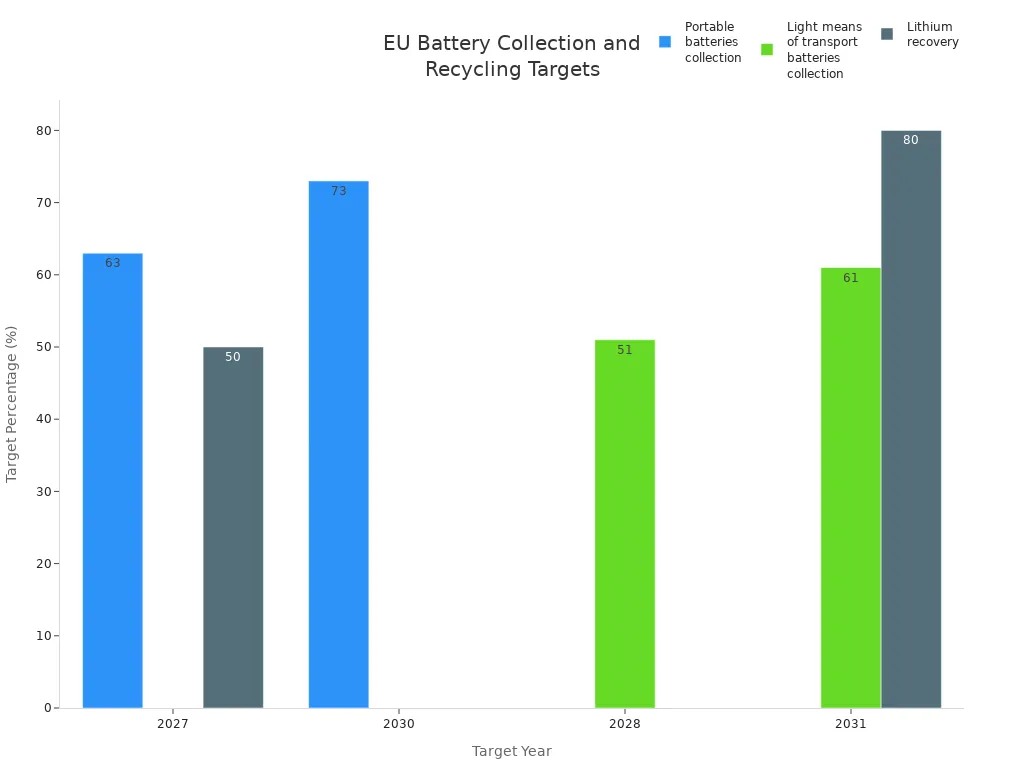
The regulation expands the scope to include more battery types and introduces material-specific recovery targets for lithium, cobalt, and nickel. You must implement efficient take-back systems and recycling processes to meet these goals. The approach shifts from basic recycling participation to a lifecycle and circular economy model, emphasizing producer responsibility, safety standards, and traceability.
Efficient battery recycling supports compliance and reduces your environmental impact. For more on battery recycling regulations, review the latest updates from the European Commission.
2.5 Replaceable Battery
The regulation requires that portable batteries in devices must be safely removable and replaceable by the end user using commercially available tools. This requirement applies from February 2027 and aims to improve repairability, extend product life, and support recycling.
Devices must operate with both original and compatible batteries.
Spare batteries must be available at a reasonable price for at least five years after the last unit is placed on the market.
Instructions and safety information on battery use, removal, and replacement must be provided and permanently available online.
Some exceptions exist for products used in wet environments, certain medical devices, and devices where power continuity is critical.
These requirements directly influence the physical design and assembly of lithium battery packs. You must design for easy access and replacement, support third-party repairers, and ensure safety and compliance. Modular, standardized, and sustainable battery designs will help you meet both regulatory and market demands.
Part 3: Challenges and Solutions
3.1 Data and Reporting
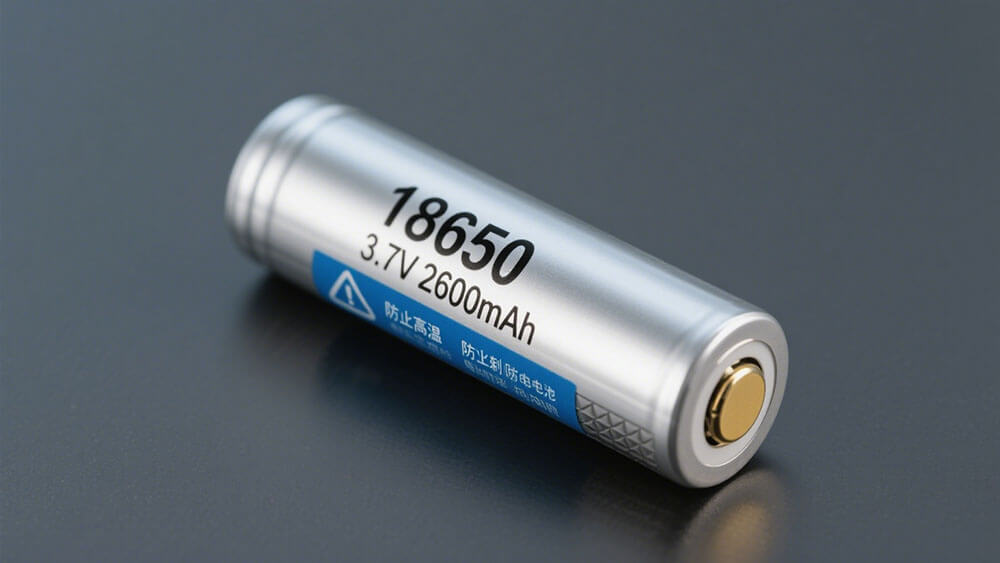
Battery-passport compliance requires coordinated data collection across cell suppliers, pack manufacturers, BMS developers, device manufacturers, importers, repairers, repurposing operators, and recyclers. The main challenge is not simply the number of regulatory articles; it is maintaining accurate, interoperable, and access-controlled information throughout the battery lifecycle.
Data Area | Preparation Priority |
|---|---|
Product identity | Define model identifiers, serial-number rules, QR-code ownership, and links between physical batteries and digital records. |
Supplier data | Obtain chemistry, material, sourcing, recycled-content, and carbon-footprint inputs under clear contractual responsibilities. |
BMS data | Determine which capacity, cycle, state-of-health, temperature, and fault data can be measured reliably and shared lawfully. |
Lifecycle updates | Plan how repair, remanufacturing, repurposing, and end-of-life events will update the record. |
Access control | Separate public information from data reserved for authorities, notified bodies, and parties with a legitimate interest. |
Change management | Track implementing acts, delegated acts, harmonized standards, and future guidance before product release. |
A well-designed BMS and PCM architecture can provide useful operational data, but BMS readings should be validated before they are used for regulatory reporting. Manufacturers of industrial battery systems should define data accuracy, retention, cybersecurity, ownership, and interface requirements during the design phase.
3.2 Cost Management
Cost management is critical as you adapt to new EU regulations for batteries in the energy sector. You can control expenses by investing in integrated ERP systems that centralize compliance, automate documentation, and track supplier performance. Consider these strategies:
Use ERP platforms for real-time monitoring and early risk detection.
Centralize data collection to simplify audits and inspections.
Automate compliance reporting to reduce manual errors.
Train staff regularly on regulatory updates.
Benchmark costs against industry peers and adjust pricing as needed.
Embrace energy efficiency and sustainability initiatives to lower operational costs.
Outsource non-core activities to scale efficiently.
A culture of continuous improvement and preventive maintenance helps you avoid downtime and extend the life of batteries, especially in demanding energy applications.
3.3 Supplier Engagement
Strong supplier engagement ensures you meet EU battery regulation standards and maintain energy supply chain resilience. Follow these steps:
Conduct a gap analysis to identify compliance shortfalls.
Build a detailed plan for phased regulatory obligations.
Audit suppliers and provide targeted training on compliance.
Communicate clear goals and expectations to all partners.
Use technology platforms for data intelligence and risk management.
Collaborate with legal and regulatory experts for due diligence.
Proactive engagement, long-term partnerships, and regular audits improve transparency and accountability. Training and incentives help suppliers align with your sustainability and energy goals. Technologies like blockchain and AI enhance traceability, supporting compliance for batteries in Medical, robotics, security, infrastructure, consumer electronics, and industrial sectors.
Part 4: EU Battery Strategy
4.1 Market Impact
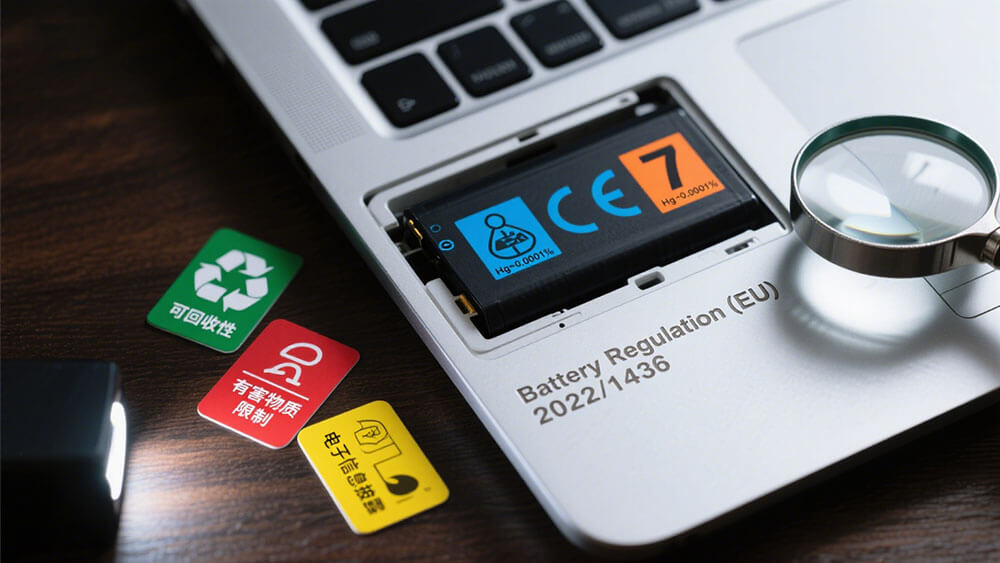
You operate in a rapidly changing energy market shaped by the EU battery strategy. The regulation introduces strict requirements for sustainability, safety, and circular economy, directly affecting lithium battery pack manufacturers. You must adapt to new rules that cover every vehicle segment, from electric vehicle production to industrial and consumer electronics. The regulation mandates consumer-removable batteries by 2027, which challenges your product design and may increase costs. You face the need to create EU-specific variants, which can fragment the market and slow the energy transition.
The EU battery strategy aims to harmonize the legal framework for all battery types, supporting the energy transition and reducing reliance on non-EU raw materials. This approach increases complexity and compliance costs, especially for companies producing batteries for vehicles and energy storage. You must navigate overlapping regulations and prepare for extensive documentation, which can impact your ability to innovate and compete in the European market.
Note: The regulation’s focus on circularity may paradoxically increase electronic waste if not managed carefully, as more DIY battery replacements could reduce recycling efficiency.
4.2 Competitive Advantage
You can turn the EU battery strategy into a competitive advantage by acting early. Proactive compliance gives you access to advanced, sustainability-focused markets and positions your brand as an ESG leader. Early adoption of the Digital Battery Passport streamlines supply chain management and ensures responsible sourcing for every vehicle and energy application.
You improve operational efficiency by embedding traceability and real-time data capture at every stage of production.
Upgrading workflows for compliance future-proofs your business against evolving energy transition demands.
The strategy drives innovation in modular, repairable, and recyclable lithium battery packs, extending their value across multiple energy cycles.
You reduce long-term costs by automating data collection and lifecycle planning, which supports second-life battery applications in energy storage and vehicle fleets. By aligning with the EU battery strategy, you build resilience and unlock new opportunities in the global energy transition.
You gain a competitive edge by prioritizing compliance and continuous improvement in lithium battery pack operations. Assess your readiness, update your processes, and leverage digital tools. For complex regulatory challenges, seek expert guidance through our customized consulting services. Stay proactive to lead in the evolving EU market.
FAQ
1. What is the digital battery passport, and how does it affect lithium battery pack compliance?
The digital battery passport stores essential data for each lithium battery pack. You use it to prove compliance, track lifecycle, and support recycling.
2. How do the EU regulations impact lithium battery pack design for industrial applications?
You must design lithium battery packs for easy replacement, clear labeling, and traceability. These steps ensure compliance and support sustainability in industrial sectors.
3. Where can I get expert guidance on EU battery regulation compliance for my business?
You can contact Large Power for custom battery consulting. Our team helps you navigate compliance, optimize supply chains, and maintain your competitive edge.


