

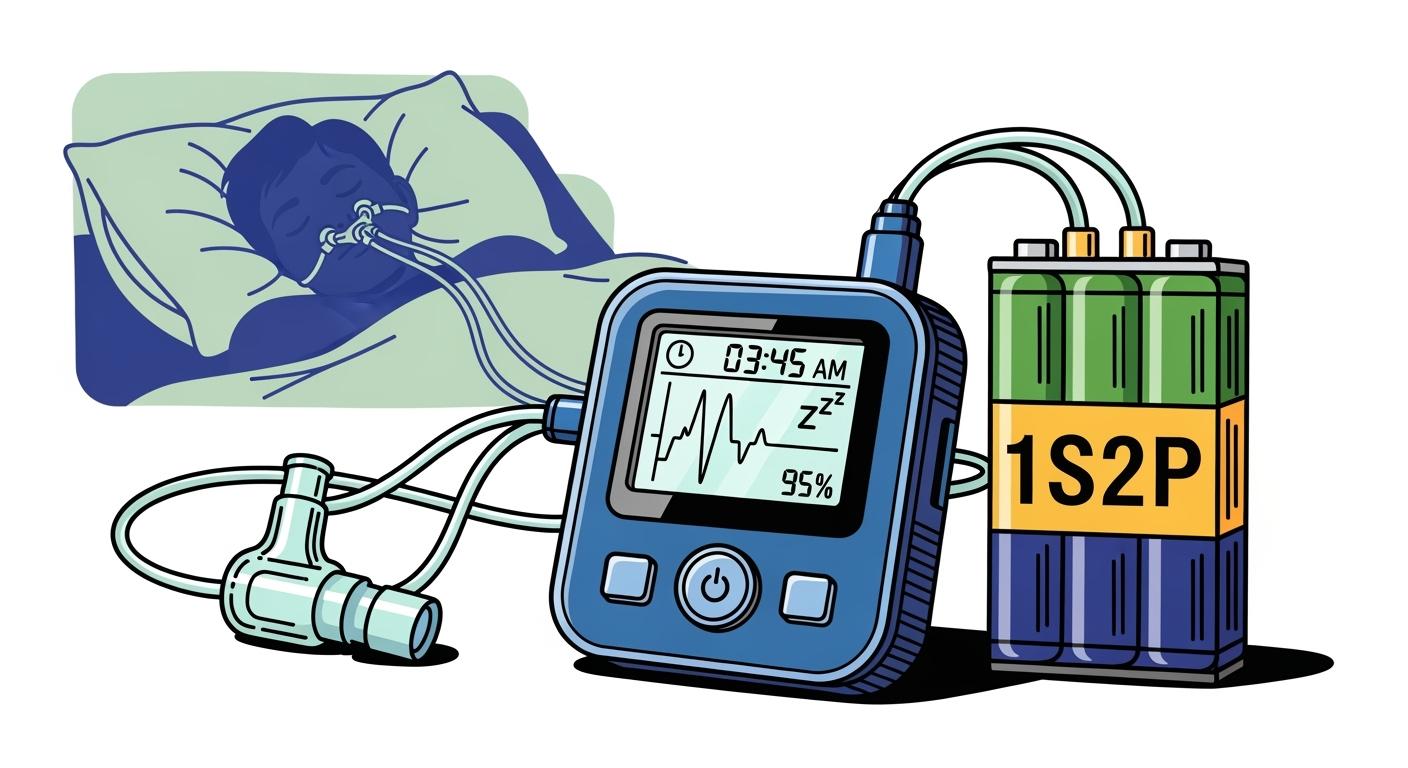
You rely on a lithium battery solution to power portable sleep apnea screening devices with maximum safety and uninterrupted therapy. Smart battery management systems in medical devices protect users and enhance reliability. The market for lithium battery solutions continues to grow, as shown below:
Year | Projected Market Size | CAGR (%) |
|---|---|---|
2022 | $12 billion | N/A |
2025 | $20 billion | N/A |
2025 | $68.66 billion | 21.1% |
Key Takeaways
The 1S2P lithium battery configuration doubles capacity while keeping voltage stable, making it ideal for portable medical devices.
Smart battery management systems enhance safety and reliability, providing real-time monitoring and extending battery life by up to 50%.
Extended runtime and compact design of 1S2P batteries ensure uninterrupted therapy for sleep apnea patients, improving patient comfort and mobility.
Part1: 1S2P Lithium Battery Solution Overview

1.1 What Is 1S2P Configuration
You encounter various battery configurations when designing portable medical devices. The 1S2P configuration consists of one cell in series and two cells in parallel. This setup doubles the capacity while maintaining the same voltage as a single cell. The following table compares common configurations:
Configuration | Description | Voltage | Capacity |
|---|---|---|---|
1S1P | A single cell battery. | V = Vc | Ah = Ahc |
1S2P | 1 cell in series, 2 cells in parallel. | V = Vc x 1 | Ah = Ahc x 2 |
2S1P | 2 cells in series, 1 cell in parallel. | V = Vc x 2 | Ah = Ahc x 1 |
You benefit from the 1S2P configuration by achieving higher capacity without increasing voltage, which is ideal for diagnostic and monitoring devices and wearable medical devices.
1.2 Role in Portable Monitoring Devices
You need reliable power for remote patient monitoring systems and lightweight cpap travel batteries. The 1S2P lithium battery provides extended runtime and stable performance. Typical voltage and capacity ranges for medical-grade batteries include:
Voltage Range | Nominal Voltage | Capacity |
|---|---|---|
3.0V to 4.2V | 3.3V | 2.2Ah |
3.6V | 3.6V | 5.7Ah |
3.6V | 3.6V | 38000mAh |
You ensure uninterrupted operation for portable devices, supporting medical device clearance and compliance with faa approved batteries.
1.3 Safety Features and Smart BMS
You prioritize safety features in every lithium-ion battery pack. Essential safety mechanisms include:
Safety circuit
Overcharge and overdischarge detection
Compliance with UL 1642 and CE Mark standards
Smart battery management systems enhance safety and reliability. You gain real-time monitoring, overcharge protection, and temperature control, which extend operational lifespan by up to 50%. Advanced BMS integrates a high-performance 32-bit MCU, multiple temperature sensors, and active balancing algorithms. These systems respond to anomalies within milliseconds and provide precise thermal management, extending battery lifespan by at least 20%. You meet strict safety requirements for portable medical devices and remote patient monitoring systems.
Part2: Benefits for Portable Sleep Apnea Screening

2.1 Extended Runtime and Power Efficiency
You need portable medical devices that deliver consistent performance throughout the night. The 1S2P lithium battery configuration provides extended runtime for sleep therapy devices and portable oxygen concentrators. You can rely on these batteries to support monitoring and diagnostic functions without frequent recharging. The increased capacity of the 1S2P setup ensures that your portable sleep apnea screening device operates for longer periods, reducing interruptions during critical monitoring sessions.
Tip: Extended runtime means fewer battery swaps and less downtime for patients using portable sleep therapy devices.
The cycle life of lithium battery packs plays a crucial role in medical devices. You benefit from a 1S2P lithium battery pack with a cycle life of over 500 cycles, which supports repeated use in portable monitoring applications. For comparison, a 1S4P configuration offers even greater longevity, reaching up to 700 cycles for demanding diagnostic scenarios.
Configuration | Cycle Life |
|---|---|
1S2P | 500+ cycles |
1S4P | ≥700 cycles |
You achieve optimal power efficiency with advanced battery management systems. These systems monitor voltage and temperature, ensuring that your portable medical devices maintain stable performance. You can trust lithium battery technology to deliver reliable energy for continuous monitoring and diagnostic tasks.
2.2 Portability and Compact Design
You require medical devices that are easy to transport and use in various environments. The compact design of 1S2P lithium battery packs enhances portability for sleep therapy devices and portable oxygen concentrators. You can integrate these batteries into lightweight monitoring equipment, making it easier for patients to carry devices during travel or daily activities.
The 1S2P lithium battery configuration allows you to reduce device weight without sacrificing capacity.
You improve portability for diagnostic and monitoring devices, supporting patient mobility and comfort.
You select lithium battery packs that fit seamlessly into portable medical devices, ensuring ergonomic design and ease of use.
You prioritize portability when designing sleep apnea screening solutions. The compact form factor of lithium battery packs enables you to create portable monitoring systems that meet the needs of patients and healthcare professionals.
2.3 Uninterrupted Therapy and UPS Mode
You understand the importance of uninterrupted therapy for sleep apnea patients. The 1S2P lithium battery solution supports UPS (Uninterruptible Power Supply) mode, ensuring that portable medical devices continue to operate during power outages or transitions. You can rely on lithium battery packs to maintain continuous monitoring and therapy, even in challenging environments.
Note: UPS mode provides peace of mind for patients and caregivers, guaranteeing uninterrupted sleep therapy and diagnostic monitoring.
You enhance reliability by integrating lithium battery packs with smart battery management systems. These systems detect power fluctuations and automatically switch to battery backup, preventing disruptions in therapy. You support portable sleep apnea screening devices that deliver consistent performance, whether at home, in clinics, or during travel.
You choose lithium battery solutions for their proven reliability in medical applications. The combination of extended runtime, portability, and UPS mode ensures that your portable monitoring devices meet the highest standards for patient care and diagnostic accuracy.
Part3: Selection Criteria for Portable Medical Devices
3.1 Capacity and Device Compatibility
You must evaluate capacity and device compatibility when selecting a lithium battery solution for portable sleep apnea monitoring devices. Capacity determines how long your device can operate without interruption. For sleep apnea therapy, you need a battery that supports at least 8-12 hours of runtime. Device compatibility ensures the battery matches your device’s voltage and connector requirements. You should check if the battery supports dual voltage (12V/24V) and matches the connector type. The table below summarizes key criteria:
Criteria | Description |
|---|---|
Capacity and runtime | Battery should power the device for 8-12 hours for uninterrupted treatment. |
Device compatibility | Must support dual voltage and accurate voltage/connector matching. |
Portability | Lightweight and compact design for easy transport. |
Higher capacity batteries provide longer run times, which is essential for travel or power outages. You should assess your typical usage to select the right battery.
3.2 Safety, Certifications, and Compliance
You must prioritize safety when choosing a lithium battery pack for medical devices. The 1S2P configuration uses two 3.6V 18650 cells and includes overcharge, over-discharge, and overcurrent protection. You should confirm that the battery meets international certifications such as UN38.3, CE, RoHS, UL, and IEC. The table below lists common standards:
Standard | Description |
|---|---|
IEC 62133 | Safety requirements for lithium ion batteries in portable applications. |
UN/DOT 38.3 | Guidelines for the safe transport of lithium batteries. |
UL 2054 | Safety standards for household and commercial batteries. |
You ensure compliance with these standards to guarantee safe operation in medical environments.
3.3 Charging and Maintenance
You must consider charging options and maintenance to maximize battery performance. Select batteries with multiple charging options to fit different scenarios. Regular maintenance, such as following recommended charge-discharge cycles and avoiding complete drains, extends battery lifespan. You should control temperature during charging to prevent overheating. Proper charging and maintenance practices ensure reliable operation and reduce long-term costs for your portable sleep apnea monitoring devices.
You gain optimal performance and safety with the 1S2P lithium battery solution for portable sleep apnea monitoring devices. You meet strict medical standards and ensure reliable therapy.
For custom lithium battery packs, click here to consult our experts. Choose advanced solutions for better patient outcomes.
FAQ
What makes the 1S2P lithium battery pack ideal for portable medical devices?
You benefit from stable voltage and extended runtime. The 1S2P lithium-ion battery pack fits compact medical devices and supports uninterrupted therapy for sleep apnea monitoring.
How does Large Power ensure safety and compliance for lithium battery packs?
You receive lithium battery packs with advanced BMS and certifications like UL, CE, and IEC 62133. Large Power meets strict safety standards for medical and industrial applications.
For custom lithium battery solutions, consult Large Power experts to optimize your device performance.
Can you compare lithium-ion and LiFePO4 chemistries for sleep apnea monitoring?
Chemistry | Cycle Life | Safety Level | Application Scenario |
|---|---|---|---|
Lithium-ion | 500+ | High | Medical, consumer |
LiFePO4 | 2000+ | Very High | Industrial, robotics |
You select lithium-ion for lightweight medical devices. You choose LiFePO4 for longer life in industrial and security systems.


