

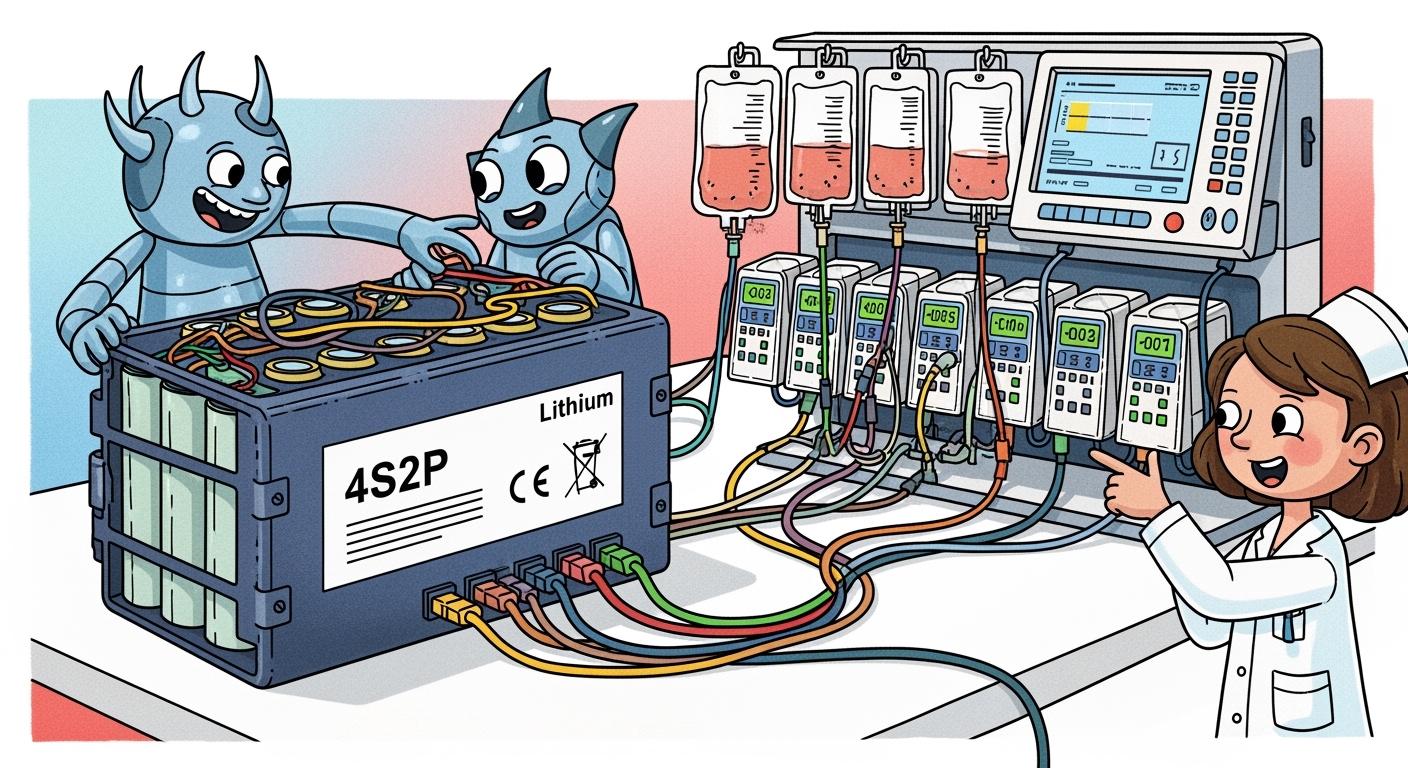
You design a Lithium Battery Backup system to ensure continuous operation for medical battery solutions infusion workstations. Safety, reliability, and compliance guide your process. A robust BMS, modular architecture, and predictive maintenance support long-term performance. The 4S2P configuration matches the power and capacity requirements for critical medical environments.
Key Takeaways
The 4S2P configuration provides stable voltage and increased capacity, essential for the reliable operation of medical devices.
Integrating a smart Battery Management System (BMS) allows for real-time monitoring, enhancing safety and performance while reducing maintenance costs.
Regular maintenance and operating within optimal charge levels can significantly extend the lifespan of lithium battery systems, ensuring continuous operation in critical medical environments.
Part1: Lithium Battery Backup System Essentials
1.1 4S2P Configuration Overview
You need to understand the basics of a 4S2P configuration when designing a Lithium Battery Backup for multi-channel infusion workstations. In this setup, four cells connect in series to provide a nominal voltage of 14.8V. Each series group contains two cells in parallel, which doubles the capacity while maintaining the same voltage. This arrangement offers several advantages for medical devices:
Stable voltage output supports sensitive medical electronics.
Increased capacity ensures longer backup times during outages.
Balanced energy density and discharge capability meet the demands of critical care equipment.
Medical devices represent a significant application area for the 4S2P configuration, with typical capacity requirements ranging from 4,000 to 7,000mAh.
The series-parallel structure also enhances reliability. You benefit from consistent power delivery, which is essential for life-supporting devices.
1.2 Power and Voltage Requirements
Multi-channel infusion workstations require precise power and voltage management. The Lithium Battery Backup must deliver a charging voltage of 16.8V (±0.03V) and maintain a discharge cut-off at 12.0V. The following table summarizes the recommended charging parameters:
Parameter | Value |
|---|---|
Charging Voltage | 16.8 ± 0.03V |
Standard Charge Current | Constant Current 0.2C5A |
Fast Charge Current | Constant Current 0.5C5A |
Discharge Cut-off Voltage | 12.0V |
You must ensure that the battery system meets these requirements to guarantee uninterrupted operation. The integration of a Battery Management System (BMS) is vital for monitoring cell performance and maintaining safety.
1.3 Cell Selection and Capacity Planning
Selecting the right cells is critical for the performance and safety of your Lithium Battery Backup. For medical applications, you should prioritize cells with high energy density, long cycle life, and robust safety certifications. Li-MnO2 (LMO) cells are often preferred due to their predictable end-of-life characteristics and strong pulse power capability.
Certification Standard | Description |
|---|---|
UL 2849 | Safety for e-bikes and their batteries |
UL 2271 | Safety for battery packs in many uses |
UL 2272 | Safety for e-bike electrical systems |
EN 15194 | European standard for electric bicycles |
When planning capacity, consider the hospital’s power infrastructure. At least 50% of receptacles in critical care areas should connect to an uninterrupted power supply. Modularity in battery design, as outlined by IEC 62619 and IEC 62660, allows you to scale and adapt the backup system as needs evolve. This approach supports rolling maintenance and localized protection, ensuring continuous operation in demanding hospital environments.
Part2: BMS, Safety, and Compliance

2.1 BMS Features and Remote Monitoring
You rely on a smart Battery Management System (BMS) to maintain the safety and performance of your lithium battery backup. The BMS monitors each cell’s state of charge (SOC) and state of health (SOH), providing real-time data on voltage, temperature, and current. This system logs charge cycles, temperature changes, and fault events, allowing you to track battery health over time. Remote monitoring capabilities enable you to access battery information from any location, which is essential for predictive maintenance and early fault detection. You receive alerts for abnormalities, helping you address issues before they escalate. The BMS communicates with external devices, supporting integration with hospital management systems and ensuring continuous operation of infusion workstations.
Tip: Remote monitoring via BMS reduces the need for on-site inspections, saving time and operational costs for medical facilities.
Key BMS Features for Medical Lithium Battery Backup:
Real-time remote monitoring of battery status
Detailed logging of charge cycles and fault events
SOC and SOH tracking for each cell
Cell balancing for uniform charge levels
Overcharge and over-discharge protection
Thermal management to prevent overheating
Communication with external systems for alerts and data sharing
Recent advancements in BMS technology include smart, connected batteries with IoT integration, miniaturized designs for compact medical devices, and hybrid approaches that combine batteries with energy harvesting techniques.
2.2 Balanced Charging and Discharging
Balanced charging and discharging are critical for maximizing the lifespan and safety of your lithium battery backup. The BMS ensures that all cells charge and discharge evenly, preventing cell drift and voltage imbalances. You benefit from over-current, over-voltage, and thermal protection, which safeguards the battery pack during operation. Charging at controlled rates, typically up to 1C, helps prevent damage and supports long-term reliability.
Benefits of Cell Balancing:
Extended battery lifespan by preventing overcharging and over-discharging
Improved safety through minimized risks of voltage reversal and thermal runaway
Enhanced energy efficiency and performance
Energy-efficient DC/DC converter-based active cell balancing techniques provide real-time energy indication, further optimizing battery pack performance in medical devices. You should prioritize these methods to ensure the highest level of safety and reliability.
2.3 IEC 60601 Compliance and Testing
Compliance with international standards is essential for lithium battery backup systems in medical environments. You must ensure that your battery packs meet IEC 60601 requirements for medical electrical equipment. Rigorous testing protocols validate safety, performance, and reliability. The following table compares international and regional standards relevant to lithium battery packs in medical devices:
Region | International Standards | Regional Standards |
|---|---|---|
Global | UL, IEC, ISO, SAE | UN/DOT regulations for shipping and handling lithium batteries |
China | N/A | GB/T Standards, China Compulsory Certification (CCC) |
United States | UL, SAE | FAA and DOT regulations |
European Union | N/A | Battery Regulation (EU 2023/1542) for sustainability and recycling mandates |
Japan | N/A | Japan Industrial Standards (JIS) |
South Korea | N/A | Korean Industrial Standards (KS) |
You should implement robust safety systems, including thermal management, short circuit protection, and cybersecurity measures to prevent unauthorized access and ensure safe data transfer. Real-time monitoring and hazard identification further support compliance and operational safety.
2.4 Maintenance and Lifecycle Management
Effective maintenance strategies maximize the lifespan and reliability of your lithium battery backup. You should maintain batteries in temperature-controlled environments, as exposure to temperatures above 30°C (86°F) can reduce lifespan by up to 30%. Keeping charge levels between 20% and 80% prevents irreversible damage and capacity decline. Regular monitoring of charge cycles and avoiding deep discharges are essential practices.
Note: Operating within the optimal charge range can increase battery lifespan by 50%, which is crucial for medical applications.
Implementing predictive maintenance allows you to detect anomalies early, minimize downtime, and reduce costs. You focus resources on systems that need immediate attention, enhancing safety and sustainability. For more information on maintenance best practices, consult industry experts.
Benefits of Predictive Maintenance:
Minimizes downtime and ensures continuous operation
Reduces costs by preventing catastrophic failures
Enhances safety by detecting potential issues early
Optimizes resource allocation
Supports sustainability by extending system life
Provides a competitive advantage in critical medical environments
You should schedule regular inspections, monitor battery health, and follow manufacturer guidelines to ensure your lithium battery backup system remains reliable and compliant throughout its lifecycle.
You ensure safety and reliability in your 4S2P battery backup design by following these best practices:
Use modular designs for flexibility and easy repairs.
Integrate a smart BMS for real-time monitoring and predictive analytics.
Adhere to medical standards and schedule regular testing to maintain compliance and system performance.
FAQ
What advantages does a 4S2P lithium battery pack offer for medical and industrial applications?
You gain stable voltage, extended runtime, and modularity. These features support critical systems in medical, robotics, and industrial sectors.
How can you ensure compliance with international safety standards for lithium battery packs?
You should select certified cells, implement a smart BMS, and follow IEC 60601 and UL standards. Regular testing and documentation remain essential.
Where can you request a custom lithium battery solution for your enterprise project?
You can consult Large Power’s custom battery team for tailored lithium battery packs designed for medical, security, or industrial applications.


