

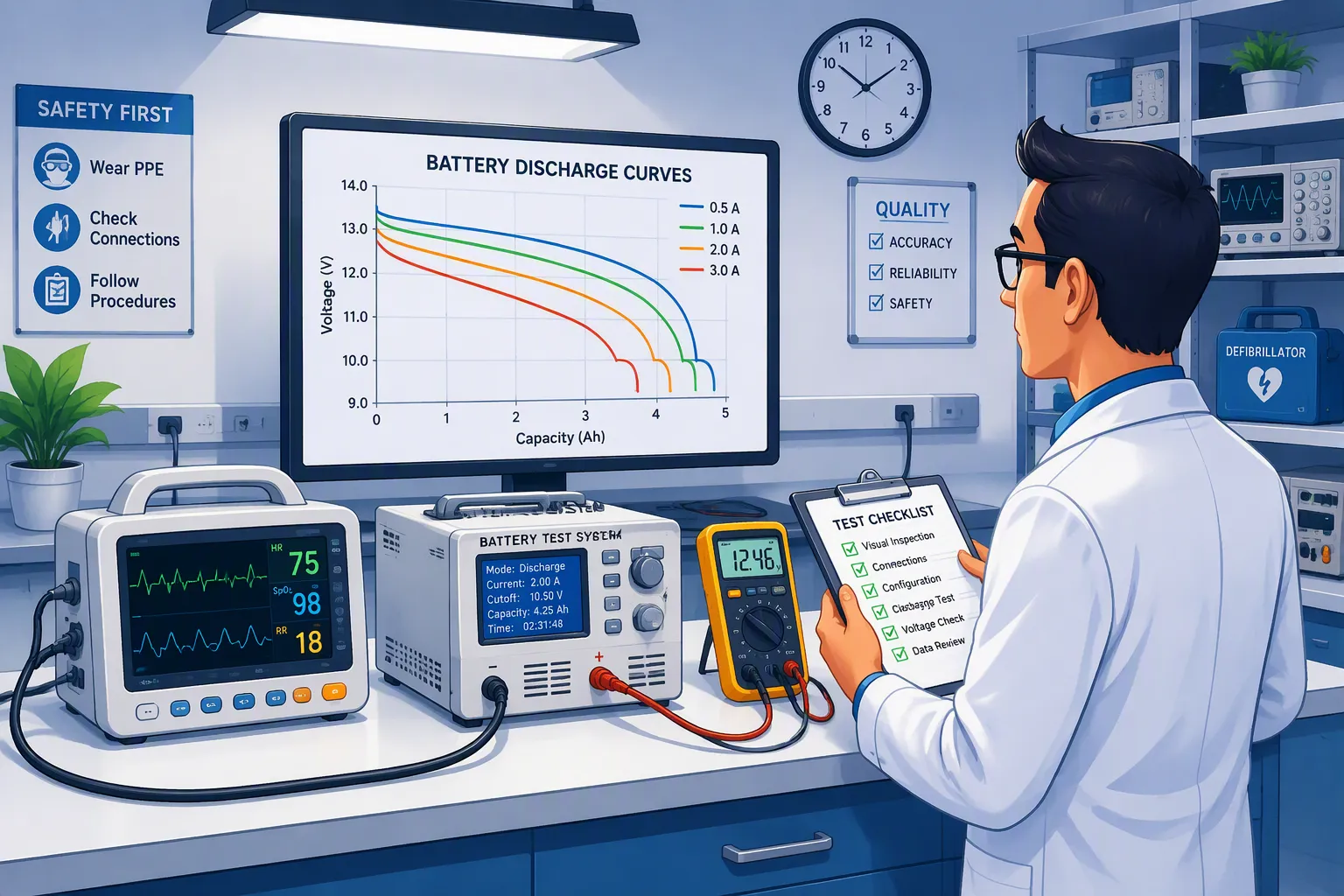
Quick Answer: Medical-device manufacturers should validate battery runtime using the complete device, production-representative battery packs and realistic operating profiles. IEC 60601-1 does not prescribe one universal runtime or sample quantity. The validation plan should instead be based on intended use, essential performance, risk management, labeling claims and any applicable particular standards.
Imagine a portable infusion pump stopping before treatment is complete. A low-battery alarm may sound, but if the remaining operating time is insufficient, the situation can become critical. Manufacturers must therefore demonstrate that battery-powered medical equipment performs predictably throughout its declared operating period and transitions safely when available energy becomes low.
IEC 60601-1 addresses the basic safety and essential performance of medical electrical equipment. Battery runtime becomes relevant when loss or degradation of power could create an unacceptable risk, interrupt an essential clinical function or make a declared performance claim inaccurate.
Runtime validation is not simply a cell-capacity measurement. It should evaluate the battery, protection circuit, power path, charger, firmware, alarms and medical device as an integrated system.
Key Takeaways
Define the operating-time or procedure-count claim before creating the validation protocol.
Use load profiles that reproduce startup, standby, communication, display, pump, heater, motor and alarm activity.
Test the complete device with its production-representative battery pack and final cutoff settings.
Include foreseeable worst-case conditions such as battery aging, low temperature, high device load and repeated alarms.
Verify that low-battery indications provide sufficient time for the user to respond.
Document assumptions, acceptance criteria, configurations, firmware versions and deviations in the validation report.
Use medical battery solutions designed around the device’s actual power and risk requirements.
Part 1: IEC 60601-1 Framework for Battery Runtime Validation
IEC 60601-1 does not hand you a fixed runtime number. The standard requires you to declare a Rated Operating Time in your technical description. You must then validate that declaration through testing. This validation ensures your device maintains Essential Performance throughout the entire declared period. The standard’s power supply requirements and battery interruption scenarios are governed by relevant clauses. Together, these clauses form your primary regulatory hooks for Battery Runtime Validation.
1.1 Essential Performance and Declared Runtime
Essential Performance means the performance of a clinical function whose loss or degradation would result in unacceptable risk. You determine this through hazard analysis per ISO 14971. Consider a portable ventilator. Its clinical function—delivering prescribed tidal volume—becomes Essential Performance because failure could cause patient harm. An intermittent monitoring device might define Essential Performance differently. Your declared runtime must cover all safety-critical functions, including alarms and backup transitions.
You identify Essential Performance through a structured process. First, list all clinical functions your device performs. Second, set performance limits between full function and loss or degradation. Third, evaluate the risk of harm from failure of each function. If a function’s failure does not lead to harm, it does not qualify as Essential Performance. If it does, you must document that function in your risk management file.
Your risk management file ties directly to ISO 14971. There, you record Essential Performance criteria and demonstrate compliance under normal and fault conditions. A notified body will scrutinize the link between your declared runtime and your test evidence. They will ask: does your test data prove Essential Performance holds for the entire declared period? Your documentation must answer this question clearly.
1.2 Key Clauses Governing Battery-Powered Devices
The standard requires your device to operate safely across specified power supply conditions. For battery-powered devices, this means your power system must maintain Essential Performance from full charge to end-of-discharge voltage. Your battery management system (BMS) plays a critical role here. The BMS monitors cell voltages, manages charge states, and protects against over-discharge. Understanding BMS architecture helps you design effective runtime validation protocols. You can explore additional resources on BMS and protection circuit modules to strengthen your approach.
The standard addresses what happens when battery power interrupts. Your device must transition safely to backup power or shut down in a controlled manner. This clause demands you test the transition between mains and battery power. You must also verify that alarms activate appropriately during power loss events. These requirements directly shape your Battery Runtime Validation strategy.
Your declared runtime must account for worst-case scenarios. A device operating at maximum load with active alarms consumes more power than one in standby. Your validation tests must reflect these demanding conditions. Only then can you confidently claim compliance with IEC 60601-1.
Part 2: Core Test Methodologies for Runtime Validation

To validate your runtime claims, you need two complementary test methods. Capacity discharge testing establishes the baseline performance of your battery cells. Dynamic load profile testing pushes your system closer to real-world conditions. Together, these methods form the backbone of a robust Battery Runtime Validation program.
2.1 Capacity Discharge Testing Under Controlled Conditions
Constant current (CC) and constant power (CP) discharge are the standard methods for capacity testing. In CC discharge, you draw a fixed current from the battery until it reaches the end-of-discharge voltage (EODV). In CP discharge, you maintain constant power output, which more closely mimics devices with regulated power consumption. You define EODV based on two factors: the battery management system cutoff voltage and the minimum operational voltage of your device. The BMS cutoff prevents cell damage from over-discharge. The device minimum voltage ensures your electronics can still function. The lower of these two values sets your EODV.
Set your test environment to a controlled room temperature as a baseline. This temperature range represents typical indoor operating conditions for most medical devices. Your pass criterion is straightforward: the measured capacity in mAh or Wh must meet or exceed your declared value. Run multiple samples to account for cell-to-cell variation. The average capacity across all samples must satisfy the requirement.
You must also document the test conditions precisely. Record the temperature, humidity, and charge state before each discharge cycle. Use calibrated equipment and trace your measurements back to a known standard. This documentation supports your risk management file and helps your notified body verify your claims.
2.2 Dynamic Load Profile Testing for Real-World Scenarios
Dynamic load testing takes you beyond static discharge. Here you program a battery cycler to simulate the actual mission profile of your device. This profile includes peak loads during motorized functions, standby currents when the device idles, and communication bursts from wireless modules. The goal is to verify that voltage sags under pulse loads do not trigger a premature system shutdown.
The most accurate approach is to capture the actual current consumption waveform directly from your device. For example, a pulse oximeter medical IoT device shows a specific current drain pattern during operation. By replicating this waveform on the cycler, you test the battery under conditions that mirror real use. This method is more precise than using generic load profiles, because it captures the variable current consumption of your device. You can record this waveform using a data logger or oscilloscope while the device runs through a complete use cycle.
Your device must complete the full simulated mission while maintaining Essential Performance. Monitor the battery voltage throughout the test. If voltage drops below the minimum operational threshold during a pulse, your system may shut down prematurely. Adjust your battery capacity or BMS settings accordingly. Document the test results, including the load profile, voltage trace, and runtime achieved. A well-designed dynamic load test reduces the risk of field failures and strengthens your Battery Runtime Validation evidence.
Part 3: Environmental Factors Affecting Battery Runtime Validation

Your lab tests at a comfortable room temperature tell only part of the story. Medical devices operate in hospital corridors, ambulances, and patient homes. Each environment presents different temperature challenges. Lithium-ion cells respond dramatically to thermal conditions. You must understand these responses to design meaningful validation tests.
3.1 Temperature Extremes and Their Impact on Lithium-Ion Cells
Cold temperatures increase internal resistance within lithium-ion cells. This resistance restricts ion movement between electrodes. The result: reduced usable capacity and lower voltage under load. A device that runs at room temperature might deliver significantly less time in cold conditions. Your infusion pump could alarm prematurely in a cold ambulance bay, even with a freshly charged battery.
High temperatures create opposite problems. Heat accelerates chemical reactions inside the cell. This acceleration causes faster degradation of electrode materials and electrolyte. A battery cycled at elevated temperatures loses capacity more quickly than one at room temperature. The device might pass initial validation but fail after months of operation in warm environments.
IEC 60601-1 requires you to declare an operating temperature range for your device. You must test Battery Runtime Validation across this entire range. A typical specification spans the declared operating temperature range. Your test plan should include discharge testing at the lower limit, upper limit, and room temperature. This approach reveals how temperature affects your runtime claims.
Consider the practical implications. At low temperatures, the battery management system may interpret voltage sag as end-of-discharge. The system shuts down the device while usable energy remains in the cell. Your firmware must account for this behavior. You might need to adjust cutoff thresholds or implement temperature-compensated discharge algorithms.
3.2 Aging and End-of-Life Performance Considerations
A fresh battery represents the best-case scenario. Real devices spend months or years in service. Every charge cycle degrades the cell slightly. Lithium-ion batteries lose capacity through repeated cycling. Active material becomes less accessible. Internal resistance increases. Your validation strategy must account for this inevitable decline.
Industry practice establishes a clear benchmark for battery replacement. The standard threshold for end-of-life is 80% State of Health. This means the battery delivers only 80% of its original rated capacity. At this point, the cell can no longer reliably support critical applications.
The industry standard for End of Life (EOL) is 80% State of Health (SOH). This is the typical threshold used across sectors, including medical devices, to determine when a battery should be replaced, as it indicates the battery can no longer reliably deliver the required power for critical applications.
For defibrillator batteries, a capacity reading below 80% indicates that a replacement is needed. This threshold serves as a benchmark to determine when a battery’s state-of-health has degraded to the point of requiring end-of-life action.
Consider a home-use portable diagnostic device rated for 500 charge cycles. After those cycles, capacity drops below 80%. Your runtime validation must prove the device still meets minimum requirements at this degraded state. Testing only new batteries creates a dangerous gap in your evidence.
You should test aged cells in your validation program. You can accelerate aging through controlled cycling at elevated temperatures. Alternatively, you can purchase cells that have already undergone partial cycling. Test these aged cells under your dynamic load profile. Verify that Essential Performance continues throughout the declared runtime, even at 80% capacity.
This approach prevents premature field failures. A device that barely passes with a new battery will fail early in service. Your risk management file should document the relationship between battery age and runtime performance. This documentation demonstrates proactive safety engineering to your notified body.
Part 4: Compliance Strategy and Documentation Best Practices
4.1 Building a Traceable Test Report for Notified Bodies
Your test report serves as the primary evidence for your runtime claims. A notified body reviews this document to verify compliance with IEC 60601-1. The report must connect directly to your Risk Management File per ISO 14971. This connection shows how your testing addresses each identified hazard.
Include specific details in every test report. Record the battery model number and manufacturer. Document the firmware version running on your device during testing. Note the calibration dates of all test equipment. Describe the environmental conditions, including temperature and humidity levels. These details allow reviewers to assess the validity of your results without requesting additional information.
A well-structured report anticipates common reviewer questions. State the test objective clearly at the beginning. Explain how the test setup matches the device’s intended use. Show the relationship between your declared runtime and the measured capacity. Include pass-fail criteria and the actual outcomes. This preparation reduces the number of review cycles and accelerates your certification timeline.
4.2 Avoiding Common Pitfalls in Battery Testing
Manufacturers repeat the same mistakes during Battery Runtime Validation. These errors lead to costly re-testing cycles and regulatory delays. You can avoid them with proper planning.
The most common pitfall is testing only at room temperature. Your device must operate across its declared temperature range. Test at the lower limit, upper limit, and room temperature to validate runtime claims fully.
Using only new batteries creates another gap. A fresh cell delivers maximum capacity. Aged cells at 80% State of Health perform differently. Your validation must include end-of-life conditions to prevent field failures.
Failing to define a realistic load profile also causes problems. Static discharge tests do not reflect real device behavior. Use a dynamic load profile that captures peak loads, standby currents, and communication bursts. This approach ensures your battery can handle actual mission profiles.
Neglecting to test the transition between mains and battery power is another frequent error. The standard requires you to verify safe power transitions. Your device must maintain Essential Performance during these events.
Additional pitfalls relate to scope and quality. Testing individual cells rather than the complete battery pack leaves protection circuits unverified. Using labs without ISO 17025 accreditation for IEC 62133 testing leads to rejected reports. Continuing to test against outdated standard versions creates compliance gaps. Overreliance on battery manufacturer specifications without your own testing ignores real-world conditions. Each of these issues requires attention during your validation planning.
Battery runtime validation demands your full attention across every development phase. You must understand IEC 60601-1 deeply, design realistic tests, and document everything thoroughly. This multi-faceted process protects patients and secures market access.
Proactive planning delivers the strongest results. Define your intended use profile early. Test under environmental extremes. Account for battery aging at 80% State of Health. These steps prevent costly re-testing cycles and regulatory delays.
Recent research by the U.S. Department of Energy has developed cobalt-free lithium-ion batteries with silicon-carbon composites that could triple storage capacity, potentially extending device runtimes significantly.
The medical battery market continues expanding at a CAGR of 7.8% through 2028. Emerging chemistries like solid-state batteries promise higher energy density and improved safety. Your validation framework must adapt as power systems evolve. Robust testing remains your foundation for patient safety and regulatory success.
FAQ
How many battery samples should manufacturers test?
There is no universal IEC 60601-1 sample quantity for battery runtime validation. Manufacturers should justify the sample plan according to risk, manufacturing variation, reliability objectives and applicable regulatory requirements. Multiple samples and production lots may be appropriate for higher-risk devices.
Should manufacturers test cells or the complete battery pack?
Cell data is useful for component selection, but device-runtime validation should use the production-representative battery pack and complete device. Protection circuits, BMS settings, connectors, wiring, converters, firmware and cutoff thresholds all affect usable runtime.
Must testing be repeated after every firmware update?
Not necessarily. Manufacturers should document a change-impact assessment. Targeted regression or complete runtime testing is needed when the update can affect power consumption, operating sequences, alarms, charging or shutdown behavior.
Does IEC 60601-1 specify a minimum medical-device runtime?
IEC 60601-1 does not establish one minimum runtime for all medical devices. The required performance depends on intended use, essential performance, risk controls, labeling claims and applicable particular standards.
Can manufacturers rely on the battery supplier’s datasheet?
No, not for the final device-runtime claim. Supplier data supports cell and pack selection, but it usually reflects specified laboratory conditions. Device manufacturers must validate their own operating profile, thermal environment, BMS thresholds and end-of-discharge behavior.
How should manufacturers define battery end of life?
End of life should be connected to safe device operation, not capacity alone. A battery may require replacement when it can no longer complete the declared procedure, maintain essential performance, deliver peak current or provide sufficient warning time before shutdown.
For support with load-profile analysis, BMS configuration and device-level battery integration, discuss your requirements with our custom battery engineering team.


