

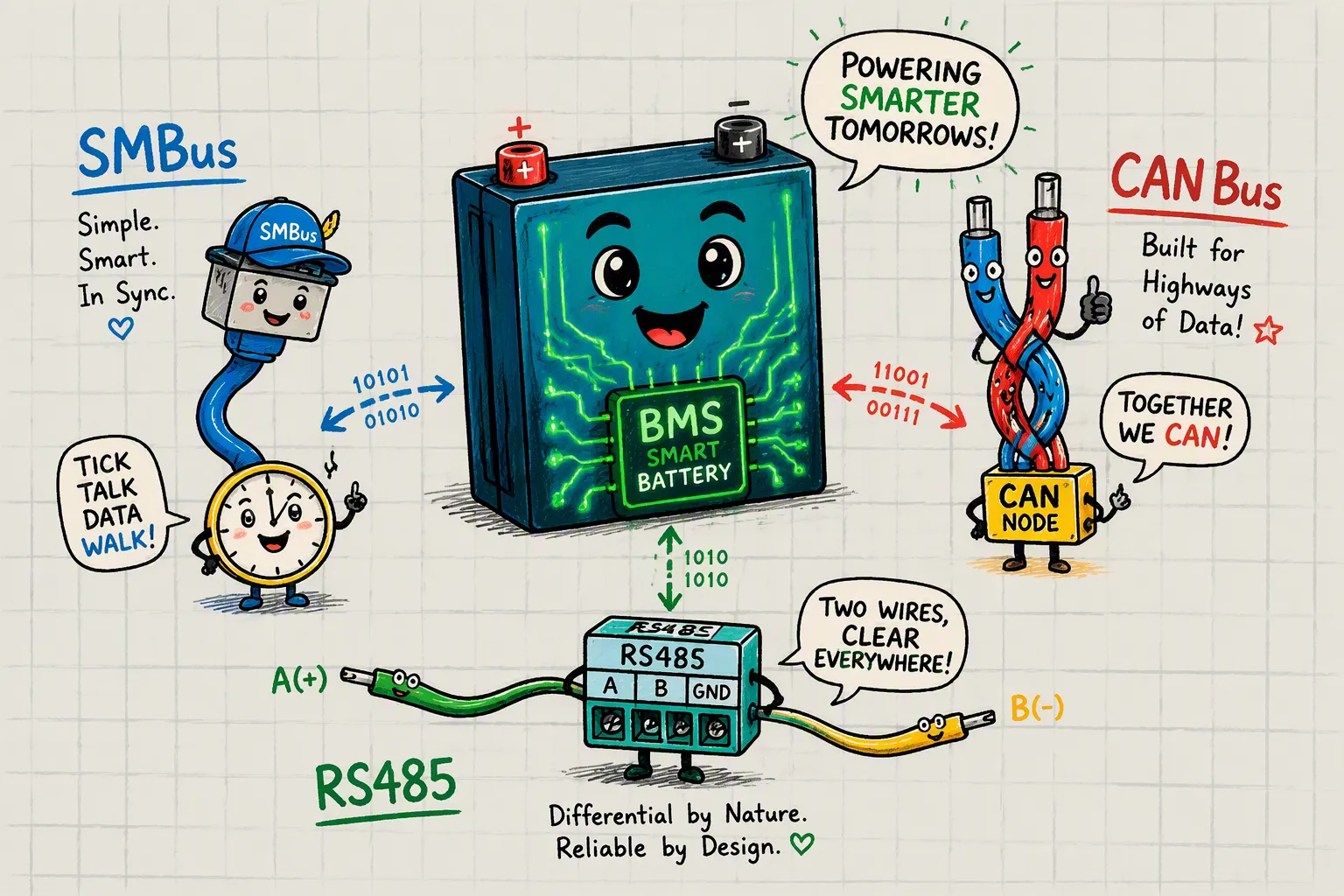
The communication interface of a Battery Management System (BMS) determines how reliably a smart lithium battery pack exchanges voltage, current, temperature, state-of-charge, alarm, and diagnostic data with the host device.
Selecting the wrong interface can cause communication instability, integration delays, or incomplete fault reporting. However, communication loss should never disable the battery pack’s essential protection functions. Overvoltage, undervoltage, overcurrent, short-circuit, and overtemperature protection must remain available locally within the BMS.
SMBus, CAN Bus, and RS485 serve different engineering requirements:
SMBus is well suited to portable medical devices, laptops, handheld equipment, and other compact systems requiring standardized smart-battery data exchange.
CAN Bus supports reliable, real-time communication in electrically noisy environments such as robotics, AGVs, industrial equipment, and high-voltage battery systems.
RS485, typically combined with Modbus RTU or a proprietary protocol, is suitable for long-distance and multi-drop communication in energy storage, backup power, and remote monitoring systems.
The right choice depends on communication distance, data rate, electromagnetic interference, network architecture, host compatibility, functional-safety requirements, and development cost.
Key Takeaways
Select SMBus for compact smart-battery systems requiring standardized battery data over short communication distances.
Select CAN Bus for robotics, vehicles, and industrial equipment requiring deterministic communication and strong fault detection.
Select RS485 for long-distance, multi-drop networks, but define the application-layer protocol and error-checking mechanism clearly.
Do not rely on communication alone for battery protection. Critical cutoffs must operate independently inside the BMS.
Consider hybrid architectures when the battery system requires fast internal communication and long-distance external monitoring.
Confirm message definitions, baud rate, connector pinout, termination, isolation, and host compatibility before finalizing the battery design.
Part 1: Understanding Protocol Options for Smart Battery Packs
1.1 Impact on BMS Safety and Performance
Your battery management system (BMS) guards every cell in your lithium battery pack. It tracks voltage, current, and temperature continuously. The communication protocol determines how fast and how accurately your BMS receives sensor data and sends commands. A weak protocol introduces delays or corrupted readings. Those errors can prevent your BMS from disconnecting a cell during overvoltage or overheating. That delay creates a real safety hazard.
The protocol also shapes your system architecture and total cost. Medical devices demand low power and compact layouts. Robotics and industrial equipment require high-speed communication with strong noise rejection. Security systems and infrastructure projects often place battery cabinets far apart. Consumer electronics prioritize simplicity and low component cost. Each scenario pushes you toward a different protocol choice. Reviewing BMS and PCM design considerations early helps you align your communication strategy with your safety requirements. You avoid expensive redesigns when you match the protocol to your physical layout and environmental conditions from the start.
1.2 Overview of SMBus, CAN Bus, and RS485
Three wired protocols dominate smart lithium battery communication. Each serves a distinct application space.
SMBus builds on I2C, a two-wire protocol for short-distance communication between integrated circuits. It connects a BMS microcontroller to temperature sensors or fuel gauges inside a compact pack. SMBus appears almost exclusively in consumer and portable electronics, including laptops and medical instruments. Its low power draw and minimal pin count suit small battery assemblies.
CAN Bus leads electric vehicles, automated guided vehicles, and industrial machinery. It delivers higher communication speeds with excellent interference rejection. CAN supports robust multi-device networking, which fits systems with multiple battery modules talking to one master controller. The CANopen application layer standardizes messaging further in industrial deployments.
RS485 uses differential signaling for long-distance communication over a serial bus. It connects up to 32 devices in a multi-drop arrangement. This makes RS485 the standard choice for stationary energy storage, telecom infrastructure, and large-scale backup systems. Its noise immunity proves essential near motors, inverters, and other electrical interference sources. Modbus frequently runs on top of RS485 for structured data exchange.
Feature | CAN Bus | RS485 |
|---|---|---|
Communication Speed | Higher | Medium |
Anti-Interference | Excellent | Good |
Complexity | Higher | Lower |
Cost | Higher | Lower |
Multi-Device Networking | Excellent | Good |
EV Applications | Very Common | Less Common |
ESS Applications | Common | Very Common |
CAN appears across every industry at the BMS master level. SMBus stays limited to consumer devices. RS485 dominates stationary storage. Your operating environment and performance targets will point you toward the right option.
Part 2: Comparing CAN Bus, RS485, and SMBus
Three protocols compete for smart lithium battery communication. CAN Bus dominates electric vehicles and high-speed industrial systems. RS485 excels in long-distance multi-drop networks for energy storage. SMBus fits low-power consumer devices. Selecting protocol for smart lithium battery packs requires matching your operating environment to the right communication standard. Your decision affects data speed, noise immunity, and total system cost.
2.1 SMBus: Best for Low-Power Monitoring
SMBus builds on the I2C standard. It uses only two wires for communication between integrated circuits. This simplicity keeps power consumption extremely low. You find SMBus in consumer electronics like laptops and medical devices where battery life matters most. The protocol connects a BMS microcontroller to temperature sensors or fuel gauges inside a compact pack. Implementation cost ranks low alongside RS485. SMBus chips cost little and require minimal board space. The trade-off comes with distance. SMBus works only over short traces on a single PCB. It cannot handle long cable runs or high electrical noise. For a small lithium battery pack in a handheld device, SMBus offers the simplest path. You gain low power draw, low cost, and straightforward integration. You lose the ability to communicate across a large system or through noisy environments. If your pack stays within a single enclosure and you prioritize battery runtime, SMBus makes sense. For more complex systems with multiple modules, you need a different protocol.
2.2 CAN Bus: Dominant for EV and High-Speed Systems
CAN Bus sets the standard for electric vehicle battery communication. It delivers high speed with excellent noise rejection. CAN FD extends the original protocol to achieve 5 Mbps data rate with 64 byte payloads. This speed suits complex BMS architectures that require frequent parameter updates. You can monitor every cell group, temperature sensor, and contactor state in real time. CAN supports robust multi-device networking. You connect multiple battery modules to a single master controller. The protocol detects and corrects transmission errors automatically. This built-in safety reduces the risk of corrupted data causing undercharging or missed fault alerts. Implementation costs rank medium. CAN controllers like the MCP2515 and transceivers cost more than RS485 or SMBus components. Proper termination with 120 ohm resistors adds minor complexity. This higher upfront investment reduces long-term risk. Compare this with RS485. An RS485 chip like the MAX485 costs a fraction of a CAN controller. Wiring is simpler with no special termination for short distances. RS485 uses differential signaling over twisted pair cables. You can connect up to 32 devices in a multi-drop arrangement. Modbus frequently runs on top of RS485 for structured data exchange. However, the lack of built-in safety and error correction creates higher long-term risk. A corrupted RS485 signal might cause your inverter to undercharge the battery, reducing cycle life. A missed fault alert could lead to inverter repair costs of one thousand to five thousand dollars for industrial models. CAN Bus prevents these failures through its error detection framework. When selecting protocol for smart lithium battery packs, remember that CAN Bus offers the best balance of speed and safety for high-performance systems. For robotics, industrial machinery, and electric vehicles, CAN Bus remains the dominant choice. You gain speed, reliability, and noise immunity that RS485 and SMBus cannot match at high data rates. For long cable runs between battery cabinets in an industrial ESS, RS485 remains a practical choice. You balance lower initial cost against the need for robust error checking.
Part 3: Selecting Protocol for Smart Lithium Battery Packs

3.1 Mapping Requirements: Data Rate, Distance, and Noise
You need a clear process to match your battery pack to the right protocol. Start by defining your system requirements. Follow these five steps:
Specify the data volume your BMS must transmit. Include voltage readings, current measurements, temperature data, and state-of-charge updates. Higher data volume demands faster protocols like CAN Bus. A pack with 16 cells in series generates more data than a 4-cell pack.
Evaluate your operating environment. Measure the electrical noise level near motors, inverters, and power supplies. Measure the distance between your battery pack and the master controller. A robotics application may place the battery close to the controller. An infrastructure project may spread batteries across a large building.
Check interoperability with existing equipment. Your inverter or PLC may already use Modbus over RS-485. Match the protocol to avoid adding conversion hardware. Industrial ESS systems commonly use Modbus for SCADA integration.
Review security features and certifications. Industrial systems often require specific safety standards. CAN Bus includes built-in error detection that strengthens system safety. This reduces the risk of missed fault alerts.
Calculate the total cost. Include hardware components, cabling, connectors, and development time. A lower component price may lead to higher integration costs.
Distance and noise are the two most critical factors. CAN Bus is rated with very high noise immunity. It handles automotive EMI environments well. RS-485 offers high common-mode rejection but is less robust in extremely noisy conditions. If your battery pack sits near large inverters or motor drives, CAN Bus provides stronger anti-interference capabilities. For long cable runs between battery cabinets in an energy storage system, RS-485 works well because you can place nodes up to 1200 meters apart.
The table below shows how application context maps to protocol choice:
Application Context | Recommended Protocol | Rationale |
|---|---|---|
Energy Storage Systems (ESS) & Grid | Modbus over RS-485 | Ensures compatibility with existing inverters and PLCs |
ESS with higher performance demands | CAN | Supports faster data exchange and more robust real-time control |
3.2 Evaluating System Complexity and Development Cost
Selecting protocol for smart lithium battery packs requires you to look beyond the component price. You must evaluate the total cost of ownership. This includes cabling, connectors, and processor requirements.
CAN Bus requires a dedicated controller chip and a transceiver. The MCP2515 controller and a CAN transceiver add cost to your bill of materials. You also need two 120 ohm termination resistors at each end of the bus. Wiring must follow strict impedance guidelines. This complexity increases your development effort but reduces long-term risk. For an electric vehicle BMS, this investment pays off through reliable operation.
RS-485 uses a simpler chip like the MAX485. You do not need special termination for short distances. Twisted pair cable works well. This lowers your initial hardware cost. However, you must implement error checking in your software. Without built-in error correction, a corrupted signal can cause your inverter to undercharge the battery. That hidden cost can exceed the hardware savings. Industrial ESS systems often accept this trade-off for the benefit of long-distance communication.
SMBus offers the lowest component cost. Two wires connect your BMS microcontroller to sensors. No termination resistors are needed. Development time is minimal. But this simplicity limits you to short distances and low noise environments. Consumer electronics packs use SMBus because the battery stays inside the device enclosure.
Consider these factors when you evaluate your system:
Type of application: mobility, industrial, or energy storage
Required communication distance
Complexity of the data to be transmitted
Need for real-time control
Cloud connectivity requirements
A medical device pack with a few cells needs SMBus. A robotics system with multiple battery modules needs CAN Bus. A security system with battery cabinets spread across a building needs RS-485. Selecting protocol for smart lithium battery packs means matching these factors to your specific application.
Your final choice depends on your priority. Select SMBus for simple, low-power packs. Select CAN Bus for high-reliability, real-time systems like EVs and robotics. Select RS-485 for long-distance, multi-drop networks in ESS and industrial applications. Selecting protocol for smart lithium battery packs starts with defining your voltage, cell count, and environmental noise level.
Part 4: Future Trends in Battery Communication Protocols
4.1 Hybrid Approaches: Combining CAN Bus and RS485
You no longer need to choose one protocol for your entire system. Many smart lithium battery packs now use hybrid architectures. A BMS may run CAN Bus internally between battery modules. This gives you high-speed data exchange and strong noise rejection. A gateway then converts that CAN data to RS485 for transmission to a central controller.
This approach serves large energy storage installations well. You place battery cabinets hundreds of feet apart. RS485 handles that distance reliably. Each cabinet’s internal modules communicate over CAN at high speed. You gain the best of both standards without compromising safety.
Industrial robotics systems also benefit from hybrid designs. The robot’s main controller speaks CANopen. Your battery pack speaks CAN. The factory’s supervisory system uses Modbus over RS485. A protocol converter bridges these worlds.
4.2 Compatibility with Higher-Level Protocols (Modbus, CANopen)
Higher-level protocols simplify your integration work. Modbus over RS485 connects your battery pack to existing PLCs and SCADA systems. CANopen over CAN Bus achieves the same for industrial machinery. These application-layer standards define message formats and data objects. You avoid custom software to interpret raw readings.
The communication landscape continues to evolve. Emerging trends point toward greater connectivity and intelligence:
Cloud-connected battery monitoring
IoT battery management
Wireless BMS systems
AI-based battery diagnostics
Remote firmware upgrades
Smart energy optimization
These capabilities extend your reach beyond physical wiring. You can monitor a security system’s backup batteries from a central office. You can update firmware on medical device packs without opening the enclosure. AI diagnostics can predict cell failures before they happen.
Wired protocols remain essential despite this wireless growth. Real-time control demands deterministic latency. CAN Bus delivers messages within microseconds. Bluetooth and Wi-Fi cannot guarantee that timing. Use wireless for setup and monitoring. Keep wired connections for safety-critical functions.
Your future-proof design should plan for both worlds. Select a BMS with CAN or RS485 interfaces today. Ensure it supports remote monitoring features. This prepares your pack for tomorrow’s intelligent energy systems.
No single protocol fits every smart lithium battery pack. Your choice balances speed, distance, noise immunity, and cost. CAN Bus delivers up to 1 Mbps over 10–40 meters with robust error detection. RS485 reaches 1200 meters at lower speeds with minimal hardware expense. SMBus operates only at board level but draws negligible power.
Application | Recommended Protocol |
|---|---|
Consumer electronics, medical devices | SMBus |
EVs, robotics, industrial machinery | CAN Bus |
ESS, security systems, infrastructure | RS485 |
Selecting protocol for smart lithium battery packs starts with your system’s voltage, cell count, and environmental noise level. Define those parameters first. Then match your distance and data requirements to the protocol that fits. Selecting protocol for smart lithium battery packs becomes straightforward when you prioritize safety and reliability over component savings.
FAQ
What is the practical communication distance of each interface?
The usable distance depends on data rate, cable type, topology, termination, electromagnetic interference, and transceiver design.
Interface | Typical Application Distance | Important Limitation |
|---|---|---|
SMBus | Short-distance pack-to-host connection | Sensitive to capacitance and electrical noise |
CAN Bus | Up to about 40 m at 1 Mbps; longer at lower speeds | Requires controlled topology and termination |
RS485 | Up to approximately 1,200 m at reduced data rates | Requires an application-layer protocol |
These figures are engineering guidelines rather than guaranteed limits. Validate the complete system under its actual cable length and EMI conditions.
Can multiple communication interfaces be used in one battery system?
Yes. A modular battery system may use CAN Bus between battery modules and the master BMS, while an isolated RS485 interface connects the master BMS to an external controller or monitoring platform.
Some battery packs also provide SMBus for service tools or host-device communication. A gateway must define how alarms, state-of-charge data, and diagnostic messages are translated between interfaces.
Which interface provides the strongest noise immunity?
CAN Bus is generally the strongest option for real-time communication in electrically noisy automotive, robotic, and industrial environments. Its differential signaling, message arbitration, error detection, automatic retransmission, and fault confinement improve communication reliability.
RS485 also offers good noise resistance and supports much longer cable runs. Its overall reliability, however, depends heavily on the higher-level protocol, termination, grounding, isolation, and software error handling.
SMBus is normally better suited to shorter connections inside compact equipment.
How does the communication interface affect BMS safety?
The interface affects the reliable delivery of alarms, measurements, and control commands, but it should not be the primary safety layer.
The BMS must independently protect the battery pack against:
Cell overvoltage and undervoltage
Charge and discharge overcurrent
Short circuits
Abnormal cell or MOSFET temperature
Charger or contactor faults
CAN Bus provides strong communication-level fault detection. RS485 systems should implement CRC checking, timeout handling, message counters, and fail-safe behavior in the application protocol. SMBus may use Packet Error Checking (PEC) and communication timeouts.
Is RS485 a complete battery communication protocol?
No. RS485 defines the electrical characteristics of the communication link. It does not define battery registers, message content, alarms, or commands.
A battery system using RS485 also needs an application-layer protocol, such as Modbus RTU or a manufacturer-specific protocol. The register map, byte order, scaling, fault codes, timeout behavior, and command permissions must be documented for successful integration.
Which interface costs the most?
SMBus generally has the lowest hardware cost in compact systems. RS485 transceivers are also inexpensive, although isolation and surge protection can increase the system cost.
CAN Bus may require a CAN controller, transceiver, termination network, isolation components, and more extensive validation. Its higher initial cost can be justified in systems where communication reliability, real-time performance, diagnostics, and fault containment are critical.
The final decision should consider integration effort, testing, field-service requirements, and failure risk rather than transceiver price alone.


