

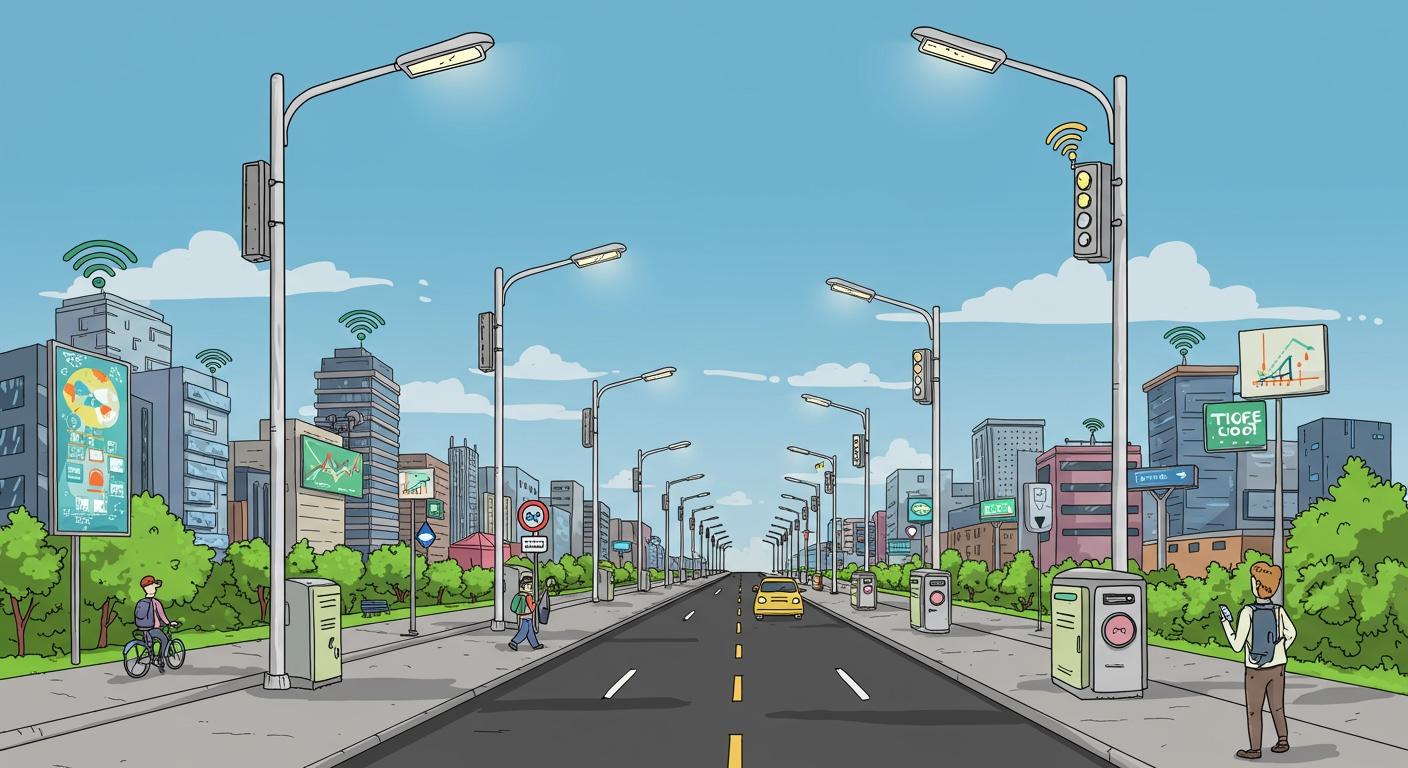
Lithium battery solar street lights play a vital role in modern smart cities. You gain energy efficiency, safety, reliability, and cost savings with this technology. Urban centers face major challenges:
Inadequate lighting can raise crime rates by 30% in unlit areas.
Traditional street lights emit up to 12 tons of carbon over ten years.
Smart solar street lights in cities like Los Angeles and New York cut emissions and energy use significantly.
Key Takeaways
Lithium battery solar street lights enhance public safety by improving visibility, which helps reduce crime and accidents in urban areas.
Investing in solar street lights leads to long-term cost savings, as they require less maintenance and eliminate energy costs compared to traditional lighting.
These lights support environmental sustainability by using renewable energy, reducing carbon emissions, and promoting recycling of materials.
Part1: Lithium Battery Solar Street Lights Benefits

1.1 Safety & Reliability
You need reliable lighting solutions for urban environments. Lithium battery solar street lights deliver consistent performance and safety, even in challenging conditions. Their advanced battery technology ensures stable operation, reducing the risk of sudden outages that can compromise public safety.
Tip: Regular inspections for discoloration and cracks help maintain performance, especially in high-temperature areas.
Reliability in Various Climates:
High-performance lithium batteries support reliable operation in extreme heat, cold, rain, and snow.
Monocrystalline silicon panels outperform polycrystalline panels in low-light conditions, ensuring efficiency during cloudy days.
Proper tilt angles and timely cleaning prevent snow buildup and maintain solar panel effectiveness.
Reinforced structures withstand strong winds, reducing the risk of physical damage.
Safety Features:
Lithium iron phosphate batteries offer long cycle life and high efficiency, making them ideal for urban lighting.
Battery compartments with waterproof ratings of IP67 or higher protect against water ingress.
Low-temperature electrolyte formulations and nanoscale anode materials improve battery performance in cold climates.
Comparative Maintenance Table:
Lighting System Type | Maintenance Frequency |
|---|---|
Solar Street Lights | Low |
Traditional Lights | Moderate to high |
Solar street lights require minimal maintenance due to fewer components. LED bulbs last over 50,000 hours, reducing the need for frequent replacements. You avoid wiring issues common with traditional systems, which often need regular checks and repairs.
1.2 Performance & Efficiency
You benefit from the high energy efficiency of lithium battery solar street lights. These systems achieve charge and discharge rates between 90% and 97%, far surpassing older battery technologies.
Battery Charging Efficiency Table:
Battery Type | Charging Efficiency |
|---|---|
Lead-Acid Battery | Average |
Gel Battery | Good |
Lithium Battery | High |
Solar street lights using lithium batteries leverage LED technology, achieving energy efficiency conversion rates above 80%. In contrast, traditional high-pressure sodium and metal halide lamps only reach 20% to 25%. This efficiency translates to lower operational costs and reduced maintenance needs.
Solar street lights collect enough solar energy daily to power lighting for several nights under sunny conditions.
The light power density of solar street lights is over 30% lower than that of traditional lights, yet they provide superior light quality.
Although the initial investment is higher, you realize significant long-term energy savings and minimal maintenance costs.
Technological Advancements Table:
Advancement Type | Description |
|---|---|
Improved Energy Density | Modern lithium batteries store more energy in smaller, lighter packages. |
Enhanced Lifespan and Durability | Lifespans often exceed five years, reducing maintenance costs. |
Superior Charge-Discharge Efficiency | Efficient conversion of solar energy into stored electricity. |
Temperature Resilience | Consistent operation across a wide temperature range. |
Faster Charging Times | Efficient recharging, even on cloudy days. |
Environmental and Safety Improvements | Enhanced safety features and environmental friendliness. |
1.3 Public Safety Impact
You enhance public safety by deploying smart solar street lights in urban areas. Well-lit streets deter crime and reduce accidents, creating safer environments for residents and businesses.
Studies show that improved street lighting helps prevent road traffic crashes, injuries, and fatalities.
The impact of street lighting is especially significant in low and middle-income countries, where it serves as a vital road safety measure.
Municipal reports confirm that solar street lights have significantly reduced crime rates in local communities by eliminating hiding spots for criminals.
A randomized experiment in New York City demonstrated that better street lighting can effectively reduce violent crimes by altering the environment for potential offenders.
Crime Reduction Table:
Source | Findings |
|---|---|
Happy Eco News | Solar street lights have significantly reduced crime rates in local communities. |
You also benefit from long warranty periods. Many manufacturers offer lithium battery warranties lasting up to 10 years, with end-of-life capacity guarantees of 60% to 80%. This reliability ensures your investment in smart solar street lights supports long-term urban safety and efficiency.
Part2: Cost, Sustainability, and Smart City Integration
2.1 Long-Term Cost Savings
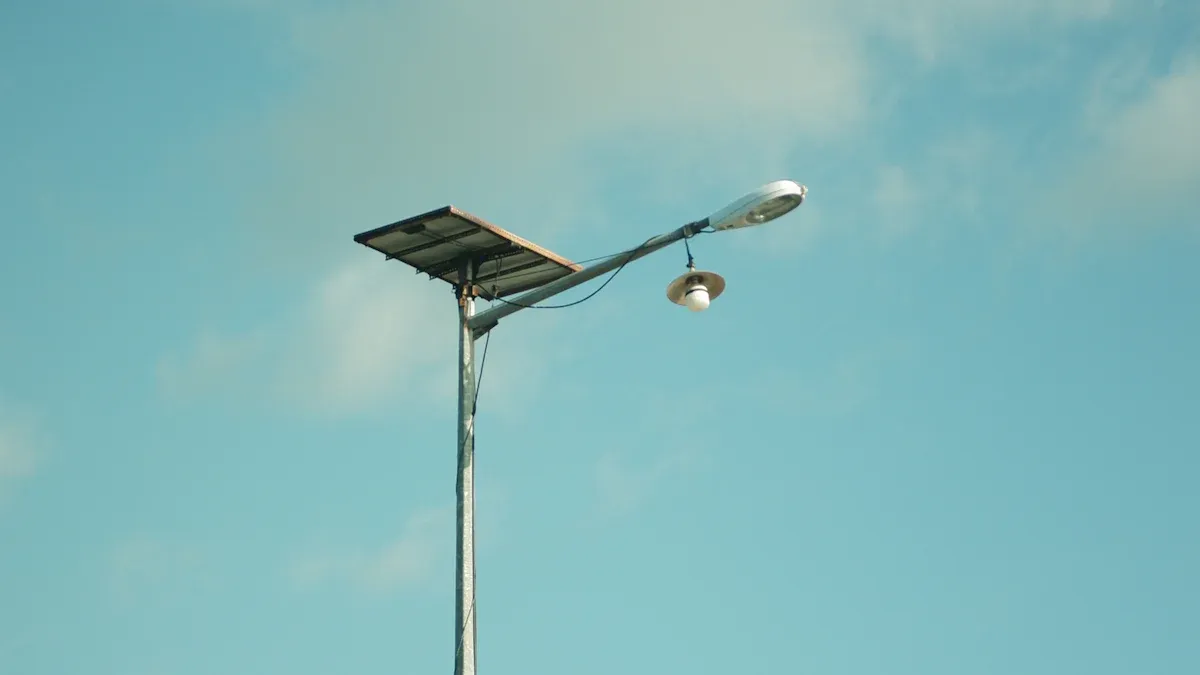
You gain significant cost advantages by choosing lithium battery solar street lights for your infrastructure projects. While the initial investment may appear higher than traditional lighting, the long-term savings quickly outweigh the upfront costs. The average payback period for advanced solar lighting installations is less than half that of conventional grid-powered systems.
Lighting Type | Payback Period (years) |
|---|---|
LED ASL Lighting Installations | 3.15 |
AC Grid Powered LED Lighting | 7.20 |
You also benefit from lower total cost of ownership and reduced maintenance. Solar street lights require battery replacement every five years, costing about $400 per light. In contrast, traditional street lights incur annual maintenance costs of $100 per light, totaling $100,000 for 100 lights over a decade. Solar street lights eliminate energy costs, while traditional systems accumulate approximately $1,200 in energy expenses per light over five years. The total five-year cost for solar street lights is around $4,800, compared to $8,800 for traditional systems, which includes trenching and installation.
Maintenance for solar street lights involves replacing batteries every 5 years, costing $400 per light.
Traditional street lights have annual maintenance costs averaging $100 per light, leading to a total of $100,000 for 100 lights over 10 years.
Solar street lights incur no energy costs, while traditional lights accumulate approximately $1,200 in energy costs over 5 years for one light.
The total cost for solar street lights over 5 years is around $4,800, compared to $8,800 for traditional lights, which includes trenching and installation costs.
Note: High initial investment and integration complexity can be barriers. Many municipalities overcome these challenges through public-private partnerships and government initiatives, which support sustainable city development and encourage adoption of advanced solar technologies.
2.2 Environmental Sustainability
You support environmental goals by deploying solar street lights. These systems harness solar power, reducing reliance on fossil fuels and lowering greenhouse gas emissions. Replacing conventional lighting with lithium battery solar street lights can cut carbon emissions by over 145,000 tons annually for a city with 100,000 lights.
Description | Value |
|---|---|
Carbon emissions reduced per light | 1453 kg annually |
Total lights considered | 100,000 |
Total carbon emissions reduction | Over 145,000 tons/year |
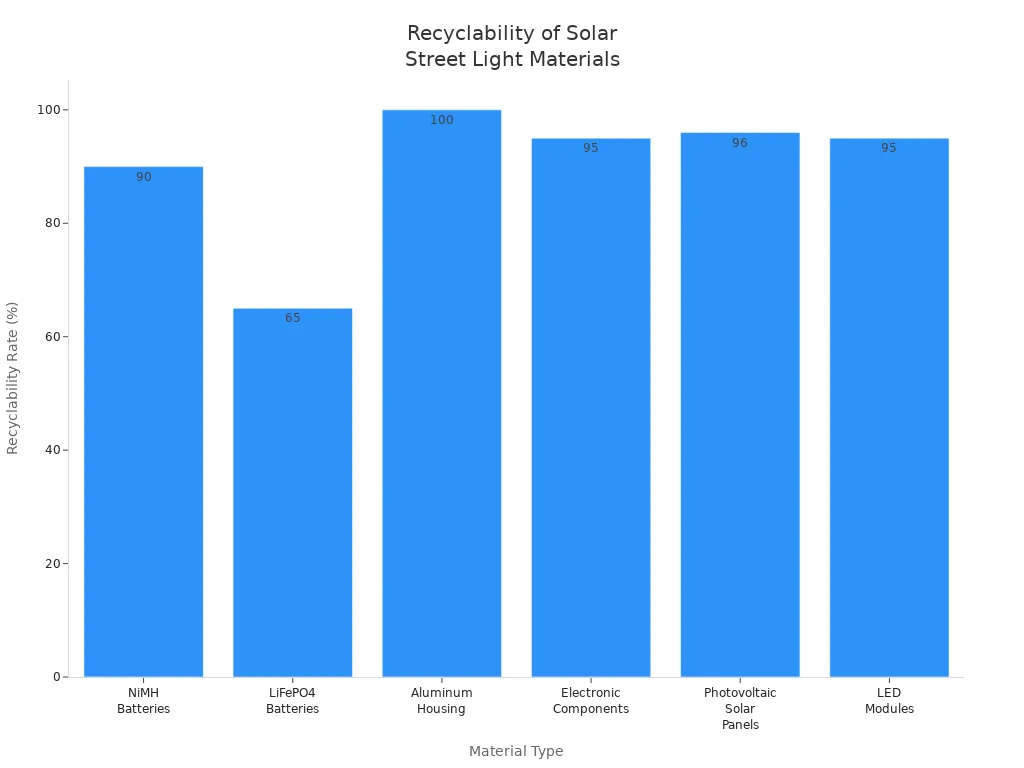
You also benefit from high recyclability rates for key components, which enhances environmental friendliness and supports sustainability. For more on this topic, see our sustainability blog.
Material Type | Recyclability Rate | Notes |
|---|---|---|
NiMH Batteries | 85% – 95% | Metals like nickel are reused in stainless steel. |
LiFePO4 Batteries | 65% | Requires specific methods for lithium extraction. |
Aluminum Housing | 100% | Infinitely recyclable. |
Electronic Components | 95% | Recyclable through Ecosystem. |
Polycarbonate Lenses | N/A | Reusable for new applications. |
Photovoltaic Solar Panels | 96% | Advanced recycling techniques achieve high recovery. |
LED Modules | 95% | High luminous efficiency and long lifespan. |
You should also consider the broader environmental impact. Solar street lights conserve energy, minimize light pollution, and help preserve ecological balance.
Impact Type | Description |
|---|---|
Reduced Carbon Emissions | Solar street lights utilize renewable solar energy, significantly lowering greenhouse gas emissions. |
Energy Conservation | They store solar energy for nighttime use, reducing reliance on grid electricity. |
Minimal Light Pollution | Their design helps preserve the nocturnal environment, protecting biodiversity and ecological balance. |
For information on responsible sourcing and conflict minerals, review our conflict minerals statement.
2.3 Smart City Infrastructure
You can seamlessly integrate lithium battery solar street lights into your smart city infrastructure. These systems offer advanced connectivity and monitoring features, supporting efficient city management and public safety. For more on infrastructure solutions, visit our infrastructure battery solution.
Integration of WiFi communication enables real-time data exchange.
Monitoring probes support public safety and traffic management.
Air quality sensors track PM2.5 levels for environmental monitoring.
Broadcast functions enhance utility in tourist and commercial areas.
Intelligent lighting management systems optimize energy use and maintenance.
5G micro base stations can be installed on smart light poles, supporting next-generation connectivity.
Cities like Lagos and Nairobi have already realized the benefits of smart solar street lights. In Lagos, the deployment of 20,000 solar street lights reduced diesel generator reliance by 25% and increased nighttime business activity by 18%. Nairobi installed 10,000 solar street lamps, cutting public lighting electricity bills by 35% and reducing nighttime road accidents by 19%.
Tip: Smart solar street lights support emergency response and disaster recovery. They operate independently from the grid, providing reliable lighting during power outages and natural disasters.
2.4 Off-Grid Operation
You ensure reliable lighting in remote or off-grid locations with lithium battery solar street lights. These systems use battery analytics and predictive maintenance to maximize uptime and performance.
Evidence | Description |
|---|---|
Battery Analytics | Enhances reliability by providing real-time insights into battery health and usage patterns. |
Predictive Maintenance | Reduces operational costs and improves system performance. |
Market Growth | Driven by the demand for efficient off-grid solar lighting solutions in remote areas. |
Solar-powered street lights deliver dependable service even in challenging environments. However, you should monitor for performance drops during extended periods of low sunlight or adverse weather. Under continuous shading, photovoltaic panel efficiency can fall from 18%-22% to as low as 5%-8%. Charging times may double, and if battery charge drops below 20%, the system enters sleep mode, shutting off the light. Regular cleaning, battery checks, and monitoring systems help maintain optimal performance.
Regular cleaning of solar panels removes dust and debris.
Checking battery connections ensures secure operation.
Replacing batteries as needed prevents performance issues.
Monitoring systems track performance and facilitate timely maintenance.
In emergencies, solar street lights provide critical lighting when the grid fails, supporting emergency responders and ensuring public safety.
You gain key advantages with lithium battery solar street lights in smart cities:
High energy density
Long lifespan
Fast charging
Environmental benefits
Identify high-priority areas.
Use partnerships for funding.
Invest in advanced solar solutions.
Barrier Type | Solution |
|---|---|
Budget Constraints | Long-term savings offset initial costs. |
FAQ
What advantages do lithium battery solar street lights offer for industrial and infrastructure projects?
You gain high energy density, long lifespan, and fast charging. These features ensure reliable lighting for security systems, medical facilities, and industrial sites.
How do lithium batteries compare to other chemistries in solar-powered street lights?
Battery Chemistry | Cycle Life | Charging Efficiency | Safety Level |
|---|---|---|---|
LiFePO₄ | 2000+ | 95% | Very High |
Lead-Acid | 500 | 80% | Moderate |
NiMH | 1000 | 85% | High |
Can you customize lithium battery solutions for unique B2B applications?
Yes. Large Power offers custom battery consultation for solar street lights and other sectors. Contact our experts for tailored solutions in robotics, security, and infrastructure.


