

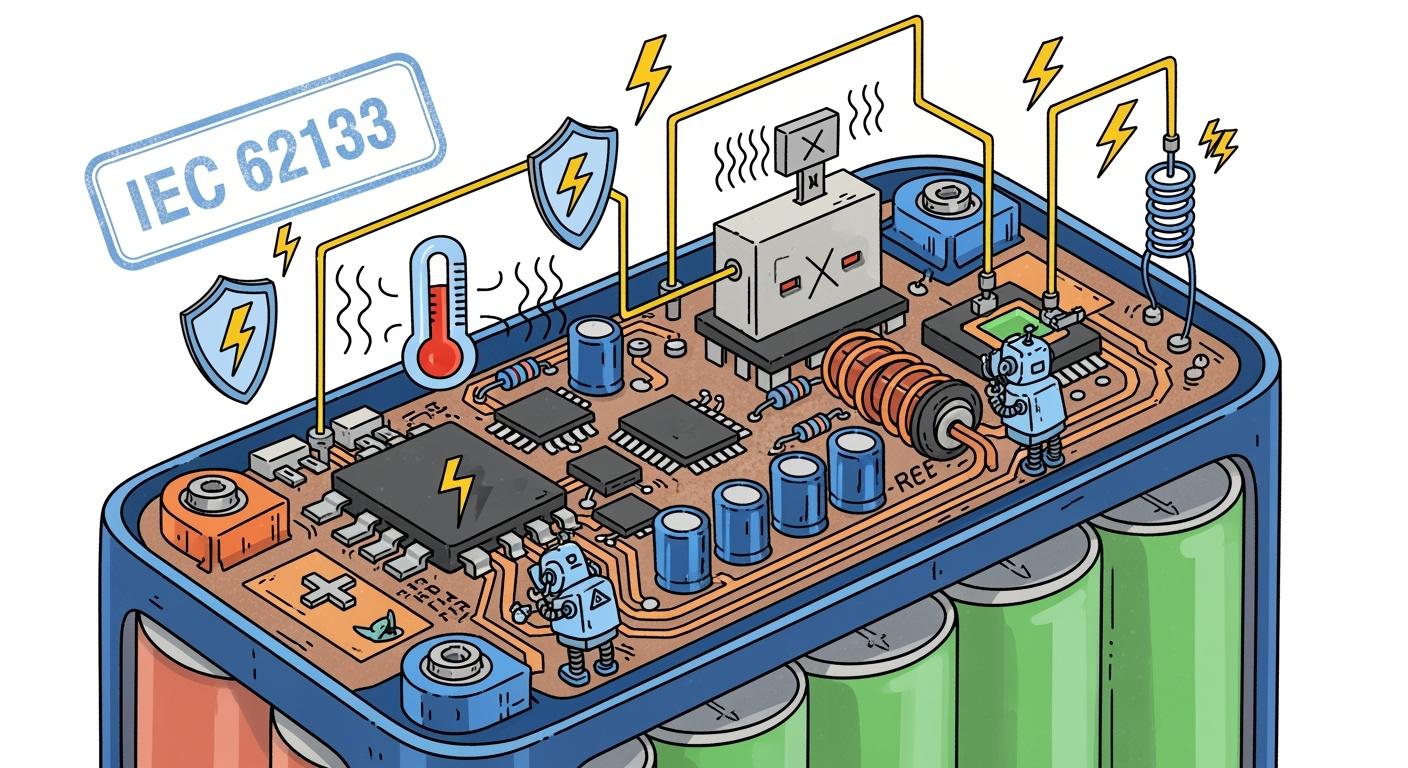
You rely on lithium battery packs to deliver consistent power in demanding environments. BMS safeguards stand at the core of reliability for IEC 62133 certified solutions. You benefit from advanced monitoring, built-in redundancy, and robust protection features that shield your operations against risks like overcharge, deep discharge, and overheating. The Anatomy of Reliability provides a clear framework to understand how these mechanisms support safety and performance for industrial applications.
Key Takeaways
BMS safeguards are essential for reliable lithium battery packs, preventing risks like overcharging and overheating.
Continuous monitoring of voltage, current, and temperature ensures safe operation and extends battery life.
Redundancy features in battery systems provide backup protection, ensuring uninterrupted power supply even during component failures.
IEC 62133 certification guarantees that battery packs meet strict safety and reliability standards, enhancing consumer trust.
Implementing predictive maintenance strategies helps identify issues early, reducing downtime and maintenance costs.
Part 1: Anatomy of Reliability in BMS Safeguards
1.1 Core Safeguard Mechanisms
You depend on lithium battery packs to power critical systems in sectors like medical devices, robotics, security, and industrial automation. The Anatomy of Reliability in these packs starts with the core safeguard mechanisms built into the Battery Management System (BMS). These mechanisms ensure your packs meet the strict requirements of IEC 62133 certification.
The BMS uses a combination of charging control, cell balancing, and fault protection to keep your battery packs safe and reliable. Charging control manages the charging process, preventing overcharging and extending battery life. Cell balancing ensures each cell in a multi-cell pack—whether LiFePO4, NMC, LCO, or LMO—maintains equal voltage, which is crucial for performance and longevity. Fault protection includes safety cut-offs for over-voltage, under-voltage, over-current, and over-temperature conditions.
Here is a summary of the primary technical mechanisms in a BMS:
Mechanism | Function |
|---|---|
Charging Control | Manages the charging process to prevent overcharging and ensure optimal battery life. |
Balancing | Ensures all cells in the battery pack are charged equally to enhance performance. |
Fault Protection | Includes safety cut-off mechanisms for over-voltage, under-voltage, over-current, and over-temperature to prevent hazardous conditions. |
Compliance Testing | BMS is tested against specifications and safety standards like ISO 26262 to verify reliability. |
These mechanisms work together to prevent the most common risks in lithium battery packs, such as overcharge, deep discharge, and overheating.
1.2 Monitoring: Voltage, Current, Temperature, Impedance
Continuous monitoring forms the backbone of the Anatomy of Reliability in your battery packs. The BMS uses advanced sensors and microcontrollers to track key parameters in real time. This monitoring covers voltage, current, temperature, and impedance, which are essential for safe operation and long service life.
Voltage Monitoring: The BMS checks the voltage of each cell to prevent overcharging and deep discharging. Voltage sensors also help estimate the State of Charge (SoC) and State of Health (SoH), ensuring you know the exact status of your pack at all times.
Current Monitoring: Current sensors oversee charging and discharging cycles. If the current exceeds safe limits, the BMS disconnects the battery to prevent damage.
Temperature Monitoring: Temperature sensors detect overheating. If the temperature rises above safe thresholds, the BMS initiates protective actions, such as reducing current or disconnecting the pack.
Impedance Monitoring: Monitoring impedance helps detect internal cell degradation, which can signal the need for maintenance or replacement.
The table below summarizes the main monitoring types and their roles:
Monitoring Type | Description |
|---|---|
Cell Voltage Monitoring | Continuously monitors individual cell voltages to identify imbalances. |
State of Charge (SoC) | Estimates remaining battery capacity using algorithms. |
State of Health (SoH) | Assesses overall health and degradation of the battery pack. |
Temperature Monitoring | Ensures operation within safe temperature limits. |
Current Monitoring | Manages charging/discharging rates and prevents overcurrent. |
Fault Diagnosis | Detects faults like overvoltage and overheating, implementing safety protocols. |
Tip: Real-time monitoring of temperature and internal pressure helps prevent overheating and catastrophic failures. This is especially important in high-demand applications like robotics and medical equipment, where safety and uptime are critical.
1.3 Redundancy and Fail-Safe Design
Redundancy and fail-safe design are essential for the Anatomy of Reliability in industrial lithium battery packs. You benefit from multiple layers of protection that ensure continuous operation, even if one component fails.
Redundant systems include dual or triple battery strings, independent BMS modules for different segments, and hot-swappable modules. These features allow automatic switchover and uninterrupted power supply, which is vital for infrastructure, security, and medical applications.
The table below compares common redundancy strategies:
Redundancy Type | Description | Advantages | Disadvantages |
|---|---|---|---|
N+1 | One spare component for backup | Reduces hardware costs, easy to implement | Less efficient for large systems |
2N | Complete duplication of the system | No single point of failure, high reliability | Higher costs, more complex management |
You also gain from intelligent contactor control strategies, secure firmware with self-test routines, and independent safety circuits. These features provide backup protection, even if the main BMS fails. Circuit protection devices, such as fuses and advanced solutions like the GigaFuse, interrupt the circuit during short circuits or overcurrent events, reducing the risk of catastrophic failure.
Note: Well-designed redundancy and fail-safe features help you avoid costly recalls and liability issues. They align with best practices for functional safety in industrial and mission-critical environments.
The Anatomy of Reliability in your IEC 62133 certified packs combines advanced monitoring, robust protection, and layered redundancy. This approach ensures your lithium battery packs deliver safe, dependable power for every application, from medical devices to industrial automation.
Part 2: IEC 62133 Certification & Reliability
2.1 Certification Overview
You need lithium battery packs that meet strict safety and reliability standards. IEC 62133 certification sets the benchmark for safe operation in industrial, medical, robotics, security, infrastructure, and consumer electronics sectors. This certification covers lithium-ion and lithium-polymer chemistries, including LiFePO4, NMC, LCO, and LMO. The standard focuses on portable applications and ensures your packs pass rigorous safety testing.
The table below highlights the scope and significance of IEC 62133 certification:
Aspect | Description |
|---|---|
Certification Importance | Ensures safety and reliability of lithium batteries, providing guidelines for safety testing. |
Market Access | Enhances product quality assurance and supports access to international markets. |
Brand Value | Improves brand reputation and consumer trust in lithium battery products. |
Scope of Standard | Covers safety requirements for lithium-ion and lithium-polymer batteries, focusing on portable applications. |
Recent Changes | Significant updates in 2017 to address the shift from nickel to lithium chemistries in the market. |
Division of Standards | IEC 62133-1 for nickel chemistries and IEC 62133-2 for lithium, reflecting the evolving battery landscape. |
IEC 62133 certification gives you confidence that your battery packs meet global safety expectations.
2.2 BMS Requirements for Compliance
Your battery management system (BMS) plays a central role in meeting IEC 62133 requirements. The standard demands advanced monitoring, protection, and control features. You must ensure your BMS can detect and respond to overcharge, deep discharge, overheating, and short-circuit events. The BMS must support cell balancing for chemistries like LiFePO4 and NMC, and provide accurate voltage, current, and temperature monitoring.
Key BMS criteria for compliance include:
Real-time monitoring of cell voltage, current, and temperature.
Fault detection and automatic safety cut-off.
Cell balancing for multi-cell packs.
Protection against short-circuiting and overheating.
The table below summarizes how compliance enhances reliability:
Aspect | Benefit |
|---|---|
Safety Standards | Ensures rigorous testing for overheating, fire, and short-circuiting. |
Consumer Confidence | Increases trust in product safety and reliability. |
International Compliance | Helps manufacturers meet global regulations, enhancing market access. |
2.3 Reliability Benefits for Industrial Packs
You gain significant reliability benefits when your lithium battery packs achieve IEC 62133 certification. The Anatomy of Reliability in certified packs means you get robust safeguards, consistent performance, and reduced risk of failure. Industrial users in medical, robotics, security, and infrastructure sectors rely on these packs for uninterrupted power and long service life.
Certified packs help you avoid downtime, costly recalls, and liability issues. You can trust your battery packs to deliver safe, dependable energy in every application.
Part 3: Reliability Engineering in BMS
3.1 Failure Analysis (FMEA)
You improve reliability in lithium battery packs by using Failure Mode and Effects Analysis (FMEA). This method helps you identify possible failure points in the Battery Management System. You analyze each component, such as sensors, microcontrollers, and protective circuits, to predict how failures might affect your operations. You prioritize risks and develop safeguards that address the most critical issues. FMEA supports your efforts to meet IEC 62133 standards and ensures your packs perform safely in medical, robotics, and industrial environments.
3.2 Reliability Metrics: MTBF & Failure Rates
You measure reliability using metrics like Mean Time Between Failures (MTBF) and failure rates. MTBF tells you how long your battery pack operates before a failure occurs. You use this metric to plan maintenance and replacement schedules. Failure rates help you compare different BMS designs and chemistries, such as LiFePO4, NMC, LCO, and LMO. The table below shows how standard and custom BMS solutions compare:
BMS Type | Monitoring Features | Safety Features | Typical MTBF (hours) |
|---|---|---|---|
Standard BMS | Basic voltage/current | Essential protection only | 10,000–20,000 |
Custom BMS | Real-time SoC/SoH, advanced | Multiple layers, continuous | 20,000–50,000 |
Custom BMS solutions give you higher reliability and better diagnostics. You gain more control over maintenance and reduce the risk of unexpected failures.
3.3 Predictive Maintenance
You use predictive maintenance to minimize unplanned downtime in industrial applications. Your BMS collects real-time data on battery health and performance. You analyze this data to spot early signs of failure. You act before issues become critical. Here are the main benefits:
You receive early warnings about battery problems, allowing you to fix them before downtime occurs.
You optimize maintenance planning and avoid unforeseen failures.
You save costs by preventing unexpected repairs.
You use computerized maintenance systems to detect patterns and reduce downtime by up to 50%.
The Anatomy of Reliability in your BMS safeguards supports predictive maintenance, helping you maintain safe and efficient operations in demanding sectors.
Part 4: Testing, Validation & Compliance

4.1 BMS Validation Processes
You need reliable battery management systems (BMS) for your lithium battery packs. Validation processes confirm that safeguards work as intended in industrial, medical, robotics, and security applications. You benefit from extra sensing elements and logic checks in the microcontroller. These steps improve sensor reliability and robustness. Redundancy architecture, such as two-channel and 1oo2 control units, ensures backup protection. External crystal oscillators address clock instability in the MCU. If the system detects errors, it isolates battery cells to prevent risks.
Validation Process | Description |
|---|---|
Additional Sensing Elements | Extra hardware and logic checks in the MCU improve sensor reliability. |
Redundancy Architecture | Two-channel and 1oo2 control units provide backup protection. |
External Crystal Oscillator | Addresses MCU clock instability and isolates cells if discrepancies occur. |
Error Detection Protocol | System isolates battery cells if firmware errors persist beyond set time limits. |
You gain confidence in your battery packs when you see robust validation steps in place.
4.2 IEC 62133 Compliance Testing
You must meet IEC 62133 standards to access global markets and ensure safety. Compliance testing covers design, validation, and documentation. You select high-quality cells, design robust BMS safeguards, and create enclosures that withstand mechanical stress. You manage heat with effective thermal solutions. Formal risk assessment documentation supports your process.
Design Considerations:
Select cells from reputable suppliers.
Design BMS with advanced safety features.
Build enclosures for mechanical durability.
Implement thermal management.
Document risk assessments.
Testing & Validation:
Conduct abuse tests in accredited labs.
Perform electrical, mechanical, and thermal abuse tests.
Documentation & Market Access:
Obtain formal test reports and UN 38.3 Test Summary.
Prepare Declaration of Conformity and verify QMS.
Finalize labeling and user instructions.
Thorough documentation and traceability help you meet regulatory standards and build trust with your clients. You can review our conflict minerals statement for more details on responsible sourcing.
4.3 Quality Assurance
You rely on quality assurance to maintain long-term reliability and safety in your lithium battery packs. The BMS oversees each cell, preventing overheating and maintaining balance. Rigorous testing detects defects before they reach production. Monitoring for defects ensures safety features work and reduces risks of thermal runaway. Consistent performance maintains energy density and cycle life.
Aspect of Quality Control | Contribution to Reliability and Safety |
|---|---|
Rigorous Testing | Detects defects early, preventing costly recalls. |
Monitoring for Defects | Ensures safety features are active, reducing risks of failure. |
Consistent Performance | Maintains energy density and cycle life for long-term reliability. |
You meet regulatory and quality requirements with strong traceability and documentation. Certifications like UL, UN, and CE support your market access and safety goals.
Part 5: Real-World Performance & Maintenance
5.1 Field Data & Case Studies
You see IEC 62133 certified lithium battery packs with advanced BMS deliver reliable performance in demanding environments. Real-world data from medical devices, robotics, drones, and security systems show consistent uptime and safety. Industrial users report fewer unexpected failures and longer operational periods. You benefit from robust safeguards that prevent downtime in infrastructure and consumer electronics applications.
Medical devices maintain continuous operation during critical procedures.
Robotics systems achieve high cycle life and stable energy density, supporting complex tasks.
Security and infrastructure installations experience reduced maintenance interruptions.
Drones and consumer electronics operate safely in diverse conditions.
5.2 Maintenance Strategies
You maximize the lifespan and reliability of your lithium battery packs by following proven maintenance strategies. The table below outlines key approaches for industrial users:
Strategy | Description |
|---|---|
Depth of Discharge (DoD) | Maintain DoD between 70% and 90% to balance usable capacity and cycle life. |
Battery Management System | Use BMS for real-time monitoring of voltage, current, and temperature to optimize performance. |
Schedule regular checks to track battery health and plan preventive maintenance. |
You ensure optimal charging and discharging, which extends battery life. You prevent overcharging and over-discharging, reducing the risk of early failure. You balance cell voltages and receive real-time feedback on battery health. These strategies support sustainability and long-term reliability.
Learn more about our approach to sustainability here.
5.3 User Best Practices
You maintain reliability and safety by following best practices for lithium battery packs in industrial settings:
Prevent short-circuiting, overcharging, and disassembling.
Use only cells with protection circuits and approved chargers.
Stop using batteries that overheat during charging.
Respond promptly to BMS warnings and check SOC/SOH data.
Schedule regular inspections at authorized service centers.
Optimize charging habits by charging up to 80% and recharging below 20%.
Choose smart, OTA-enabled BMS for continuous optimization.
Managing the state of charge and responding to system alerts help you avoid degradation and maintain system integrity in medical, robotics, security, infrastructure, and industrial applications.
You see how the Anatomy of Reliability combines BMS safeguards, reliability engineering, and IEC 62133 certification to deliver dependable lithium battery packs. You benefit from features such as:
Overcharge and over-discharge protection
Thermal monitoring and fault detection
Charge equalization and real-time data monitoring
These safeguards help you maintain safety, performance, and compliance in industrial, medical, robotics, and security applications. If you want to discuss tailored solutions for your business, reach out to our team for expert guidance.
FAQ
What makes IEC 62133 certified lithium battery packs reliable for industrial use?
You get advanced BMS safeguards, including real-time monitoring and layered protection. These features help prevent overcharge, deep discharge, and overheating. Certified packs support critical operations in medical, robotics, security, and infrastructure sectors.
How does the BMS handle different lithium chemistries like LiFePO4, NMC, LCO, and LMO?
You benefit from tailored BMS algorithms for each chemistry. The table below compares key properties:
Chemistry | Platform Voltage (V) | Energy Density (Wh/kg) | Cycle Life (cycles) |
|---|---|---|---|
LiFePO4 | 3.2 | 90–120 | 2000–4000 |
NMC | 3.7 | 150–220 | 1000–2000 |
LCO | 3.7 | 150–200 | 500–1000 |
LMO | 3.7 | 100–150 | 700–1500 |
What maintenance steps help extend the life of lithium battery packs in industrial settings?
You should schedule regular inspections, monitor State of Charge (SoC) and State of Health (SoH), and follow BMS alerts. Keep the Depth of Discharge (DoD) between 70% and 90%. Use only approved chargers and avoid overheating.
How does real-time monitoring improve safety in medical and robotics applications?
You receive instant alerts for abnormal voltage, current, or temperature. The BMS disconnects the pack if it detects unsafe conditions. This rapid response helps prevent failures during critical operations.
Can you use these battery packs in harsh environments?
You can deploy certified packs in demanding conditions. The BMS includes thermal management and rugged enclosures. These features support reliable performance in security, infrastructure, and industrial automation.


