

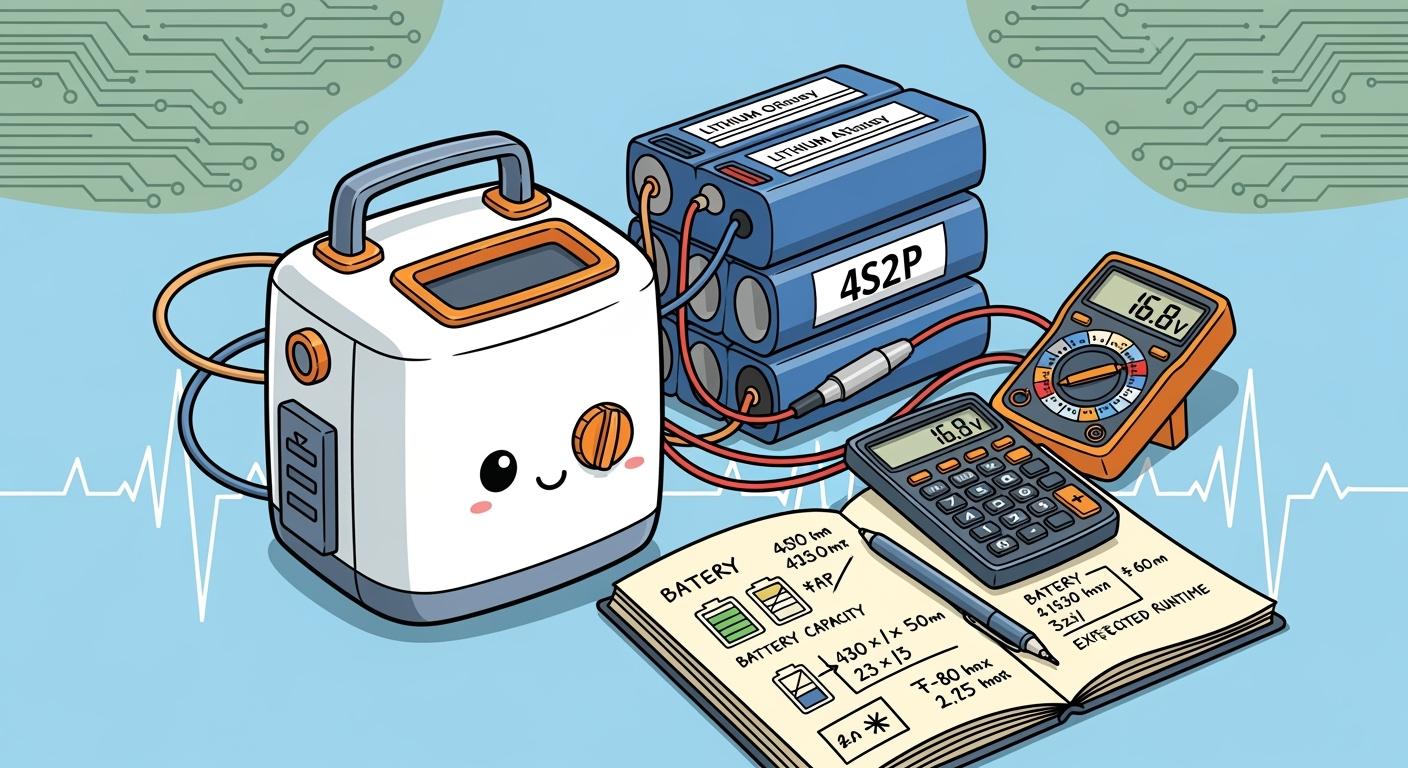
Reliable power solutions keep portable oxygen concentrators running for every patient in critical scenarios. You calculate the capacity and runtime of a 4s2p lithium battery pack using straightforward formulas. The table below shows how battery voltage, capacity, and total energy determine runtime for a 4s2p lithium-ion battery in oxygen concentrator applications. Battery configuration, chemistry, and robust safety systems ensure dependable operation.
Calculation Type | Formula | Example Calculation |
|---|---|---|
Total Capacity (Ah) | Capacity of One Cell (Ah) × Number of Parallel Cells | 3Ah × 2 = 6Ah |
Total Voltage (V) | Nominal Voltage of One Cell (V) × Number of Series Cells | 3.7V × 4 = 14.8V |
Total Energy (Wh) | Total Capacity (Ah) × Total Voltage (V) | 6Ah × 14.8V = 88.8Wh |
Runtime (hours) | Total Energy (Wh) ÷ Power Consumption (W) | 88.8Wh ÷ 20W = 4.44 hours |
Key Takeaways
Understand the 4s2p configuration for lithium batteries. This setup doubles capacity and enhances runtime, ensuring reliable power for portable oxygen concentrators.
Calculate runtime by dividing total energy (Wh) by power consumption (W). This helps predict how long your battery will last, ensuring uninterrupted oxygen delivery.
Prioritize safety by selecting battery packs that meet medical standards. Compliance with safety regulations protects patients and ensures reliable operation.
Part1: 4S2P Lithium Battery Pack Basics & Runtime Calculation

1.1 4S2P Configuration Explained
You need to understand the structure of a 4s2p lithium battery pack to make informed decisions for portable oxygen concentrators. In this configuration, you connect four lithium-ion cells in series to increase voltage, then pair two of these series strings in parallel to double the capacity. This arrangement uses eight cells in total.
The 4s2p configuration doubles the capacity compared to a 4s1p pack, which enhances runtime for your oxygen concentrator.
Using eight 18650 cells in a 4s2p setup provides twice the energy storage while maintaining the same voltage output of 14.8V.
The parallel arrangement offers redundancy, ensuring continued power supply even if one cell fails. This feature is vital for critical medical applications, where uninterrupted oxygen delivery is essential for patient safety.
This design supports extended runtime and reliability, making it a preferred choice for power solutions in medical devices like portable oxygen concentrators.
1.2 Voltage, Capacity, and Energy (Wh)
You must evaluate three core parameters when selecting battery packs for portable oxygen concentrators: voltage, capacity, and energy.
Parameter | Value |
|---|---|
Full Charge Voltage | 16.8 volts |
Nominal Voltage | 14.8 volts |
Discharged Rating | 12 volts to 12.8 volts |
In a 4s2p lithium battery pack, the total capacity is determined by the nominal capacity of the individual cells. Four cells in series set the voltage at 14.8V (3.7V multiplied by 4). Two cells in parallel double the capacity, making the overall capacity of the 4s2p configuration twice that of a single cell string.
For example, if each cell has a nominal capacity of 4000mAh (4Ah), the total capacity becomes 8000mAh (8Ah). The energy output is calculated as:
Specification | Value |
|---|---|
Nominal Voltage | 14.8V |
Capacity | 8000mAh |
Energy Output | 118.4Wh |
Calculation Method | 14.8V × 8Ah |
This high energy density supports the demanding requirements of portable oxygen concentrators, ensuring patients receive continuous oxygen therapy.
1.3 Runtime Formula for Portable Oxygen Concentrators
You can estimate the runtime of a 4s2p lithium battery pack by dividing the total energy (in watt-hours) by the power consumption of the oxygen concentrator (in watts):
Runtime (hours) = Total Energy (Wh) ÷ Device Power Consumption (W)
Device power requirements directly impact runtime. Advanced features in modern oxygen concentrators may increase power consumption, reducing effective runtime even if battery capacity improves. The 4s2p configuration influences how power is distributed and managed within the pack, affecting overall performance and runtime.
Tip: Always check the device’s rated power draw and consider any additional features that may increase consumption. Accurate runtime predictions help ensure uninterrupted oxygen delivery for every patient.
1.4 Sample Runtime Calculation
Let’s walk through a practical example. Suppose you have a 4s2p lithium-ion battery pack with a nominal voltage of 14.8V and a capacity of 8Ah (8000mAh). The total energy is:
Total Energy (Wh) = 14.8V × 8Ah = 118.4Wh
If your portable oxygen concentrator consumes 25W:
Runtime (hours) = 118.4Wh ÷ 25W = 4.74 hours
This calculation gives you a clear estimate of how long the battery pack will power the oxygen concentrator before requiring a recharge or replacement. For critical medical applications, always factor in a safety margin to account for battery aging and unexpected power surges.
Selecting the Right Chemistry and Capacity for Reliability
You must choose the right lithium-ion chemistry to balance energy density, safety, and cycle life for your application. Common chemistries include NMC (Nickel Manganese Cobalt), LCO (Lithium Cobalt Oxide), LMO (Lithium Manganese Oxide), LiFePO4 (Lithium Iron Phosphate), and LTO (Lithium Titanate). Each chemistry offers unique advantages:
Chemistry | Platform Voltage | Energy Density (Wh/kg) | Cycle Life (cycles) |
|---|---|---|---|
NMC | 3.6–3.7V | 150–220 | 1000–2000 |
LCO | 3.7V | 150–200 | 500–1000 |
LMO | 3.7V | 100–150 | 300–700 |
LiFePO4 | 3.2V | 90–120 | 2000–5000 |
LTO | 2.4V | 70–80 | 5000–15000 |
Li-ion batteries are preferred for their high energy density, which is essential for the runtime of portable medical devices. Safety mechanisms are crucial due to the potential hazards associated with lithium-ion chemistry, necessitating features like thermal shutdown and over-current protection. Battery capacity degrades over cycles, impacting runtime. You must consider this degradation when estimating device performance.
Sophisticated fuel-gauge ICs help you develop battery packs that are safe and provide accurate predictions of remaining runtime. Medical professionals rely on accurate fuel gauges to ensure that devices maintain sufficient battery capacity for operation. For more information on battery management systems (BMS), see our BMS guide. For application scenarios in the medical sector, visit our Medical Applications page.
By understanding these fundamentals, you can select power solutions that deliver extended runtime, robust safety, and reliable performance for every patient and every critical application.
Part2: Power Solutions & Practical Considerations for Portable Oxygen Concentrators
2.1 Step-by-Step Runtime Calculation Process
You can determine the runtime of battery packs for portable oxygen concentrators by following a clear process:
Calculate the total energy capacity. Multiply the battery pack’s total capacity by its total voltage.
Example: If your battery pack has 12Ah capacity and 11.1V, the total energy capacity is 133.2Wh.Identify the power consumption of your oxygen concentrator in watts.
Divide the total energy capacity by the concentrator’s power consumption to estimate runtime.
Example: If the device uses 20W, runtime equals 133.2Wh divided by 20W, resulting in 6.66 hours.
This method helps you select power solutions that deliver reliable power for patient monitors and oxygen therapy.
2.2 Factors Affecting Real-World Runtime
Several factors can impact the actual runtime of a 4s2p lithium battery pack in portable oxygen concentrators:
Discharge rate: High discharge rates reduce runtime. For example, a 4s2p 6700mAh battery discharging at 9.75A may last only 20 minutes.
Device settings: Higher oxygen flow rates increase power draw and shorten runtime.
Battery aging: Over time, battery capacity decreases. Environmental conditions, such as extreme temperatures, also affect efficiency and lifespan.
Specification
Description
Total Energy Capacity
Indicates the maximum power reserve available per charge.
Lifecycle Ratings
Number of full discharge and recharge cycles before significant degradation occurs.
Recharge Time
Time required to fully recharge the battery, typically 2-3 hours.
To maximize battery life, avoid full depletion, store batteries partially charged, and replace them every 2-3 years.
2.3 Safety, Reliability & Health Management System (HMS)
You must prioritize safety and protection when selecting lithium-ion battery packs for portable oxygen concentrators. Medical devices require compliance with ANSI/AAMI ES 60601-1, IEC 62133, IEC 60086 Part 4, and UL 1642 standards. These ensure safety, reliability, and protection for patient monitors and oxygen concentrators. Lithium batteries are classified as Class 9 dangerous goods, so they must meet UN 38.3 for safe transport.
A robust Health Management System (HMS) or Battery Management System (BMS) [see our BMS guide] monitors battery health, prevents overcharge, and provides thermal protection. This system is critical for uninterrupted patient care and extended runtime.
Tip: Always verify that your battery packs meet all regulatory requirements for medical applications.
2.4 4S2P vs 3S2P Configurations
You should compare 4s2p lithium battery and 3s2p configurations to select the best power solutions for portable oxygen concentrators. The table below highlights key differences:
Configuration | Platform Voltage | Energy Density (Wh/kg) | Runtime Benefit | Reliability for Patient Monitors |
|---|---|---|---|---|
4S2P | 14.8V | 180 | Longer operational time | Enhanced, fewer replacements |
3S2P | 11.1V | Lower | Shorter operational time | More frequent maintenance |
The 4s2p lithium-ion battery provides higher voltage and energy density, supporting extended runtime and reducing maintenance for patient monitors and oxygen concentrators. This configuration ensures reliable power and protection for every patient in critical care.
You can calculate the runtime of a 4s2p lithium battery pack by multiplying battery capacity and voltage, then dividing by your oxygen concentrator’s power draw. Chemistry, safety, and protection features matter for every patient. Review device specs, consult with battery solution providers, or request a custom battery solution for extended runtime and compliance.
FAQ
What factors impact the runtime of battery packs in portable patient monitors?
You must consider battery chemistry, device power draw, and runtime requirements. Large Power offers custom lithium ion battery packs for continuous oxygen delivery in critical care scenarios.
How do you ensure safety and reliability for patient monitors using lithium battery packs?
You should select battery packs with advanced BMS, certified to IEC 62133 and UL 1642. This protects every patient and supports uninterrupted operation of portable medical devices.
Why choose higher capacity battery packs for patient monitors in medical applications?
Higher capacity battery packs extend runtime, reduce maintenance, and support patient monitors in critical care scenarios. You improve patient safety and meet demanding runtime requirements for every patient.


