

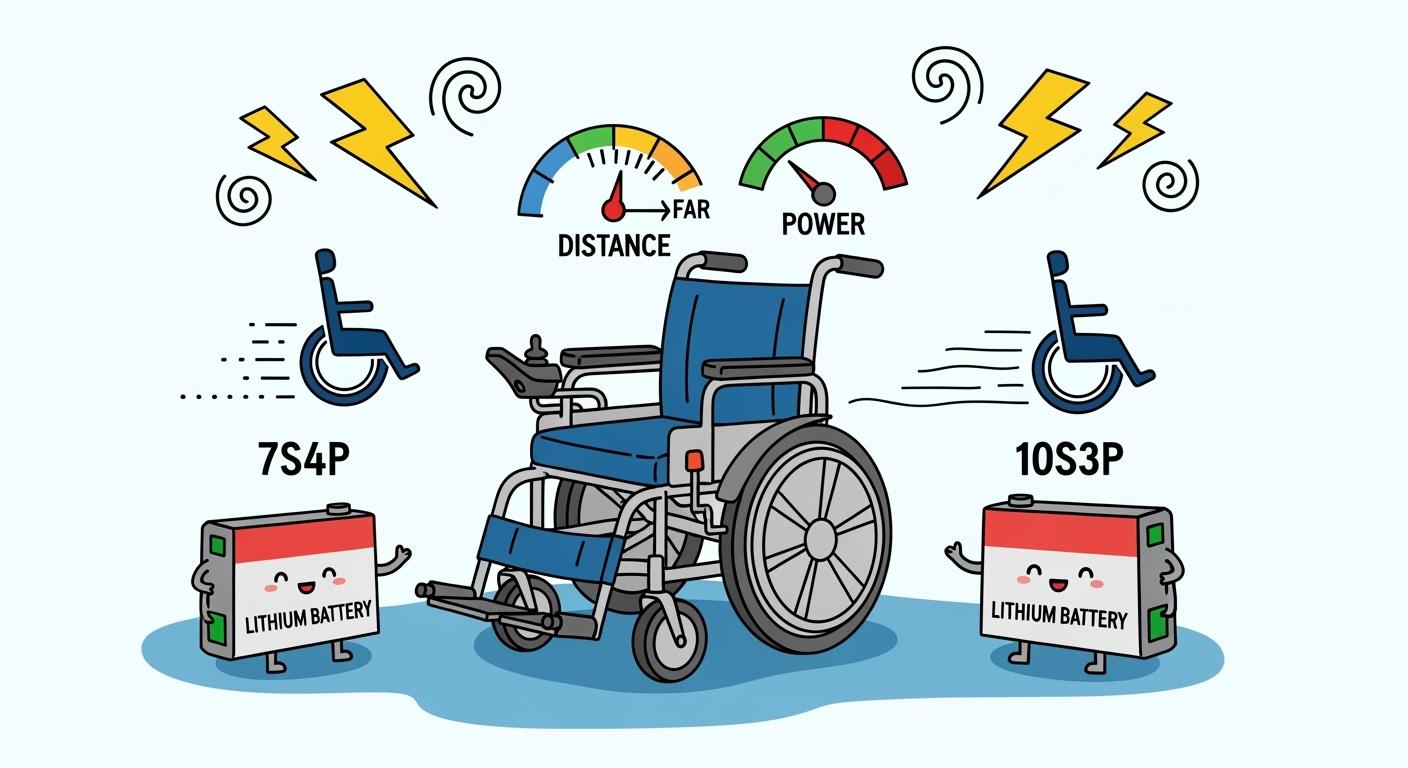
You will find that the 10S3P configuration delivers a better balance of range and power for electric wheelchairs using lithium battery packs. This article analyzes the technical reasons behind this recommendation. You can match the battery configuration to specific use cases in medical, robotics, and industrial applications.
Key Takeaways
The 10S3P configuration offers higher voltage and energy, making it ideal for long-range and high-power needs in electric wheelchairs.
Consider factors like battery size, charge condition, and terrain when evaluating the driving range of electric wheelchairs.
Safety features in both battery configurations protect against hazards, but regular maintenance is crucial for longevity and performance.
Part 1: Lithium Battery Packs Overview
1.1 7S4P vs. 10S3P Basics
When you compare Lithium Battery Packs for electric wheelchairs, you encounter two common configurations: 7S4P and 10S3P. These designations describe how cells are arranged inside the pack. In a 7S4P pack, you find seven cells connected in series, boosting the voltage, and four sets of these series cells connected in parallel, increasing the capacity. A 10S3P pack contains ten cells in series and three sets in parallel, which changes both voltage and capacity. This structure directly impacts the performance and suitability for different application scenarios, including Medical, Robotics, and Industrial sectors.
Lithium-ion batteries (internal link) remain the standard chemistry for these packs, offering high energy density and reliable cycle life.
Below is a technical comparison table for both configurations:
Specification | 7S4P | 10S3P |
|---|---|---|
Nominal Voltage | 19.6V | 36.4V |
Maximum Voltage | 29.4V | 42.0V |
Minimum Voltage | 17.5V | 25.0V |
Capacity | 14000mAh | 10500mAh |
Watt Hours | 274.4 Wh | 382.2 Wh |
Chemistry | Lithium-ion | Lithium-ion |
You see that the 10S3P pack delivers higher voltage and energy, which translates to greater power and longer range for electric wheelchairs.
1.2 Series and Parallel Impact
The arrangement of cells in series and parallel shapes the core characteristics of Lithium Battery Packs. Series connections add up the voltage of each cell, while parallel connections multiply the capacity and current output.
Configuration | Voltage Effect | Capacity Effect |
|---|---|---|
7S4P | Sum of voltages of 7 cells | Four times that of a single cell |
10S3P | Sum of voltages of 10 cells | Three times that of a single cell |
Parallel configurations increase amp capacity and runtime.
Voltage remains constant in parallel, but current capacity rises.
Reduced internal resistance in parallel boosts efficiency.
You benefit from higher voltage in series for powerful motors, while parallel arrangements extend runtime and support higher current demands. This balance is critical for electric wheelchairs in Medical and Industrial environments, where reliability and performance matter most.
Part 2: Performance and Suitability
2.1 Range Comparison
When you evaluate the driving range of electric wheelchairs powered by 7S4P and 10S3P Lithium Battery Packs, several factors shape your experience. The 10S3P configuration typically provides a longer range due to its higher watt-hour rating. However, real-world range depends on more than just battery specifications.
Key factors affecting range in electric wheelchairs:
Battery size: Larger capacities allow you to travel farther.
Battery charge and condition: Well-maintained and fully charged packs extend your distance.
Electrical functions: Features like lights or powered seats consume energy, reducing range.
Prevailing temperature: Cold weather lowers battery capacity.
Terrain: Steep or rough surfaces require more power.
Speed and driving style: Fast speeds and frequent stops decrease range.
Tyres: Proper type and pressure optimize efficiency.
Weight of user: Heavier loads shorten travel distance.
You must consider these variables when selecting a battery pack for Medical, Robotics, or Industrial applications. The 10S3P pack, with its higher energy density, supports longer trips and heavier usage scenarios. The 7S4P pack suits lighter, short-range tasks or environments with minimal power demands.
2.2 Power Output and Use Cases
The voltage and current output of Lithium Battery Packs directly influence the wheelchair’s performance. The 10S3P configuration delivers higher voltage, supporting powerful motors and advanced features. This makes it ideal for demanding environments.
User Scenario | Benefits of 10S3P Battery Packs |
|---|---|
Electric Transportation | Powers motors of 480W and above, enabling speeds up to 35 km/h and ranges exceeding 60 km. |
Energy Storage | Supports 12V/24V devices and 220V AC through inverters, with 95% charge/discharge efficiency. |
Drones and Surveying Instruments | Delivers high discharge rates (15C), providing up to 112.5A for improved flight times and efficiency. |
You benefit from the 10S3P pack in high-power applications, such as wheelchairs used in Security System, Infrastructure, or Industrial settings. The 7S4P pack fits basic mobility needs, especially in Medical or Consumer Electronics scenarios where lower power suffices.
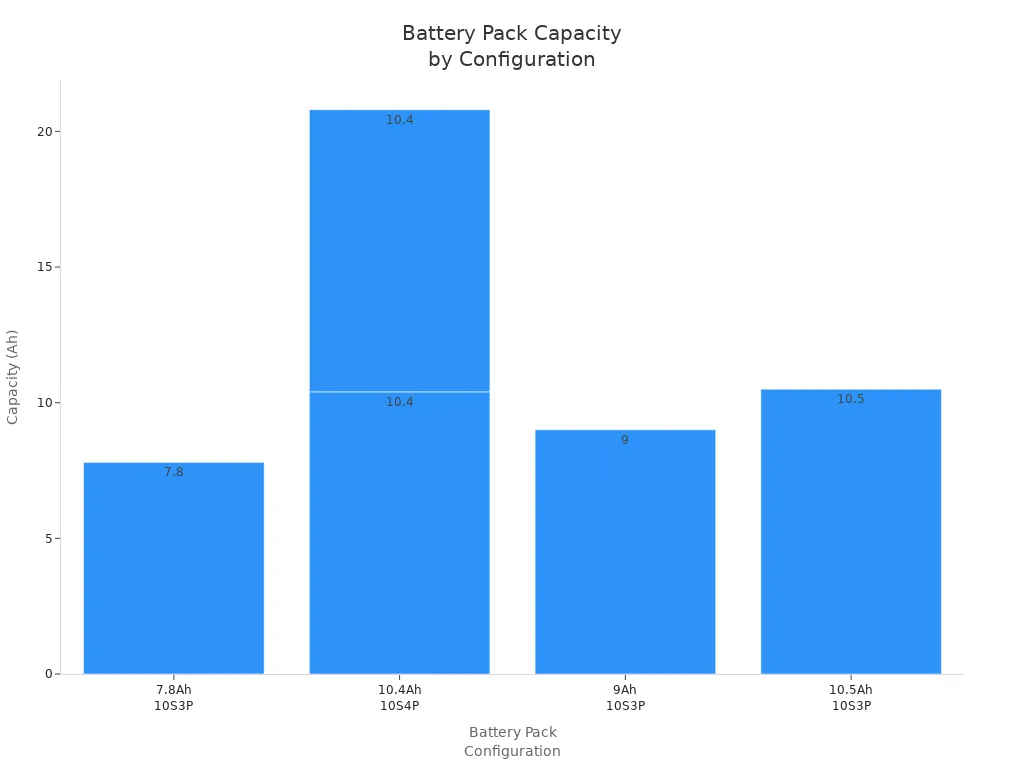
The chart above shows how different configurations compare in capacity and cycle life. You see that 10S3P packs offer higher load per cell, which supports robust performance but may impact longevity under heavy use.
2.3 Safety, Longevity, and Cost
Safety remains a top priority when you choose Lithium Battery Packs for mobility devices. Both 7S4P and 10S3P packs include advanced Battery Management Systems (BMS), which protect against common hazards.
Safety Feature | Description |
|---|---|
Short Circuit Protection | Support. |
Over Charge Protection | Prevent over-charging affects battery life. |
Over Discharge Protection | Prevent the battery from running out. |
Over Current Protection | Prevent the current from exceeding the battery range. |
Over Temp Protection | Prevent the battery from overheating. |
All-in Protection | Prevent cable drop or poor contact. |
Despite these protections, incidents can occur. You must remain vigilant during charging and operation.
Incident Description | Consequence |
|---|---|
Smoke from a battery charger on a Southwest Airlines flight | Flight diversion |
Charging phone explosion causing a fire in a Massachusetts home | Minor burn to resident |
Fire from a portable power bank on a South Korean airliner | Injuries to several people and destruction of the aircraft |
Longevity depends on chemistry, cycle life, and load distribution. Most Lithium Battery Packs, including LiFePO4, NMC, LCO, LMO, LTO, solid-state, and lithium metal types, deliver 800–1000 cycles under standard conditions. You should monitor load per cell, as higher loads may reduce lifespan.
Battery Pack | Configuration | Capacity | Cycle Life | Load Distribution |
|---|---|---|---|---|
36V | 7.8Ah | 10S3P | 800–1000 cycles | Higher load per cell |
36V | 10.4Ah | 10S4P | 800–1000 cycles | Lower load per cell |
36V | 9Ah | 10S3P | 800–1000 cycles | Higher load per cell |
36V | 10.5Ah | 10S3P | 800–1000 cycles | Higher load per cell |
36V | 10.4Ah | 10S4P | 800–1000 cycles | Lower load per cell |
Warranty terms from major manufacturers remain consistent for both configurations.
Battery Type | Configuration | Warranty Period |
|---|---|---|
7S4P | Various | 12 months |
10S3P | Various | 12 months |
Tip: Regular maintenance and proper charging habits extend the life of your Lithium Battery Packs and reduce the risk of failure.
You should also consider sustainability and conflict minerals (sustainability, conflict minerals) when sourcing battery packs for your organization. Reliable after-sales support and standardized warranty terms ensure peace of mind for B2B buyers in Medical, Robotics, Security System, Infrastructure, Consumer Electronics, and Industrial sectors.
You should choose the 10S3P pack for high-power, long-range needs in industrial or medical wheelchairs. The 7S4P pack fits lighter, short-range tasks. When selecting a battery, consider:
User needs and mobility requirements
Battery capacity, weight, and safety features
Maintenance and budget constraints
Explore technical resources and compare models to match your application.
FAQ
What advantages do Large Power’s 10S3P lithium battery packs offer for industrial wheelchairs?
You gain higher voltage, increased energy density, and robust cycle life. Large Power supports custom battery solutions for Medical, Robotics, and Industrial sectors.
How do you select the right lithium battery chemistry for your application?
You compare LiFePO4, NMC, LCO, LMO, LTO, solid-state, and lithium metal chemistries. Each offers unique platform voltage, energy density, and cycle life. See table below.
Chemistry | Platform Voltage | Energy Density | Cycle Life |
|---|---|---|---|
3.2V | 100~180 Wh/kg | 2000-5000 cycles | |
NMC | 3.6~3.7V | 160~270 Wh/kg | 1000~2000 cycles |
LCO | 3.7V | 180~230 Wh/kg | 500~1000 cycles |
LMO | 3.7V | 120~170 Wh/kg | 300~700 cycles |
LTO | 2.4V | 60~90 Wh/kg | 10,000~20,000 cycles |
/ | 300~500 Wh/kg | / | |
Lithium metal | / | 300~500 Wh/kg | / |
Where can you request a customized lithium battery pack for your B2B project?
You click here for a custom battery consultation with Large Power. You receive tailored solutions for Security System, Infrastructure, and Consumer Electronics applications.


