

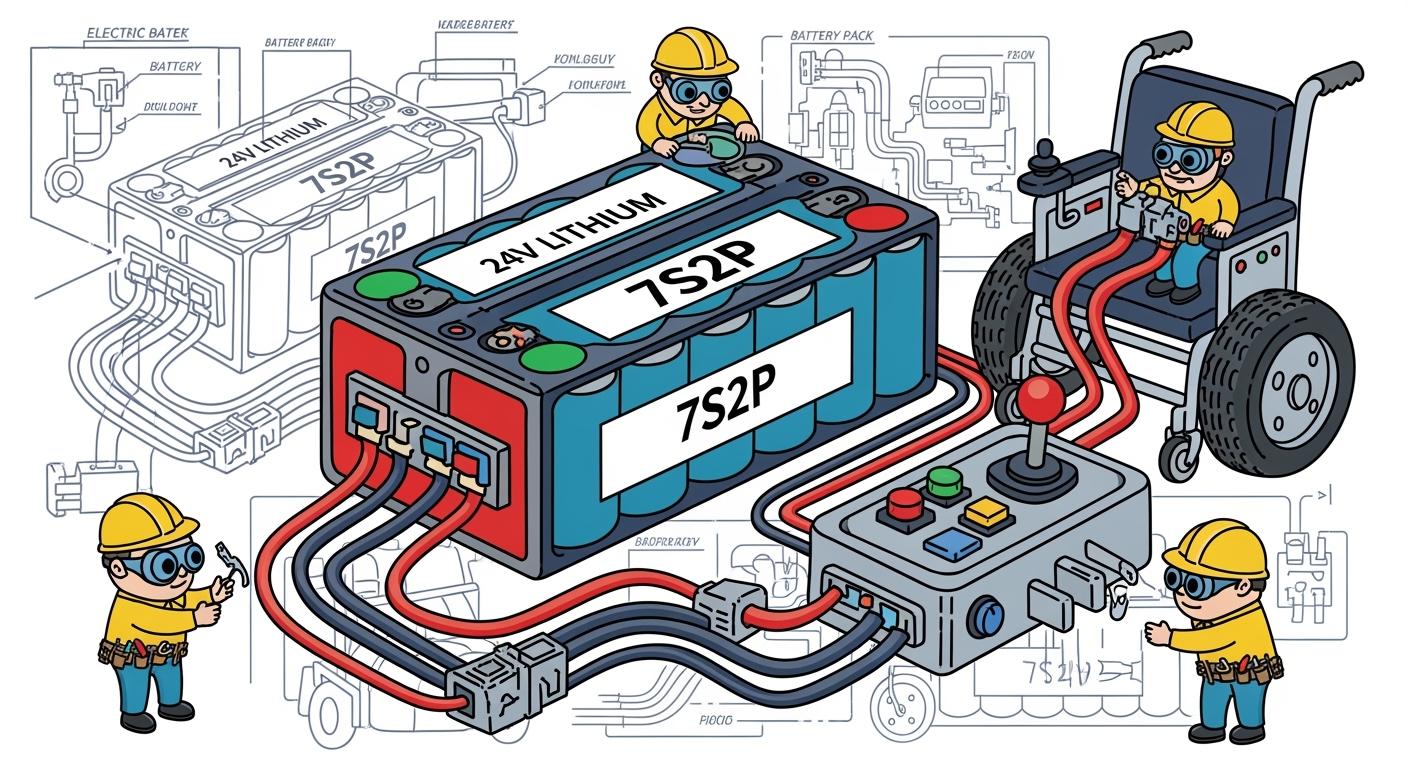
You face increasing demand for reliable power solutions in electric wheelchair control systems as the global market expands rapidly:
The market reached USD 4.35 billion in 2024, with projections of USD 11.97 billion by 2033.
Growth rates exceed 10% CAGR, highlighting the need for optimized Lithium Battery Pack design.
Key Takeaways
Choose a 24V lithium battery pack for reliable performance in electric wheelchairs. This voltage balances power and safety, ensuring optimal operation.
Implement a robust Battery Management System (BMS) to monitor and protect your battery pack. A good BMS extends battery life and enhances safety.
Follow strict testing and maintenance protocols to ensure safety and performance. Regular checks and proper storage can prevent premature battery failure.
Part 1: Design Requirements & 7S2P Setup
1.1 Voltage, Capacity, and Cycle Life
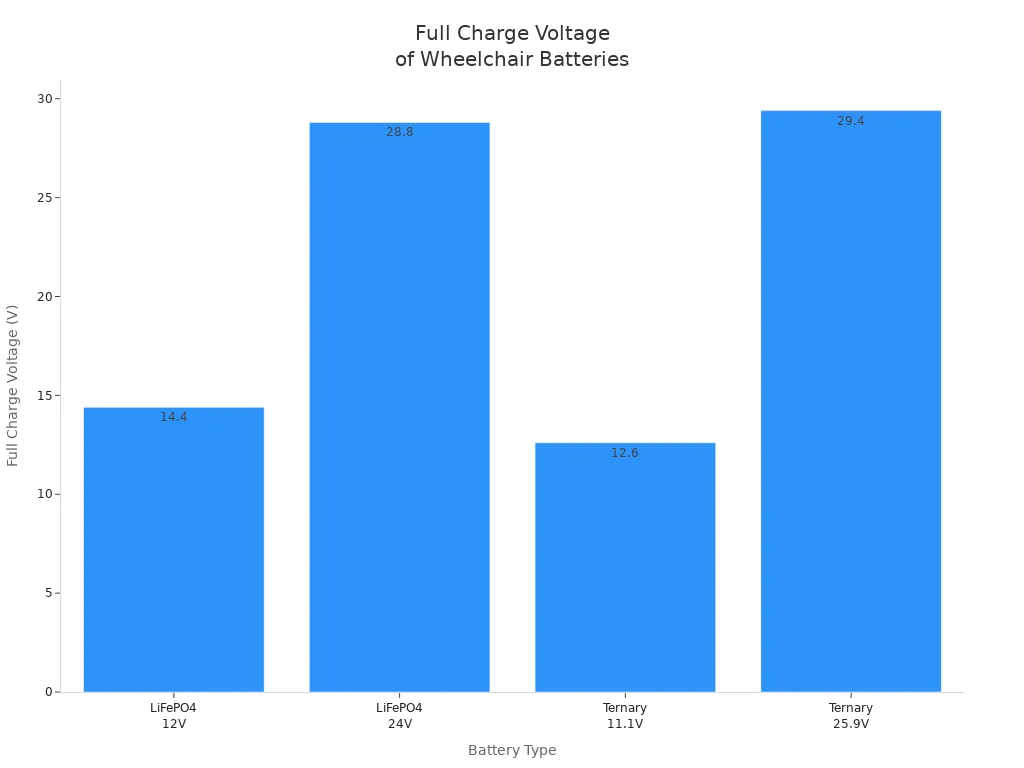
You need to select the right voltage and capacity to ensure reliable performance in electric wheelchair control systems. Most applications require a 24V system, which balances power and safety. The table below compares common lithium battery chemistries and their specifications for electric wheelchair use:
Battery Type | Specification | Charger | Full Charge Voltage |
|---|---|---|---|
LiFePO4 12V | 12.8V | 14.4V | 14.4V |
LiFePO4 24V | 25.6V | 28.8V | 28.8V |
Ternary 11.1V | 11.1V | 29.4V | 12.6V |
Ternary 25.9V | 25.9V | 29.4V | 29.4V |
You should also consider cycle life. Many lithium battery packs for wheelchairs offer more than 2,000 cycles at 80% depth of discharge. This ensures long-term reliability for medical, robotics, and industrial applications.
12V 100Ah LiFePO4: Over 2,000 cycles, 100A continuous discharge
12V 200Ah LiFePO4: Over 2,000 cycles, 200A continuous discharge
12V 50Ah LiFePO4: 2,000 cycles, 80% DOD
1.2 7S2P Configuration Explained
The 7S2P configuration connects seven cells in series (7S) to achieve a nominal voltage of 25.9V. Two cells in parallel (2P) increase the overall capacity. This setup provides both the voltage and energy density required for electric wheelchair control systems. You benefit from higher output and longer runtime, which is essential for medical and industrial mobility devices.
7S increases voltage to 25.9V
2P doubles the capacity for extended use
Typical pack: 25.9V, 5.2Ah
1.3 Safety and Regulatory Considerations
You must comply with international standards when designing a lithium battery pack for mobility devices. Regulations limit each battery to 100Wh, with up to two spares (101-160Wh) allowed with airline approval. This ensures safe transport and use in medical, robotics, and security system applications.
Standard | Description |
|---|---|
ISO 7176-21 | Electromagnetic compatibility for electric wheelchairs |
GB/T 18029.25-2022 | Battery and charger safety, performance, and protection functions |
SJ/T 11810-2022 | Structural and thermal safety for lithium-ion batteries |
EN 12184 | Electrical system safety for European market entry |
Tip: Always consider sustainability and responsible sourcing. Learn more about sustainability and conflict minerals in battery manufacturing.
Part 2: Lithium Battery Pack Components & Safety

2.1 Cell Selection & Quality
You must start with high-quality cells to ensure the safety and reliability of your lithium battery pack. In medical mobility applications, poor cell quality can lead to failures that put users at risk. You should follow strict quality control measures during cell selection:
Quality assurance processes focus on safety and reliability for medical devices.
Choose suppliers who meet ISO 9001 and ISO 13485 standards.
Use statistical process control to monitor manufacturing and maintain consistency.
You should also pay attention to the assembly process. Each step, from grading to environmental control, impacts the final product’s safety and performance. The table below outlines the most effective assembly steps for lithium battery packs in electric wheelchair applications:
Step | Description |
|---|---|
Grading | Assess the quality of cells to ensure only the best are used. |
Stacking | Arrange electrode sheets with separators to form cells. |
Cleaning | Remove contaminants from all components before assembly. |
Welding | Connect electrode sheets or tabs using spot or laser welding for secure connections. |
Testing | Evaluate the Battery Management System (BMS) to confirm safety and reliability. |
Sealing | Seal cells to prevent leakage and ensure integrity. |
Assembly Line | Integrate individual cells into packs or modules for the final product. |
Automated Systems | Use automation to enhance efficiency and reduce human error. |
Environmental Control | Maintain optimal humidity and air quality during critical processes like coating and filling. |
Tip: Always document your quality control procedures. This practice helps you meet regulatory requirements and provides traceability in case of recalls or incidents.
2.2 Battery Management System (BMS)
You need a robust Battery Management System (BMS) to protect your lithium battery pack and extend its service life. The BMS acts as the brain of the battery, monitoring and controlling each cell.
The table below summarizes the essential functions of a BMS in a 24V (7S2P) lithium battery pack:
Feature | Description |
|---|---|
Over-charge protection | Prevents the battery from charging beyond its capacity. |
Over-discharge protection | Stops the battery from discharging below a safe level. |
Automatic balancing | Ensures all cells are charged evenly. |
Communication protocols | Supports RS485, CanBus, Modbus, UART, BT for system integration. |
A high-quality BMS also provides:
Over-current protection
Short-circuit protection
You should select a BMS that matches your application’s requirements in medical, robotics, or industrial sectors. Reliable communication protocols allow seamless integration with wheelchair control systems and remote monitoring platforms.
2.4 Safety Features & Protection
You must prioritize safety features to prevent incidents such as fires or explosions. The most frequent safety incidents in electric wheelchair applications involve thermal runaway, which can lead to catastrophic failures.
“Electric wheelchair lithium batteries have been reported to catch fire and explode, with a significant incident occurring in 2019 when a lithium battery in a wheelchair exploded on a plane, resulting in the grounding of the flight. This incident underscores the serious safety risks associated with lithium battery packs in electric wheelchairs.”
To minimize these risks, you should implement the following safety features:
Improved battery pack design to reduce heat buildup and thermal propagation.
Advanced BMS for real-time monitoring of voltage, current, and temperature.
Gas sensors for early detection of hazardous gases during battery decomposition.
You should also use effective protection circuits, including:
Overcharge protection: Monitors battery voltage and disconnects output if it exceeds 4.4V.
Over-discharge protection: Cuts off discharge if voltage drops below 2.3V.
Over-current and short-circuit protection: Disconnects the battery during excessive current draw or short circuits.
A compact design helps you integrate the lithium battery pack into electric wheelchairs without sacrificing safety or performance. Always test your safety features under real-world conditions before deployment.
Part 3: Testing, Maintenance & Longevity
3.1 Testing Procedures
You must follow strict testing protocols to ensure your lithium battery pack meets safety and performance standards for medical, robotics, and industrial applications. Start with initial capacity and load testing to verify the pack delivers the required voltage and current. Use industry standards such as:
IEC 62133 for portable lithium-ion batteries
IEC 60086-4 for primary lithium batteries
IEC 61960 for secondary lithium cells
IEC 62281 for transport safety
UL 1642, UL 2054, and UL 2271 for safety in light electric vehicles
Diagnostic tools help you identify issues early. The table below summarizes common tools:
Diagnostic Tool | Description |
|---|---|
Peaxy Predict | Uses analytics and machine learning for predictive maintenance and health checks |
Open Circuit Voltage Test | Measures voltage without load to detect cell imbalance or sulfation |
Coulomb Counting | Tracks charge/discharge cycles to assess capacity and health |
On-board Diagnostics | Monitors battery performance in real time within the device |
Tip: Always inspect for swelling, cracks, or leaks before and after testing.
3.2 Performance Monitoring
You can extend the life of your lithium battery pack by establishing a daily charging routine. Use SMART chargers designed for your electric wheelchair model. Clean charging ports regularly to maintain efficiency. Charge the battery after each use and avoid storing it empty. If the wheelchair remains unused, top off the battery every two weeks.
Note: On-board diagnostics and predictive analytics platforms help you monitor battery health and schedule maintenance before issues arise.
3.3 Maintenance & Replacement
Regular maintenance prevents premature failure. The table below outlines recommended intervals:
User Type | Maintenance Interval |
|---|---|
General users (indoor, smooth) | Every 3-4 months |
Rough terrain or heavy use | Every 2 months |
Before long trips | Full check |
Store your battery at 40–60% charge in a cool, dry place (20°C–25°C). Avoid extreme temperatures and direct sunlight. Signs that indicate replacement include bulging, cracking, hissing, leaking, rapid temperature rise, or smoking. Always recycle old batteries responsibly to support sustainability.
If you notice any damage or performance drop, replace the battery immediately to maintain safety and reliability.
You ensure safety and reliability by selecting quality cells, integrating a robust BMS, and following strict documentation and testing protocols.
Always use certified chargers and maintain optimal charging temperatures.
Partner with certified labs and secure IATA and UN38.3 certifications for compliance.
Regular maintenance maximizes battery life and performance.
FAQ
What battery chemistries work best for electric wheelchair control systems?
You can choose from lithium-ion, LiFePO4, lithium-polymer, or solid-state batteries. See the table below for technical data.
Chemistry | Nominal Voltage | Cycle Life | Safety Level |
|---|---|---|---|
LiFePO4 | 3.2V/cell | 2000+ | High |
Lithium-ion | 3.6V/cell | 1000–1500 | Medium |
Lithium-polymer | 3.7V/cell | 800–1200 | Medium |
Solid-state | 3.8V/cell | 2500+ | Very High |
Which industries benefit most from 24V (7S2P) lithium battery packs?
You gain the most value in medical, robotics, security, infrastructure, consumer electronics, and industrial sectors.
How can you get a custom lithium battery pack for your application?
You can request a custom battery solution from Large Power.
Contact our engineers for a free consultation and tailored battery design.


