

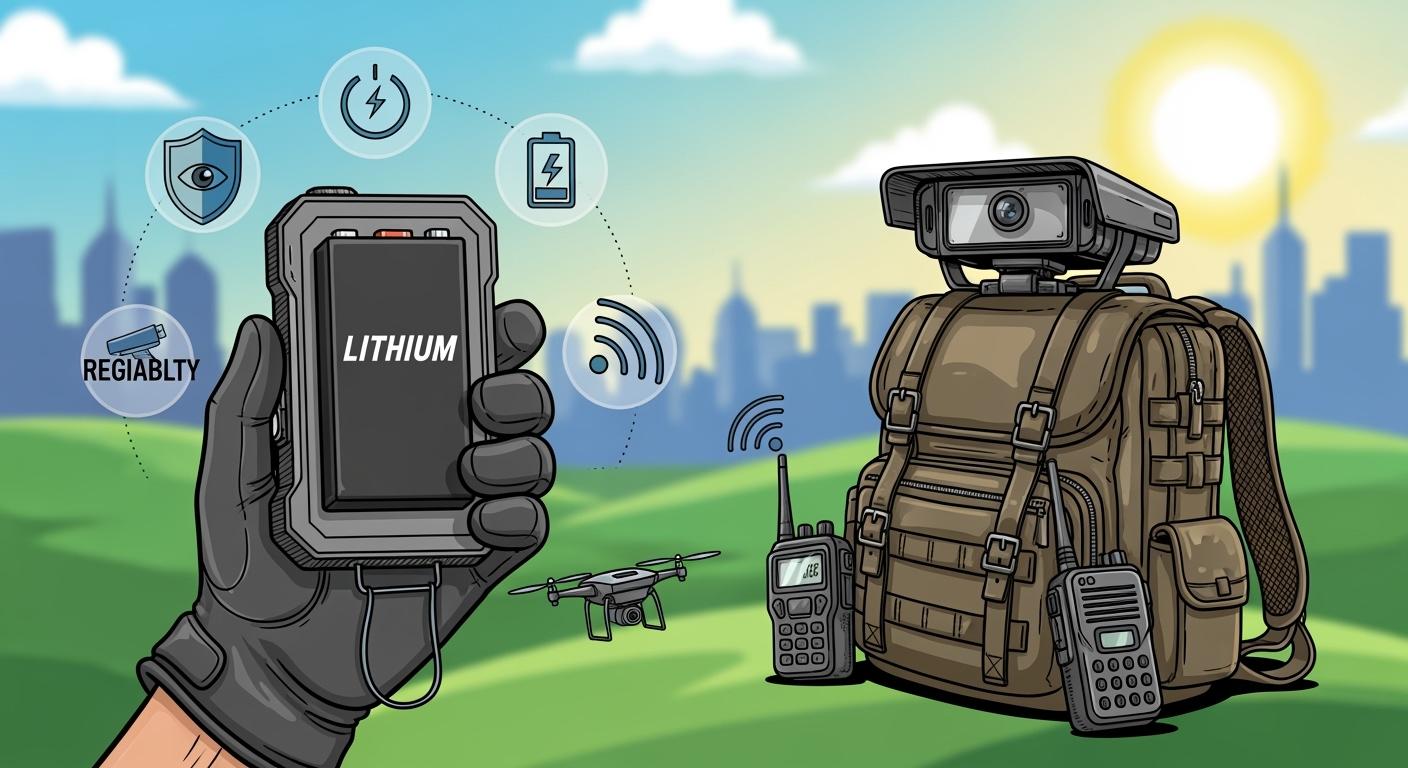
You need reliable lithium battery solutions to meet the strict demands of portable security and tactical field equipment. Military and government agencies trust these power solutions for their high energy density and lightweight design. You benefit from advanced battery technology that supports mission readiness, even in harsh environments. As government requirements grow, lithium battery solutions offer improved safety and supply chain security. The latest power solutions deliver consistent battery performance, helping you maintain operational efficiency across diverse government and defense applications.
Battery Type | Characteristics |
|---|---|
Primary Batteries | Lightweight and reliable for essential government and military functions. |
Secondary Batteries | Rechargeable, long-lasting, and eco-friendly, ideal for tactical power needs. |
Smart Batteries | Real-time monitoring and management for superior operational efficiency. |
Advanced Management | Extends battery lifespan and ensures reliability in government operations. |
Key Takeaways
Lithium batteries offer high energy density and lightweight design, ideal for portable security equipment.
Advanced battery technology ensures mission readiness in harsh environments, supporting operational efficiency.
Rechargeable lithium batteries reduce maintenance needs and lower total ownership costs.
Modular battery designs provide flexibility and scalability for rapid deployment and changing power needs.
Safety features in lithium batteries protect equipment and personnel, ensuring reliable performance.
Part1: Power Challenges in Tactical Field Equipment
1.1 Field Reliability and Mission Readiness
You depend on reliable power to keep your tactical field equipment operational during every mission. Power failures often occur because backup systems are fragile. If a backup battery fails or depletes, your electronic equipment can shut down without warning. Generator failures also happen, especially when they are not serviced or refueled on time. Sometimes, teams miscalculate the generator’s capacity, which can lead to a loss of power for entire buildings. These risks make effective battery management essential for operational continuity.
Evidence | Description |
|---|---|
80% of supply missions | Indicates the high percentage of missions focused on fuel delivery, highlighting vulnerability. |
1,100 attacks on fuel convoys | Demonstrates the risks associated with fuel logistics, impacting operational safety. |
Energy is a cornerstone of military readiness.
Distributed renewable energy and microgrids enhance operational continuity.
Secure and decentralized power is recognized as a defense asset.
1.2 Environmental and Supply Chain Risks
Your battery performance faces threats from extreme environments. High and low temperatures can speed up electrolyte breakdown and gas generation inside battery cells. High-altitude operations expose batteries to lower air pressure, which increases internal pressure differences. Rapid charging can create too much heat, making battery chemistry unstable.
Environmental Factor | Impact on Battery Performance |
|---|---|
Extreme Temperature Variations | Accelerates electrolyte decomposition and gas generation within battery cells. |
High-Altitude Operations | Exposes batteries to reduced atmospheric pressure, exacerbating internal pressure differentials. |
Rapid Charging Protocols | Generates excessive heat, destabilizing battery chemistry. |
Supply chain disruptions can also limit your access to batteries for tactical field equipment. Gaps in the War Reserve Materiel framework mean you may not have enough Tactical Energy Storage solutions. This shortage can hurt your mission readiness and your ability to respond to threats. Modern military operations rely on battery power for many weapon systems, so integrating batteries and energy storage into your supply chain is critical.
1.3 Mobility and Rapid Deployment Needs
You need power sources that support rapid deployment and flexible operations. Mobile power units must be easy to dispatch and set up quickly to meet urgent energy needs. Modular battery designs let you adjust capacity as your power requirements change. This approach helps you control costs by avoiding permanent infrastructure for temporary or seasonal needs. Reliable backup power ensures your systems keep running during grid maintenance or unexpected outages.
Flexibility and efficiency allow you to deploy mobile power units quickly.
Scalability lets you adjust battery capacity for different missions.
Cost-effectiveness comes from using modular systems for short-term needs.
Reliable backup power keeps your equipment running during outages.
Feature | Traditional Lithium-Ion Batteries | Supercharge Ion Batteries |
|---|---|---|
Charging Speed | Slower, leading to long wait times | Faster, enabling quick deployment |
Energy Density | Relatively low, requiring frequent recharges | Higher, resulting in longer runtime |
Safety | Risk of overheating and explosion | Improved safety features |
You gain a tactical advantage when you use advanced lithium battery packs. These batteries charge faster, last longer, and offer better safety features than older technologies. This reliability supports your mission success in every environment.
Part2: Lithium Battery Solutions and Tactical Energy Storage
2.1 High Energy Density and Lightweight Packs
You need tactical energy storage that delivers maximum power in a compact form. Modern lithium battery packs provide high energy density, which means you get more energy per kilogram than with older chemistries. This advantage allows you to reduce the weight of your portable security and tactical field equipment. You can carry more gear or extend mission duration without increasing your load.
Battery Type | Energy Density (Wh/kg) |
|---|---|
Lithium-ion | 300–350 |
Lithium-metal | 473–510 |
Lithium-ion and lithium-metal batteries outperform legacy chemistries like lead-acid and nickel-cadmium. You see these high-performance battery technology solutions used in medical devices, robotics, security systems, and industrial infrastructure. For example, lithium battery packs in mobile surveillance units enable longer operation times and faster redeployment.
Battery Type | Weight Comparison |
|---|---|
Lithium | 60-75% lighter |
Lead-acid | Reference weight |
You benefit from lighter packs, which means easier transport and faster setup. This weight reduction supports rapid deployment and flexible operations in the field.
Safety Feature | Description |
|---|---|
Overheating Prevention | Mechanisms to prevent the battery from overheating during operation. |
Short-Circuit Protection | Built-in features to avoid short-circuiting, ensuring safe operation. |
Overcharging Prevention | Safety measures to prevent overcharging, which can lead to battery failure. |
Durability | Designed to withstand harsh military conditions, ensuring reliability. |
You can trust lithium battery innovation to deliver consistent performance in rugged conditions. These batteries support critical applications in robotics, security systems, and industrial automation. You also see them in medical and infrastructure sectors, where reliability is essential.
Temperature resilience: Lithium batteries perform well within rated limits, but you should avoid sustained exposure to extreme heat or cold. Nuclear batteries offer better stability in extreme conditions, but lithium remains the preferred choice for most tactical energy storage needs.
Power stability: You may notice some variation in output as batteries age or face temperature swings. Regular monitoring helps you maintain optimal performance.
Lifetime expectations: Lithium batteries last from several months to a few years, depending on use and environment. You should plan for periodic replacement to ensure mission readiness.
Maintenance requirements: You need to schedule retrieval and replacement, but lithium batteries require less frequent attention than older chemistries.
2.3 Rechargeability and Maintenance Benefits
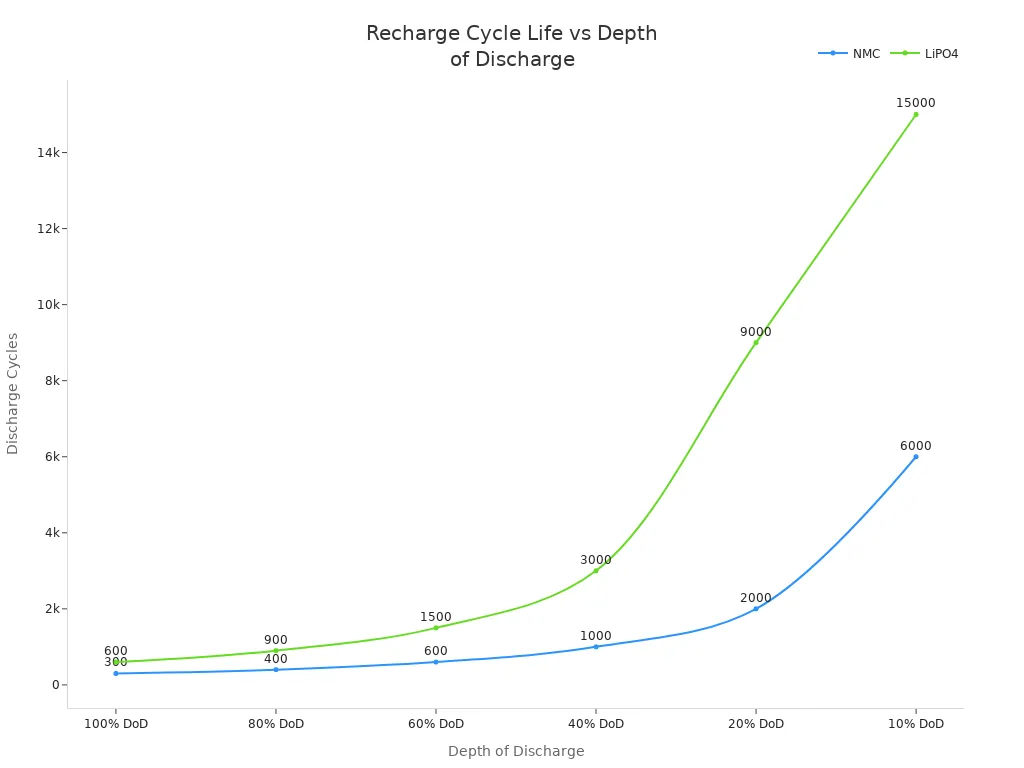
You gain a major advantage with rechargeable lithium battery packs. These batteries support hundreds to thousands of cycles, depending on how deeply you discharge them. This feature reduces your need for frequent replacements and lowers your total cost of ownership.
Depth of Discharge | Discharge cycles (NMC) | Discharge cycles (LiFePO4) |
|---|---|---|
100% DoD | ~300 | ~600 |
80% DoD | ~400 | ~900 |
60% DoD | ~600 | ~1,500 |
40% DoD | ~1,000 | ~3,000 |
20% DoD | ~2,000 | ~9,000 |
10% DoD | ~6,000 | ~15,000 |
You spend less time on maintenance when you use lithium battery packs. Lead-acid and nickel-cadmium batteries require regular electrolyte checks and frequent capacity testing. Lithium batteries need much less maintenance, which means less downtime and lower labor costs. Some lithium battery packs require no scheduled maintenance and can last eight years or longer in tactical energy storage applications.
You see these benefits in security systems, medical devices, and industrial robotics. Rechargeable lithium batteries help you keep your operations running smoothly and efficiently.
Tip: You can extend battery life by avoiding deep discharges and storing batteries at moderate temperatures.
You rely on battery innovation to meet the demands of modern tactical energy storage. These advancements give you the performance, safety, and reliability you need for mission success.
Part3: Battery Solutions for Security and Defense
3.1 Lithium-Ion and Polymer Chemistries
You need battery solutions that deliver military grade performance for government application and defense operations. Lithium-ion battery and lithium-polymer chemistries offer distinct advantages. Lithium-ion battery technology provides higher energy density, making it ideal for high-capacity tactical equipment. Lithium-polymer batteries use solid or gel-state electrolytes, which enhance safety and allow flexible packaging. You benefit from slower degradation rates and lower self-discharge with lithium-polymer batteries. Both chemistries support critical government application scenarios, including medical devices, robotics, security systems, and industrial infrastructure.
Feature | Lithium-Ion | Lithium-Polymer |
|---|---|---|
Platform Voltage | 3.6–3.7 V (NMC, LCO, LMO) | 3.7 V |
Energy Density | 300–350 Wh/kg | 200–250 Wh/kg |
Cycle Life | 500–1000 cycles | 800–1200 cycles |
Safety | Built-in protection circuits | Enhanced stability, flexible packaging |
Applications | Surveillance, infrastructure, robotics | Wearable, compact, undersea lithium battery packs |
Note: Lithium-polymer batteries resist physical damage and offer enhanced protection from leakage and combustion.
3.2 Modular Packs and Custom Designs
You gain operational flexibility with modular battery packs and customized power solutions. Modular packs allow rapid field replacement, minimizing downtime in tactical environments. You benefit from enhanced durability, protection from moisture, resistance to corrosive agents, and shielding from electromagnetic interference. Custom-designed battery solutions meet stringent requirements for military-standard batteries, including compliance with MIL-STD-810H and ITAR regulations. These batteries deliver lightweight, energy-dense performance for UAVs, drones, and advanced battery systems.
Feature | Description |
|---|---|
Ruggedized Battery Packs | Engineered for defense, aerospace, and UAV/drone applications, ensuring reliability under extreme conditions. |
Compliance with Military Standards | Validated to MIL-STD-810H environmental test methods, ensuring performance under shock, vibration, and temperature extremes. |
High-Energy Density Solutions | Designed for UAV and drone applications, enhancing mission endurance and operational efficiency. |
MIL-STD-810H Environmental Test Methods
ITAR Compliance
AS9100 Certification
3.3 Battery Management and Safety Systems
You rely on battery management strategies to maximize safety and operational life. Advanced battery systems use battery management systems (BMS) to monitor temperature, state of charge, and cell balancing. BMS prevents overcharging, over-discharging, and thermal runaway. You benefit from preventive maintenance capabilities and smart communication protocols. Effective thermal management keeps battery temperature within optimal ranges, extending cycle life and ensuring reliability for military-standard batteries.
Function | Description |
|---|---|
Charging accuracy | Ensures precise state of charge calculations to prevent overcharging. |
Preventive maintenance capabilities | Monitors state of health and detects faults to enhance safety. |
Battery cell balancing | Maintains cell charge within safe limits to prevent imbalances. |
Smart communication | Integrates control protocols for effective communication with charging systems. |
Tip: Battery management systems help you avoid performance loss and premature aging by controlling battery pack temperature during charging.
Part4: Selection Criteria for Tactical Battery Solutions
4.1 Capacity and Runtime
You need to select lithium battery packs that match your operational demands. Capacity and runtime determine how long your equipment can function without interruption. Tactical field devices, such as portable surveillance units and communication gear, require batteries with high capacity and reliable runtime. You must consider the depth of discharge (dod) to maximize battery life and efficiency.
Battery Type | Capacity (mAh) | Typical Use Cases |
|---|---|---|
CR2 | 600 – 900 | Compact cameras, small LED flashlights, basic security sensors |
CR123 | 1,300 – 1,700 | Professional photography equipment, high-output flashlights, advanced security systems |
You benefit from lithium battery solutions that redefine energy efficiency for medical and field operations. Swappable battery technology ensures continuous operation, allowing you to replace batteries quickly and keep your devices running. Long cycle life supports extended operational time, which is crucial for continuous field work. Advanced battery management systems optimize runtime by monitoring and controlling parameters such as dod and state of charge.
Robust power solutions enhance mobility and productivity in field operations.
Intelligent control circuits predict and adjust power consumption based on usage requirements.
Lithium-ion batteries provide efficiency for high production levels in security systems and industrial infrastructure.
Tip: Choose batteries with high energy density and long cycle life to reduce downtime and maintenance costs.
4.2 Ruggedness and Temperature Tolerance
You operate in environments where equipment faces extreme temperatures, humidity, vibration, and mechanical shock. Ruggedness and temperature tolerance are essential for tactical battery solutions. You must select batteries that meet department of defense requirements and industry standards for durability.
Standard | Requirement Description |
|---|---|
MIL-STD-810 | Temperature cycling from -54°C to +71°C, humidity resistance up to 95% relative humidity, vibration tolerance across multiple frequency ranges. |
MIL-STD-461 | Addresses electromagnetic interference requirements to maintain signal integrity. |
DLA Procurement | Corrosion resistance equivalent to 1000-hour salt spray testing, mechanical shock resistance up to 40G acceleration, flame retardancy compliance with UL 94 V-0. |
Low-temperature lithium batteries are optimized for cold environments. You can rely on these batteries to deliver consistent power at sub-zero temperatures. They pack high energy density in a lightweight package, which is essential for military personnel needing portable power solutions. These batteries charge quickly and maintain performance in freezing conditions, ensuring critical devices remain operational.
These batteries operate reliably in temperatures as low as -40°C.
Safety mechanisms prevent overheating, short-circuiting, and overcharging.
Military equipment remains functional in extreme cold, which is critical for mission success.
You see these features in communication systems, unmanned aerial vehicles (UAVs), and portable military equipment. Rugged lithium battery packs support robotics, medical devices, and industrial automation. You must verify compliance with MIL-STD-810 and MIL-STD-461 to ensure your batteries meet department of defense requirements.
Note: Rugged battery solutions reduce the risk of equipment failure in harsh environments.
4.3 Rechargeability and Safety Features
You value rechargeable batteries for their longevity and lower life-cycle costs. Efficient charge retention and reusability make lithium battery packs ideal for tactical applications. Smart battery technology, including self-diagnosis and improved power management, enhances operational efficiency and sustainability in challenging environments.
You must prioritize safety features to reduce operational risks. Integrated gas sensors and advanced Battery Management Systems (BMS) enable early detection of hazards. Gas sensors identify potential issues before they escalate, giving you critical time to mitigate risks. The BMS monitors battery condition, including voltage and temperature, and takes action to prevent overheating. These features reduce the likelihood of thermal runaway and ensure safe operation.
Feature | Description |
|---|---|
Rechargeability | Supports hundreds to thousands of cycles, lowering replacement frequency and costs. |
Smart Battery Technology | Includes self-diagnosis and power management for enhanced efficiency. |
Integrated Safety | Gas sensors and BMS monitor battery health and prevent hazards. |
You benefit from lithium battery packs that maintain performance across extreme temperature ranges and support high dod. These batteries deliver reliable power for communication devices, security systems, and industrial infrastructure.
Callout: Rechargeable lithium batteries with advanced safety features help you meet department of defense requirements and ensure mission readiness.
Part5: Warfighter Applications and Best Practices

5.1 Mobile Surveillance and Silent Watch
You support the warfighter by powering mobile surveillance systems that require long runtimes and silent operation. Lithium battery packs with chemistries like LiFePO4 and NMC deliver high energy density and stable platform voltage. These batteries enable silent watch missions, where you must avoid detection and maintain continuous monitoring. You see these solutions in security systems, medical monitoring devices, and robotics. Warfighter equipped with advanced battery technology can deploy portable surveillance units quickly and operate them for extended periods without noise or emissions. This approach improves warfighter performance in the field.
Application Scenario | Battery Chemistry | Platform Voltage (V) | Energy Density (Wh/kg) | Cycle Life (cycles) |
|---|---|---|---|---|
Mobile Surveillance | NMC | 3.6–3.7 | 300–350 | 500–1000 |
Silent Watch Medical | LiFePO4 | 3.2 | 160–200 | 2000+ |
Robotics Patrol | LCO | 3.7 | 250–270 | 300–500 |
Tip: Use modular battery packs to swap power sources in the field and reduce downtime for warfighter operations.
5.2 Rapid Deployment and Communication Gear
You rely on lithium battery packs for rapid deployment of communication gear and unmanned aerial vehicles. Warfighter teams need lightweight batteries to power military drones and smart soldier systems. These batteries must withstand harsh environments and deliver consistent power. You see lithium battery packs used in industrial robotics, infrastructure monitoring, and consumer electronics for quick setup and reliable performance. Warfighter units benefit from batteries that support fast charging and high discharge rates, ensuring communication gear and unmanned aerial vehicles remain operational during critical missions.
Lightweight batteries increase mobility for warfighter teams.
Fast charging reduces wait times during rapid deployment.
Reliable power supports continuous operation of military drones and communication devices.
5.3 Reliability and Safety Protocols
You must follow strict reliability and safety protocols to protect the warfighter and mission-critical equipment. Battery management systems monitor temperature, voltage, and state of charge. These systems prevent overcharging and overheating, which reduces the risk of failure. Warfighter operations depend on batteries that meet military standards for ruggedness and safety. You see these protocols applied in medical devices, industrial automation, and security systems. Warfighter teams use batteries with integrated safety features to ensure consistent performance in every environment.
Note: Always verify that your battery packs comply with MIL-STD-810 and MIL-STD-461 for maximum warfighter safety.
You improve warfighter performance by choosing lithium battery solutions designed for demanding field applications. These best practices help you maintain operational readiness and safety across all sectors.
You gain reliable power for security and defense equipment with lithium battery solutions. These batteries deliver consistent performance, support mission readiness, and enhance operational safety. You benefit from secure supply chains as domestic policies reduce dependency on foreign lithium sources. You see long-term value through strategic battery care and efficient engineering.
Well-designed battery packs withstand shocks and vibrations, extending service life.
Efficient components reduce battery strain, improving cycle life and customer satisfaction.
FAQ
What are the main advantages of custom lithium battery packs for tactical field equipment?
You gain high energy density, lightweight design, and long cycle life with lithium battery packs. These features support rapid deployment and reliable power for security, medical, and industrial applications. For custom battery solutions, contact Large Power’s engineering team for professional consultation.
How do LiFePO4 and NMC chemistries compare for field use?
Chemistry | Platform Voltage (V) | Energy Density (Wh/kg) | Cycle Life (cycles) |
|---|---|---|---|
LiFePO4 | 3.2 | 160–200 | 2,000+ |
NMC | 3.6–3.7 | 300–350 | 500–1,000 |
You choose LiFePO4 for longer life and NMC for higher energy density.
What safety features should you look for in lithium battery solutions?
You should select battery packs with integrated Battery Management Systems (BMS), gas sensors, and overcharge protection. These features help prevent overheating, short-circuiting, and thermal runaway in demanding environments.
Can you use lithium battery packs in extreme temperatures?
You can use ruggedized lithium battery packs in temperatures as low as -40°C and as high as +71°C. These batteries maintain performance for robotics, security systems, and industrial infrastructure.
Why are modular battery packs important for B2B operations?
You benefit from modular battery packs because they allow quick replacement and scalability. This flexibility reduces downtime and supports continuous operation in medical, security, and industrial sectors.


