

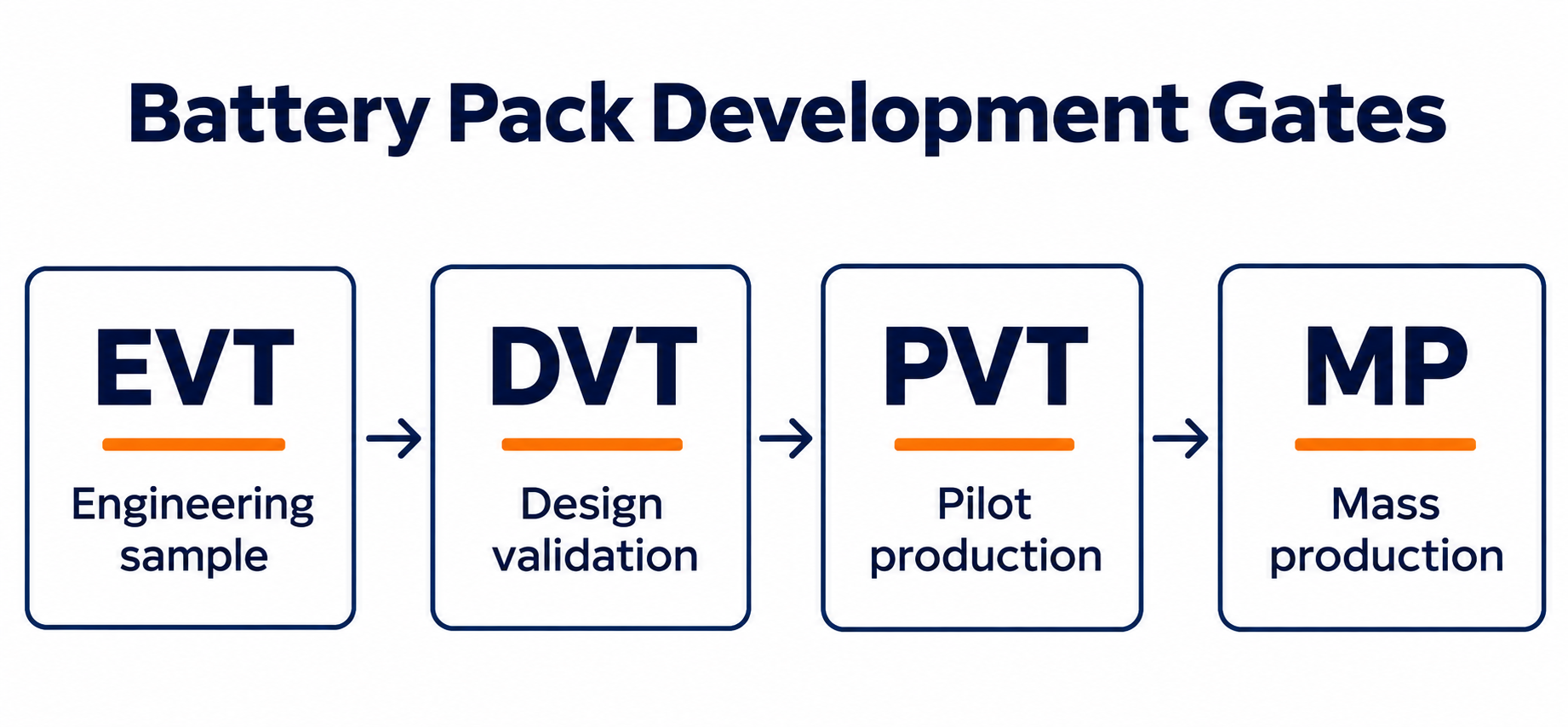
Quick Answer: Start with the device’s operating requirements, agree on the pack architecture and cell-matching criteria, then use EVT, DVT, and PVT builds to gather the evidence needed for mass production. EVT checks whether the proposed pack works in the host. DVT tests whether a controlled design meets the agreed requirements. PVT checks whether the intended production process can build it consistently. MP continues those controls through lot release, traceability, and approved changes.
This guide uses a removable battery pack for an indoor mobile robot as a running example. The OEM needs the pack to fit its battery bay, support motor startup, recharge through the approved charger, and report status to the host controller. Each development stage answers a different question about that same pack.
| Stage | OEM input | Supplier output | Decision before proceeding |
|---|---|---|---|
| RFQ and architecture | Load profile, voltage limits, fit envelope, charger, operating conditions, and volume forecast | Proposed configuration, assumptions, scope, and validation plan | Is the proposal ready for engineering development? |
| Cell selection and matching | Duty cycle, operating limits, and any cell sourcing requirements | Proposed cell model, matching criteria, and traceability plan | Which cells and controls will be used for the engineering build? |
| EVT | Host hardware, charger, interface information, and initial acceptance criteria | Engineering samples, integration results, and an issue list | Is the architecture viable enough for controlled design validation? |
| DVT | Representative host configuration, intended-use conditions, and acceptance limits | Test results tied to a controlled pack revision, with deviations and retest decisions | Does the design evidence support the next build? |
| PVT | Pilot scope, quality requirements, and production-release criteria | Pilot build records, measured variation, yield, and traceability evidence | Can the planned production process reproduce the approved design? |
| MP | Approved configuration, order quantities, and change-notification requirements | Released lots, inspection records, and traceable configuration history | Does each lot meet shipment criteria, and are subsequent changes authorized? |
Part 1: Define Requirements and Request a Quote
1.1 Start with the Device’s Measured Load
Give the pack supplier the device’s minimum and maximum operating voltage, normal current, startup and transient peaks, pulse duration, and expected runtime. Identify where and how the load was measured. A peak reading without its duration gives the supplier little basis for assessing voltage sag, heating, or a protection trip.
For the mobile robot, capture standby, travel, and loaded operation as separate cases. Include the lowest pack voltage at which the host must still start. If braking can return current to the pack, share when it happens and what the host can do if the pack limits charging.
1.2 Define the Physical and Commercial Scope
Send the battery-bay drawing with mounting points, installation direction, connector position, cable clearance, and removal space. Specify the operating and charging environments, target markets, the quantities needed for engineering and pilot builds, and the expected production volume.
Ask the supplier to identify the proposed deliverables and assumptions in the quotation. Separate the scope for engineering, tooling, samples, validation, and production. Identify which tests the pack supplier will run and which require the OEM’s finished device. Custom Battery Pack RFQ Checklist
Part 2: Agree on the Pack Architecture and Interfaces
2.1 Check Series and Parallel Configuration Against the Host
Series count sets the nominal pack voltage for the selected cell. Parallel count affects nominal capacity and how current is shared. Check the proposed configuration across the device’s usable voltage range, including the fully charged condition and voltage under load near the host cutoff. Treat nominal energy and usable runtime as separate acceptance items.
For the robot, the proposed pack must support both the normal drive cycle and a loaded start. The supplier can compare candidate configurations on paper first, then use the actual host to verify voltage sag and cutoff behavior. Battery Pack Configuration Calculator
2.2 Review Mechanical, Charging, and Control Interfaces Together
Confirm drawing revisions, connector and mating part numbers, pinout, cable routing, latch behavior, charger profile, and communication requirements. Where the BMS exchanges data with the host, agree on the data definitions, update behavior, and response to charge inhibit, low voltage, or invalid data.
For a removable pack, check the full insertion and removal path. A battery that fits the nominal bay may still need changes if the mating connector binds at the tolerance limits or the harness obstructs the latch. Robot Battery Solutions · BMS and PCM
Part 3: Cell Selection and Large Power’s Zero-State Cell Matching
3.1 Select the Cell Model for the Operating Conditions
Evaluate the cell model against the required current profile, operating temperatures, charging conditions, available space, and supply plan. Review the relevant datasheet limits before committing to an architecture. Record the cell manufacturer and model in the design baseline so sample and pilot results can be traced back to the cells used.
Once the model is selected, define the incoming checks and matching criteria for the build. For the robot pack, a useful review question is whether the cell evidence covers the operating conditions used to assess startup and usable runtime.
3.2 Where Zero-State Cell Matching Fits
Large Power lists a Zero-State Cell Matching system and a production traceability system among its custom pack manufacturing capabilities. In the OEM workflow, the matching review belongs after the cell model is selected and before the cells are assembled into packs. The review should connect the matching criteria to the specific cell and build, then carry that information forward into pilot production and lot release.
For the robot example, review how the cells used in the EVT and DVT packs are identified. Before PVT, agree on what cell and pack records will be kept and how the team will evaluate a change of cell lot, cell model, or matching criteria. This gives the OEM a way to compare a pilot or production pack with the configuration used during validation. Battery Manufacturing and Storage
3.3 Ask for the Evidence Your Project Needs
Ask which matching measurements and acceptance criteria apply to the cell model, what records can be shared, and how pack serial numbers or lots are linked to the cells used. Agree on the handling of out-of-limit cells and the evidence needed before a substitution. Set these expectations in the quality or validation plan, alongside pack-level acceptance tests.
Part 4: EVT — Engineering Validation Test
4.1 Check Whether the Engineering Pack Works in the Host
EVT uses engineering samples to answer the largest integration questions early. Record the pack drawing and BOM revisions, cell model, BMS settings, and any temporary fixtures or prototype parts. Keep the host and charger versions with the test record so the team can reproduce the findings.
On the robot, install and remove the pack, verify connector mating and polarity, and measure voltage during startup and representative load transitions. Confirm that the host interprets status and protection signals correctly. Record how the charger and pack behave when charging is permitted and when the BMS requests a limit or inhibit.
4.2 Review the First Article and Close Architecture Issues
Compare the delivered sample with the agreed drawings and interfaces. Record deviations, their impact, the responsible owner, and what needs retesting. If the battery starts the robot but the latch interferes with the chassis, the next build needs a mechanical correction and an agreed fit check.
The EVT exit decision should identify the architecture the team is taking into DVT, the changes to incorporate, and the issues that must close before the next gate. Custom Battery Pack Sample Approval
Part 5: DVT — Design Validation Test
5.1 Test a Defined Pack Revision Against Acceptance Limits
Identify which drawing, BOM, firmware, and protection settings each sample represents. Tie the test plan to specific requirements and state which tests use the pack alone and which use the complete host. Document any differences between the test samples and the intended production configuration.
For the robot, validate runtime and startup at the agreed operating temperatures and battery states. Check charging, removal and reinsertion, and the host response to a fault. Use the installed mounting conditions for mechanical verification where they affect the result. Agree on any applicable environmental, transport, or product-specific tests based on the project scope. Testing and Certification
5.2 Decide Which Evidence Supports the Next Build
Review results against limits and record open issues with their effect on the next build. If the team changes the cell, latch, or BMS cutoff after a test, assess which results still apply and which checks must be repeated. Establish a controlled design baseline and define the evidence required before production release. OEM Design Freeze and Validation Checklist
Part 6: PVT — Production Validation Test
6.1 Run a Pilot Build Using the Intended Process
Use the intended materials, tooling, assembly methods, BMS programming process, and inspection equipment to the extent defined by the pilot plan. Document temporary operations and tooling differences. Confirm that the agreed cell matching and traceability controls carry through to the pilot units.
On the robot pack, check whether battery dimensions and connector position remain within limits across the build. Review joint inspection, insulation placement, latch assembly, programming checks, and end-of-line results. Investigate recurring defects and rework to identify where the process needs adjustment.
6.2 Release the Process Against Agreed Criteria
Review measured variation, production records, yield, the disposition of nonconforming units, and traceability back to component lots and configuration revisions. Use the pilot evidence to decide whether to release production, repeat part of the pilot, or correct the process and build again. Agree on quantities and sampling based on the design and manufacturing risks. Pilot Production for Custom Battery Packs
Part 7: MP — Mass Production and Change Control
7.1 Define What Allows Each Lot to Ship
Specify the pack revision, inspection and test limits, traceability requirements, packaging, and documents the OEM expects with a shipment. Define the end-of-line checks for the actual pack, such as identity, polarity, communication, and selected protection checks. Keep sampled performance testing and design qualification in their own test plans. Battery Pack End-of-Line Testing
7.2 Keep Changes Traceable After Release
Agree on which changes require advance notification and OEM approval. Assess each change against the affected requirements. A new connector may require fit, pinout, and mating checks. A cell change can affect charge limits, runtime, voltage sag, and the scope of existing evidence. Record the approved change, related tests, and first affected lot.
If a deployed robot reports intermittent power loss, these records help the OEM and supplier identify which packs share the relevant cell lot, assembly revision, or firmware. The investigation can then compare pack records with the host logs and reproduce the failure under the recorded conditions.
FAQ
Do all custom battery projects use the EVT, DVT, and PVT labels?
Project teams may use different labels or combine stages. Agree in writing on which build configuration and evidence support each decision, and who approves the move to the next stage.
Can an approved engineering sample go straight to volume production?
First-article approval can confirm that a particular sample meets the agreed checks. Before volume release, review the remaining design and host validation evidence, and verify that the intended manufacturing and inspection process can reproduce the approved pack.
When should an OEM review cell matching?
Agree on the criteria and traceability expectations before the engineering build. Confirm during the pilot that the intended production process applies those controls. Review changes to the cell model or matching criteria for their effect on existing validation.
What should an OEM send to start a custom battery project?
Send the duty cycle, host voltage limits, charger details, mechanical envelope, operating conditions, target markets, and expected quantities. Include any test evidence or approvals your team already requires. Those inputs give the supplier enough context to discuss a pack architecture and scope the first engineering build. Large Power Custom Battery Solutions


