

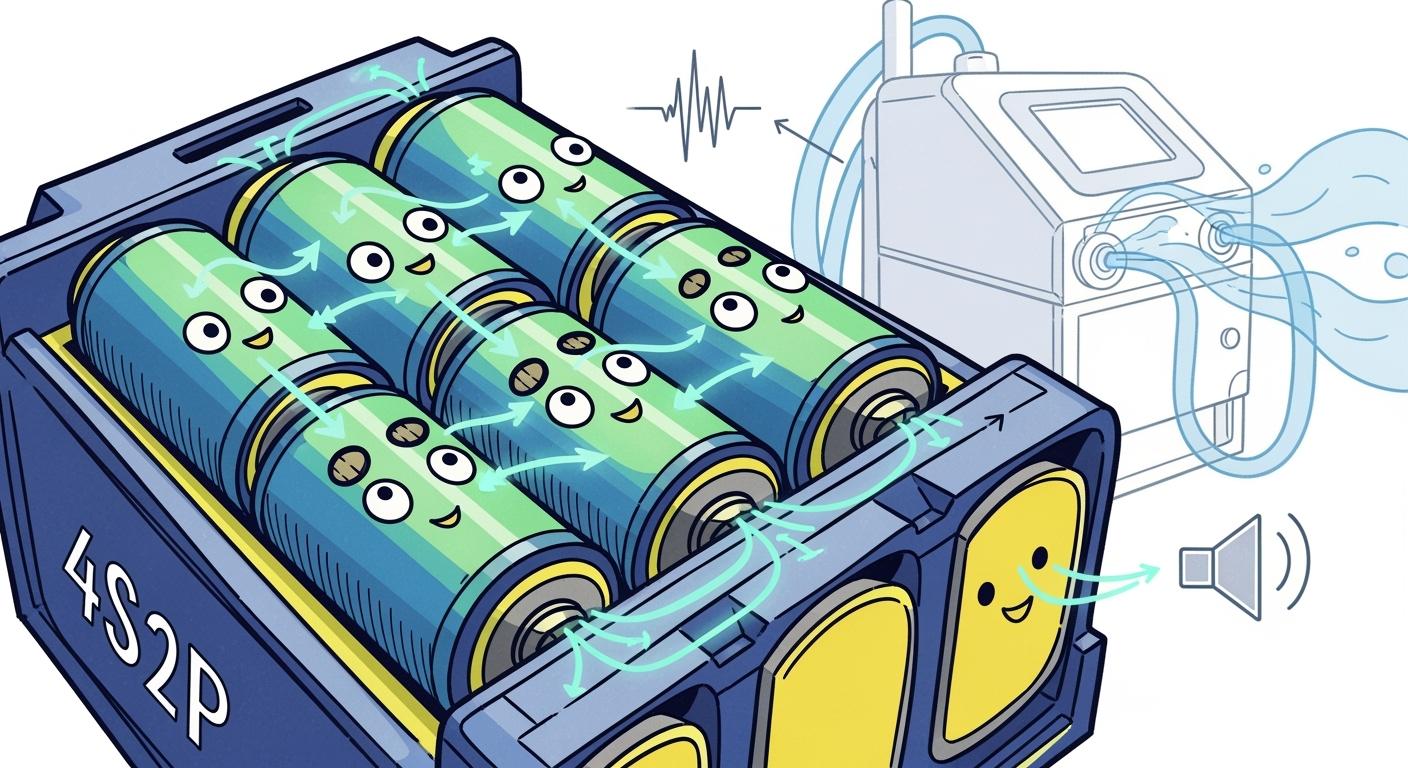
You depend on stable current delivery to keep a low-noise home ventilator running quietly and reliably. A 4S2P battery configuration, paired with a robust BMS and thermal management design, helps maintain consistent power output. Without proper thermal control, temperature fluctuations can affect battery performance, device reliability, and user comfort.
Key Takeaways
The 4S2P battery configuration enhances current stability by combining four cells in series for voltage and two sets in parallel for capacity, ensuring reliable power for ventilators.
Maintaining battery current stability is crucial for minimizing noise and ensuring consistent airflow in ventilators, which directly impacts patient comfort and device reliability.
Regular monitoring and effective thermal management are essential for prolonging battery life and performance, helping to prevent overheating and maintain stable operation.
Part1: 4S2P Pack Configuration and Battery Current Stability

1.1 4S2P Pack Structure
You often see the 4S2P configuration in medical ventilator battery packs. This setup connects four cells in series to increase voltage, then links two of these series strings in parallel to double the capacity. The table below outlines the structure:
Configuration | Description |
|---|---|
Series (4S) | Four cells connected in series to increase voltage, yielding a nominal voltage of 12.8V (4 x 3.2V). |
Parallel (2P) | Two sets of 4S connected in parallel to double the capacity while maintaining the same voltage. |
This structure allows you to achieve both the voltage and capacity needed for reliable ventilator operation.
1.2 Battery Current Stability Basics
Battery current stability means the pack delivers a steady current under varying loads. You need this stability to prevent voltage drops or surges that could disrupt sensitive medical equipment. The arrangement in a 4S2P configuration increases capacity and current delivery, which is crucial for stable power output. Using matched, graded cells in each pack ensures balanced load sharing and maximizes longevity. High temperatures, fast charge-discharge rates, and poor cell matching can all reduce battery current stability.
1.3 Why 4S2P Packs Enhance Stability
You benefit from the 4S2P configuration because it supports high continuous discharge rates and maintains stable voltage under sustained loads. This is essential for low-noise ventilators, where even minor fluctuations can affect performance. The pack can deliver a consistent 20A discharge while ensuring optimal thermal safety. The 4S2P setup also improves efficiency and reliability, making it the preferred choice for high-power lithium-ion battery packs in medical applications.
Part2: Battery Current Stability and Ventilator Performance

2.1 Current Fluctuations and Noise
You rely on your ventilator to deliver quiet, uninterrupted support. Battery current stability plays a critical role in minimizing operational noise. When the battery in your pack experiences current fluctuations, the ventilator’s motor can produce irregular sounds. These fluctuations often result from inconsistent voltage, which can stem from poor cell matching, inadequate thermal management, or suboptimal pack design.
In medical environments, even minor noise increases can disrupt patient rest and clinical workflows. The same principle applies to robotics and security systems, where noise can interfere with sensitive operations. You can see the impact of current instability in the following ways:
Sudden changes in battery output cause the ventilator’s fan speed to vary, leading to audible noise.
Inconsistent current delivery increases the risk of voltage sag, which can trigger alarms or system resets.
Poor thermal management raises the temperature of the battery, further destabilizing current output and increasing noise.
You can mitigate these issues by selecting packs with advanced battery management systems and robust thermal management. These features help maintain a stable temperature and consistent current, ensuring low-noise operation.
2.2 Stable Power for Consistent Airflow
Consistent airflow is essential for ventilator performance. You need your battery to deliver steady power so the ventilator can maintain precise airflow rates. The relationship between battery current stability and airflow performance is direct. When the battery provides a stable discharge, the ventilator’s motor speed remains constant, supporting reliable patient care.
Airflow stability in battery-powered fans depends on motor speed, which is sensitive to voltage levels.
Voltage sag reduces motor speed and weakens airflow.
Low internal resistance and stable discharge from the battery are crucial for maintaining consistent airflow over time.
PKNERGY’s battery pack design minimizes voltage drop, ensuring a stable operating voltage and long runtime, which collectively support steady airflow output.
You benefit from packs that use high-quality cells, advanced battery management, and effective thermal management. These features work together to keep the battery temperature within optimal limits, prevent overheating, and support long-term performance. In industrial and infrastructure applications, stable airflow ensures reliable operation of critical systems, such as emergency ventilation or backup power supplies.
Feature | Impact on Performance | Application Example |
|---|---|---|
Stable battery current | Consistent airflow | Medical ventilators |
Advanced thermal management | Prevents overheating | Robotics, industrial fans |
Low internal resistance cells | Reduces voltage sag | Security system backup |
Robust battery management | Extends pack lifespan | Consumer electronics |
2.3 User Comfort and Device Reliability
You expect your ventilator to provide comfort and reliability at all times. Battery current stability directly affects both. When the battery maintains a steady output, the ventilator delivers smooth, predictable airflow. This consistency reduces the risk of sudden pressure changes, which can disturb patients or compromise therapy.
Effective thermal management keeps the battery temperature within safe limits, preventing performance degradation and extending pack life. You also benefit from advanced battery management systems that monitor cell health, balance charge and discharge cycles, and provide real-time diagnostics. These features ensure the pack operates safely and efficiently, even under demanding conditions.
Reliable battery performance reduces maintenance needs and downtime.
Stable temperature and cooling systems protect sensitive electronics from heat damage.
Consistent pack operation supports patient safety and comfort in medical settings.
In robotics and industrial sectors, stable battery output ensures uninterrupted workflow and system reliability.
Tip: Regularly monitor battery temperature and pack performance using integrated management tools. Proactive maintenance and timely cooling interventions can prevent unexpected failures and extend the life of your ventilator system.
Part3: Key Factors Affecting Battery Current Stability in Packs
3.1 Cell Matching and Internal Resistance
You must prioritize cell matching and internal resistance control to achieve stable battery current in your battery module. When you select battery cells for a 4S2P pack, match them by capacity, voltage, and internal resistance. This approach ensures uniform performance and thermal management across the battery module. The table below summarizes recommended tolerances for cell matching in medical battery packs:
Tolerance Type | Recommended Tolerance |
|---|---|
Capacity Matching | ±1% (≤ 30 mAh for 3000 mAh cell) |
Internal Resistance (IR) | ±1 mΩ |
Voltage / SoC Alignment | < 0.005 V |
Temperature Control | 25°C ± 2°C |
Matched battery cells reduce voltage spread and improve current stability. You should use parallel cell capacity balancing to combine cells with different capacities, which enhances efficiency and thermal performance. Integrate NTC thermistors for temperature protection and ensure the battery thermal management system maintains optimal temperature distribution.
3.2 Battery Management System (BMS) Role
A robust battery management system (BMS) is essential for maintaining current stability in your battery module. The BMS manages charging, discharging, and thermal management, providing real-time data on state of charge and temperature. It monitors all battery cells, balancing voltages and capacities to prevent overcharging or over-discharging. The table below highlights key BMS features for ventilator battery packs:
Feature | Description |
|---|---|
Intelligent Monitoring | Tracks cell voltages, temperatures, and current; adapts to aging cells |
Efficient Design | Dual-layer safety, automotive-grade parts, passive cell balancing |
Comprehensive Data Management | Records lifetime data, enables diagnostics |
You benefit from a BMS that supports both active and passive balancing. This combination maximizes battery pack efficiency and extends battery module lifespan. The BMS also integrates with thermal management systems to optimize cooling performance and maintain thermal stability.
3.3 Pack Design and Balancing
Battery pack design directly influences current stability and thermal performance. You should implement cell balancing methods that maintain equal voltage levels across all battery cells. Without proper balancing, weaker cells degrade faster, limiting pack performance and increasing the risk of instability. Use active balancers to redistribute energy and prevent over-discharge, but monitor cell health regularly to avoid stressing weak cells. Combine active and passive balancing for optimal safety and efficiency.
Tip: Regularly inspect your battery module for signs of thermal imbalance or cooling system effectiveness. Replace degraded cells promptly and ensure your integrated cooling system supports effective thermal management.
Effective battery pack design, advanced battery thermal management system, and reliable cooling are critical for consistent charging, stable current delivery, and long-term performance in medical, robotics, and industrial applications.
You ensure battery current stability in 4S2P packs by following best practices for battery selection and thermal management:
Choose a high-quality battery management system.
Avoid recycled battery cells.
Use proper soldering and insulation. Ongoing maintenance supports battery performance, prevents imbalance, and extends battery life. Reliable battery performance guarantees quiet ventilator operation and consistent performance.
FAQ
What makes 4S2P lithium battery packs ideal for low-noise ventilators in medical settings?
A 4S2P lithium battery pack supports stable current delivery, reliable backup power, and enhanced safety for low-noise ventilators. This configuration helps medical devices operate consistently in hospitals, home care, and mobile healthcare environments.
How does lithium iron phosphate compare to other chemistries for ventilator battery packs?
Chemistry | Platform Voltage | Energy Density (Wh/kg) | Cycle Life (cycles) |
|---|---|---|---|
Lithium Iron Phosphate (LiFePO4) | 3.2V | 90–140 | 2000+ |
Lithium Nickel Manganese Cobalt Oxide (NMC) | 3.7V | 150–220 | 1000–2000 |
You benefit from LiFePO4’s long cycle life and thermal stability in medical, robotics, and industrial applications.
What maintenance practices help maximize battery pack reliability in critical infrastructure?
You should schedule regular inspections, monitor cell balancing, avoid deep discharge, and use integrated BMS diagnostics. These practices help maintain uninterrupted performance in medical devices and critical backup power applications.
Need a custom battery pack for ventilators? Contact Large Power to discuss voltage, runtime, certifications, and safety requirements.


