

Quick Answer
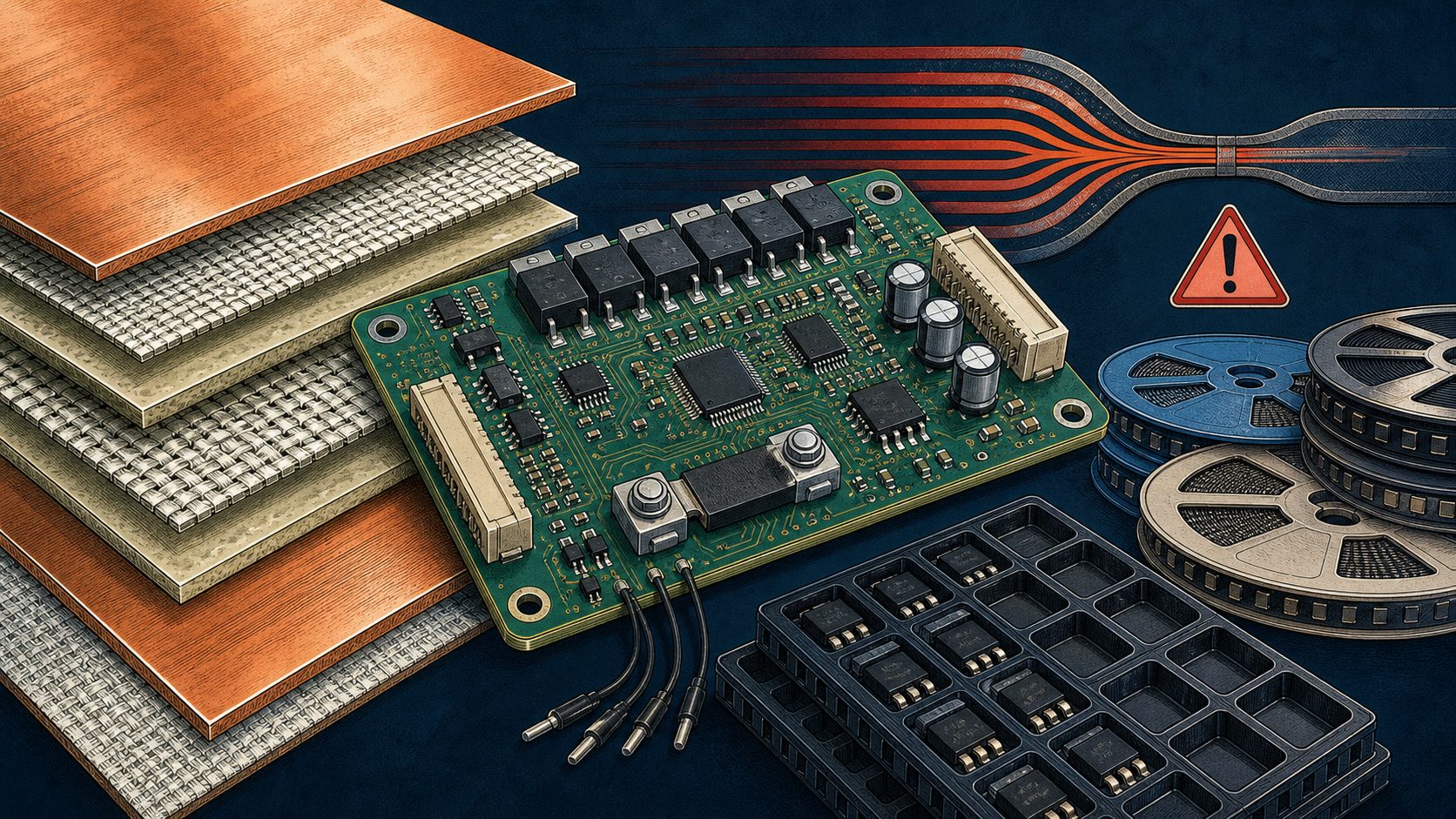
The 2026 PCB material shortage is becoming a direct delivery risk for BMS protection boards. Rapid AI data-center expansion is absorbing more high-layer PCB capacity and increasing demand for low-loss CCL, high-grade electronic glass fabric, specialty resin systems, and advanced copper foil. At the same time, selected conventional FR-4 materials, battery-monitoring ICs, MOSFETs, sensors, and connectors are experiencing tighter availability. Battery manufacturers should confirm material allocation before committing to delivery dates and avoid changing safety-critical materials or components without electrical, thermal, and production validation.
Part1: What Is Happening in the 2026 PCB Supply Chain?
1.1 CCL Price Adjustments Are Becoming More Frequent
Copper-clad laminate is the base material from which printed circuit boards are manufactured. A typical CCL structure combines copper foil, resin, and electronic glass fabric to provide electrical insulation, mechanical support, and copper conductors.
A July 2026 industry study recorded six CCL price-adjustment rounds within approximately 118 days. Early adjustment intervals were around 24–31 days, while later rounds were separated by approximately 20 days. This accelerating cadence indicates that laminate manufacturers have been passing upstream cost pressure downstream more quickly.
The same research reported that certain thick FR-4 laminates and prepreg materials experienced particularly large cumulative increases.
| 2026 supply indicator | Reported development |
|---|---|
| Number of CCL adjustment rounds | Six rounds within approximately 118 days |
| Recent adjustment interval | Compressed to approximately 20 days |
| FR-4 at 1.3 mm and above | Approximately 94% cumulative increase during the year |
| PP prepreg | Approximately 111% cumulative increase during the year |
| 7628 electronic glass fabric | Approximately RMB 8.6 per meter in early July |
| 7628 increase from June | Approximately RMB 1.2 per meter |
| 7628 increase since early 2026 | Approximately RMB 6 per meter |
These figures represent selected industry quotations and specifications rather than a universal price for every PCB order. They nevertheless demonstrate the speed and scale of upstream pressure.
1.2 Three CCL Inputs Are Under Pressure at the Same Time
An indicative CCL cost breakdown cited in the research assigns approximately:
- 42.1% to copper foil
- 26.1% to electronic glass fabric
- 19.1% to resin
- The remaining portion to labor, energy, processing, and other materials
This means that copper foil, glass fabric, and resin together account for most of the laminate’s material cost. When all three experience supply or price pressure, a CCL producer has limited ability to absorb the increase.
Copper prices remained at historically high levels during the first half of 2026. Copper-foil pricing is also affected by processing fees, certification barriers, and the limited supply of specialized foil.
Electronic glass fabric has become an especially important constraint. The 7628 fabric used in conventional laminate systems rose substantially from its 2025 low. Capacity expansion takes time, while some producers are prioritizing higher-value products for AI servers and high-speed communication equipment.
General-purpose epoxy-resin pressure may fluctuate, but selected high-performance resins remain relatively concentrated and require lengthy customer qualification.
1.3 AI Infrastructure Is Changing Material Allocation
AI computing demand is accelerating the shortage through both higher material consumption and capacity reallocation. AI servers, high-speed switches, accelerator trays, and 800G/1.6T optical-network equipment use larger, thicker, and more complex PCBs than many conventional electronic products.
A single AI platform can require high-layer backplanes, HDI boards, accelerator modules, switch boards, and power-distribution boards. These designs consume more laminate per system and often require lower-loss CCL, higher-grade electronic glass fabric, specialty resin systems, and very-low-profile copper foil.
The CICC research reviewed for this article notes that next-generation AI platforms are moving from conventional M7/M8-class laminates toward higher-performance M8/M9 materials as signal rates, board density, and thermal requirements increase. This shift does not mean that an ordinary BMS board uses AI-server-grade laminate. It means that upstream glass-fabric, copper-foil, resin, laminate-pressing, and PCB capacity is increasingly allocated to higher-value AI products.
| AI hardware requirement | Upstream material impact |
|---|---|
| More PCB layers and larger board area | More CCL and prepreg consumed per system |
| Higher signal speed | Greater demand for low-loss resin and high-grade glass fabric |
| Tighter impedance control | Higher laminate consistency and copper-foil requirements |
| Higher computing density | Greater thermal and reliability requirements |
| Rapid capacity expansion | Suppliers prioritize qualified high-value AI materials |
The result is a spillover effect. Even though BMS protection boards normally use standard or high-Tg FR-4 rather than the most advanced low-loss CCL, they compete for some of the same upstream copper foil, glass fabric, resin, production equipment, and PCB manufacturing capacity. AI demand is therefore not the only cause of the 2026 shortage, but it is an important reason why supply recovery may take longer than a normal commodity-price cycle.
Part2: Why the Shortage Is Difficult to Resolve Quickly
2.1 CCL Capacity Is Concentrated
The research estimated the global CCL market at approximately USD 18.7 billion in 2025. The five largest suppliers accounted for about 55.4% of the market.
Concentration is even higher in advanced segments. In the HDI-specific CCL market, the largest supplier was estimated to hold approximately 70%, while the five largest suppliers together exceeded 90%.
This concentration matters because downstream PCB manufacturers cannot immediately replace one laminate source with another. Alternative materials must pass technical, manufacturing, and customer qualification.
2.2 New Capacity Does Not Immediately Solve Today’s Shortage
Laminate and glass-fabric suppliers have announced expansion projects, but much of the new capacity is scheduled to enter production progressively during 2027 or 2028.
New production lines must still complete:
- Equipment installation
- Process stabilization
- Yield improvement
- Material validation
- Customer certification
- Volume ramp-up
A capacity announcement therefore does not mean that usable material is immediately available for current BMS orders.
2.3 Actual Supplier Feedback Shows Two-Month-Plus Lead Times
Recent supplier feedback collected from PCB partners shows that the pressure has moved from market forecasts into daily procurement.
Current observations include:
- Tight availability for 0.8–1.0 mm and thicker laminate
- Particularly severe shortages for common 1.6 mm material
- Standard lead times extending beyond two months
- Suppliers allocating laminate order by order
- Some PCB manufacturers reporting no available board inventory
- Cash-market purchasing no longer guaranteeing immediate material
- Delivery dates being confirmed only after laminate allocation
These conditions vary by supplier and specification, but they make short-notice production increasingly difficult.
Part3: Why BMS Protection Boards Are Exposed
3.1 BMS Boards Use Commonly Constrained Specifications
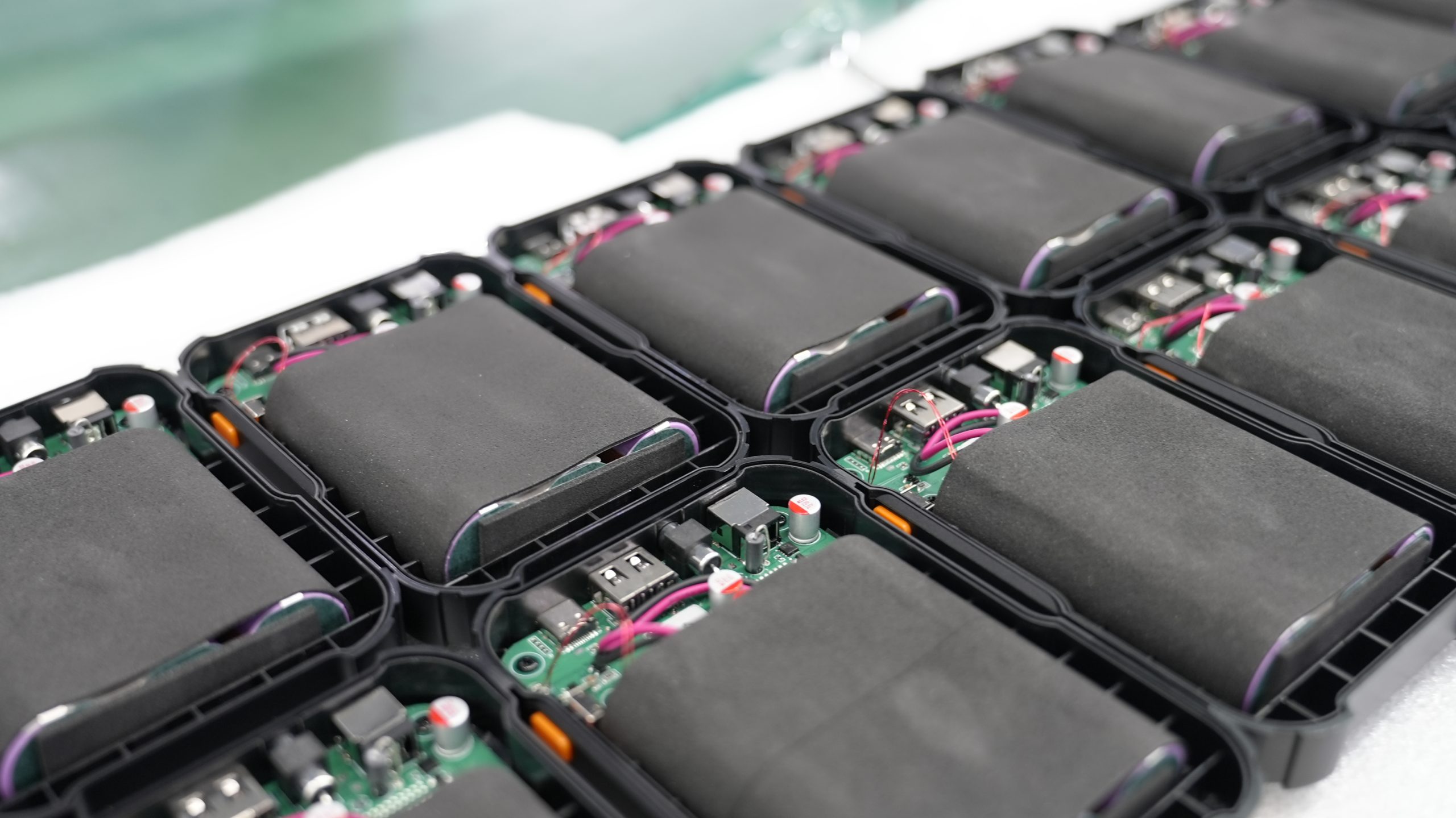
A BMS protection board may use 0.8 mm, 1.0 mm, 1.2 mm, or 1.6 mm FR-4 depending on the enclosure, connector, current, and mechanical requirements.
Many industrial battery packs use 1.6 mm boards because they provide mechanical rigidity and support for connectors, MOSFETs, busbars, and high-current terminals. This is also one of the thickness ranges experiencing significant supply pressure.
A thinner available board cannot automatically replace a specified 1.6 mm board. Thickness changes can affect:
- Enclosure fit
- Connector engagement
- Screw and standoff alignment
- Board stiffness
- Vibration resistance
- Creepage and clearance
- Thermal behavior
- Production-panel utilization
3.2 Copper Specification Is Safety-Critical
High-current BMS boards may require 2 oz copper, reinforced traces, busbars, or multilayer current paths. Copper thickness directly affects resistance, voltage drop, and temperature rise.
If a PCB supplier proposes a lower copper weight to improve availability, engineers must recalculate:
- Continuous current
- Peak current
- Short-circuit current
- Trace temperature rise
- MOSFET heating
- Fuse coordination
- Measurement accuracy
A lower-cost or faster substitute can create an unacceptable thermal risk even if the finished PCB looks identical.
3.3 FR-4 Is Not One Universal Material
Two laminates described as FR-4 may differ in:
- Glass-transition temperature
- Decomposition temperature
- Comparative tracking index
- Thermal expansion
- Moisture absorption
- Copper-peel strength
- CAF resistance
- Flammability classification
- Long-term insulation performance
For medical, industrial, security, robotics, and infrastructure battery systems, a material substitution may require renewed thermal, electrical, mechanical, or certification review.
Part4: Component and Chip Availability Can Stop the Entire BMS
4.1 Battery-Monitoring ICs and Analog Front Ends
Battery-monitoring ICs measure cell voltage and may control balancing, fault detection, and communication. Industrial and automotive-grade devices often have longer qualification cycles than general-purpose chips.
A different monitoring IC may require changes to:
- Schematic design
- PCB layout
- Firmware
- Calibration
- Cell-count support
- Diagnostic functions
- Communication protocol
- Production testing
It is rarely a true drop-in replacement.
4.2 High-Current MOSFETs
MOSFET availability is especially important for protection boards controlling large charge and discharge currents.
A replacement must be evaluated for:
- Drain-source voltage
- Continuous and pulse current
- On-resistance
- Gate charge
- Safe operating area
- Avalanche capability
- Package thermal resistance
- Parallel current sharing
- Authenticity and traceability
Matching only the voltage and current printed on a datasheet is insufficient. A higher on-resistance can increase board temperature and reduce pack efficiency.
4.3 Current Sensors and Shunt Resistors
Current measurement affects overcurrent protection, SOC estimation, and diagnostic accuracy.
A substitute shunt or current-sense amplifier can change:
- Resistance tolerance
- Temperature coefficient
- Offset voltage
- Gain error
- Response time
- Power dissipation
- Protection threshold accuracy
For a high-current battery, a small component difference can materially change the actual trip point.
4.4 Connectors and Passive Components
Connectors, thermistors, capacitors, and balancing resistors can also become bottlenecks.
A connector replacement must match current capacity, contact resistance, locking force, vibration resistance, polarity control, temperature rise, wire specification, and mating life.
Even when an alternative component is electrically acceptable, a different footprint can trigger a PCB redesign at a time when new PCB material is already difficult to secure.
Part5: How the Shortage Affects Customer Projects
5.1 Delivery Commitments Become Conditional on Material Allocation
Under normal conditions, a PCB manufacturer may confirm production after checking internal stock. During a shortage, it may need to secure CCL from an upstream supplier before confirming the schedule.
The complete BMS timeline includes:
- CCL allocation
- PCB fabrication
- Bare-board electrical testing
- Component procurement
- SMT assembly
- Firmware programming
- BMS functional testing
- Battery-pack integration
- Pack-level validation
- Final inspection and shipment
A two-month delay in obtaining laminate occurs before most of these steps begin.
5.2 A Quotation Does Not Reserve Material
Pricing and availability can change between quotation and purchase-order confirmation. During rapid material adjustments, suppliers may shorten quotation validity or require confirmed orders before reserving stock.
Customers should ask whether a quotation includes:
- Confirmed CCL availability
- Reserved component inventory
- Fixed or adjustable material pricing
- Prototype material only
- Mass-production material
- Non-cancellable material commitments
5.3 Prototype Success Does Not Guarantee Production Supply
A supplier may have enough CCL and components for 10 or 20 samples but not for a production order of several thousand units.
Engineering stock may also use components that cannot be replenished at the same lead time. Before design approval, customers should confirm whether the sample BOM is sustainable for mass production.
5.4 Cancellation Can Create Obsolete Inventory
Custom BMS boards often use project-specific PCB dimensions, connectors, firmware, and protection parameters. If a supplier reserves scarce material or builds custom boards and the customer cancels the project, those materials may be difficult to use elsewhere.
This is why urgent material allocation may require a formal purchase order, deposit, or non-cancellable commitment.
Part6: Engineering and Procurement Responses
6.1 Separate Replaceable and Non-Replaceable Items
The BOM should classify materials into three groups:
| Category | Treatment |
| Directly interchangeable | Can be replaced under controlled purchasing rules |
| Engineering-approved alternative | Requires documented technical review |
| Safety-critical or non-substitutable | Requires redesign, testing, or customer approval |
This prevents procurement teams from treating every same-value resistor, MOSFET, laminate, or connector as equivalent.
6.2 Qualify CCL Alternatives Before an Emergency
Where appropriate, manufacturers can qualify more than one laminate grade during development.
The comparison should include:
- Tg and Td
- CTI
- Flammability
- Copper adhesion
- CAF resistance
- Moisture absorption
- Thickness tolerance
- Thermal expansion
- PCB manufacturing compatibility
- Application certification impact
Alternative qualification is much easier before production becomes urgent.
6.3 Freeze Safety-Critical Specifications Earlier
Repeated changes to board thickness, connector position, current, communication, or enclosure dimensions can delay PCB release and cause reserved materials to become unusable.
Customers should freeze the following as early as possible:
- Pack voltage and cell count
- Continuous and peak current
- Board dimensions
- Connector and wiring interface
- Communication protocol
- Protection thresholds
- Temperature requirements
- Certification targets
6.4 Provide Realistic Demand Forecasts
Suppliers can reserve CCL and long-lead components more effectively when customers provide:
- Prototype quantity
- Pilot-production quantity
- Monthly forecast
- Annual volume
- Required delivery date
- Product lifetime
- Certification schedule
Forecasts do not replace a purchase order, but they allow earlier risk identification.
6.5 Maintain Strategic Inventory for Long-Lead Parts
Safety stock is most valuable for items that are difficult to replace, including:
- Battery-monitoring ICs
- Industrial microcontrollers
- Qualified MOSFETs
- Specialized connectors
- Approved CCL grades
- Custom bare PCBs
Inventory should be managed for moisture sensitivity, shelf life, oxidation, traceability, and product obsolescence.
Part7: What Battery Customers Should Do Now
Customers preparing new battery projects should take the following actions:
- Confirm PCB and component availability before fixing the delivery schedule.
- Allow at least two months of additional risk buffer where constrained CCL is involved.
- Avoid assuming that cash purchasing can always secure spot material.
- Provide formal orders early for delivery-critical projects.
- Review every proposed safety-critical substitution.
- Approve alternative materials before mass production.
- Confirm whether prototype and production boards use the same material.
- Keep forecasts updated when quantities or schedules change.
- Do not cancel reserved custom material without understanding the liability.
- Maintain communication with the battery manufacturer throughout procurement.
The objective is not to create panic or excessive inventory. It is to identify which materials can be substituted and which ones can stop production for months.
Part8: Why This Matters for BMS Reliability
The 2026 CCL shortage is not only a purchasing problem. It is an engineering and product-reliability problem.
A rushed laminate substitution can affect insulation, thermal expansion, mechanical strength, and flame resistance. An unverified MOSFET can increase heat. A different monitoring IC can alter voltage accuracy and protection behavior. An incompatible connector can increase contact resistance or disconnect under vibration.
Reliable BMS production requires coordination between engineering, procurement, PCB manufacturing, component suppliers, quality control, and the customer.
Large Power combines BMS and PCM engineering with complete custom lithium battery pack development. This allows PCB material, protection logic, thermal performance, connectors, communication, and battery integration to be reviewed as one system.
FAQ
Why are BMS protection-board lead times increasing in 2026?
CCL, electronic glass fabric, copper foil, and selected resin systems are experiencing supply and price pressure. Some BMS chips, MOSFETs, sensors, and connectors also have volatile lead times. A delay in one item can stop the complete PCBA.
Which CCL specifications are currently most difficult to source?
Availability varies, but recent supplier feedback indicates pressure across 0.8–1.0 mm and thicker materials, with commonly used 1.6 mm boards facing particularly serious constraints. Copper weight and laminate grade also affect availability.
Can another FR-4 laminate be used immediately?
Not necessarily. FR-4 materials can differ in Tg, Td, CTI, moisture absorption, CAF resistance, thermal expansion, and flammability. Safety-critical substitutions require engineering review.
Can a different MOSFET solve a component shortage?
Only after electrical and thermal validation. The alternative must be checked for on-resistance, gate charge, safe operating area, package thermal resistance, avalanche capability, and fault response.
How should customers protect urgent projects?
Finalize requirements early, issue formal purchase orders, provide forecasts, confirm material reservation, and approve qualified alternatives before production becomes urgent.
How does Large Power manage BMS supply-chain risk?
Large Power reviews CCL specifications, safety-critical components, alternative parts, PCB design, thermal behavior, firmware, and pack-level performance as part of its BMS and custom battery development process.
Need to assess the PCB, component, or delivery risk of an upcoming battery project? Contact Large Power’s battery engineers to review your requirements and production schedule.


