

Quick Answer
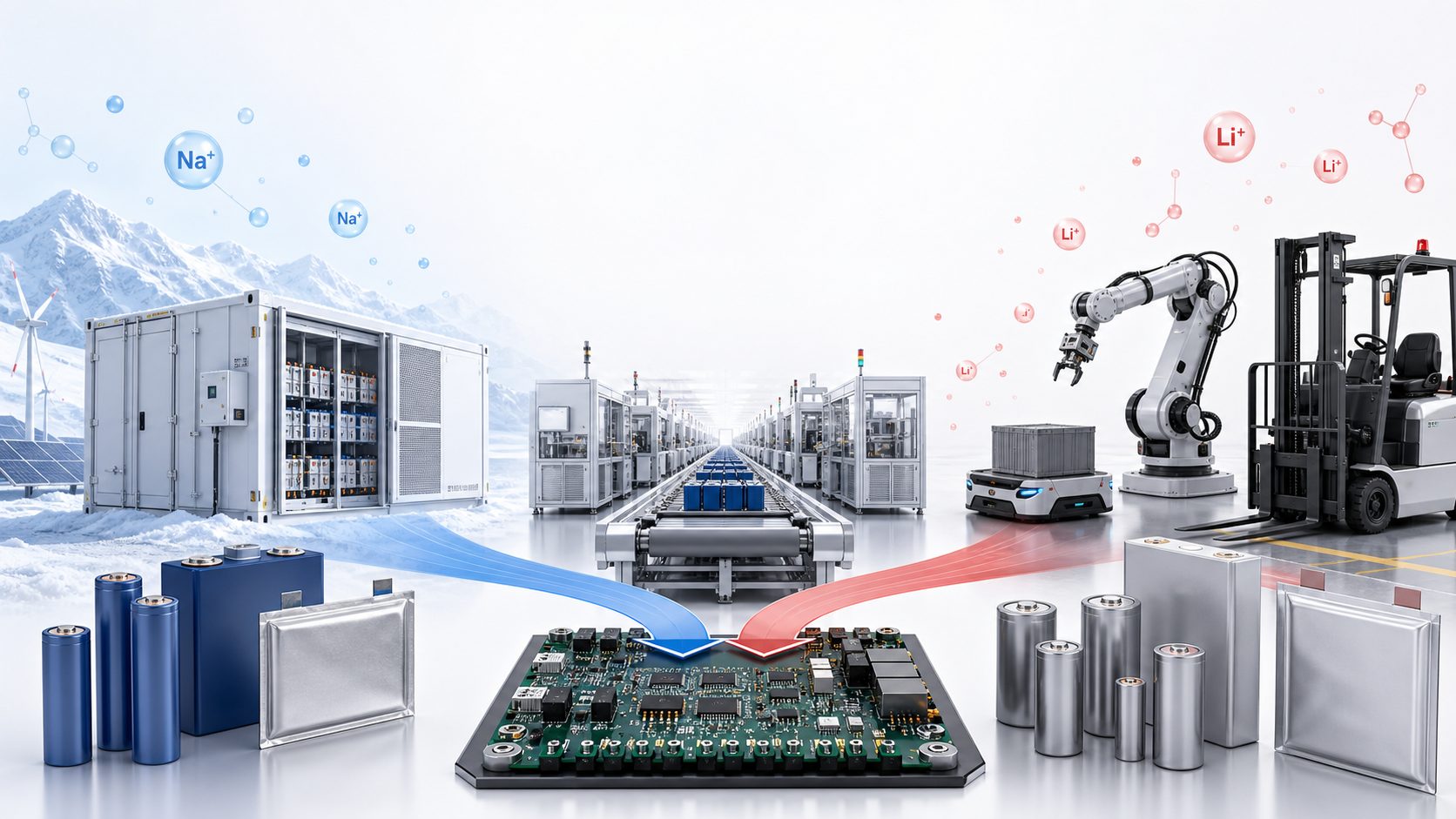
CATL’s recent sodium-ion battery deployments signal that sodium-ion technology is moving from pilot production toward commercial-scale energy storage and selected mobility applications. Sodium-ion batteries offer strong low-temperature performance, high safety, fast charging, and reduced dependence on lithium and copper. Lithium-ion batteries still lead in energy density, supply-chain maturity, compactness, and application flexibility. Manufacturers should select the chemistry according to temperature, space, weight, cycle life, cost, and power requirements rather than treating sodium-ion as a universal replacement for lithium-ion.
Part 1: Why CATL’s Sodium-Ion Expansion Matters in 2026
Sodium-ion batteries have spent years moving through laboratory research, pilot production, and limited commercial validation. CATL’s recent deployment plans suggest that the technology is entering a more important industrial phase.
CATL and HyperStrong announced a three-year cooperation covering 60 GWh of sodium-ion batteries for energy storage. CATL has also introduced sodium-ion solutions for passenger vehicles and large-scale battery energy storage systems.
This development matters because production scale has been one of the largest barriers to sodium-ion adoption. Sodium resources are abundant, but sodium-ion batteries still require mature cathode materials, consistent hard-carbon anodes, suitable electrolytes, reliable manufacturing processes, and application-specific control systems.
According to CICC research, 2026 may represent the beginning of the scale-production stage for sodium-ion batteries. The report estimates that global sodium-ion battery demand could exceed 400 GWh by 2030 if commercialization and cost reduction progress as expected.
However, rising production capacity does not mean sodium-ion batteries will immediately replace lithium-ion batteries. The two technologies provide different performance advantages and will increasingly serve complementary markets.
Part 2: What Is Driving Sodium-Ion Battery Adoption?
2.1 Energy and Supply-Chain Security
Lithium resources are geographically concentrated, exposing manufacturers to material-price volatility, trade restrictions, and geopolitical risks. Sodium is widely distributed and can be sourced from abundant raw materials.
Sodium-ion batteries also reduce reliance on several materials used in conventional lithium-ion cells. For example, both the positive and negative current collectors can use aluminum foil. Lithium-ion cells generally require copper foil on the anode side.
Using aluminum instead of copper may help reduce raw-material costs and supply-chain exposure. It can also support a more diversified global battery-material system.
Sodium-ion technology should therefore be viewed not only as a lower-cost chemistry, but also as a strategic alternative for applications where energy security and material availability matter.
2.2 Better Low-Temperature Performance
Low-temperature operation is one of the strongest technical advantages of sodium-ion batteries.
CICC research indicates that some sodium-ion products retain more than 90% of their capacity at -20°C and more than 70% at -40°C. CATL has also reported strong power and capacity retention under extreme cold conditions.
This performance makes sodium-ion batteries relevant for:
- Outdoor energy storage systems
- Cold-region infrastructure
- Remote monitoring equipment
- Telecommunications backup power
- Automotive start-stop systems
- Low-speed vehicles
- Two-wheel electric vehicles
Lithium-ion batteries can also operate in low-temperature environments when cells, heaters, insulation, charging control, and the Battery Management System are engineered correctly. Sodium-ion technology, however, may reduce the amount of auxiliary thermal management required in some applications.
2.3 Safety and Thermal Stability
Sodium-ion cathode materials can offer strong thermal stability. Polyanionic and Prussian blue material systems generally have higher decomposition temperatures than common layered oxide materials.
Sodium-ion cells may also produce less heat during operation and experience lower expansion stress in suitable applications. These characteristics can reduce the probability of thermal propagation, although they do not remove the need for protection.
A commercial sodium-ion pack still requires:
- Cell-level safety validation
- Overcharge and over-discharge protection
- Temperature sensing
- Current monitoring
- Short-circuit protection
- Cell balancing
- Fault diagnostics
- Thermal management
- Mechanical and environmental protection
Battery chemistry is only one layer of safety. Pack architecture, BMS logic, charger design, enclosure engineering, production consistency, and validation determine how safely the complete system performs.
Part 3: Sodium-Ion vs. Lithium-Ion Batteries
| Performance Factor | Sodium-Ion Battery | Lithium-Ion Battery |
|---|---|---|
| Energy density | Improving; selected products reach approximately 160–175 Wh/kg | Commonly 150–250+ Wh/kg depending on chemistry |
| Low-temperature performance | Excellent in suitable material systems | Requires careful cell and thermal design |
| Cycle life | Potentially 10,000+ cycles for some storage-oriented systems | Approximately 1,000–5,000+ depending on chemistry |
| Fast charging | Strong ion transport and high-rate potential | Mature fast-charging solutions available |
| Raw-material availability | Sodium is widely available | Lithium supply is more concentrated |
| Current collectors | Aluminum can be used on both electrodes | Copper is generally used for the anode |
| Supply-chain maturity | Developing | Highly mature |
| Pack size and weight | May require more space for the same energy | Better for compact, weight-sensitive devices |
| Commercial availability | Expanding from an early base | Widely available across industries |
| Best-fit applications | Energy storage, cold climates, backup power and cost-sensitive mobility | Medical, robotics, industrial, security and compact portable devices |
The comparison shows why sodium-ion and lithium-ion batteries should not be treated as direct substitutes in every project.
Sodium-ion becomes attractive when low-temperature performance, safety, material availability, long cycle life, or stationary-system economics have priority. Lithium-ion remains the stronger option when a device requires minimum weight, compact dimensions, high energy density, established certifications, or a mature supply base.
Part 4: Where Sodium-Ion Batteries Have the Strongest Potential
4.1 Stationary Energy Storage
Energy storage is likely to become one of the largest sodium-ion markets.
Storage systems value long cycle life, thermal stability, low auxiliary energy consumption, and raw-material cost more than maximum gravimetric energy density. Pack size and weight are less restrictive than in portable equipment or passenger vehicles.
Polyanionic sodium-ion batteries are particularly suitable for storage because they can offer:
- Long cycle life
- Stable voltage characteristics
- Wide operating temperature ranges
- High-rate charge and discharge
- Strong thermal stability
- Reduced dependence on lithium resources
CICC estimates that sodium-ion penetration in energy storage could reach 18% by 2030, representing approximately 248 GWh of annual demand under its forecast assumptions.
These figures are projections rather than guaranteed outcomes. Actual adoption will depend on material costs, production yield, field performance, certification, and competition from lithium iron phosphate and other storage technologies.
4.2 Data Centers and Backup Power
Data centers and industrial backup systems require rapid power response, predictable performance, and strong safety controls. Sodium-ion batteries may suit these applications because of their rate capability and broad temperature tolerance.
However, engineers must evaluate more than cell chemistry. The system requires coordinated design of:
- Battery modules
- Power conversion equipment
- BMS communication
- State-of-charge estimation
- State-of-health monitoring
- Thermal control
- Fire protection
- Redundancy
- Maintenance access
Sodium-ion batteries have different voltage curves and electrochemical characteristics from lithium-ion batteries. Existing lithium-ion SOC algorithms cannot always be transferred without recalibration.
4.3 Cold-Region Infrastructure
Outdoor communication equipment, security systems, remote monitoring stations, solar lighting, and grid infrastructure often operate in temperatures that reduce conventional battery capacity and charging efficiency.
Sodium-ion batteries could reduce winter performance losses and heating demand. Nevertheless, manufacturers must still validate charging limits, enclosure protection, condensation control, connectors, and communication reliability.
For compact devices where size and weight remain critical, a customized low-temperature lithium battery may still be more suitable.
4.4 Entry-Level Electric Vehicles and Two-Wheelers
Sodium-ion batteries can support vehicles that do not require the highest possible driving range. Their low-temperature capability, fast charging, safety, and potential cost advantages make them relevant for entry-level cars, low-speed vehicles, and electric two-wheelers.
CICC estimates that sodium-ion penetration could reach 5% in new-energy vehicles and 12% in electric two-wheelers by 2030.
Lithium-ion batteries will probably continue to dominate vehicles requiring extended range and maximum pack-level energy density.
Part 5: Why Lithium-Ion Batteries Will Remain Essential
The growth of sodium-ion technology does not make lithium-ion batteries obsolete.
Lithium-ion cells benefit from decades of commercial development, extensive production capacity, mature battery management technology, established certification processes, and a broad range of chemistries and form factors.
Manufacturers can select:
- NMC for high energy density and compact devices
- LiFePO4 for long cycle life and thermal stability
- LCO for small portable electronics
- LMO for high-rate applications
- LTO for exceptional cycle life and rapid charging
- Lithium polymer cells for thin or irregular product designs
- Low-temperature cells for cold environments
- Explosion-proof cells for high-risk applications
These options make custom lithium battery packs highly adaptable to medical devices, robotics, industrial equipment, security systems, and portable electronics.
Lithium-ion is likely to remain preferable when:
- Battery space is severely restricted.
- Equipment must remain lightweight.
- High energy density is essential.
- The application requires proven cell availability.
- Existing certification is based on lithium-ion technology.
- The product needs a customized pouch, cylindrical, or prismatic cell.
- Production volumes do not justify a new sodium-ion development program.
Part 6: Sodium-Ion Manufacturing Challenges
Despite its advantages, sodium-ion technology still faces several engineering and commercialization barriers.
6.1 Hard-Carbon Consistency
Hard carbon is currently the main sodium-ion anode material. Biomass-derived hard carbon is commercially advanced, while coal- and pitch-based routes offer potential cost advantages.
Manufacturers must control pore structure, moisture, gas generation, initial efficiency, capacity consistency, and production yield. Variability in hard-carbon performance can affect capacity, cycle life, and SOC estimation.
6.2 Cathode Route Selection
Three major sodium-ion cathode routes are being developed:
| Cathode Route | Main Advantage | Main Limitation | Suitable Direction |
| Layered oxide | Higher energy density | Greater sensitivity and shorter cycle life in some systems | Mobility applications |
| Polyanionic | Long cycle life and thermal stability | Currently higher material and processing costs | Energy storage |
| Prussian blue | Cost and rate-performance potential | Moisture, structural water and consistency challenges | Storage and cost-sensitive applications |
Manufacturers must avoid selecting sodium-ion cells solely by nominal energy density. Cathode chemistry affects voltage behavior, thermal stability, lifetime, power capability, and system-control requirements.
6.3 Electrolyte Development
Sodium-ion electrolytes generally replace lithium salts with sodium salts while retaining many familiar carbonate solvents and additives.
Sodium hexafluorophosphate is currently an important commercial option because it provides good conductivity and compatibility with existing manufacturing processes. However, moisture sensitivity, thermal stability, and material cost still require improvement.
According to the CICC report, sodium-ion electrolyte materials and existing lithium-ion production lines have considerable compatibility. This could help the supply chain expand more quickly, but electrolyte formulations still need cell-specific validation.
6.4 Aluminum-Foil Adhesion
Using aluminum foil on both electrodes provides a cost advantage, but hard-carbon adhesion can become a production challenge.
Manufacturers must control foil cleanliness, surface energy, coating adhesion, interface resistance, strength, and elongation. Thinner and higher-surface-energy aluminum foil may improve energy density and cycle stability, but it also increases process-control requirements.
Part 7: BMS Design for Sodium-Ion Battery Packs
A sodium-ion battery should not simply be connected to a BMS configured for lithium-ion cells.
The BMS must account for the chemistry’s specific:
- Nominal cell voltage
- Charge and discharge limits
- Voltage-SOC relationship
- Temperature behavior
- Internal resistance
- Balancing strategy
- Aging model
- Fault thresholds
State-of-charge estimation deserves particular attention. A flatter or chemistry-specific voltage curve can make simple voltage-based SOC estimation inaccurate. Engineers may need coulomb counting, temperature compensation, model-based estimation, and periodic recalibration.
The BMS should also support:
- Individual cell-voltage monitoring
- Multi-point temperature monitoring
- Active or passive cell balancing
- Current and insulation monitoring
- Charge-path and discharge-path control
- Contactor or MOSFET diagnostics
- Event logging
- State-of-health estimation
- CAN, RS485, SMBus, or other device communication
- Fault-tolerant shutdown logic
Learn more about BMS and PCM engineering for customized battery systems.
Part 8: How Manufacturers Should Choose Between Sodium-Ion and Lithium-Ion
Start with the application rather than the chemistry.
8.1 Choose Sodium-Ion When:
- The equipment operates regularly in severe cold.
- Long cycle life is more important than compact size.
- Stationary storage reduces weight constraints.
- Supply-chain diversification is a strategic priority.
- High-rate charge and discharge are required.
- The project volume supports chemistry-specific engineering.
- The customer accepts a developing supply ecosystem.
8.2 Choose Lithium-Ion When:
- The product must be compact and lightweight.
- High energy density determines device runtime.
- Proven supply and certification are required.
- The battery needs a customized shape.
- Production volume is limited or moderate.
- The project has a short development schedule.
- The device operates in medical, robotics, industrial, or portable applications with mature lithium-ion integration requirements.
Some future systems may use sodium-ion and lithium-ion batteries together. Hybrid architectures could use sodium-ion for cold-weather power, high-rate response, or stationary energy capacity while retaining lithium-ion for compactness and higher energy density.
Such systems will require advanced BMS coordination and carefully designed charge, discharge, thermal, and communication strategies.
Part 9: What CATL’s Expansion Means for Battery Manufacturers
CATL’s sodium-ion expansion does not signal the end of lithium-ion technology. It signals the beginning of a broader multi-chemistry battery market.
Battery manufacturers and equipment developers should prepare by:
- Evaluating sodium-ion cells for suitable storage and low-temperature projects.
- Building chemistry-independent battery development processes.
- Updating BMS algorithms for sodium-ion voltage and aging behavior.
- Validating cells at pack and system levels rather than relying on datasheets.
- Monitoring hard-carbon, electrolyte, and aluminum-foil supply chains.
- Comparing total lifecycle cost rather than only initial cell price.
- Maintaining lithium-ion development capabilities for compact and high-energy applications.
The winning chemistry will vary by project. In many portable and specialized devices, lithium-ion will remain the best engineering choice. In stationary storage, cold-region infrastructure, and selected mobility markets, sodium-ion adoption may accelerate as production scale improves.
Conclusion
CATL’s 2026 sodium-ion expansion shows that sodium-ion technology is progressing toward commercial-scale deployment. Abundant raw materials, excellent low-temperature performance, strong rate capability, and potential cost reductions make it a serious option for energy storage, backup power, cold-region infrastructure, and selected vehicles.
Lithium-ion batteries still offer higher energy density, a mature supply chain, broader form-factor availability, and established performance across specialized equipment.
Manufacturers should not ask whether sodium-ion will replace lithium-ion. The better question is which chemistry delivers the best balance of safety, runtime, size, cost, temperature performance, cycle life, and supply stability for a specific product.
Large Power develops customized battery systems by integrating cell selection, electrical design, BMS and PCM, thermal management, enclosure engineering, communication protocols, and compliance testing.
Contact Large Power to evaluate the right battery chemistry and pack architecture for your application.
FAQ
Is sodium-ion safer than lithium-ion?
Sodium-ion batteries can offer strong thermal stability and lower heat generation in suitable material systems. However, safety depends on the complete battery system. Cell quality, BMS protection, charger design, enclosure construction, thermal management, and validation remain essential.
Will sodium-ion batteries replace LiFePO4 batteries in energy storage?
Sodium-ion batteries may capture part of the energy-storage market, especially in cold regions and applications prioritizing material availability and long cycle life. LiFePO4 batteries will remain competitive because of their mature supply chain, established safety record, and proven field performance.
What is the energy density of sodium-ion batteries?
Commercial sodium-ion energy density varies by material system and cell design. Advanced products have reached approximately 160–175 Wh/kg, while many lithium-ion cells still provide higher energy density.
Can a lithium-ion BMS be used for sodium-ion cells?
Not without chemistry-specific configuration and validation. Sodium-ion batteries have different voltage ranges, SOC characteristics, temperature behavior, and aging patterns. The BMS thresholds and estimation algorithms must match the selected cell.
Which applications are best suited to sodium-ion batteries?
Promising applications include stationary energy storage, data-center backup, automotive start-stop systems, low-speed vehicles, electric two-wheelers, and cold-region infrastructure.
How can manufacturers compare sodium-ion and lithium-ion solutions?
Compare pack-level energy density, operating temperature, cycle life, power capability, BMS requirements, certification, supply availability, development time, and total lifecycle cost. Cell price alone is not sufficient.


