

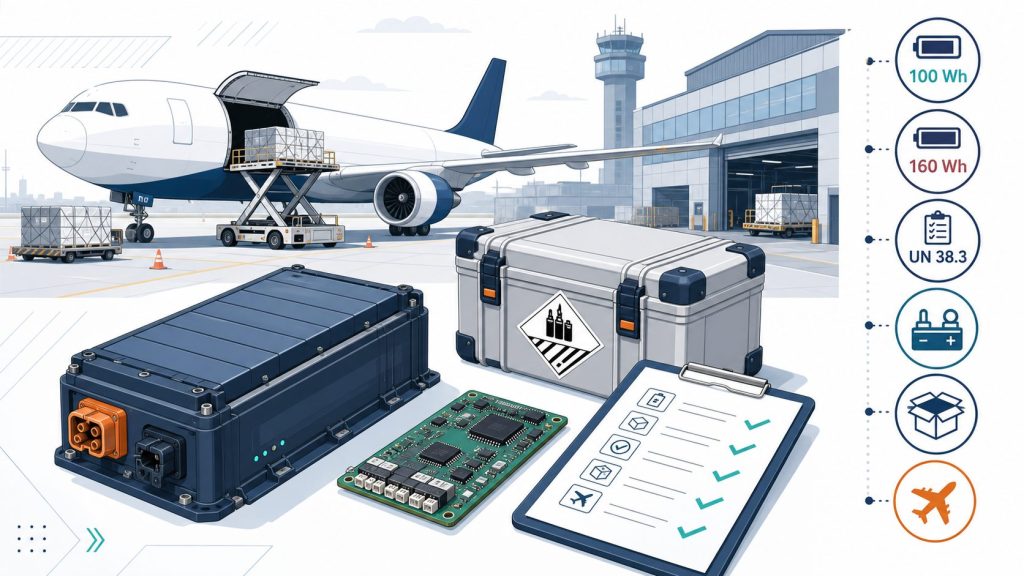
Lithium batteries allow medical and industrial equipment to operate beyond fixed power sources, but air transportation introduces additional safety and compliance requirements. A battery that performs reliably inside a device may still be rejected by an airline or freight carrier if its classification, state of charge, packaging, test documentation, or labeling is incorrect.
Medical device and industrial equipment manufacturers must distinguish between batteries carried by passengers and batteries shipped as commercial cargo. The familiar 100 Wh and 160 Wh limits mainly apply to passenger baggage. Commercial shipments follow a different framework based on the UN number, battery configuration, energy rating, state of charge, packaging instruction, and operator restrictions.
Quick Answer
For passenger travel, rechargeable lithium-ion batteries rated at 100 Wh or less are generally permitted, while batteries rated from 101 Wh to 160 Wh usually require airline approval. Spare batteries must remain in carry-on baggage, and batteries over 160 Wh are generally prohibited as passenger baggage. Commercial shipments require the correct UN classification, UN 38.3 test documentation, compliant packaging, labels, marks, and shipping documents. Manufacturers should verify the current IATA Dangerous Goods Regulations and the carrier’s operator variations before every shipment.
Key Takeaways
- Do not apply passenger baggage limits directly to commercial battery shipments.
- Calculate watt-hours using
Wh = nominal voltage × amp-hours. - UN3480 covers lithium-ion batteries shipped by themselves.
- UN3481 covers lithium-ion batteries packed with or contained in equipment.
- Battery designs offered for transport must pass UN 38.3 testing.
- Standalone UN3480 batteries transported by air are generally restricted to cargo aircraft and a state of charge not exceeding 30%.
- Airlines and logistics providers may impose stricter requirements than the baseline regulations.
- Battery configuration, labeling, documentation, and packaging should be considered during product development, not after production.
Part 1: Understand the Two Air Transport Scenarios
1.1 Passenger Baggage Is Not the Same as Commercial Cargo
Manufacturers often hear that lithium-ion batteries must remain below 100 Wh or 160 Wh. These thresholds are important, but they do not describe every form of air transportation.
The FAA distinguishes between batteries carried by passengers and batteries offered as cargo. Under current passenger guidance:
| Lithium-Ion Battery Rating | General Passenger Treatment |
|---|---|
| 0–100 Wh | Generally allowed for personal use |
| 101–160 Wh | Airline approval is generally required |
| Over 160 Wh | Generally prohibited as passenger baggage |
| Spare batteries | Carry-on baggage only |
| Damaged or recalled batteries | Not permitted unless removed or otherwise made safe |
For lithium-ion batteries between 101 Wh and 160 Wh, passengers are generally limited to two spare batteries. Airlines may impose stricter quantity or watt-hour restrictions. The FAA therefore recommends confirming requirements with the operating airline before travel. See the current FAA passenger battery guidance.
These rules are particularly relevant to portable oxygen concentrators, diagnostic instruments, cameras, and other battery-powered devices that may accompany a passenger.
Commercial shipments are different. They are regulated as dangerous goods and must follow applicable classification, packaging, marking, labeling, documentation, and training requirements.
1.2 Calculate Watt-Hours Correctly
Manufacturers should print the watt-hour rating clearly on rechargeable lithium battery packs.
Use:
Watt-hours = nominal voltage × amp-hours
For example:
- 14.4 V × 6.6 Ah = 95.04 Wh
- 14.4 V × 10 Ah = 144 Wh
- 25.2 V × 8 Ah = 201.6 Wh
If capacity is stated in milliamp-hours, divide by 1,000 first:
Wh = voltage × (mAh ÷ 1,000)
A 14.4 V, 6,600 mAh battery therefore has an energy rating of approximately 95 Wh.
Designing a pack just below 100 Wh may simplify passenger use, but the final design must still meet device runtime, discharge current, safety, and cycle-life requirements. Large Power can develop a custom battery solution around both operational and transport constraints.
Part 2: Select the Correct UN Classification
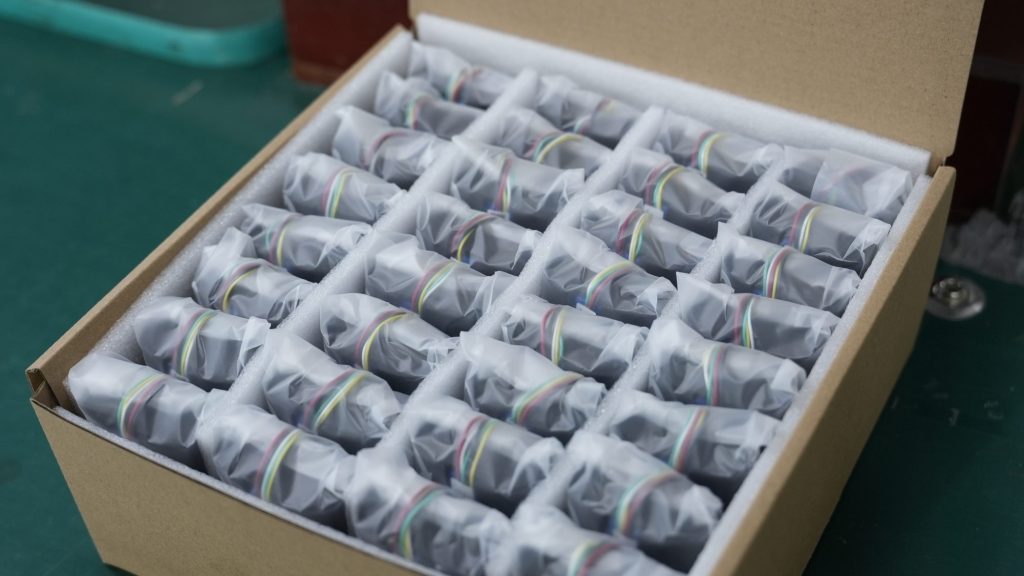
2.1 UN3480 vs UN3481
The battery’s relationship to the equipment determines its basic classification.
| UN Number | Description | Typical Example |
| UN3480 | Lithium-ion batteries shipped by themselves | Replacement battery packs shipped without a device |
| UN3481 | Lithium-ion batteries packed with equipment | A device and its removable batteries in the same package |
| UN3481 | Lithium-ion batteries contained in equipment | Battery installed inside the device |
| UN3090 | Lithium metal batteries shipped by themselves | Standalone non-rechargeable lithium batteries |
| UN3091 | Lithium metal batteries packed with or contained in equipment | Primary lithium battery supplied with a device |
A spare battery placed in the same package as equipment is not automatically “contained in equipment.” The actual packaging configuration determines the classification.
PHMSA provides separate shipping guides for fully regulated and smaller UN3480 and UN3481 batteries. Manufacturers should use the appropriate guide rather than relying only on the battery’s watt-hour rating. See the official PHMSA Lithium Battery Guide for Shippers.
2.2 Avoid Classification Based Only on Product Marketing
Descriptions such as “medical battery,” “industrial battery,” or “portable equipment battery” are not transport classifications.
The classification process should consider:
- Rechargeable lithium-ion or non-rechargeable lithium metal chemistry.
- Standalone, packed with equipment, or contained in equipment.
- Cell and battery watt-hour ratings.
- Quantity and net battery weight.
- Passenger aircraft or cargo aircraft restrictions.
- Battery condition, including whether it is damaged, defective, recalled, used, or intended for recycling.
- Applicable national rules and airline operator variations.
Incorrect classification can lead to rejected shipments, delays, repacking costs, penalties, and increased fire risk.
Part 3: Apply UN 38.3 Testing and Documentation
3.1 UN 38.3 Testing Is a Design Requirement
Lithium cells and batteries offered for transportation must pass the applicable tests in subsection 38.3 of the UN Manual of Tests and Criteria.
The test sequence addresses transport-related hazards through:
- Altitude simulation
- Thermal testing
- Vibration
- Shock
- External short circuit
- Impact or crush
- Overcharge
- Forced discharge
Passing UN 38.3 does not mean a battery is certified for every device or operating environment. It demonstrates that the tested cell or battery design has passed specified transport tests.
A change to the cell, electrical configuration, protective circuit, mechanical structure, or other design element may affect whether existing test evidence remains applicable. Manufacturers should review design changes with the test laboratory before assuming that an earlier report still covers the modified pack.
3.2 Maintain a UN 38.3 Test Summary
Manufacturers and distributors must make the UN 38.3 test summary available upon request. The document supports traceability by identifying the battery design, test laboratory, applicable test report, and confirmation that the required tests were completed.
PHMSA explains that the test summary is intended to improve accountability for lithium battery designs placed into transportation. Review the official PHMSA lithium battery transport resources.
A practical compliance file should include:
- Battery model and part number
- Cell manufacturer and cell model
- Nominal voltage and capacity
- Watt-hour rating
- UN 38.3 test report and test summary
- Safety data sheet when required
- Pack drawings and electrical configuration
- BMS and protection specifications
- Packaging instructions
- Labels and marks
- Shipping declaration templates
- Change-control history
Part 4: Control State of Charge and Short-Circuit Risk
4.1 State-of-Charge Restrictions
Standalone UN3480 lithium-ion batteries transported by air are generally restricted to cargo aircraft and must normally be offered at a state of charge not exceeding 30% of rated capacity.
The 2026 IATA Dangerous Goods Regulations also introduce stricter battery-related provisions, including updated charge limits for certain lithium-ion batteries packed with equipment. Because the applicable requirement depends on the packing instruction and shipping configuration, shippers should consult the current 67th Edition of the IATA DGR, its addenda, and carrier variations. IATA summarizes the principal changes in its 2026 cargo manual update.
State of charge should be controlled through a documented manufacturing process rather than estimated from an imprecise display.
For smart packs, the Battery Management System may support:
- SOC estimation
- Charge and discharge logging
- Cell-voltage monitoring
- Temperature monitoring
- Shipping-mode activation
- Output isolation
- Fault history
- Communication through CAN, SMBus, UART, or RS485
A BMS supports control and traceability, but it does not replace regulatory testing or compliant packaging.
4.2 Protect Against Short Circuits
Spare batteries and exposed terminals must be protected against short circuits.
Suitable measures may include:
- Recessed or covered terminals
- Keyed connectors
- Insulating caps
- Individual inner packaging
- Non-conductive bags
- Connector locks
- Protective cases
- Prevention of movement inside the package
Packaging must also prevent accidental activation of equipment and protect the battery against crushing, puncture, and movement.
Part 5: Address the 2026 Passenger and Power Bank Changes
ICAO approved additional international restrictions for power banks effective March 27, 2026. The changes limit passengers to two power banks and prohibit passengers from recharging them during flight. Airlines may publish additional operating requirements. See the official ICAO power bank announcement.
Although custom medical and industrial packs are not necessarily marketed as power banks, manufacturers should pay attention to how airlines interpret devices that provide external power.
A removable battery with a USB output may receive additional scrutiny if its function resembles a portable charger. Product labeling and documentation should clearly identify:
- Intended device
- Battery model
- Nominal voltage
- Capacity
- Watt-hour rating
- Whether the battery is spare or installed
- Approved charging equipment
- Manufacturer contact information
Part 6: Design Medical Device Batteries for Air Travel
6.1 Portable Oxygen Concentrators
Portable oxygen concentrators frequently travel with patients, making energy rating and replaceability important design decisions.
A battery below 100 Wh can simplify passenger handling. A 101–160 Wh battery may provide longer runtime but generally requires airline approval. Multiple lower-energy packs may improve flexibility, but airline quantity restrictions and the device’s required operating time must still be considered.
Manufacturers developing oxygen concentrator batteries should evaluate:
- Required operating duration
- Continuous-flow or pulse-flow demand
- Battery swapping without interrupting therapy
- Clear watt-hour labels
- State-of-health indication
- Protected terminals
- Airline documentation
- Charger compatibility
- UN 38.3 evidence
Battery runtime must not be advertised solely from nominal capacity. Actual runtime depends on flow setting, device efficiency, battery age, temperature, and safety reserve.
6.2 Other Portable Medical Devices
Air transport planning also affects:
- Infusion pumps
- Patient monitors
- Defibrillators
- Portable ultrasound systems
- Ventilators
- Diagnostic analyzers
- Negative-pressure wound therapy devices
A battery for a medical device must satisfy both operational safety and transport requirements. IEC 62133-2, IEC 60601-related device evaluation, UN 38.3, and market-specific approvals address different risks and should not be treated as interchangeable certifications.
Part 7: Plan Industrial Equipment Shipments
Industrial inspection and communication equipment may use batteries above passenger baggage limits. Examples include:
- Thermal imaging cameras
- Ground-penetrating radar
- Pipeline inspection equipment
- Portable spectrometers
- Emergency communication systems
- Robotics and field testing instruments
For these applications, reducing battery capacity solely to remain below 100 Wh may compromise runtime or output power. Manufacturers should instead evaluate whether the equipment will travel with an operator, ship as cargo, or use regionally stocked replacement batteries.
An industrial battery solution can be designed around:
- Modular battery architecture
- Separately shippable packs
- Shipping mode
- Tool-free replacement
- Protected connectors
- Rugged enclosures
- Clear model identification
- BMS event logs
- Regional charger compatibility
Part 8: Follow a Pre-Shipment Compliance Checklist
Before offering lithium batteries for air transport, confirm the following:
| Check | Verification |
| Chemistry | Lithium-ion or lithium metal |
| Configuration | Standalone, packed with equipment, or contained in equipment |
| UN number | UN3480, UN3481, UN3090, or UN3091 |
| Energy rating | Wh marked clearly on the battery |
| Testing | UN 38.3 design tests completed |
| Test summary | Available upon request |
| State of charge | Meets applicable packing instruction |
| Battery condition | No damage, swelling, leakage, recall, or unresolved fault |
| Terminal protection | Short circuits prevented |
| Inner packaging | Battery movement and contact prevented |
| Outer packaging | Meets applicable performance requirements |
| Marks and labels | Correct type, size, placement, and durability |
| Documentation | Shipping papers and declarations completed when required |
| Training | Personnel performing regulated functions are trained |
| Carrier variations | Current airline requirements reviewed |
| Destination rules | National and regional requirements confirmed |
Do not rely on an old shipment as proof that a new shipment is compliant. Regulations, operator variations, battery designs, and packaging configurations can change.
Part 9: Build Transport Compliance into Battery Development
Air transport compliance becomes more difficult and expensive when it is considered only after the battery pack has entered production.
Manufacturers should define the following during the battery specification stage:
- Target watt-hour rating.
- Passenger-carried or cargo-shipped use.
- Required UN classification.
- Removable or installed configuration.
- State-of-charge control method.
- Shipping-mode behavior.
- Terminal and connector protection.
- Label area and traceability markings.
- Packaging concept.
- Required test reports and certification files.
Large Power develops custom lithium battery packs for medical, robotics, security, infrastructure, consumer electronics, and industrial applications. Engineering support can include chemistry selection, BMS and PCM design, mechanical integration, charger matching, prototype validation, and transport documentation preparation.
Conclusion
Lithium battery air transport compliance requires more than keeping a pack below a single watt-hour threshold. Passenger baggage rules, cargo classifications, UN 38.3 testing, state-of-charge limits, packaging instructions, airline variations, and battery condition all affect whether a shipment can travel safely and legally.
Medical and industrial equipment manufacturers should define transport requirements before finalizing battery voltage, capacity, enclosure, connector, and BMS architecture. This approach reduces redesign risk, shipment delays, and compliance gaps while supporting reliable power in the field.
Contact Large Power to discuss a custom battery pack designed around your device’s runtime, safety, integration, certification, and transportation requirements.
FAQ
What is the maximum lithium-ion battery size allowed on a passenger aircraft?
Rechargeable lithium-ion batteries rated at 100 Wh or less are generally permitted for personal use. Batteries from 101 Wh to 160 Wh normally require airline approval, and passengers are generally limited to two spare batteries in this range. Batteries exceeding 160 Wh are generally prohibited as passenger baggage. Always verify the operating airline’s requirements.
What is the difference between UN3480 and UN3481?
UN3480 applies to lithium-ion batteries shipped by themselves. UN3481 applies when lithium-ion batteries are packed with equipment or contained inside equipment. The distinction affects packing instructions, quantity limits, state-of-charge requirements, marks, labels, and documentation.
Do all lithium battery packs need UN 38.3 testing?
Lithium cell and battery designs offered for transportation must pass the applicable UN 38.3 tests. Manufacturers and distributors must also make the corresponding test summary available upon request. Device-level safety certification does not replace UN 38.3 transport testing.
Can a medical device battery above 160 Wh be carried by a passenger?
A lithium-ion battery above 160 Wh is generally prohibited as ordinary passenger baggage. Certain mobility aids and specialized equipment may follow separate provisions. The manufacturer or passenger should contact the airline before travel and provide the battery’s specifications and supporting documentation.
How can a BMS support lithium battery transportation?
A BMS can monitor cell voltage, current, temperature, state of charge, and fault conditions. It may also support shipping mode and output isolation. However, a BMS does not replace UN 38.3 testing, compliant packaging, labels, documentation, or carrier approval.
Where can manufacturers obtain custom transport-ready lithium battery packs?
Large Power provides custom battery solutions for medical and industrial equipment. The engineering team can help define voltage, capacity, chemistry, BMS functions, mechanical protection, charger requirements, certification needs, and transport documentation. Contact Large Power for a project evaluation.


