

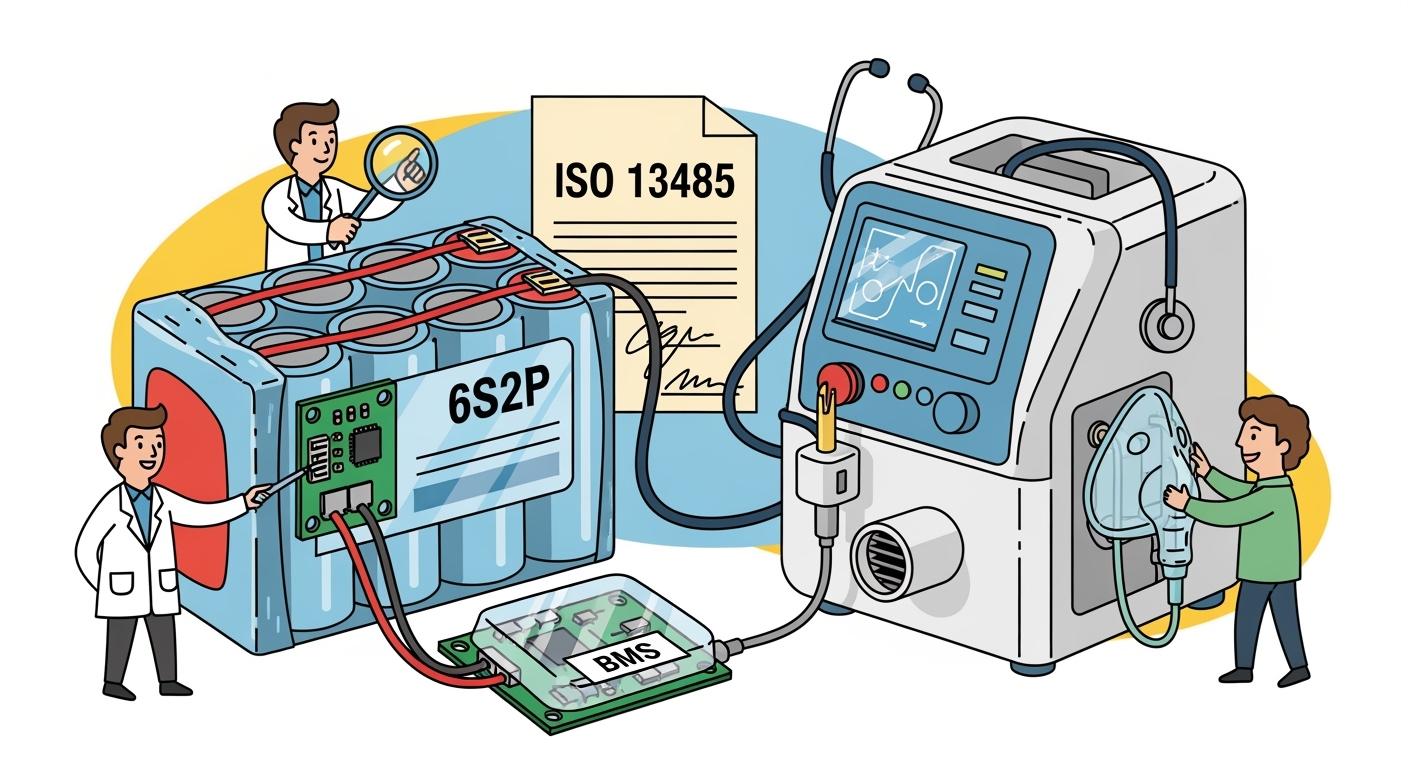
You rely on a 6S2P lithium battery pack to provide compact, reliable power for portable medical oxygen concentrators. An NMC-based 6S2P configuration typically delivers a nominal voltage of 21.6–22.2V and a maximum charging voltage of 25.2V, while its high energy density supports longer runtime without adding excessive weight.
|
Feature |
Engineering Value |
|---|---|
|
High Energy Density |
Supports longer operating time in a compact, portable battery pack |
|
6S2P Configuration |
Combines the required system voltage with increased capacity and discharge capability |
|
BMS Protection |
Monitors voltage, current, temperature, and cell balance to reduce electrical and thermal risks |
|
Quality Management |
ISO 13485-aligned processes support controlled design, production, testing, and traceability |
A robust Battery Management System (BMS) is essential for managing overcharge, over-discharge, overcurrent, short-circuit, temperature, and cell-imbalance risks. For medical applications, ISO 13485 quality management should also be combined with applicable battery testing, transport requirements, and device-level regulatory evaluation.
Key Takeaways
-
Choose NMC cells for your 6S2P Lithium Battery Pack. They offer high energy density, and a long cycle life, making them ideal for portable medical applications.
-
Integrate a robust Battery Management System (BMS) to monitor and protect your battery pack. This ensures safety and reliability, preventing issues like overcharging and overheating.
-
Follow ISO 13485 standards for quality management. This includes maintaining traceability and rigorous testing to ensure compliance and enhance product reliability.
Part1: 6S2P Lithium Battery Pack Design
1.1 NMC Cell Selection and 6S2P Configuration
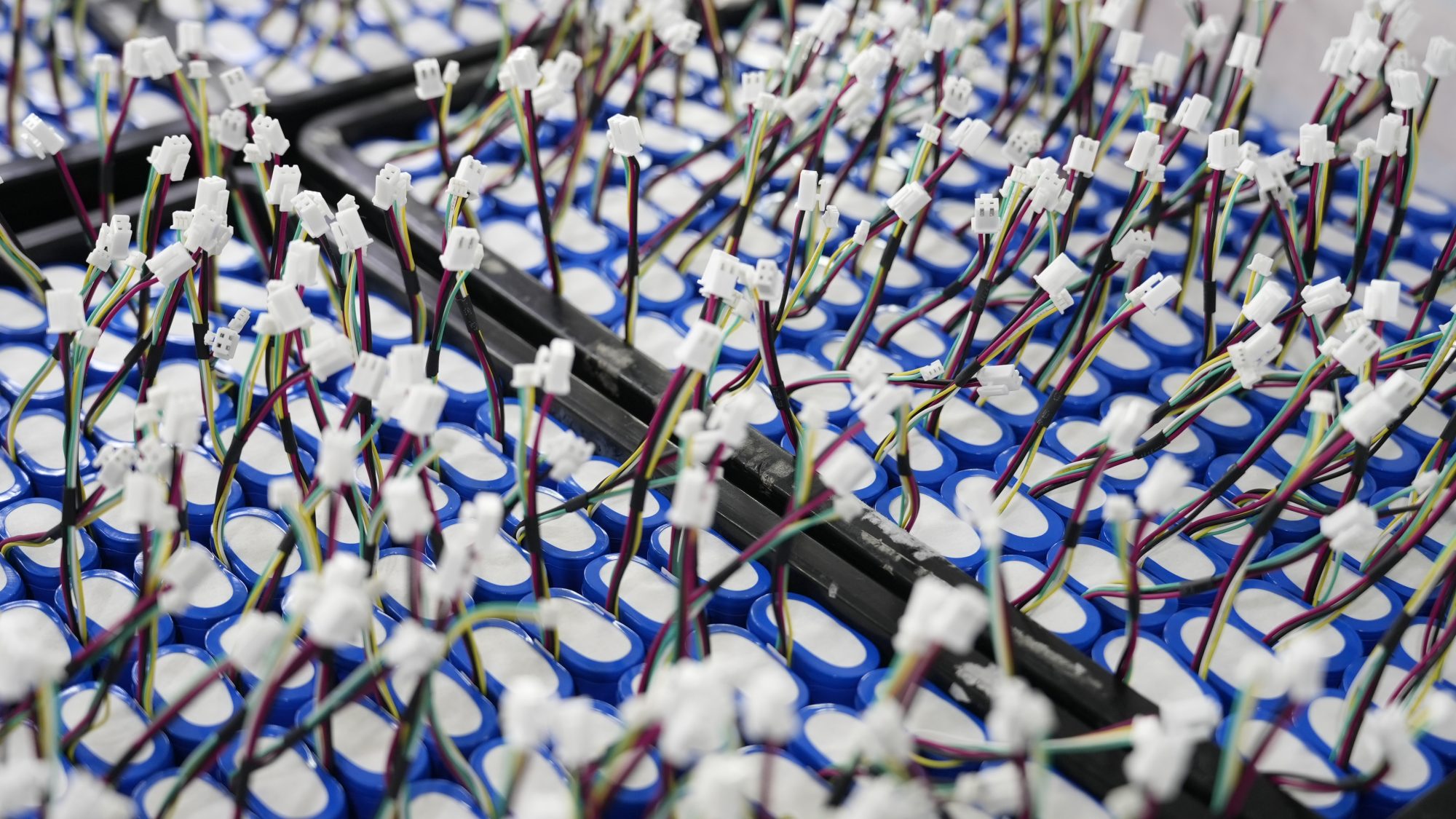
Cell chemistry and pack configuration directly affect the runtime, weight, safety, and service life of a battery designed for a portable oxygen concentrator. A 6S2P configuration connects six cell groups in series and two cells in parallel within each group. The series connection establishes the required operating voltage, while the parallel connection increases capacity and allowable discharge current.
For portable oxygen concentrators, NMC lithium-ion cells are commonly selected because their high energy density supports longer runtime without making the battery pack excessively large or heavy. Compared with LiFePO4, NMC generally provides more energy within a limited enclosure, making it better suited to portable medical equipment in which size and weight are important design constraints.
|
Chemistry |
Nominal Cell Voltage |
Typical Energy Density |
Typical Cycle Life |
Primary Design Advantage |
|---|---|---|---|---|
|
NMC |
3.6–3.7V |
150–220 Wh/kg |
500–1,500 cycles |
High energy density and compact size |
|
LiFePO4 |
3.2V |
90–160 Wh/kg |
2,000–5,000 cycles |
Long cycle life and high thermal stability |
|
LCO |
3.6–3.7V |
150–200 Wh/kg |
500–1,000 cycles |
High energy density for compact devices |
|
LMO |
3.7V |
100–150 Wh/kg |
300–1,000 cycles |
Good power capability |
|
LTO |
2.3–2.4V |
50–90 Wh/kg |
10,000–20,000 cycles |
Very long life and fast charging |
Actual values depend on the selected cell model, operating temperature, discharge rate, charging strategy, and end-of-life criteria.
For a 6S2P battery pack using conventional 4.2V NMC cells, typical electrical parameters are:
|
Specification |
Typical Value |
|
Nominal Voltage |
21.6–22.2V |
|
Maximum Charging Voltage |
25.2V |
|
Recommended Discharge Cutoff |
Defined by the selected cells, BMS, and device requirements |
|
Pack Capacity |
8,000mAh when two matched 4,000mAh cells are connected in parallel |
|
Typical Cycle Life |
Approximately 500–1,500 cycles, depending on cell selection and operating conditions |
The discharge cutoff should not be presented as a universal fixed value. It must be coordinated with the cell manufacturer’s limits, the oxygen concentrator’s operating voltage range, and the protection thresholds programmed into the Battery Management System (BMS).
The BMS should provide cell-voltage monitoring, overcharge and over-discharge protection, overcurrent and short-circuit protection, temperature monitoring, and cell balancing. For medical applications, cell consistency, supplier qualification, batch traceability, and documented verification are also essential. ISO 13485 quality-management controls and applicable testing requirements, such as IEC 62133-2 and UN 38.3, should be evaluated according to the product design, target market, and transportation method.
Tip: Confirm the oxygen concentrator’s voltage range, peak current, required runtime, charging interface, enclosure dimensions, and regulatory pathway before finalizing the cell model and BMS settings.
1.2 Electrical & Mechanical Design
You must design your Lithium Battery Pack to meet both electrical and mechanical safety standards. The electrical design should include robust protection circuits and cell balancing to prevent overcharge, over-discharge, and short-circuit events. Accurate state-of-charge and state-of-health monitoring support clinical decision-making and maintenance planning.
Key electrical and mechanical features include:
|
Feature |
Description |
Significance |
|---|---|---|
|
High Energy Density |
Stores a large amount of energy relative to size and weight. |
Ensures uninterrupted operation of medical devices during critical situations. |
|
Consistent Discharge Rate |
Delivers stable voltage output throughout discharge cycle. |
Prevents power fluctuations that could disrupt sensitive medical electronics. |
|
Lightweight and Compact Design |
Compact form factor enhances portability and ergonomics. |
Minimizes fatigue for medical professionals during prolonged use. |
|
Advanced Thermal Management |
Equipped with thermal regulation systems to prevent overheating. |
Protects battery and users from burns or device failure during extended use. |
|
Integrated Safety Mechanisms |
Includes protection circuits for overcharge, short-circuit, and thermal shutdown. |
Mitigates risks associated with improper handling and ensures compliance with safety standards. |
|
Environmental Resilience |
Designed to withstand wide temperature ranges and mechanical shock, often sealed to IP67 standards. |
Ensures reliable performance in diverse and challenging environments. |
Testing is essential for compliance and reliability. You should perform runtime, stress, environmental, and cycle testing, as well as fault simulation, to validate the safety and durability of your Lithium Battery Pack.
1.3 Integration with Oxygen Concentrators
You must ensure seamless integration of the Lithium Battery Pack with your oxygen concentrator system. The pack should fit within the device’s mechanical constraints and connect easily to the power management circuitry. Custom features, such as quick-release connectors and modular designs, can simplify maintenance and replacement in clinical environments.
You should prioritize the following integration considerations:
-
Match the battery pack’s voltage and current output to the concentrator’s requirements.
-
Ensure the BMS communicates with the device’s control system for real-time monitoring.
-
Use ruggedized enclosures to protect against drops, vibration, and fluid ingress.
-
Select materials and finishes that support frequent cleaning and disinfection.
Note: Proper integration reduces downtime and enhances patient safety by ensuring continuous oxygen delivery.
By focusing on these design principles, you can deliver a Lithium Battery Pack that meets the highest standards for safety, reliability, and regulatory compliance in medical applications.
Part2: BMS & Lithium Battery Pack Compliance
2.1 BMS Protection Functions
You must equip every Lithium Battery Pack with a robust Battery Management System (BMS) to ensure safety, reliability, and regulatory compliance in medical oxygen concentrators. The BMS acts as the central intelligence, monitoring and controlling each cell to prevent failures that could compromise patient safety.
Key BMS protection functions include:
-
All PCM (Protection Circuit Module) features
-
Cell balancing (active or passive)
-
State of Charge (SOC) estimation
-
State of Health (SOH) estimation
-
Temperature monitoring and control
-
Current and voltage sensing
-
Communication protocols (UART, I²C, SMBus, CAN, RS485, Bluetooth)
-
Fault logs and diagnostics
-
Charge optimization
-
Communication with the host system
You rely on these features to maintain optimal performance and extend the service life of your battery packs. Advanced cell balancing ensures each cell operates at the same voltage, which enhances energy efficiency and reduces heat generation. This process prevents overcharge and undercharge, mitigating the risk of thermal runaway—a critical safety concern in medical environments.
Thermal management remains essential for performance and reliability, especially under high-power demands. Effective temperature control prevents hazardous conditions and supports consistent operation, even in challenging clinical settings.
Tip: Always review fault logs and diagnostics to identify trends and address potential issues before they impact device performance.
2.2 BMS Selection for Medical Devices
Selecting the right BMS for your medical device requires careful evaluation of several criteria. You must prioritize safety and reliability, as these factors directly impact patient outcomes. Consider the following when choosing a BMS:
-
Safety features and certifications
-
Proven reliability in clinical environments
-
Size and weight compatibility with your device
-
Compatibility with your chosen battery chemistry (such as LiFePO4)
-
Adequate power output for your application
-
Battery life optimization
-
Charging efficiency and protocols
-
Cost-effectiveness for large-scale production
You should also evaluate the latest advancements in BMS technology. Modern systems offer improved algorithms for charge-discharge control, enhanced thermal management, and advanced SOH monitoring. Leading manufacturers, such as Medtronic and LG Energy Solution, have introduced innovations like proprietary cathode materials and nano-scale particle engineering to improve energy density and charging speed.
Common BMS-related failure modes and mitigation strategies include:
|
Failure Mode |
Mitigation Strategy |
|---|---|
|
Overcharging |
Halt charging when cell voltage reaches safe limits to prevent electrolyte breakdown. |
|
Deep Discharging |
Disconnect load if voltage drops below safe thresholds to avoid cell damage. |
|
Overcurrent |
Trigger shutdown during short circuits or excessive load demands. |
|
Overheating |
Monitor temperature and reduce charge/discharge rates or disconnect if needed. |
You must ensure that your BMS supports communication with the host system for real-time monitoring and integrates seamlessly with your device’s power management architecture.
2.3 ISO 13485 & Global Standards
You must comply with ISO 13485 and other global standards to manufacture battery packs for medical devices. ISO 13485 provides a framework for quality management, focusing on risk mitigation, traceability, and regulatory alignment.
Medical devices fall into different risk classes:
|
Device Class |
Risk Level |
Examples |
|---|---|---|
|
Class 1 |
Low |
Plasters, bandages, wheelchairs |
|
Class 2A |
Medium |
Blood pressure monitors, stethoscopes |
|
Class 2B |
Higher |
Contact lenses, X-ray machines |
|
Class 3 |
High |
Joint replacements, pacemakers |
You must use customer specifications as the foundation for your Lithium Battery Pack design. This approach ensures you meet both regulatory requirements and the unique needs of each application, such as infusion pumps or oxygen concentrators.
To achieve compliance, you should:
-
Establish and maintain robust procedures for all manufacturing steps.
-
Document every process to align with ISO 13485.
-
Implement cleanliness and cross-contamination protocols, especially during audits.
You must also meet additional standards, such as UN 38.3 for transport safety and IEC 62133 for electrical safety. These standards require rigorous testing, including resistance to sterilization and electromagnetic interference.
Note: Maintaining full traceability of each component, from raw materials to finished products, is essential for addressing any issues and ensuring every battery pack meets both internal and external standards.
2.4 Documentation & Quality Control
You must implement comprehensive documentation and quality control measures to demonstrate compliance with ISO 13485 and other global standards. Effective quality management reduces the risk of product recalls and enhances your reputation in the medical device industry.
Key documentation and quality control practices include:
-
Implementation of robust quality management systems
-
Detailed records of all manufacturing activities
-
Validation of each manufacturing step and thorough testing at various stages
-
Documentation of cleanliness and cross-contamination protocols
-
Full traceability for every component and process
You should use high-grade, name-brand cells to reduce the risk of failure. Extensive performance testing validates reliability in clinical conditions. Established manufacturers help you avoid counterfeit components, while technical support ensures long-term usability.
Rigorous testing for medical compliance includes resistance to sterilization processes and electromagnetic interference. By adopting advanced quality assurance practices, you can achieve higher product reliability and performance, which directly correlates with a reduction in product recalls.
For sustainable development, consider integrating sustainability best practices into your supply chain and manufacturing processes. You should also ensure your sourcing aligns with conflict minerals compliance to meet global ethical standards.
By following these guidelines, you can deliver Lithium Battery Packs that meet the highest standards for safety, reliability, and regulatory compliance in medical applications.
You can achieve safe, compliant battery design by selecting LiFePO4 cells, integrating a robust BMS, and following ISO 13485 standards. Prioritize quality control and traceability for long-term reliability.
FAQ
What advantages does a 6S2P NMC battery pack offer for portable oxygen concentrators?
A 6S2P battery pack using NMC cells provides high energy density, suitable operating voltage, and increased capacity in a compact design. These advantages help portable oxygen concentrators achieve longer runtime without excessive battery weight. A conventional 6S NMC pack typically provides a nominal voltage of 21.6–22.2V and a maximum charging voltage of 25.2V.
Why is a BMS important in an oxygen concentrator battery pack?
A Battery Management System (BMS) monitors cell voltage, current, temperature, and state of charge. It also provides overcharge, over-discharge, overcurrent, short-circuit, and temperature protection. Correct BMS configuration helps maintain consistent battery performance and reduces electrical and thermal risks in portable medical equipment.
How does Large Power apply ISO 13485 quality-management principles to medical battery projects?
Large Power applies controlled design procedures, supplier qualification, cell-batch traceability, documented testing, change control, and production records to medical battery projects. ISO 13485 is a quality-management system standard rather than a standalone battery product certification. Applicable product and transport requirements must still be evaluated according to the device, target market, and intended use.
How do NMC and LiFePO4 chemistries compare for medical battery packs?
|
Chemistry |
Nominal Cell Voltage |
Typical Energy Density |
Typical Cycle Life |
Primary Advantage |
|---|---|---|---|---|
|
NMC |
3.6–3.7V |
150–220 Wh/kg |
500–1,500 cycles |
Higher energy density and lower pack weight |
|
LiFePO4 |
3.2V |
90–160 Wh/kg |
2,000–5,000 cycles |
Longer cycle life and higher thermal stability |
NMC is generally more suitable for portable oxygen concentrators when compact size and low weight are priorities. LiFePO4 may be considered for less weight-sensitive equipment that prioritizes cycle life and thermal stability. Final selection should be based on the device voltage range, runtime target, peak current, available space, charging system, and regulatory requirements.
What testing should a medical oxygen concentrator battery pack undergo?
Testing should cover electrical performance, cell consistency, BMS protection thresholds, temperature behavior, cycle life, enclosure integrity, charger compatibility, and device-level operation. Requirements such as UN 38.3, IEC 62133-2, UL 2054, and applicable medical device standards should be assessed according to the product design and intended market.
For engineering support, request a custom battery solution for your portable oxygen concentrator or other medical device.


