

 Quick Answer
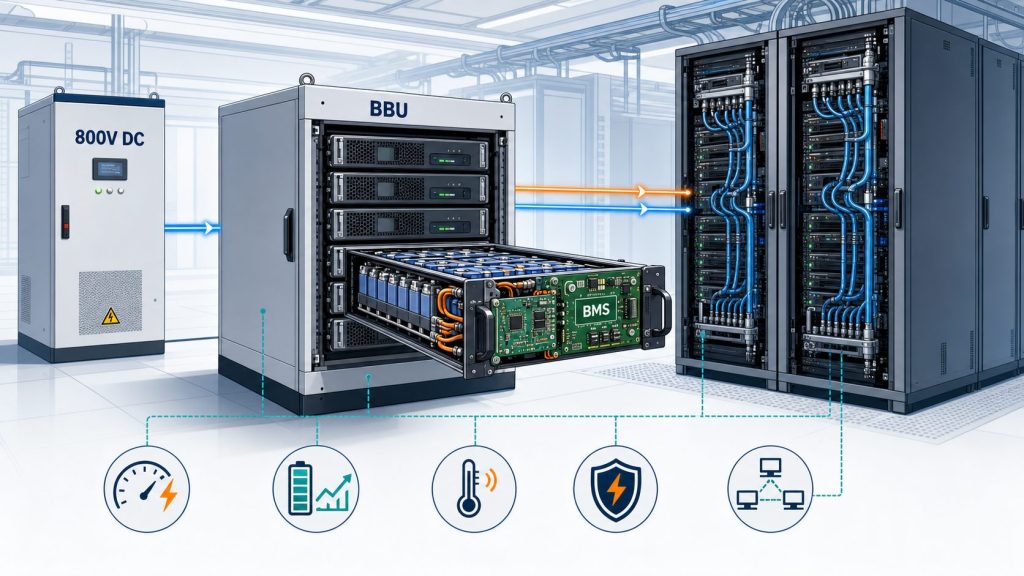
AI data centers are moving toward higher-voltage DC power distribution as rack power rises from tens of kilowatts toward hundreds of kilowatts and, in future systems, megawatt-scale levels. The transition to 800V HVDC does not eliminate battery backup. Instead, it increases the importance of lithium battery backup units (BBUs), fast fault isolation, accurate state estimation, thermal management, and coordinated BMS communication. For equipment manufacturers, battery systems must be designed as active parts of the power architecture rather than passive emergency backups.
AI computing is changing more than processor performance. It is also transforming how electricity is converted, distributed, stored, monitored, and protected inside data centers.
Traditional server racks commonly rely on facility-level AC power, uninterruptible power supplies (UPS), rack power supplies, and low-voltage DC distribution. However, this architecture becomes increasingly difficult to scale as AI accelerators push rack power toward hundreds of kilowatts.
NVIDIA has introduced an 800V DC architecture intended to support future AI infrastructure, including racks operating at 1 MW and beyond. Higher-voltage distribution reduces current, copper requirements, conversion stages, and cable volume. However, it also creates new requirements for battery backup, electrical isolation, fault response, thermal control, and communication.
Lithium BBUs and their Battery Management Systems (BMS) therefore remain critical to the reliability of next-generation AI power systems.
Part 1: Why AI Servers Are Changing Data Center Power Architecture
1.1 AI Rack Power Is Increasing Rapidly
Traditional server racks often operated at approximately 5–10 kW. AI and high-performance computing racks can require 20–30 kW or more, while advanced rack-scale systems are moving toward hundreds of kilowatts.
At these power levels, distributing energy through a low-voltage bus creates very high current.
For example:
| Rack Power | Distribution Voltage | Approximate Current |
|---|---|---|
| 100 kW | 50V DC | 2,000 A |
| 200 kW | 50V DC | 4,000 A |
| 1 MW | 50V DC | 20,000 A |
| 1 MW | 800V DC | 1,250 A |
These simplified calculations exclude conversion losses, but they demonstrate the basic engineering challenge. Raising the distribution voltage substantially reduces current for the same power level.
Lower current can reduce:
- Busbar cross-sectional area
- Copper consumption
- Conduction losses
- Cable volume
- Heat generation
- Space occupied by power equipment
This is why higher-voltage DC distribution is becoming an important option for future AI data centers.
1.2 The Server Power Market Is Expanding
According to estimates presented in a CICC research report, the AI server power module market, including PDU, AC-DC, and DC-DC modules, could increase from approximately USD 7.4 billion in 2025 to USD 32.5 billion in 2027.
The same research identifies several major growth areas:
- Power supply units (PSUs)
- Power distribution units (PDUs)
- Battery backup units (BBUs)
- Power distribution boards (PDBs)
- Voltage regulator modules (VRMs)
- GaN and SiC power devices
- Intelligent power management
- 800V HVDC and solid-state transformer architectures
These figures are forecasts rather than guaranteed outcomes. Nevertheless, they illustrate how AI computing is increasing the value and complexity of the complete power chain.
Part 2: What 800V HVDC Changes
2.1 Fewer Power Conversion Stages
A conventional power path may include several AC and DC conversion stages before energy reaches the processor:
Grid power → Transformer → UPS → AC distribution → Rack PSU → 54V DC bus → DC-DC conversion → GPU
A future 800V DC architecture may centralize AC-to-DC conversion and distribute high-voltage DC closer to the computing equipment:
Grid power → Central AC-DC conversion → 800V DC distribution → Rack DC-DC conversion → GPU
Reducing conversion stages can improve efficiency and decrease the number of components that generate heat or create potential failure points.
NVIDIA reports that its proposed architecture is intended to support racks from approximately 100 kW to more than 1 MW. The company has also identified energy storage as part of the architecture for managing load spikes and sub-second GPU power fluctuations.
2.2 800V HVDC Does Not Make Battery Backup Unnecessary
It would be inaccurate to conclude that higher-voltage DC distribution eliminates battery systems.
Data centers still need energy storage for several different functions:
| Requirement | Typical Response Duration | Relevant Power Solution |
| GPU load fluctuation smoothing | Milliseconds to seconds | Rack-level BBU or other fast storage |
| Ride-through during switching | Seconds | BBU or UPS battery |
| Generator start transition | Seconds to minutes | UPS or battery cabinet |
| Extended grid outage | Minutes to hours | Generator, fuel cell, or large energy storage system |
| Grid support and peak management | Variable | Stationary energy storage |
A BBU responds quickly to sudden changes in load or input power. A generator or solid oxide fuel cell cannot normally replace this immediate response because these systems serve different time scales.
Lithium batteries, UPS systems, and long-duration power sources should therefore be treated as complementary layers.
2.3 Existing Data Centers Will Not Change Overnight
New 800V DC infrastructure requires compatible:
- Rectifiers
- Protection devices
- Connectors
- Busways
- DC circuit breakers
- Power modules
- Maintenance procedures
- Safety standards
- Technician training
Existing facilities also face substantial retrofit costs. As a result, AC UPS systems, intermediate architectures, and 800V DC systems are likely to coexist.
Manufacturers should design modular power platforms that can support current architectures while preparing for future high-voltage DC integration.
Part 3: Why Lithium BBUs Matter in AI Data Centers
3.1 Fast Response to Dynamic AI Loads
AI training workloads can create rapid changes in power demand. Thousands of accelerators may transition between processing phases at nearly the same time, producing steep load ramps.
A properly designed lithium BBU can:
- Deliver power during short load peaks
- Absorb energy when demand falls
- Reduce stress on upstream power conversion equipment
- Stabilize the DC bus
- Support orderly shutdown during power loss
- Bridge the time required for another backup source to start
This changes the role of the battery. It is no longer used only when utility power fails. It can become an active power-control component that cycles frequently.
3.2 Higher Energy Density in Limited Rack Space
Data center racks have strict space constraints. Every rack unit used by power equipment reduces the space available for computing, networking, or cooling equipment.
Lithium-ion batteries generally provide higher gravimetric and volumetric energy density than lead-acid batteries. This can help equipment designers:
- Reduce BBU size and weight
- Increase backup duration within a fixed enclosure
- Create modular, serviceable battery trays
- Position energy storage closer to the load
- Support hot-swappable designs
Battery chemistry still needs to be selected according to the application rather than energy density alone.
| Chemistry | Main Advantage | Engineering Consideration |
| NMC | High energy density and compact size | Requires strong thermal and electrical protection |
| LiFePO4 | Long cycle life and good thermal stability | Lower energy density than NMC |
| LTO | Very long cycle life and high charge acceptance | Lower energy density and higher cost |
| LCO | High energy density | Generally less suitable for high-cycle industrial BBU use |
For frequently cycled BBUs, cycle life, power capability, heat generation, and safety can be more important than maximum nameplate energy density.
3.3 BBU Designs Must Match the Power Architecture
A BBU cannot be selected using capacity alone. Engineers must define:
- Nominal and maximum bus voltage
- Continuous and pulse discharge current
- Required ride-through time
- Maximum acceptable voltage drop
- Charge recovery time
- Expected cycling frequency
- Available cooling method
- Rack dimensions
- Service and replacement requirements
- Communication protocol
- Redundancy strategy
A pack designed for occasional emergency discharge may not perform reliably when used for frequent load smoothing. The duty cycle must be established before selecting cells or configuring the pack.
Part 4: Why BMS Design Is Central to Reliability
4.1 Cell-Level Monitoring
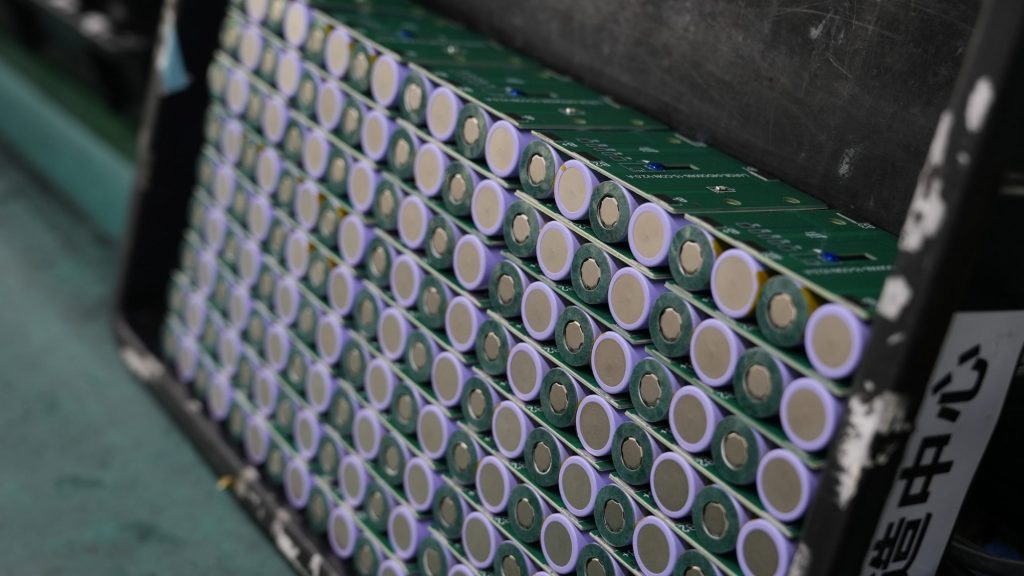
A BMS monitors individual cell or parallel-group voltages, pack current, and battery temperatures.
This allows the system to identify:
- Cell imbalance
- Abnormal voltage rise
- Excessive voltage drop
- Overcurrent
- Internal resistance growth
- Temperature variation
- Connector or busbar problems
- Capacity degradation
In a large AI power system, a battery fault should be detected before it affects the DC bus or surrounding equipment.
Learn more about BMS and PCM design.
4.2 Accurate SOC and SOH Estimation
State of charge (SOC) indicates the remaining usable energy. State of health (SOH) estimates how battery capability has changed through aging.
Simple voltage-based SOC estimation may be inadequate for a BBU exposed to:
- Rapid current changes
- Shallow cycling
- Variable temperatures
- Long standby periods
- High pulse loads
- Parallel modules with different aging histories
A more robust estimation strategy may combine:
- Coulomb counting
- Open-circuit voltage correction
- Temperature compensation
- Impedance tracking
- Historical cycle data
- Model-based estimation
- Periodic capacity calibration
Incorrect SOC estimation can create false confidence. A system may report available backup time that the battery can no longer deliver under the required power load.
4.3 Thermal Management
High-density racks generate substantial heat. Battery systems may be positioned near power electronics, cooling loops, and processors, making temperature control a system-level requirement.
The BMS should monitor more than one temperature point when the pack is large or thermally uneven. Sensors may be required near:
- High-current terminals
- Central cell groups
- Outer cell groups
- MOSFETs or contactors
- Busbars
- Air inlets and outlets
A thermal control strategy can include current derating, fan or liquid-cooling coordination, charge limitation, warning thresholds, and emergency isolation.
4.4 Fast and Selective Fault Isolation
An 800V DC system presents different protection challenges from a conventional low-voltage BBU.
DC arcs do not naturally pass through a zero-current point as AC arcs do. Protection equipment must therefore interrupt fault current quickly and reliably.
Depending on the architecture, protection may include:
- DC-rated fuses
- Contactors
- Pre-charge circuits
- Insulation monitoring
- Pyrotechnic disconnects
- Solid-state circuit breakers
- Current sensors
- Isolation monitoring
- Emergency discharge paths
The BMS must coordinate with these components. A single abnormal module should be isolated without unnecessarily shutting down healthy racks or battery strings.
4.5 Communication With the Power System
A server BBU should communicate with the wider power-management system rather than operate as an isolated pack.
Common communication options include CAN bus, RS485, SMBus, Ethernet gateways, or customer-specific protocols.
The system may need to report:
- SOC and SOH
- Available discharge power
- Available charge power
- Estimated backup duration
- Maximum and minimum cell voltage
- Temperature distribution
- Alarm history
- Contactor status
- Insulation status
- Maintenance recommendations
Accurate data allows the facility controller to distribute loads, schedule maintenance, and avoid unexpected battery failures.
Part 5: Key Safety and Reliability Requirements
5.1 Preventing Propagation
A safe BBU should be designed so that a single-cell fault does not spread through the module or rack.
Engineering measures may include:
- Cell spacing
- Thermal barriers
- Flame-retardant materials
- Controlled venting paths
- Mechanical separation
- Heat-resistant busbar insulation
- Cell-level or group-level fusing
- Early temperature and voltage detection
Compliance testing must reflect the complete battery system, not only the individual cell.
5.2 Mechanical and Electrical Integration
Battery reliability can be reduced by problems outside the cell itself, including:
- Loose terminals
- High-resistance welds
- Inadequate creepage and clearance
- Poor connector retention
- Uneven compression
- Cooling obstruction
- Vibration damage
- Incorrect torque
- Insulation degradation
The enclosure, BMS, connection system, thermal design, and cell configuration must be engineered as one product.
5.3 Standards and Qualification
Applicable requirements depend on battery size, installation type, market, and whether the BBU is treated as an IT component, stationary energy storage system, or part of a larger listed product.
Potentially relevant standards and requirements include:
- UN 38.3 for lithium battery transport
- IEC 62619 for industrial secondary lithium cells and batteries
- UL 1973 for batteries used in stationary and auxiliary power applications
- UL 9540 for complete energy storage systems where applicable
- NFPA 855 for stationary energy storage installation
- Relevant IEC or UL requirements for server and data center equipment
Manufacturers should confirm the final certification path with a qualified laboratory at the beginning of development. Testing requirements can influence the cell, enclosure, spacing, protection, and communication architecture.
Part 6: Where SOFC and Long-Duration Power Fit
Solid oxide fuel cells (SOFCs) are gaining attention as data centers seek cleaner and more flexible sources of long-duration power.
SOFC systems can provide continuous or extended power, but they do not remove the need for fast battery response.
| Technology | Primary Function |
| Lithium BBU | Millisecond response, load smoothing, short ride-through |
| UPS battery system | Facility-level backup and transition support |
| SOFC | Continuous or long-duration distributed power |
| Diesel or gas generator | Extended emergency generation |
| Grid-scale battery storage | Peak management and longer backup |
A hybrid design can use lithium batteries to handle sudden load changes while an SOFC supplies sustained power. This reduces the need to oversize the long-duration source for every transient event.
The control system must coordinate battery SOC, fuel-cell output, grid status, and computing load. Once again, battery communication and BMS accuracy become central to system reliability.
Part 7: A Design Checklist for Equipment Manufacturers
Before developing a lithium BBU for an AI server or high-density power rack, define the following:
- What is the DC bus voltage?
- What continuous and peak power must the BBU deliver?
- How quickly must it respond?
- How long must it sustain the load?
- How frequently will it cycle?
- What battery chemistry best matches the duty cycle?
- What cooling method is available?
- How will the system estimate SOC and SOH?
- Which communication protocols are required?
- How will faulty modules be isolated?
- Can modules be serviced or hot-swapped safely?
- Which transport and product certifications apply?
- How will the design prevent thermal propagation?
- How will the BBU interact with UPS, HVDC, or long-duration generation?
- What production tests will verify every completed pack?
Defining these requirements early helps prevent costly redesigns during validation and certification.
Part 8: Preparing Battery Systems for the 800V DC Era
The transition to 800V DC will not be a simple voltage upgrade. It changes the relationship between power conversion, energy storage, protection, thermal management, and software control.
Battery manufacturers and server power engineers should prepare by focusing on:
- Modular battery architecture
- High-cycle cells
- Accurate SOC and SOH estimation
- High-speed current measurement
- Multi-point temperature sensing
- DC fault interruption
- Redundant communication
- Predictive maintenance
- Traceable production testing
- System-level safety validation
As AI racks become more powerful, the cost of an unexpected shutdown also increases. Battery reliability must therefore be evaluated in terms of available power, response speed, fault tolerance, and maintainability—not only capacity and cycle life.
Conclusion
AI infrastructure is accelerating the transition toward higher-power, higher-voltage, and more intelligent data center power systems. NVIDIA’s 800V DC roadmap demonstrates why traditional low-voltage distribution will become difficult to scale for future megawatt-class racks.
However, 800V HVDC does not reduce the importance of lithium battery backup. It makes battery integration more demanding.
Lithium BBUs must respond to rapid load changes, provide reliable ride-through power, communicate with facility controllers, and isolate faults without disrupting healthy equipment. Their BMS must deliver accurate state estimation, thermal monitoring, diagnostics, and protection throughout the battery’s operating life.
Large Power develops custom battery solutions with tailored cell configurations, protection systems, communication protocols, thermal designs, and qualification support. Discuss your voltage, power, runtime, enclosure, and BMS requirements with our engineering team through Contact Us.
FAQ
What is a battery backup unit in an AI server?
A battery backup unit provides short-duration power close to the server or rack. It can support ride-through during input interruptions, smooth rapid GPU load changes, and allow an orderly shutdown. Unlike a large facility UPS, a BBU is typically designed around the response and power requirements of specific computing equipment.
Will 800V HVDC replace UPS systems?
Not immediately. New 800V DC architectures can reduce conversion stages and move power conversion outside the computing rack, but existing data centers still depend on AC distribution and UPS systems. UPS, intermediate DC architectures, and 800V DC systems are likely to coexist during a long transition period.
Which lithium battery chemistry is suitable for a server BBU?
NMC offers high energy density for space-constrained systems, while LiFePO4 provides strong thermal stability and long cycle life. LTO may suit exceptionally high-cycle applications. The correct choice depends on discharge power, available space, cycling frequency, temperature, backup duration, and certification requirements.
Why is a BMS important for AI server battery systems?
A Battery Management System monitors voltage, current, temperature, SOC, and SOH. It controls charging and discharging, balances cells, reports available power, and coordinates fault isolation. These functions are essential when batteries support rapidly changing, high-value computing loads.
Can lithium batteries work with SOFC power systems?
Yes. Lithium batteries can provide immediate response and absorb short power fluctuations, while an SOFC supplies sustained energy. A coordinated hybrid system can improve response, reliability, and utilization of the long-duration power source.
How can manufacturers develop a custom BBU?
Start by defining bus voltage, peak power, ride-through time, cycling frequency, cooling, dimensions, communication protocol, redundancy, and certification requirements. Large Power can develop custom lithium battery packs and BMS solutions around these system-level requirements.
References
- NVIDIA, “800 VDC Architecture Will Power the Next Generation of AI Factories,” 2025.
- NVIDIA GTC 2026, “800 VDC and Modular Data Center Solutions.”
- CICC Research, “AI Evolution (15): Server Power, the Next Hundred-Billion-Yuan Market.”
- CICC Research, “GTC 2026 Observations: Liquid Cooling Upgrades and the Official Release of the 800V HVDC Solution.”
- CICC Research, “New Power Solutions for Data Centers: SOFC Enters a Period of Rapid Growth.”


