

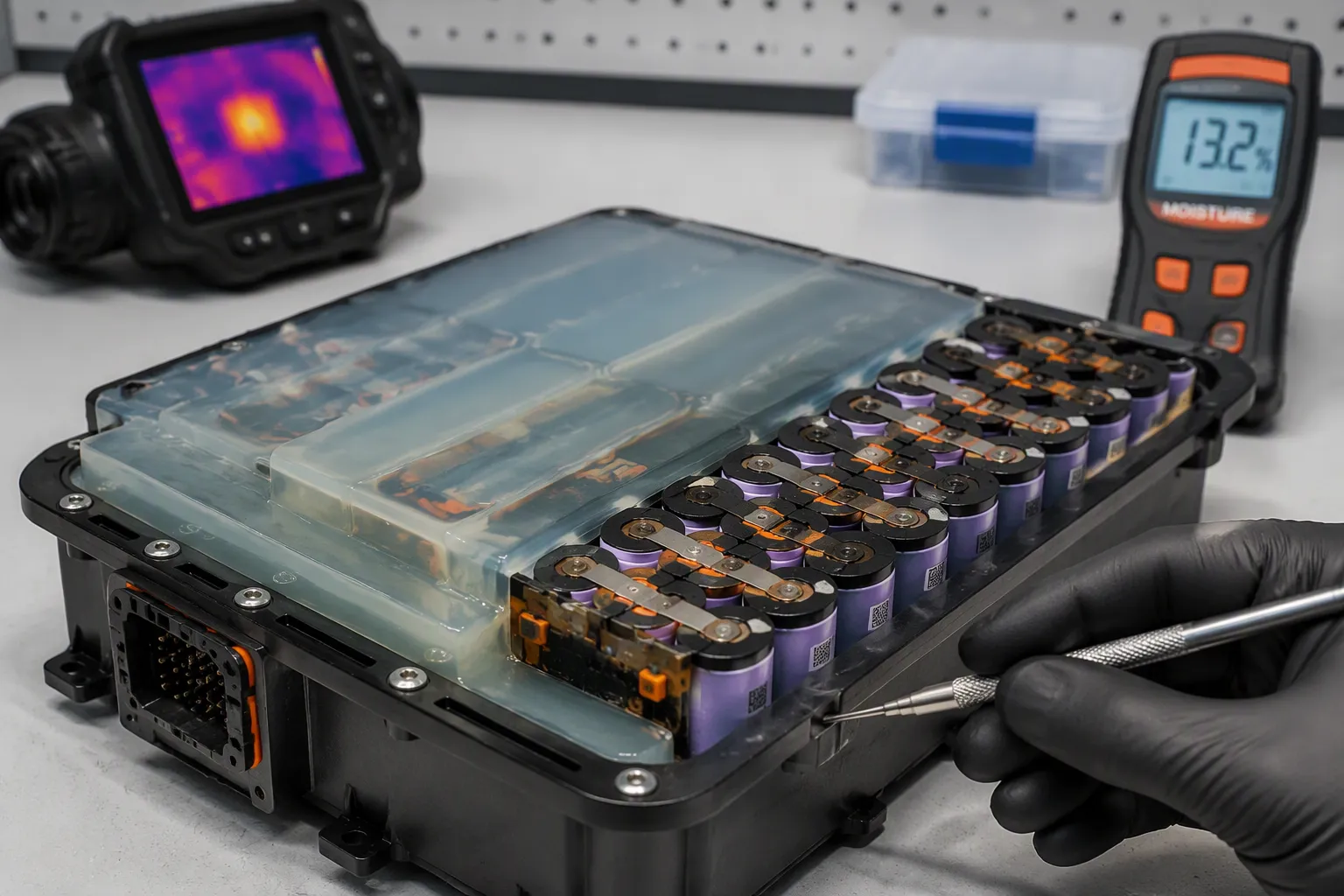
Potting and encapsulation are overlapping terms used differently by suppliers. Specify the actual process: protected area, fill depth, retained housing or mold, material, cure conditions and service access. For custom lithium packs, assess moisture, thermal paths, cell expansion, venting and repairability together.
Quick Answer: Neither process name guarantees water resistance, heat dissipation or repairability. Select a qualified material and controlled process for the actual pack architecture, keep required cell vents and pressure paths functional, and validate the finished assembly.
Key Takeaways
Specify the protected area and actual manufacturing process, not only its name.
Qualify the exact compound, cure profile and electrical insulation properties.
Preserve cell vents, expansion allowance and pressure-relief functions.
Verify thermal paths and moisture exposure on the completed assembly.
Define safe replacement units and service access before tooling release.
Part 1: Battery Pack Potting and Encapsulation Terminology
1.1 Overlap and Divergence
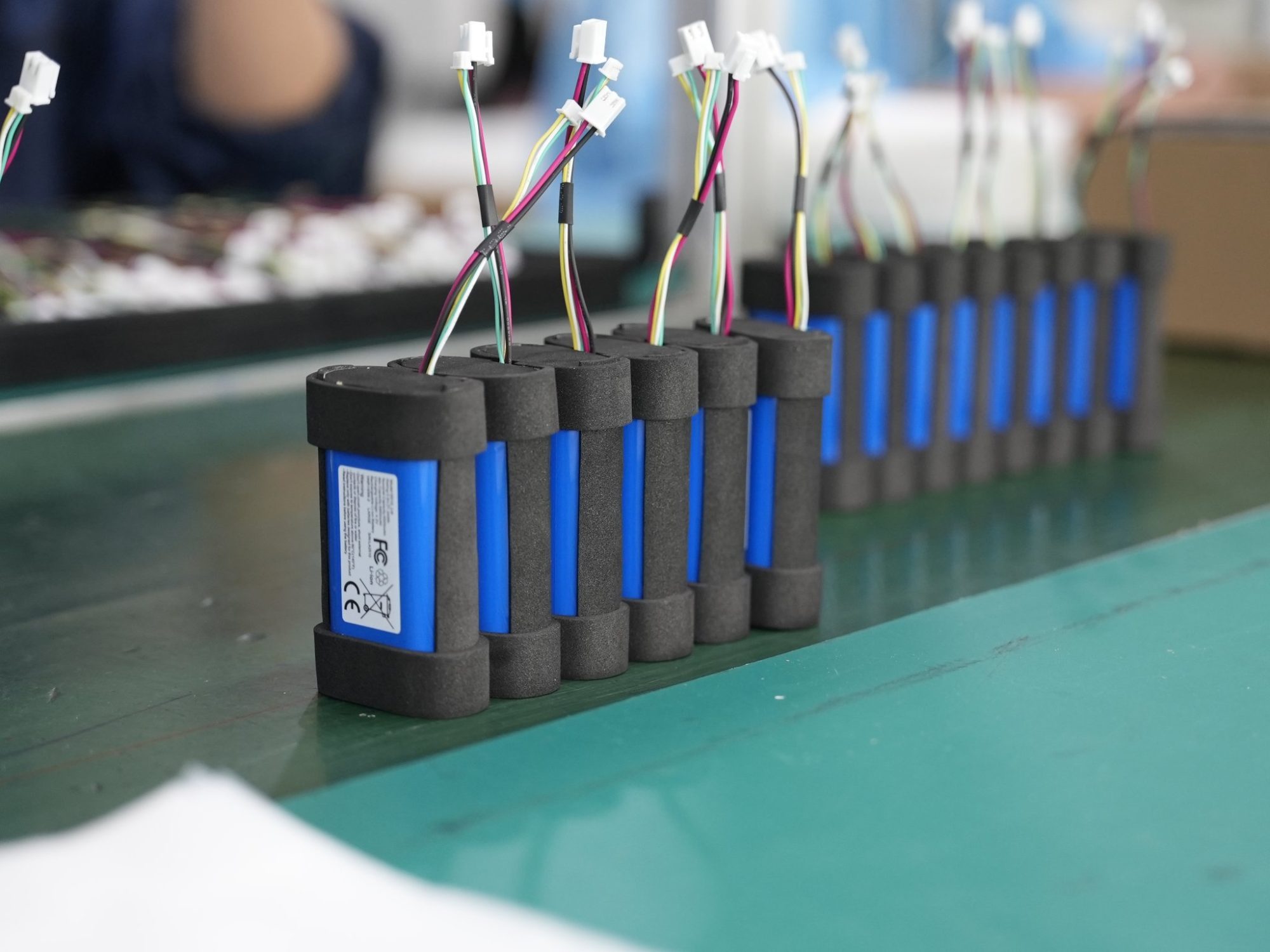
A filled housing, a molded protective layer and localized protection may all be described as encapsulation. Use drawings and process specifications rather than terminology to establish scope. The table below describes possible implementations, not universal definitions.
Dimension | Potting | Encapsulation |
|---|---|---|
Fill volume | Partly or fully fills internal cavities and embeds cells and electronics; uses more material | Forms a protective outer layer without fully embedding internal structures; uses less material |
Rework path | Rework depends on architecture, material and authorized process | Mold release does not establish finished-pack serviceability |
Material properties influence rework, but a soft compound does not automatically make a battery safe to repair, and a rigid compound does not define every service route. Decide whether the approved service unit is a board, module or complete pack. Avoid unqualified excavation, solvents or heat near energized cells.
1.2 PCB Encapsulation vs. Conformal Coating
Conformal coating is generally a thin protective layer on electronics; potting or encapsulation can cover or embed selected areas more deeply. Coverage, adhesion, thickness and material properties determine protection. Neither a coated board nor an embedded board automatically qualifies a complete pack for immersion.
Protection depends on the qualified material, coverage, interfaces and manufacturing process. A thicker layer does not automatically provide a better complete-pack result.
Compare protection using the actual exposure, interfaces and process quality, not a blanket ranking. Moisture can permeate polymers or enter along poorly bonded surfaces. Review BMS and protection circuitry for thermal behavior, inspection access and compatibility with the selected compound.
Part 2: How Each Material Behaves and How Curing Affects It
2.1 Silicone, Polyurethane, and Epoxy
Material family alone does not establish adhesion, stiffness, thermal conductivity or electrical insulation. Obtain the exact grade datasheet and qualify cured properties, temperature limits, dielectric strength, compatibility and process conditions. Electrically conductive fillers may create hazards near live conductors. The following table must be treated as a selection framework, not family-wide performance data.
Property | Silicone | Polyurethane | Epoxy |
|---|---|---|---|
Adhesion | Good, flexible | Strong, flexible | Excellent, rigid |
Thermal conductivity | Grade-specific; verify datasheet | Grade-specific; verify cured material | Grade-specific; verify electrical insulation |
Key limitation | Conductivity and compatibility vary by grade | Moisture, cure and mechanical limits vary | Brittle; CTE mismatch stress |
Compare modulus, thermal expansion, cure shrinkage and bond behavior for the actual formulation and temperature cycle. Flexible and rigid compounds can each be suitable in different designs; qualify cell, board and enclosure stresses rather than selecting by family name alone.
2.2 Curing Heat and Shrinkage StressCure exotherm and shrinkage depend on chemistry, fill mass, geometry, mixing and cure schedule. Establish the permitted pour depth and peak cell and board temperatures with the compound supplier and process trials. There is no universal safe fill thickness.
Cure exotherm, shrinkage and thermal-expansion mismatch can load cell seals, solder joints and insulation. Cracks or lifted joints need failure analysis; they do not identify one cause by themselves. Qualify mix ratio, material temperature, working time, dispense mass, cure profile and peak component temperature at production scale. Trial coupons alone may not reproduce the heat of a large pour. Protect only the required region and preserve the cell supplier-approved venting, swelling allowance and safety architecture.
Part 3: Moisture Protection Mechanisms
3.1 Adhesion, Permeation, and Housing Interaction
Water gets into a pack in three ways: through the polymer, along the bond surface, and through gaps in the housing. A compound that bonds well blocks the surface path, so cleaning the surface matters as much as the chemistry. Dirty or poorly primed surfaces let water creep under the cured layer. Water moves through the material itself more slowly, but it never fully stops. Thin sections and low-crosslink formulas let more vapor pass over time.
The housing and the fill work as one system. A rigid fill inside a flexible housing can crack when temperatures change, and a crack becomes a direct path for water to get in. Flexible potting compounds take up housing movement and keep the seal tight. Other benefits come from the same behavior. A soft compound absorbs shock and reduces vibration, and these effects help protect electronics in robotics and handheld security devices. Engineers should confirm these benefits by testing, not by assuming.
3.2 Why Potting Does Not Guarantee an IP Rating
Battery pack potting is one part of a waterproof design, not the whole design. A real IP67 or IP68 rating depends on how the whole system fits together. Six layers usually work together:
Specify housing joints, seals and feedthroughs for the exposure profile.
Qualify connector ingress protection in the installed condition.
Choose coating or local fill only where compatible with the electronics.
Preserve cell expansion space, vents and intended pressure-relief paths.
Separate moisture breathing from thermal-event pressure relief.
Test the completed assembly and assess condensation, chemicals and aging separately from the IP test.
An IP rating alone does not confirm suitability for salt spray, condensation, pressure washing, vibration, thermal cycling, or long-term outdoor exposure — these must be reviewed separately during battery design.
Connector quality and seal condition decide the result as much as the fill does. A good conformal coating protects the board, but a failed gasket still lets water in. Encapsulation has the same limit. Teams should treat moisture resistance as a system property and check it on the assembled pack.
Part 4: Heat Dissipation and Thermal Paths
4.1 Filler Loading and Bond-Line Thickness
Heat leaves a cell through the compound, the housing, and the surrounding air. Every interface adds resistance, so managing heat flow starts with the fill itself. Teams comparing battery pack potting with encapsulation often look at moisture first and miss this path. Filler content controls thermal conductivity, because particles must touch to build continuous pathways. Low loading leaves gaps, and heat crosses the matrix slowly.
Design input | What to specify | What to validate |
|---|---|---|
Cured conductivity | Exact grade and test conditions | Cell and BMS temperatures in the actual enclosure |
Bond-line geometry | Thickness, contact area and interfaces | Thermal resistance and contact integrity |
Dispensing properties | Viscosity, working time and approved process | Fill consistency and void control |
Mechanical properties | Modulus, expansion and cure shrinkage | Cell clearance and joint stress through thermal cyclingDo not transfer a filler percentage or conductivity result from one formulation to another. Use the qualified compound datasheet and cured assembly measurements. A preliminary one-dimensional conduction estimate is Rth = thickness / (conductivity x contact area); interface resistance, voids and spreading resistance add to it. Higher conductivity does not solve a poor heat-rejection path, and the compound can increase thermal coupling between neighboring cells. |
4.2 Voids, Vents, and Pressure Equalization
Voids can compromise thermal contact and insulation. Use the material supplier approved mixing, dispensing, degassing and cure process, with inspection for the actual assembly. Do not expose cells to unqualified vacuum or pressure conditions. Preserve cell vents, swelling clearance and intended pressure-relief paths.
Vent designs solve the pressure problem in several ways:
ePTFE breathable membranes let gas pass but block liquid and dust, so pressure equalizes while the housing keeps its rating.A qualified flame-arresting element can limit flame transmission only within its tested gas, pressure, temperature and installation scope; it does not automatically stop a battery thermal event.
Channel-molded silicones leave hollow exhaust paths through cured compound.
Over-pressure burst discs act as a mechanical failsafe, shearing at a set threshold.
A moisture breather is not automatically a thermal-event pressure-relief device or flame arrestor. Specify separate functions and verify pressure, flow, ingress and chemical compatibility requirements for the actual enclosure. A tubing flame rating alone does not qualify the vent system.
Part 5: Repairability and Service Access
5.1 Cell, Module, and PCB Potting Service Considerations
Define serviceability before choosing a fill process. A fully embedded cell assembly may require replacement as a complete pack, while segregated electronics or sealed submodules may remain replaceable. Do not infer the repair strategy of a custom medical or robotics pack from an unrelated automotive design.
Board-level embedding can increase inspection difficulty, mass and process complexity. Balance these effects against the actual contamination and mechanical requirements, and document the approved service unit.
Define inspection, replacement and recycling access before approving an irreversible fill process.
A fully embedded BMS may be impractical to rework, but the decision depends on construction, safety controls and the approved service process rather than the process label alone.
5.2 Rework Methods and Design for Disassembly
Plan service at the architecture level. Use replaceable sealed modules or accessible electronics where required. Removing cured compound around live cells is not a normal field procedure; unqualified scraping, heating or solvent use can damage insulation and cells. Use only an authorized professional process, otherwise replace the approved unit.
Diagnostics deserve the same attention. Aging packs often report inaccurate state of health, and weak event logging delays maintenance. Poor detection of localized thermal or electrical imbalance lets faults grow. A service plan should pair a defined replacement path with clear fault reporting, so technicians replace whole modules rather than probe a filled cavity. Document the approved rework route in the pack specification before tooling release.
Part 6: Trade-Offs and Method Selection
6.1 Selection Criteria by Requirement Profile
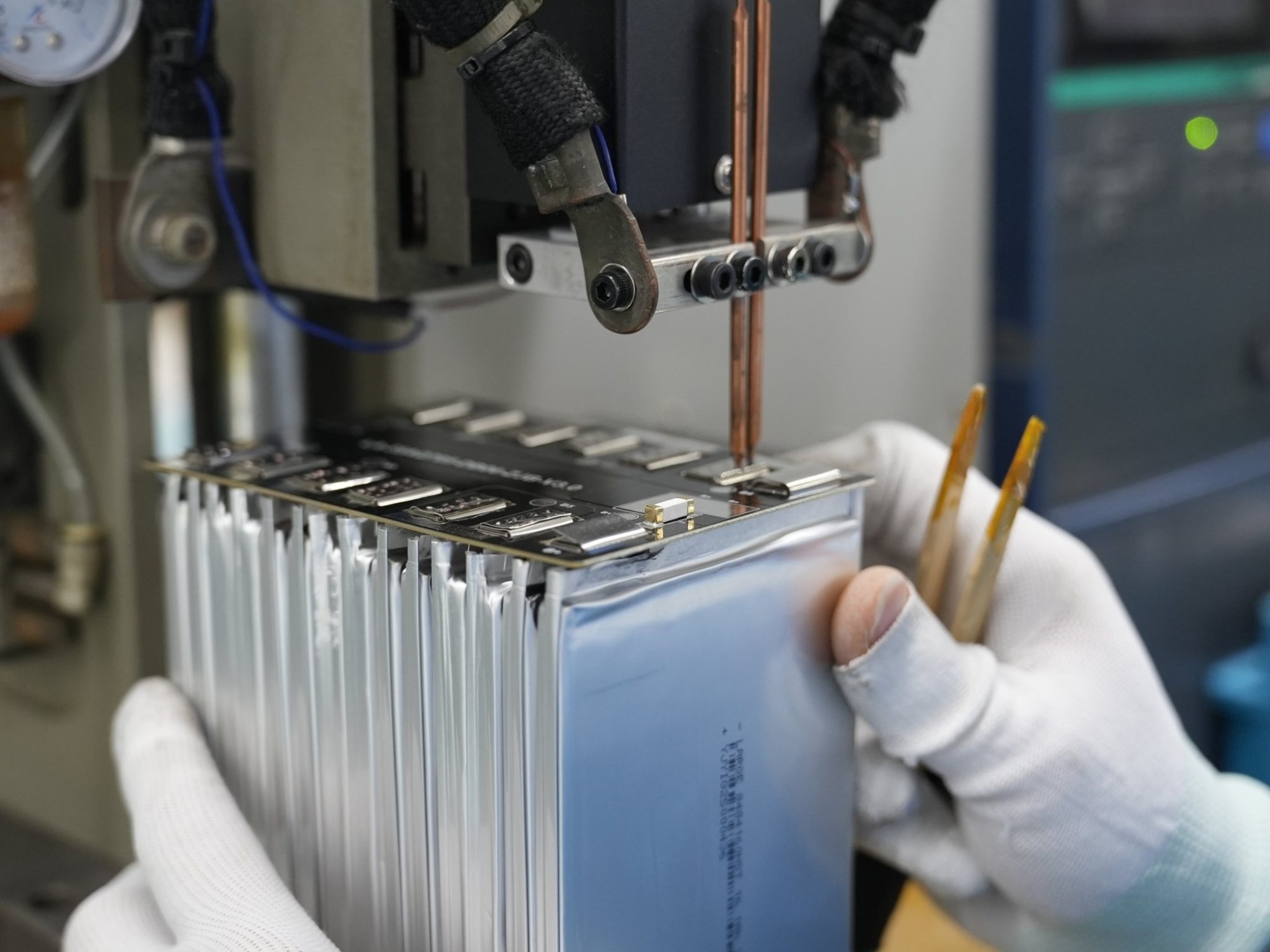
No single method wins on every point. Teams should first rank moisture exposure, thermal duty, and service model. Then let that ranking pick the process. The table below maps common requirement profiles to a starting approach.
Protection Requirement | Recommended Approach |
|---|---|
Block moisture and contamination on exposed surfaces under space and weight limits | Thin-film conformal coating |
Protect interfaces and ingress points such as cable entries and connector backshells | Local compound protection, sometimes combined with coating |
Maintain serviceability | Thin films, which offer more rework options than fully filled compounds |
Reinforce against vibration, shock, and cable strain | Potting or encapsulation for stronger mechanical supportChoose the exact grade from validated adhesion, water absorption, permeation and exposure data. Silicone is not universally better for immersion than epoxy. Cleaning-fluid exposure, condensation and continuous immersion require different qualification conditions. Thermal duty must be assessed separately from cure-process risk. In operation, the cured compound needs a qualified path to the enclosure or heat sink. During manufacture, chemical cure can generate heat even without an electrical load. Specify and validate both cases rather than assuming a thermally conductive material is safe in every fill geometry. |
A compound improves heat flow only when its cured properties and interfaces form a validated path to an effective heat sink. It can also trap heat if the complete path is poor.
The service model may favor locally protected replaceable modules over full embedding. A soft formulation alone does not establish repairability, and a long intended life does not justify an unvalidated permanent fill. Define replacement and disposal routes.
6.2 Test Acceptance and OEM Checklist
Cell datasheets describe cell behavior, not pack behavior. A cell may pass its own cycle life test and still fail once assembled. That happens because interconnects, the BMS, and the fill all change the outcome. Acceptance therefore needs three layers: cell-level checks, assembled pack checks, and system validation in the real enclosure with real connectors. Program teams should define each limit themselves and record it in the specification.
An OEM checklist keeps the review honest. A workable starting set covers housing dimensions and mass allocation, cell retention under shock and vibration, connector and feedthrough resistance, wire gauge and weld quality, insulation and short-circuit protection, the condensation control strategy, compound compatibility, service procedures, and transport traceability. Each line becomes a pass or fail item with an owner.
Test acceptance should mirror the chosen method. A filled pack needs void inspection and a cure profile record. A coated board needs coverage checks at connector pins. Thermal cycling then confirms the whole assembly, not just the compound. Document the method, the cure profile, and the rework plan before tooling release. Then the choice becomes defensible to purchasing and quality alike.
Match the qualified compound, process and coverage to the actual exposure and service requirements. Potting and encapsulation terminology alone cannot establish which design is maintainable or suitable for a long-life sealed installation.
Moisture protection, heat flow and serviceability interact. Verify the exact formulation and assembly rather than assuming every silicone is a thermal insulator or every epoxy is thermally conductive.
Teams should write down the chosen method, cure profile, and rework plan in the pack specification before tooling release. That record keeps purchasing, quality, and field service teams from facing confusion.
FAQ
Does potting guarantee an IP rating for a battery pack?
No. Verify the declared ingress rating on the complete assembly under the applicable test conditions, including connector mating states, seals and vents. Do not substitute an arbitrary immersion or pressure test for the claimed IP test. Condensation, cleaning chemicals, aging and thermal-event pressure relief require separate assessment.
Which material suits a pack with high thermal duty?
Select from the measured conductivity, electrical insulation, stiffness and compatibility of the exact grade. Silicone, polyurethane and epoxy formulations can differ widely. Validate the complete thermal path, including interfaces and the enclosure.
How do teams keep a filled pack serviceable?
Serviceability depends on architecture and an authorized safe process, not only material softness. Prefer replacement of a qualified board, sealed module or complete pack. Do not excavate cured material near energized cells in ordinary field service.
When does conformal coating replace a full fill?
Conformal coating may protect qualified PCB surfaces from contamination and condensation, but it does not seal the enclosure or qualify immersion resistance. Full embedding is not automatically suitable for immersion or washdown either. Select coverage from the actual exposure, interface sealing, thermal path and approved service model, then test the complete assembly. Keep connector contacts and required test or vent features clear unless their treatment is explicitly qualified.


