

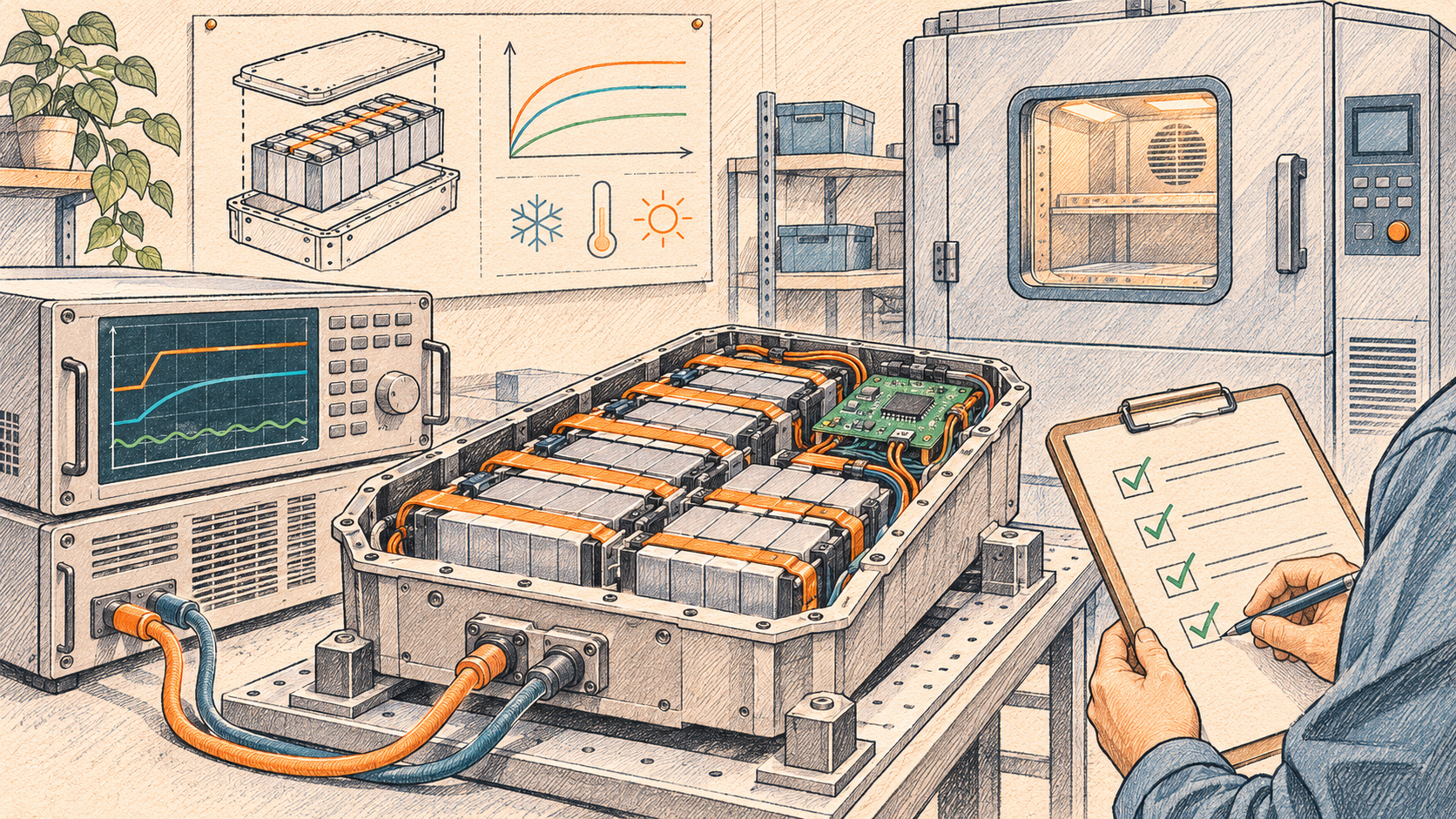
Quick Answer: Define what the battery pack must do under the device’s actual operating conditions. Qualify the cell model and specify how incoming cells are screened, matched and traced. Use EVT to check electrical behavior and protection, DVT to verify the production-intent pack, and PVT to show that the production line can build and screen it consistently. Release production lots against agreed checks and reassess validation after changes.
Part 1: Turn Device Requirements into a Battery Test Plan
1.1 Define the conditions the pack will see
Give the test team the device’s input-voltage limits, measured load profile, charger behavior, operating and storage temperatures, mounting orientation, and expected service life. Include events such as motor startup, emergency stopping, a failed temperature sensor, or a charger disconnect where they matter to the application.
Record state of charge, cell temperature, rest time and firmware revision for each run. An ambient reading alone says little about the temperature of a pack that has just come off a charger or has been sitting in cold storage. Agree where temperature will be measured and what constitutes a stabilized starting condition.
1.2 Give each requirement a measurable pass condition
For a robot startup test, define the current waveform, minimum device-side voltage and permitted protection response. For a medical backup pack, define what the device must complete before shutdown and how much warning time it needs. Measure at the host interface as well as the pack terminals when cable drop or connector resistance could affect the result.
Identify the sample build, method, acceptance limit, evidence to retain and person responsible for disposition. Link each test to a requirement so a marginal result has a clear owner. The custom battery pack development process explains where these decisions sit in the OEM program.
Part 2: Qualify Cells and Control Consistency Before Assembly
2.1 Separate cell reliability from incoming-lot consistency
Cell qualification establishes whether a cell model can support the intended current, temperature and service life. Review capacity retention and resistance growth under representative cycling or storage conditions. Incoming screening checks how closely individual cells in a lot match that baseline. Depending on the project, this can include open-circuit voltage, internal resistance, measured capacity or a self-discharge check. Compare readings collected at agreed temperatures, rest times and states of charge.
2.2 Where Large Power’s zero-state cell matching fits
Large Power describes zero-state cell matching as part of its production workflow. Specify how the matching state is defined for the selected cell, what measurements determine grouping, how outliers are handled, and how accepted cell lots are linked to each pack serial number. Record these items alongside the project’s incoming acceptance limits.
A lower-capacity series group can reach a voltage limit before the rest of the pack, reducing available energy. Resistance spread can affect voltage sag and current sharing. Check group voltage spread on assembled packs during representative load and charge events. Cell qualification, matching records and assembled-pack measurements provide evidence at different stages. Large Power standard battery manufacturing overview
Part 3: What to Verify in EVT and DVT
3.1 EVT checks the electrical and protection design
Measure usable watt-hours across the device’s operating window, observe voltage sag under repeatable load pulses, and log temperatures at cells, the BMS and high-current connections where relevant. Check protection trips and recovery. If the host reads state of charge or charge limits over a communication bus, compare reported values with measured behavior and confirm how the host responds when communication is interrupted.
Record startup near the low-charge threshold and completion of a critical task under load as separate test cases. Investigate discrepancies while the cell selection, BMS settings and enclosure are still practical to revise.
3.2 DVT verifies the production-intent configuration
Use representative cells, enclosure, interconnects, connectors, firmware and protection settings. Agree which samples will be used for environmental, mechanical and electrical work. Where a sequence matters, record the baseline before exposure and repeat relevant checks afterward. After vibration, inspect retention and wiring and compare electrical performance or communication with the baseline.
3.3 Match each lab method to the test object
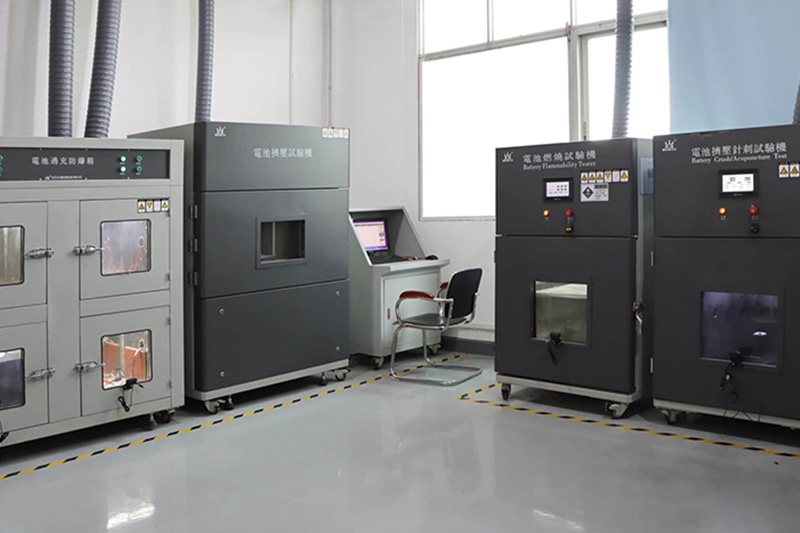
Large Power’s testing-center capability list identifies methods for lithium-ion cells and assembled packs. Use the project requirements to select the methods and samples.
| Test object | Examples in the capability list |
|---|---|
| Cell and pack | Low pressure, temperature cycling, vibration and drop |
| Cell | High-temperature external short circuit, overcharge, forced discharge, crush, heavy impact and thermal abuse |
| Pack | Stress relief and high-temperature use |
| Cell and pack | Reference-rate and rate discharge, high- and low-temperature discharge, charge retention and recovery, storage performance and cycle life |
| Pack | Internal resistance, constant damp heat, molded-case stress at high temperature, and overcharge, overdischarge and short-circuit protection |
GB 31241-2022 addresses lithium-ion cells and batteries for portable electronic equipment. GB/T 18287-2013 addresses lithium-ion cells and batteries for mobile phones. For a robot, medical device or industrial pack, determine which standards apply to the product and intended market. Confirm the specific method against the testing center’s current approved CNAS scope under L26157 and check report acceptance with the intended recipient. Large Power testing and certification
Part 4: Use PVT to Prove the Line Can Detect Defects

4.1 Test with production equipment and limits
Production validation testing checks whether the intended operators, fixtures, software and process settings can consistently build and screen the released pack. Verify that stations use the released limits and link results to each serial number. Check that failures are held for investigation and that retests remain traceable to the initial result.
Typical end-of-line checks cover polarity, terminal voltage, BMS communication, selected functional responses, and traceability. Define checks and sampling frequency in the control plan. Checking connector pin assignments can catch a harness assembly error, while long-term connector retention under vibration belongs in design validation.
4.2 Make release criteria explicit
| Stage | Question to answer | Evidence to review |
|---|---|---|
| EVT | Can the prototype support actual device loads and recover as intended? | Waveforms, protection logs and open issues |
| DVT | Does the production-intent pack meet agreed limits? | Revision-controlled reports, sample records and deviations |
| PVT | Can the line repeatedly build and screen the pack? | Pilot build records, fixture checks and defect handling |
| Mass production | Does the lot meet release limits, and can it be traced? | End-of-line results, sampling records and lot history |
Part 5: Specify the Report and the Retest Rules
5.1 Request evidence that identifies the tested build
A useful report identifies the pack model and revision, sample serial numbers, cell and firmware versions, fixture, method, conditions and acceptance limits. It records measured results, deviations and disposition. For intermittent resets or voltage drops, ask for time-aligned traces as well as the summary. For a transport or compliance submission, confirm which report and product identifiers the recipient requires.
5.2 Decide what to repeat when the pack changes
A different cell can alter voltage sag, energy, charge limits and protection behavior. A BMS firmware change may warrant regression testing of fault thresholds, communication and recovery. A new connector can affect voltage drop, temperature rise and retention. An enclosure change can alter heat flow, ingress paths or load transfer during shock. Document the affected tests, the rationale for reusing prior evidence, and who approves the revision.
FAQ
Can the same test plan cover every lithium battery pack?
Use the same planning framework, then select methods, limits and samples for the chemistry, construction, operating environment and end use.
What should an OEM send before the first validation review?
Send the load profile, input-voltage window, charger requirements, thermal limits, mechanical drawings, communication expectations and intended markets. Include the expected response to equipment faults and any agreed acceptance criteria.
How should incoming samples be checked before validation starts?
Match the pack label and revision to the drawing, verify the connector and pinout, and identify open deviations. The battery pack sample approval checklist covers first-article checks in more detail.


