

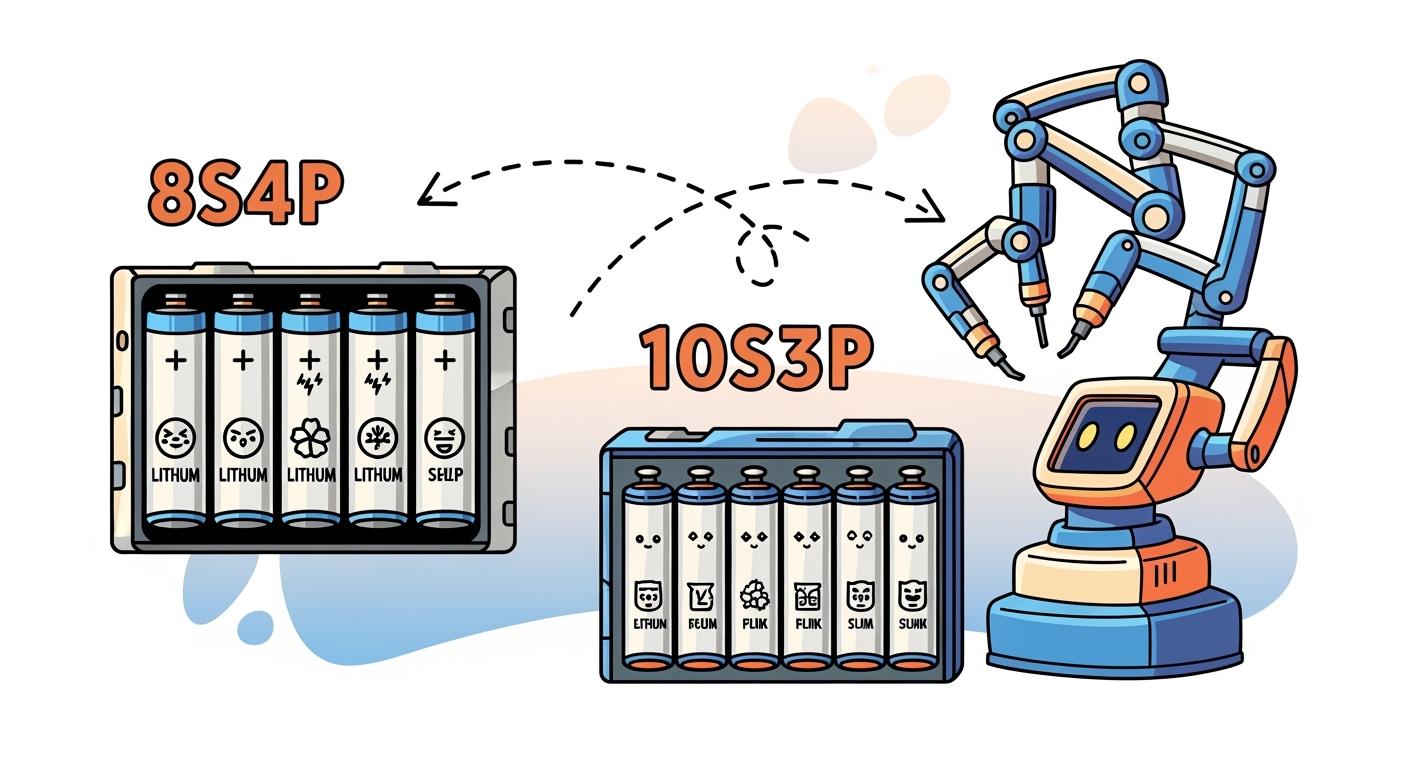
For high-power medical robots, you should prioritize the 10S3P configuration. This Lithium Battery Design delivers higher voltage, greater energy efficiency, and improved reliability. You gain enhanced safety and performance, which remain critical in advanced applications like robotics and medical equipment.
Key Takeaways
Choose the 10S3P configuration for higher voltage and efficiency in medical robots. This design enhances performance and safety.
Select the 8S4P configuration for longer runtime. It provides greater capacity, making it suitable for steady operations.
Always match your battery design to your robot’s specific needs. Consider voltage, capacity, and physical dimensions for optimal integration.
Part1: Lithium Battery Design Basics
1.1 What Is 8S4P?
You will often see 8S4P used in Lithium Battery Design for high-power applications. This configuration means you connect 8 cells in series and 4 in parallel. The series connection increases the voltage, while the parallel connection boosts the capacity. For example, an 8S4P pack using standard lithium-ion cells delivers 28.8V and 14,000mAh. This setup supports high current draw, which is essential for medical robots that require stable and reliable power.
Feature | Description |
|---|---|
Configuration | 8S4P (8 cells in series, 4 in parallel) |
Voltage | 28.8V |
Capacity | 14,000mAh |
Self Balancing Unit | Balances individual cells externally |
DroneCAN Adapter | Bus communication (150A Max) |
Battery Handle | Adds minimal size and weight |
Warranty | Lifetime for factory defects |
Safety Note: Always use a protective case for storage and transport. Never charge unattended. Only use with proper protection circuitry to prevent hazards.
1.2 What Is 10S3P?
In Lithium Battery Design, 10S3P means you connect 10 cells in series and 3 in parallel. This configuration delivers higher voltage—37V nominal and 42V when fully charged. The total capacity reaches 7,500mAh if you use 2,500mAh cells. You will find this design in medical robots, e-bikes, and power tools where high voltage and energy density are critical.
Feature | Description |
|---|---|
Configuration | 10S3P (10 cells in series, 3 in parallel) |
Nominal Voltage | 37V |
Fully Charged Voltage | 42V |
Total Capacity | 7,500mAh |
Energy Storage | 277.5Wh |
Applications | Medical robots, e-bikes, power tools |
BMS Features | Monitors voltage, current, temperature; includes protections |
1.3 Series vs. Parallel Impact
You need to understand how series and parallel connections affect your battery pack. Series connections increase the voltage, while parallel connections increase the capacity. For example, connecting two 12V, 10Ah batteries in series gives you 24V at 10Ah. Connecting them in parallel gives you 12V at 20Ah.
Connection Type | Voltage Effect | Capacity Effect |
|---|---|---|
Series | Increases voltage | Maintains capacity |
Parallel | Maintains voltage | Increases capacity |
When you design a pack for medical robots, you must choose the right balance of voltage and capacity. Most packs use 18650 or 21700 cells. The 18650 cell offers 2,000–3,500mAh and up to 500 charge cycles. The 21700 cell provides 3,000–5,000mAh and up to 1,000 cycles. These cells support the high demands of medical, robotics, and industrial sectors.
Battery Type | Diameter | Length | Capacity (mAh) | Max Discharge Rate (A) | Lifespan (Charge Cycles) | Weight (g) |
|---|---|---|---|---|---|---|
18650 | 18mm | 65mm | 2,000–3,500 | 10–35 | 300–500 | 45 |
21700 | 21mm | 70mm | 3,000–5,000 | 20–50 | 500–1,000 | 70 |
You should always match your Lithium Battery Design to your robot’s voltage and runtime needs. This approach ensures safety, reliability, and optimal performance.
Part2: Energy & Power
2.1 Voltage & Output
You need to consider voltage and output when selecting a battery pack for high-power medical robots. The 8S4P configuration delivers a nominal voltage of 28.8V, while the 10S3P configuration provides 37V. Higher voltage allows your robot to run motors more efficiently and reduces current draw, which helps minimize heat and energy loss. This advantage becomes critical in medical robots that require stable and precise operation.
Configuration | Nominal Voltage | Max Output Current | Typical Application |
|---|---|---|---|
8S4P | 28.8V | 40A | Medical robots, industrial automation |
10S3P | 37V | 30A | Medical robots, e-bikes |
Tip: Higher voltage in Lithium Battery Design can improve power delivery and efficiency, especially in demanding environments.
2.2 Runtime & Density
You must also evaluate runtime and energy density. The 8S4P pack offers a higher total capacity (14,000mAh) compared to the 10S3P pack (7,500mAh). However, the 10S3P configuration stores more energy overall due to its higher voltage, resulting in 277.5Wh versus 403.2Wh for 8S4P. This means you get longer runtime with 8S4P, but 10S3P delivers more power in a shorter period, which suits high-power bursts in medical and robotics applications.
Configuration | Total Capacity (mAh) | Energy (Wh) | Runtime (Typical Load) | Energy Density (Wh/kg) |
|---|---|---|---|---|
8S4P | 14,000 | 403.2 | Longer | Moderate |
10S3P | 7,500 | 277.5 | Shorter | Higher |
You should match your choice to your robot’s workload. If your application requires long, steady operation, 8S4P may fit better. If you need high bursts of power and efficiency, 10S3P stands out.
Part3: Size & Weight
3.1 Physical Dimensions
You must consider the physical size and weight of your battery pack when designing high-power robots. The 8S4P and 10S3P configurations use the same number of cells (32), but their arrangement changes the overall footprint. The 8S4P pack, with four parallel rows, often results in a shorter and wider shape. The 10S3P pack, with more cells in series, creates a longer and narrower profile. This difference affects how you fit the battery into your robot’s chassis.
Configuration | Typical Dimensions (mm) | Weight (kg) | Shape Profile |
|---|---|---|---|
8S4P | 150 x 70 x 70 | 1.6 | Short & Wide |
10S3P | 210 x 60 x 60 | 1.6 | Long & Narrow |
Note: Both packs weigh about the same, but their shapes may impact cooling and placement in your device.
3.2 Integration in Robots
You need to match the battery shape to your robot’s internal layout. In medical and robotics sectors, compact designs help you maximize space for sensors and actuators. In security systems and infrastructure projects, a longer battery may fit better in slim enclosures. In industrial settings, you may prioritize easy access for maintenance.
Choose 8S4P if you need a squat, stable pack for low-profile robots.
Select 10S3P if your design requires a slim, elongated battery for tight spaces.
You should always align your Lithium Battery Design with the robot’s mechanical and thermal requirements. This approach ensures safe, reliable integration across all sectors.
Part4: Battery Life & Maintenance
4.1 Cycle Count
You must evaluate cycle count when selecting a battery for your medical robot. Cycle count measures how many charge and discharge cycles a battery can complete before its capacity drops below 80% of the original value. Both 8S4P and 10S3P packs use advanced lithium-ion cells, but their configuration and usage patterns influence long-term performance.
The rate of capacity degradation depends on how you operate the battery. If you use lower charge and discharge currents, you slow down the loss of capacity. The table below shows how different current profiles affect service life:
Configuration | Capacity Degradation Rate | Service Life (Years) |
|---|---|---|
0.5D/0.15C | High | 6.11 |
0.3C | Moderate | 7.27 |
0.6C | Improved | 7.71 |
You can extend battery life by tuning operational parameters. For example, reducing current or optimizing temperature can increase service life by over 40%. You should monitor battery temperature closely, as heat speeds up lithium depletion and shortens lifespan.
Tip: Use a battery management system (BMS) to track cycles and maintain safe operating conditions.
4.2 Maintenance Needs
You must follow strict maintenance routines to ensure safety and reliability in medical robots. Regular checks help you catch problems early and prevent failures in critical applications.
Inspect the battery pack for physical damage, swelling, leaks, or discoloration.
Clean terminals with isopropyl alcohol and a non-conductive brush to remove corrosion.
Check all connections, welds, and busbars for secure attachment and signs of stress.
Monitor thermal conditions using an infrared thermometer or thermal camera to detect hot spots.
Perform periodic capacity tests to track battery degradation trends.
You should document all maintenance activities and follow manufacturer guidelines. This approach ensures your lithium battery packs deliver consistent performance in medical, robotics, and industrial environments.
You gain higher voltage, efficiency, and reliability with 10S3P for high-power medical robots. However, 8S4P offers longer runtime. Review expert recommendations below:
Factor | Recommendation |
|---|---|
Voltage & Capacity | Match motor needs |
C-Rating | Use 5C or higher |
BMS | Integrate smart safety features |
Modular packs and parallel BMS boost safety and flexibility.
Consider custom solutions—consult Large Power’s battery experts.
FAQ
What are the main differences between 8S4P and 10S3P for medical robots?
How does Large Power support custom lithium battery solutions?
You can request a custom consultation with Large Power for tailored lithium battery packs. Our experts optimize design for medical, robotics, and industrial applications.
Which configuration offers better safety for high-power robots?
You gain enhanced safety with 10S3P due to higher voltage and advanced BMS features. This configuration suits medical, security, and industrial robots requiring strict reliability.


