

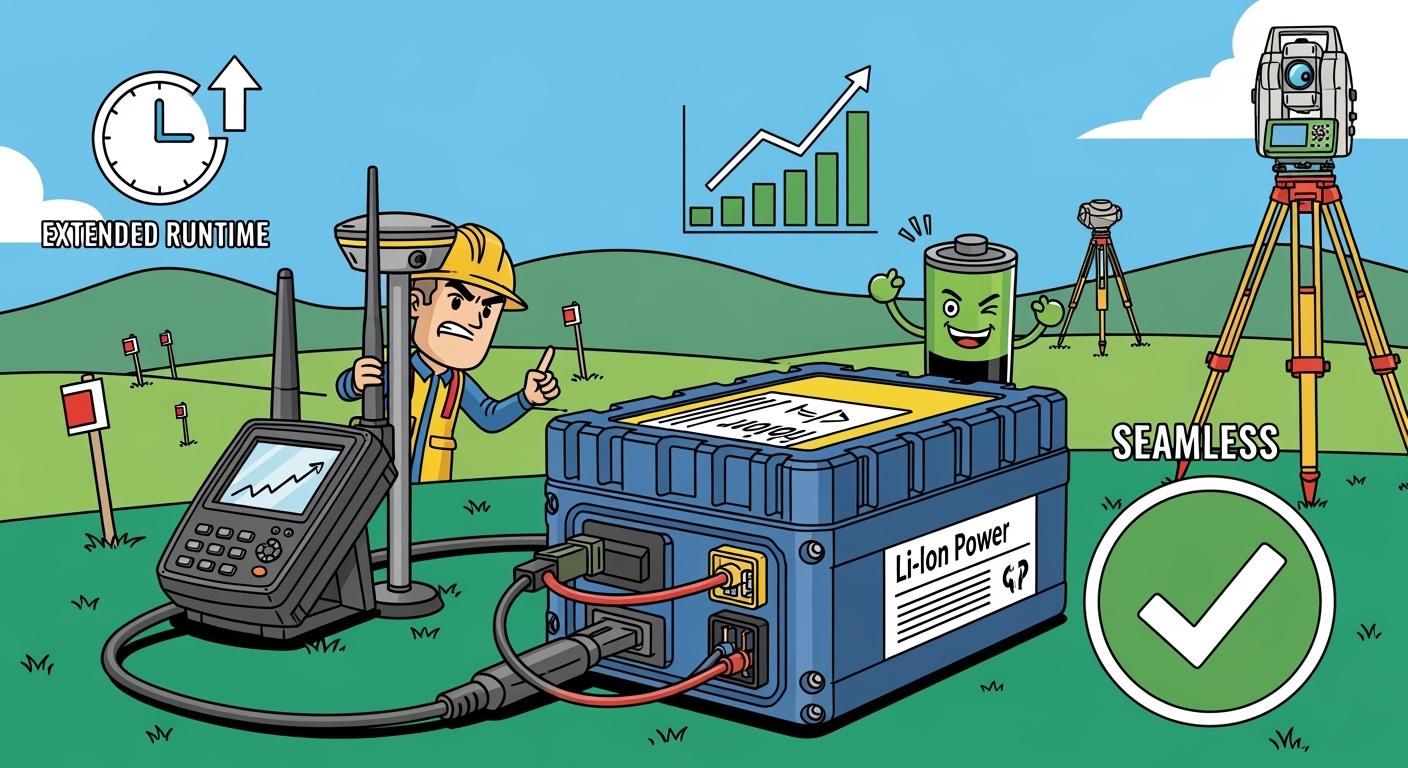
You require uninterrupted power and maximum operational uptime when deploying industrial surveying and mapping equipment in the field. Custom Lithium Batteries, designed by industry leaders such as Large Power, deliver a significant advantage. These solutions offer high energy density, rapid charging, and dependable performance across extreme temperatures. You gain lighter weight and stable discharge, which means more efficient use of equipment and fewer field interruptions. Tailored battery solutions directly address the productivity demands of your industrial operations.
Quick Answer
Industrial surveying and mapping equipment needs lithium batteries that balance high energy density, stable output, rugged packaging, and field-service reliability. A custom pack can be optimized for voltage, runtime, connector layout, enclosure size, BMS communication, and outdoor operating conditions.
Key Takeaways
Custom lithium batteries offer longer runtime, reducing the need for frequent battery swaps.
They provide reliable performance in extreme temperatures, ensuring equipment works in harsh conditions.
Advanced battery management systems protect against overcharge and overheating, increasing safety.
Custom designs fit specific equipment needs, improving efficiency and reducing downtime.
Partnering with experienced manufacturers ensures tailored solutions and seamless integration.
Part1: Battery Challenges
1.1 Limited Runtime
You face significant challenges with limited battery runtime in industrial surveying and mapping operations. Standard lithium battery packs often restrict your equipment’s operational window. This limitation can cause delays in field operations, create data gaps during surveys, interrupt workflows, and even lead to inaccuracies in data collection. The following table compares the average flight times of commonly used battery types in the field:
Battery Type | Flight Time |
|---|---|
Standard LiPo 6S | 20-25 min |
High-Discharge LiPo 6S | 22-28 min |
Smart LiPo with BMS | 25-35 min |
Li-ion Hybrid | 30-40 min |
You see that even the best standard options may not provide the extended runtime your projects demand. Custom Lithium Batteries offer a solution by optimizing energy density and matching your specific operational requirements.
1.2 Downtime Effects
Downtime directly impacts your productivity and project budgets. When batteries fail unexpectedly during critical surveys, you lose valuable time and resources. Inconsistent flight times across your battery fleet can disrupt scheduling and reduce efficiency. High replacement costs further strain your budget, especially when you must frequently swap out underperforming batteries. Regulatory compliance also becomes a challenge when batteries do not meet industry standards.
Unexpected battery failures during critical surveys
Inconsistent flight times across battery fleet
High replacement costs impacting project budgets
Regulatory compliance challenges
You need reliable power solutions to minimize these risks and maintain smooth operations.
1.3 Environmental Demands
Field environments often present harsh conditions. You may operate in extreme temperatures, high humidity, or dusty locations. Standard batteries can struggle to deliver consistent performance under these stresses. Equipment downtime increases when batteries cannot withstand environmental demands. Custom Lithium Batteries can be engineered for resilience, ensuring your surveying and mapping equipment remains operational regardless of the environment.
Tip: Choose battery solutions designed for your specific field conditions to maximize uptime and protect your investment.
Part2: Custom Lithium Batteries Solutions
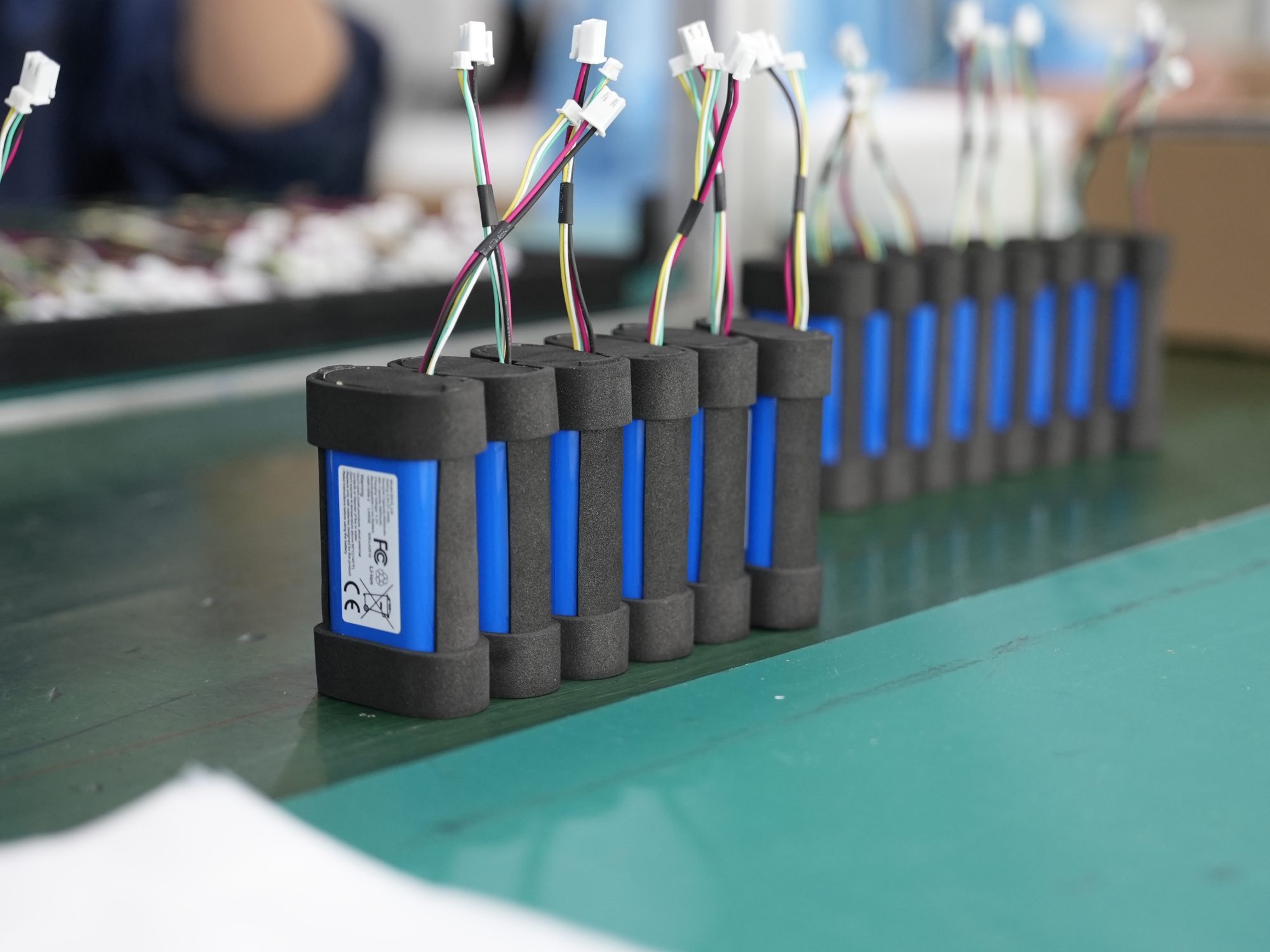
Custom Lithium Batteries directly address the operational challenges you face in industrial surveying and mapping. By leveraging advanced chemistry, tailored design, and intelligent management systems, you can achieve longer runtimes, greater reliability, and seamless integration with your equipment. Leading manufacturers like Symbo, Grepow, RELiON, Lithion, and Flux Power have set new standards in performance and safety for demanding field applications.
2.1 Energy Density
You need batteries that deliver more power in less space. Custom Lithium Batteries offer superior energy density compared to traditional chemistries, which means you can run your equipment longer without increasing weight or size. This advantage is critical for applications such as mapping UAVs, portable surveying devices, and robotics.
Battery Type | Energy Density (Wh/L) |
|---|---|
Lithium Primary | 400-1200 |
Alkaline | 250-400 |
With energy densities reaching up to 1200 Wh/L, custom lithium solutions outperform alkaline batteries by a wide margin. This translates to extended field missions, fewer battery swaps, and reduced logistical overhead. You gain a competitive edge by maximizing operational uptime and minimizing interruptions.
Note: Higher energy density not only extends runtime but also reduces the total number of battery packs you need to carry into the field.
2.2 Form Factor Flexibility
Every surveying and mapping project has unique equipment requirements. Custom Lithium Batteries provide unmatched flexibility in shape, size, and configuration, allowing you to integrate power solutions seamlessly into a wide range of devices. Whether you operate compact handheld survey tools, advanced mapping UAVs, or wearable technology, custom battery packs can be engineered to fit your exact needs.
Application Area | Benefit of Custom Lithium Batteries |
|---|---|
Surveying Equipment | Ultra-thin, compact designs enhance portability and functionality |
Mapping UAVs | Power consistency is critical for mission success |
Wearable Technology | Ultra-thin pouch cells provide essential compact power |
Medical Devices | Reliable, portable power for various medical applications |
Robotics | Custom designs meet unique space and weight constraints |
You can specify the voltage, capacity, and even the cell arrangement to match your operational profile. This level of customization ensures that your equipment remains lightweight, balanced, and efficient, regardless of the application.
Tip: Collaborate with battery manufacturers early in the design process to optimize both device performance and battery integration.
2.3 Battery Management Systems
Advanced battery management systems (BMS) set custom lithium solutions apart from standard options. A robust BMS protects your investment and ensures safe, reliable operation in the field. You benefit from features that go beyond basic monitoring, including:
Overcharge and over-discharge protection to prevent cell damage.
Thermal monitoring to detect and correct overheating.
Short-circuit and fault detection to avoid equipment risks.
Isolation and emergency shutdown for maximum safety.
Charge equalization to extend battery life and maintain efficiency.
Feature | Custom BMS | Standard BMS |
|---|---|---|
Communication Protocols | CANbus, RS485, UART, Bluetooth | Limited options |
Diagnostics | Real-time diagnostics | Basic monitoring |
Charge/Discharge Control | Advanced control mechanisms | Standard control |
State of Charge (SOC) Estimation | Enhanced SOC estimation and alert features | Basic SOC estimation |
Cloud Monitoring | Optional cloud-based fleet monitoring | Not typically available |
Custom battery packs are tailored for your specific applications, allowing precise control over voltage, capacity, and system behavior. You gain access to advanced communication protocols, real-time diagnostics, and cloud-based fleet monitoring—capabilities that standard batteries cannot match. This level of control and insight is essential for industrial, medical, and robotics applications where safety and uptime are critical.
Custom Lithium Batteries, equipped with advanced BMS, deliver the reliability and performance you need to keep your surveying and mapping operations running smoothly, even in the most demanding environments.
Part3: Field Productivity Benefits

3.1 Longer Operation
You need your surveying and mapping equipment to operate for extended periods without interruption. Custom Lithium Batteries deliver higher energy density, which means your devices can run longer between charges. This benefit is critical for applications such as mapping drones, robotic surveyors, and portable medical devices. You can cover more ground in a single deployment, reducing the need for frequent battery swaps. Construction firms have reported a 30% increase in daily site coverage after switching to custom battery solutions. This improvement allows you to complete more work in less time and meet tight project deadlines.
Note: Extended operation reduces the number of spare batteries you need to transport and manage, streamlining logistics for your field teams.
3.2 Reduced Downtime
Downtime can disrupt your workflow and increase operational costs. Custom Lithium Batteries help you minimize these interruptions by offering faster charging and longer service life. You spend less time waiting for batteries to recharge and less money on replacements. The consistent power output ensures your equipment remains available when you need it most. Companies using custom drone batteries have seen a 40% reduction in battery-related downtime. You also benefit from fewer maintenance interruptions, as these batteries require less frequent replacement.
Custom lithium batteries charge faster than traditional options, reducing waiting times.
Longer lifespan decreases the frequency of replacements and maintenance.
Consistent power output keeps critical devices running smoothly in the field.
You can rely on your equipment to stay operational, which helps you maintain productivity and control project costs.
3.3 Reliability in Harsh Conditions
Field environments often present extreme temperatures, moisture, and dust. Custom Lithium Batteries are engineered to perform reliably in these challenging conditions. Specialized chemistries such as LiFePO4 and NMC, along with advanced electrolyte formulations, ensure stable operation even in severe cold or heat. For example, custom wide-temperature LFP packs maintained a steady 3.2V output at -42°C in Arctic permafrost monitoring, retaining 82% capacity and enabling continuous data transmission. Offshore maritime sensors using NMC cells operated without voltage drop at -35°C, supporting reliable infrastructure monitoring.
Low-viscosity electrolytes reduce internal resistance, improving cold-weather performance.
Custom battery packs withstand high-current pulses and maintain voltage stability in rugged environments.
You can trust your equipment to deliver accurate results, regardless of the weather or terrain.
Tip: Choose battery solutions with proven performance in your specific field conditions to maximize uptime and protect your investment.
Part4: Custom Lithium Batteries Options
4.1 Capacity Sizing
You must select the right battery capacity for your surveying and mapping equipment. Capacity sizing impacts runtime, performance, and operational efficiency. Consider these factors when specifying custom lithium battery packs:
Voltage: Match the battery voltage to your equipment’s motor requirements. Higher voltage delivers more power, essential for heavier drones or multi-rotor platforms.
Desired Performance and Flight Efficiency: Higher voltage enables faster motor speeds. Balance speed with flight time to optimize survey coverage.
ESC Compatibility: Ensure your electronic speed controller (ESC) supports the battery voltage and motor specifications. Incompatible ESCs can cause inefficient power delivery or equipment damage.
Weight and Size Constraints: Higher-voltage batteries increase weight and size. This affects agility and flight duration.
Application Type: High-performance drones require extra power. Surveying and mapping drones often prioritize energy efficiency and longer operation.
Custom battery manufacturers like Large Power help you analyze these parameters, ensuring your battery pack meets your operational needs.
Tip: Collaborate with your battery provider early to optimize voltage, capacity, and chemistry for your application.
4.2 System Integration
You need seamless integration between your battery pack and equipment. Leading providers such as Large Power offer ODM battery systems that include design, engineering, prototyping, and certification. This approach streamlines deployment and reduces development costs. You benefit from tailored solutions that fit your device’s physical and electrical requirements.
System integration involves:
Matching battery form factor to device enclosure.
Ensuring communication protocols (CANbus, RS485, UART) align with your equipment.
Validating compatibility with charging systems and power management hardware.
Custom lithium battery packs simplify integration for industrial, medical, robotics, and security applications. You gain reliable power, longer cycle life, and reduced maintenance.
Note: Tailored battery solutions minimize integration risks and accelerate product launch.
4.3 Safety Compliance
Safety compliance is critical for industrial lithium battery packs. You must meet international standards and certifications to ensure reliability and protect users, equipment, and the environment. Review the following safety requirements:
Safety Standard/Certification | Description |
|---|---|
UN38.3 Testing | Ensures batteries withstand vibration, temperature changes, and impact during transportation. |
IEC62133 Certification | Validates safety for portable electronic applications, addressing overcharge, short circuit, and thermal abuse. |
MSDS Documentation | Provides information about battery composition and emergency handling procedures. |
CE and FCC Compliance | Ensures electromagnetic compatibility and safety standards for operation in various regions. |
BIS Certification offers a comprehensive safety framework. It protects communication stability and battery reliability, minimizing risk and maximizing performance. Manufacturers like RELiON and Lithion prioritize safety in design, adhere to UL and IEC standards, and collaborate with testing labs. They obtain certifications such as UL 1998, CE-EMC, UL 2054, and IEC 62133, verifying compliance through rigorous testing.
Custom lithium battery solutions simplify compliance, reduce risk, and ensure your equipment operates safely in demanding environments.
Part5: Implementation Steps
5.1 Power Needs Assessment
You must begin with a thorough assessment of your equipment’s power requirements. This process ensures that your custom lithium battery pack—whether LiFePO4, NMC, LCO, or LMO—matches your operational demands. Follow these steps for a successful evaluation:
Site survey: Gather data on your facility layout, electrical infrastructure, and daily operational patterns. This step helps you understand the real-world conditions your batteries will face.
Energy assessment review and recommendations: Discuss your findings with key decision-makers. Use this information to develop tailored recommendations for battery capacity, voltage, and chemistry.
Proof of concept: Test lithium-ion battery solutions in the field. Monitor performance and analyze results to confirm that the selected battery meets your runtime and reliability goals.
Tip: A detailed assessment reduces the risk of underpowered or oversized battery packs, saving you time and resources.
5.2 Partnering with Providers
You gain the most value by collaborating with experienced custom lithium battery manufacturers. These partnerships streamline the design and deployment process for your industrial, medical, or robotics applications. The following table outlines the typical collaboration workflow:
Step | Description |
|---|---|
Requirement Consultation | Analyze voltage, capacity, dimensions, safety, and communication protocols. |
Solution Design | Develop a tailored plan, including cell selection, structure, BMS, and thermal management. |
Prototype Development | Build and test prototypes to ensure performance and safety. |
Mass Production | Use automated lines and strict controls for consistent quality. |
Quality Testing | Conduct inspections and certify compliance with CE, UL, and other standards. |
Delivery & After-Sales Support | Provide on-time delivery and ongoing technical support. |
You benefit from technical expertise and custom solutions that address your unique challenges. This partnership helps you stay competitive and ensures your battery system integrates seamlessly with your equipment.
5.3 Maintenance Practices
You must implement best practices to maximize the lifespan and performance of your custom lithium batteries. Consider these guidelines:
Store batteries in cool, shaded, or temperature-controlled areas. Avoid leaving them in hot environments, such as vehicles on sunny days.
Monitor battery temperature during use. Keep batteries below 30°C (86°F) to prevent degradation.
Discharge batteries to about 20% before recharging. Avoid charging to 100% to extend cycle life.
Charge batteries slowly to minimize heat generation.
Perform regular maintenance checks to identify and address issues early.
Note: Consistent maintenance not only extends battery life but also ensures reliable operation in demanding field conditions.
Custom lithium battery packs transform your field operations. You gain longer runtime, higher reliability, and better performance in harsh environments. The table below highlights why you should choose custom solutions:
Feature | Custom Lithium Battery Solutions | Standard Options |
|---|---|---|
Performance at Low Temperatures | 90% capacity at -20°C | Reduced performance |
Carbon Footprint | 40% lower during production | Higher environmental impact |
Modularity | Tailored to specific needs | One-size-fits-all |
Compliance with Recycling | Enhanced recycling practices | Standard compliance |
Smart batteries combine ruggedness and convenience.
Hybrid designs offer plug-and-play safety.
You ensure compliance with recycling standards and future-proof your operations. Evaluate custom lithium battery solutions to maximize productivity in your surveying and mapping projects.
FAQ
What advantages do custom lithium battery packs offer over standard options?
You gain higher energy density, longer cycle life, and precise fit for your equipment. Custom packs, such as LiFePO4 or NMC, deliver stable platform voltage and reliable performance in industrial, medical, and robotics applications.
How do I determine the right lithium battery chemistry for my project?
You should assess your equipment’s power needs, runtime, and environmental conditions. For example, LiFePO4 offers long cycle life and safety, while NMC provides high energy density for compact devices. Large Power engineers can help you choose the right chemistry and battery pack structure for your application.
Can custom lithium batteries operate in extreme temperatures?
Yes. Custom lithium packs, especially those using LiFePO4 or NMC chemistries, maintain stable performance in harsh environments. You can deploy them in cold storage, outdoor infrastructure, or robotics exposed to temperature extremes.
What safety standards should custom lithium battery packs meet?
You must ensure compliance with UN38.3, IEC62133, and CE standards. These certifications verify safety during transport, operation, and integration in industrial and medical equipment.
How does a Battery Management System (BMS) improve reliability?
A BMS protects your battery from overcharge, over-discharge, and thermal risks. You benefit from real-time diagnostics, advanced communication protocols, and longer battery life, which are essential for critical field operations.


