

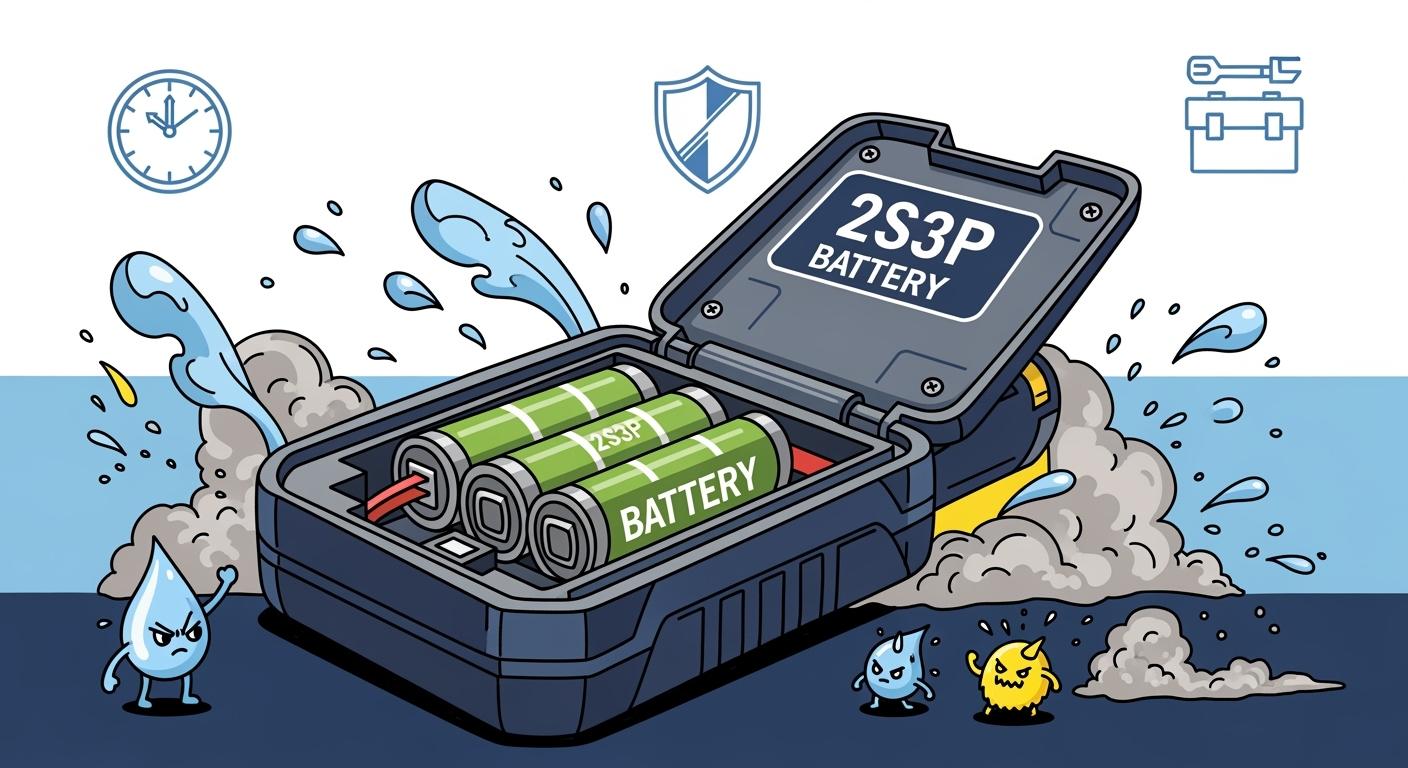
Quick Answer: A 2S3P lithium battery pack connects two cells in series and three parallel strings, typically providing a nominal voltage of 7.2–7.4V with three times the capacity of one cell. This configuration can extend the runtime of rugged ultrasonic thickness gauges while maintaining a compact form factor. However, the battery configuration does not create an IP67 rating by itself. IP67 protection depends on the device enclosure, seals, connectors, cable entries, and validation of the complete assembled product.
Rugged ultrasonic thickness gauges require stable power during pipeline inspection, corrosion assessment, ship maintenance, and structural testing. Cold conditions, vibration, moisture, repeated measurement cycles, display brightness, and wireless data transmission can all affect battery performance in the field.
A properly engineered 2S3P lithium battery pack provides a practical balance of voltage, capacity, and runtime for portable inspection instruments. Cell selection, mechanical layout, protection settings, thermal paths, connector design, and enclosure integration must be evaluated together to achieve dependable operation.
For an IP67-rated instrument, engineers must protect the battery compartment without trapping excessive heat. Appropriate solutions may include thermally conductive materials, controlled spacing, sealed connectors, pressure-equalization components, and temperature monitoring through a dedicated Battery Management System.
Key Takeaways
Use a 2S3P battery configuration when the instrument requires approximately 7.2–7.4V nominal voltage and extended capacity.
Do not describe the battery configuration itself as IP67; the rating applies to the tested enclosure or complete device.
Select consistent, traceable lithium-ion cells with suitable energy density, discharge capability, and temperature performance.
Integrate overcharge, over-discharge, overcurrent, short-circuit, cell-balancing, and temperature protection.
Validate runtime, sealing, vibration resistance, drop resistance, charging behavior, and thermal performance on the completed device.
Match maintenance intervals to actual usage and battery-health data instead of relying on arbitrary weekly or monthly checks.
Part1: 2S3P Battery Basics

1.1 2S3P Configuration Explained
You often see the 2S3P configuration in lithium battery packs. This setup means you connect two cells in series and three sets of these in parallel. You get a higher voltage from the series connection and more capacity from the parallel arrangement. For example, a typical 2S3P pack using Panasonic INR18650BD cells delivers a nominal voltage of 7.4V and a capacity of 9.6Ah. The structure supports a full charge voltage of 8.4V and a discharge cut-off at 5.0V. Here is a quick overview:
Specification | Details |
|---|---|
Battery Model | Panasonic INR18650BD, 2S3P |
Nominal Voltage | 7.4V |
Typical Capacity | 9.6Ah |
Full Charge Voltage | 8.4V |
Discharge Cut-off | 5.0V |
Structure | 2S (two cells in series) |
You can learn more about lithium battery pack structures from Nature’s battery technology review.
1.2 Application In Rugged Ultrasonic Thickness Gauges
You need reliable power for Rugged Ultrasonic Thickness Gauges, especially in harsh environments. The 2S3P configuration gives you both stable voltage and extended runtime. This setup fits well in tightly sealed enclosures, which helps you meet IP67 standards for water and dust resistance. Many industries, such as infrastructure, industrial, and security systems, use this configuration for portable devices. You benefit from consistent performance and fewer battery changes in the field.
Tip: The 2S3P configuration also supports applications in medical, robotics, and consumer electronics, where reliability and compact size matter.
1.3 Comparison With Other Configurations
You may wonder how 2S3P compares to other common battery pack setups. Here is a table to help you see the differences:
Configuration | Voltage (V) | Capacity (Ah) | Typical Use Cases |
|---|---|---|---|
1S3P | 3.7 | 9.6 | Small electronics, wearables |
2S3P | 7.4 | 9.6 | Rugged Ultrasonic Thickness Gauges, Industrial, Security Systems |
3S2P | 11.1 | 6.4 | Robotics, Medical, Drones |
3S3P | 11.1 | 9.6 | Power tools, Infrastructure, Medical |
You get a balance of voltage and capacity with 2S3P, making it ideal for devices that need both long runtime and moderate voltage. Other configurations may offer higher voltage or capacity, but they often require larger enclosures or more complex management systems.
Part2: IP67 Durability Factors

2.1 Sealing And Enclosure
You need a battery pack that fits tightly inside your device. The 2S3P configuration allows you to design a compact and efficient lithium battery pack. This shape makes it easier to seal the enclosure. You can use high-quality gaskets and adhesives to block water and dust. Many industries, such as medical and industrial, require this level of protection for portable devices. You also benefit from a pack that does not waste space, which helps you maintain a strong seal. When you choose the right enclosure material, you increase the lifespan of your battery and device.
Tip: Always check the enclosure rating before installing your battery pack. A proper fit prevents leaks and keeps your electronics safe.
2.2 Water And Dust Resistance
You want your device to work in wet and dusty environments. The 2S3P battery configuration supports this goal. You can place the cells in a way that reduces gaps and weak points. This design helps you achieve IP67 certification, which means your device can handle immersion in water up to 1 meter for 30 minutes. You also get strong dust protection. Security systems and robotics often use this setup for field operations. You should test your device after assembly to confirm the seal works as expected.
IP Rating | Protection Level | Test Condition |
|---|---|---|
IP67 | Water & Dust Tight | 1m water, 30 min, dustproof |
Note: Lithium battery packs with IP67 ratings help you avoid costly repairs and downtime.
2.3 Mechanical Strength
You need a battery pack that can handle shocks and vibrations. The 2S3P configuration gives you a sturdy structure. You can add foam padding or shock-absorbing materials around the pack. This step protects the cells from impact. Infrastructure and consumer electronics applications often require this level of durability. You also reduce the risk of internal damage, which keeps your device running longer. When you combine a strong enclosure with a robust battery pack, you meet the demands of harsh field conditions.
Callout: Mechanical strength is key for Rugged Ultrasonic Thickness Gauges used in industrial and field environments.
Part3: Field Performance Benefits
3.1 Capacity And Runtime
You need a battery pack that lasts through long shifts and demanding tasks. The 2S3P configuration gives you both high capacity and stable voltage. You can use Rugged Ultrasonic Thickness Gauges in the field for extended periods without frequent recharging. This setup supports lithium-ion chemistry, which delivers reliable energy density and consistent performance. Medical, robotics, and industrial sectors rely on this configuration to keep devices running during critical operations. You reduce downtime and increase productivity when you choose a battery pack with a 2S3P structure.
Tip: You can estimate runtime by dividing the battery capacity (in amp-hours) by the device’s average current draw. This helps you plan for field use and avoid unexpected interruptions.
3.2 Reliability In Harsh Conditions
You face tough environments in infrastructure, security systems, and consumer electronics applications. The 2S3P configuration provides redundancy by connecting multiple cells in parallel. If one cell fails, the others continue to supply power. You benefit from a battery pack that withstands shocks, vibrations, and temperature changes. You can trust your device to operate reliably in wet, dusty, or cold conditions. Many industries require this level of reliability to ensure safety and performance. You protect your investment and maintain operational efficiency with a robust battery pack.
Industry | Typical Field Conditions | Battery Pack Benefit |
|---|---|---|
Medical | Mobile, sterile, temperature | Continuous operation |
Robotics | Outdoor, vibration, dust | Redundancy, durability |
Security Systems | Remote, weather, impact | Reliable power, protection |
Infrastructure | Construction, moisture, heat | Extended runtime, safety |
Industrial | Factory, shock, humidity | Stable voltage, longevity |
Consumer Electronics | Travel, drops, spills | Compact, resilient design |
Callout: Redundancy in the 2S3P configuration helps you avoid sudden device failures during critical tasks.
3.3 Power Management
You need efficient power management to maximize battery life and safety. The 2S3P configuration works well with advanced battery management systems (BMS). You can use integrated circuits like the Texas Instruments BQ28200 for cell balancing and recovery from single cell over-discharge failures. This IC helps you maintain optimal performance in rugged devices. The Ricoh R5460x2xx series IC acts as a primary protector, guarding against over-current, over-charge, and over-discharge. You gain proven reliability, even in demanding applications such as space missions.
Effective power management ICs for 2S3P battery packs:
Texas Instruments BQ28200: Cell balancing, recovery from over-discharge.
Ricoh R5460x2xx series: Primary protection, safety against electrical faults.
You can combine these ICs with your battery pack to extend device lifespan and reduce maintenance needs. You also improve safety for users and equipment. Efficient power management supports longer field use and helps you meet industry standards for rugged devices.
Note: Proper power management ensures your lithium battery pack delivers consistent performance and protects your device from electrical hazards.
Part4: Implementation For Rugged Ultrasonic Thickness Gauges
4.1 Cell Selection
You should start with high-quality lithium-ion cells when building a 2S3P battery pack. Trusted brands like Panasonic, Samsung, LG, and Sony offer 18650 cells with reliable capacity and discharge ratings. You need to match all cells in each parallel group for capacity, internal resistance, and age. This practice ensures even current sharing and prevents imbalance, which can cause early failure. For rugged ultrasonic thickness gauges used in Medical, Robotics, and Industrial applications, you should always verify the cell’s datasheet and source from reputable suppliers.
Tip: Always check for compliance with international safety standards and avoid cells with unknown origins.
4.2 Assembly And Protection
You need to assemble your pack with precision. Spot welding nickel strips is the preferred method for connecting 18650 cells. This technique reduces resistance and prevents hotspots that can lead to inefficiency or fire risk. Avoid soldering directly to cells, as this can damage them. You should integrate a Battery Management System (BMS) to balance cells and prevent overcharging. A BMS also protects against over-discharge and short circuits, which is critical for devices in harsh environments like Infrastructure and Security Systems. Pair your pack with a dedicated balance charger for optimal performance.
Common assembly errors to avoid:
Using mismatched cells in parallel groups
Poor welding or loose connections
Skipping BMS integration
Note: A well-assembled pack with proper protection circuits increases both safety and device lifespan.
4.3 Maintenance And Safety
You need a regular maintenance routine to keep your battery pack reliable in the field. Monitor voltage weekly if the pack is in storage. Check temperature during heavy use. Inspect the pack for physical damage every month. Log performance data to spot trends and address issues early.
Maintenance Task | Frequency |
|---|---|
Check voltage | Weekly (if in storage) |
Monitor temperature | During heavy use |
Inspect battery pack for damage | Monthly |
Log performance data | Ongoing |
You should store packs at 40–60% charge when not in use for long periods. Avoid full discharges and extreme temperatures. These steps help you extend the life of your lithium battery pack and maintain safe operation in demanding environments.
Callout: Consistent maintenance and safety checks protect your investment and ensure your rugged ultrasonic thickness gauge performs when you need it most.
Part5: Common Pitfalls
5.1 Overheating Risks
You must watch for overheating when using 2S3P lithium-ion battery packs in rugged ultrasonic thickness gauges. High temperatures can damage cells and shorten battery life. Overheating often happens if you place the pack in a sealed enclosure without enough ventilation. You may also see heat build-up during fast charging or heavy use in industrial, medical, or robotics applications.
Tip: Never ignore signs like swelling, leakage, or a hot battery pack. These can signal internal failure or thermal runaway.
You can reduce overheating risks by following these steps:
Provide space for airflow around the battery pack.
Use foam padding that does not trap heat.
Avoid placing the pack near heat sources or direct sunlight.
Always use a Battery Management System (BMS) with overcharge and over-discharge protection.
If you notice any physical damage, swelling, or leakage, retire the pack and send it to an authorized recycling facility. Attempting repairs without proper training can be dangerous.
5.2 Charging And Balancing Issues
You need to pay close attention to charging and balancing when working with 2S3P battery packs. Poor cell matching or lack of a proper BMS can lead to imbalanced cells, reduced runtime, or even device failure. This is especially important for devices used in security systems, infrastructure, and consumer electronics.
Here is a table that highlights common charging and balancing considerations:
Consideration Type | Key Factor | Best Practice | Potential Risk if Ignored |
|---|---|---|---|
Quality | Cell Matching | Imbalanced discharge, reduced life | |
Quality | Voltage Stability | Implement BMS for series balance | Device malfunction, data loss |
Quality | Synchronization | Ensure uniform wiring and connections | Power drops, system failure |
Safety | Thermal Management | Provide ventilation, avoid enclosed spaces | Overheating, thermal runaway |
Safety | Protection Circuitry | Use 2S BMS with overcharge/discharge protection | Fire, explosion, equipment damage |
Safety | Physical Handling | Avoid punctures, drops, or bending terminals | Internal short, leakage, ignition |
You can avoid most charging and balancing issues by:
Always using a BMS designed for 2S packs.
Charging with a balanced lithium-ion charger that supports 2S (7.4V) packs.
Storing batteries in a cool, dry place.
Recharging before voltage drops below 6.0V.
Tracking the age and cycle count of each pack.
Note: Regularly measure individual cell voltages and inspect for damage. Early action can prevent safety hazards and extend battery life.
You gain the best performance for Rugged Ultrasonic Thickness Gauges by choosing the 2S3P battery configuration. This setup supports IP67 durability, long runtime, and reliable operation in Medical, Robotics, Security System, Infrastructure, Consumer Electronics, and Industrial applications. For successful adoption, select quality lithium-ion cells, use a trusted BMS, and follow a regular maintenance routine.
Tip: Test your battery pack in real field conditions before full deployment.
FAQ
What does 2S3P mean in lithium battery packs?
You see “2S3P” when two cells connect in series and three sets connect in parallel. This setup gives you higher voltage and more capacity. You use it in rugged devices across Medical, Robotics, and Industrial fields.
How does 2S3P improve IP67 durability?
You fit 2S3P packs into compact enclosures. This helps you seal devices tightly. You achieve IP67 protection against water and dust. You rely on this for Security Systems and Infrastructure tools.
What industries benefit most from 2S3P battery packs?
You find 2S3P packs in Medical, Robotics, Security System, Infrastructure, Consumer Electronics, and Industrial applications. These industries need reliable power, extended runtime, and rugged protection.
How do you maintain a 2S3P lithium battery pack?
You check voltage weekly, monitor temperature during heavy use, and inspect for damage monthly. You store packs at 40–60% charge. You avoid extreme temperatures and full discharges.
What is the best way to prevent overheating in rugged devices?
You provide airflow around the battery pack. You use foam padding that does not trap heat. You avoid placing packs near heat sources. You always use a Battery Management System for safety.


