

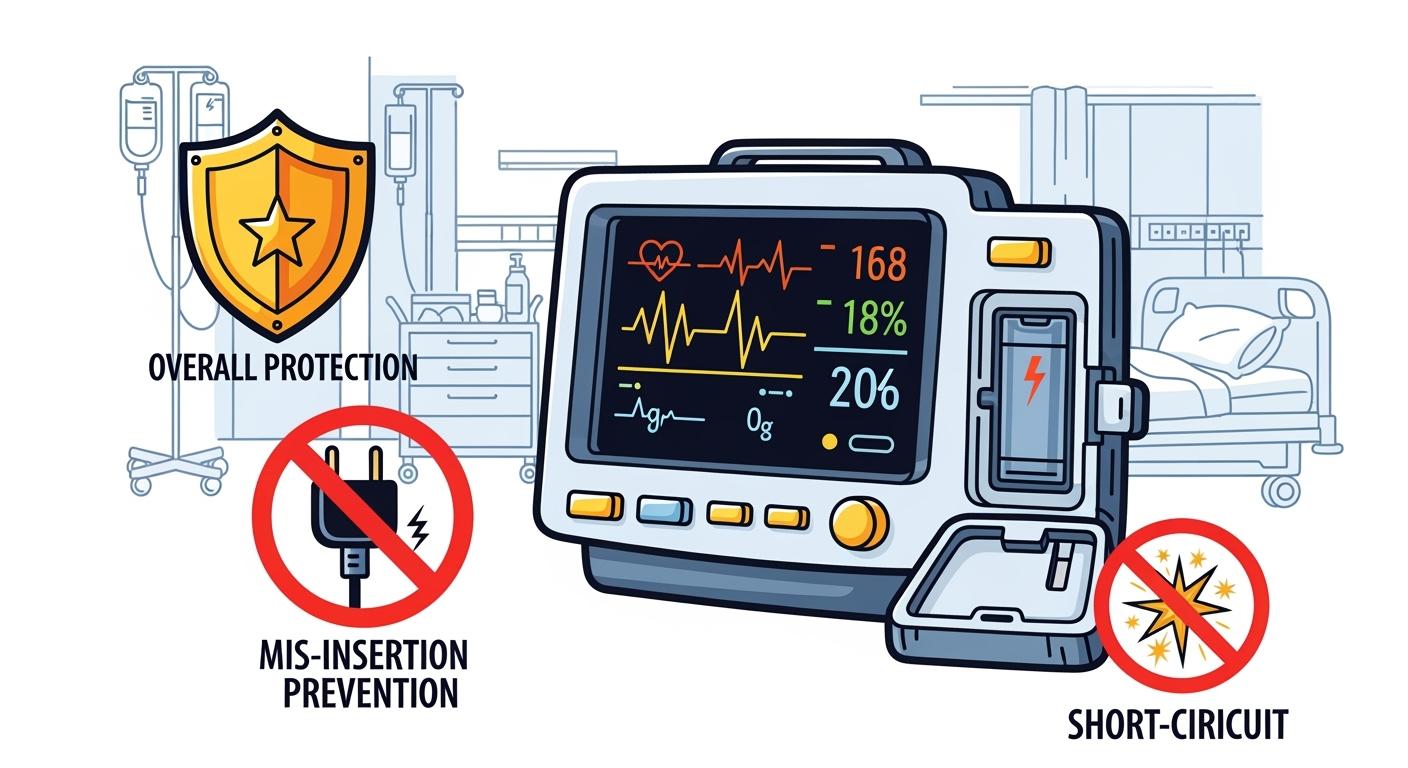
You rely on battery safety to protect patient health and maintain critical hospital monitor operations. Lithium batteries pose risks including fire and explosion, making robust Short-Circuit Protection and advanced systems essential. Industry standards, such as IEC 62133, help you prevent failures and ensure batteries meet strict medical device requirements.
Key Takeaways
Prioritize explosion-proof designs and advanced protection circuits in lithium batteries to enhance safety and reliability in hospital monitors.
Implement anti-mis-insertion features and train staff on proper battery handling to prevent device failures and ensure continuous patient monitoring.
Integrate a battery management system for continuous monitoring, which helps detect faults early and prevents hazardous incidents, protecting patient health.
Part1: Battery Safety Risks in Hospitals

1.1 Lithium Batteries: Explosion and Fire Hazards
You face significant health concerns with batteries when you use lithium batteries in medical devices. Lithium battery packs power critical hospital monitors, but they present explosive hazards if not managed with proper safety circuits and protective circuits. The primary causes of lithium battery explosions in hospital environments include:
Overcharging, which can trigger thermal runaway and compromise battery safety.
Overheating, destabilizing the chemical structure of lithium-ion batteries.
Short circuit events, causing rapid discharge and increasing the risk of fire.
Physical damage to battery packs, breaching internal structures and leading to hazardous failures.
Manufacturing defects, which create instability in lithium batteries and threaten device reliability.
Improper charging, especially when incompatible chargers are used with lithium battery packs.
Aging and wear, which degrade lithium batteries and reduce battery reliability.
Electrolyte leakage, where flammable liquids from lithium batteries can ignite.
Poor ventilation, allowing heat to accumulate and increasing the risk of thermal runaway.
Note: You must prioritize explosion-proof designs and integrate advanced protection circuits to minimize hazardous incidents and maintain health standards in medical environments.
1.2 Mis-Insertion and Device Reliability
Mis-insertion of battery packs in medical devices can disrupt device reliability and compromise patient health. You encounter health concerns with batteries when staff insert lithium batteries incorrectly, which can damage safety circuits and protective circuits. Mis-insertion may lead to:
Equipment downtime, affecting continuous patient monitoring and hospital operations.
Increased risk of short-circuit protection failure, exposing lithium battery packs to hazardous conditions.
Reduced battery reliability, as repeated mis-insertion damages connectors and safety features.
You must train staff to handle lithium battery packs properly and use medical devices with anti-mis-insertion features. These features help maintain battery safety and device reliability, ensuring uninterrupted health monitoring.
1.3 Short-Circuit Protection Essentials
Short-circuit protection is essential for lithium battery packs in medical devices. You must understand the common causes of short circuits to prevent hazardous incidents and protect patient health. The following table summarizes the main causes:
Cause Type | Description |
|---|---|
Internal Factors | Manufacturing defects, such as impurities or misaligned separators, create unintended current flow. |
External Factors | Mechanical stress or improper handling, like drops or collisions, damage battery casing and expose internal components. |
Environmental Factors | Temperature extremes and humidity impact short-circuit risk. High temperatures cause thermal runaway, while low temperatures may lead to lithium plating and internal short circuits. |
Short-circuiting lithium batteries can lead to fires, threatening patient health and hospital safety. You must address causes such as manufacturing defects, overcharging, exposure to high voltage, and physical damage to battery packs. Protective circuits and advanced safety circuits in medical devices help you prevent these hazardous events.
Tip: Continuous monitoring with a battery management system (BMS) [internal link] ensures battery safety and reliability in medical devices. You should select battery packs with robust short-circuit protection and integrate BMS for optimal health outcomes.
Overcharging and Over-discharging Risks
You must also consider the effects of overcharging and over-discharging on lithium battery packs in medical devices. The following table outlines the impact on battery performance:
Incident Type | Effects on Battery Performance |
|---|---|
Overcharging | Increased internal pressure, battery deformation, liquid leakage, reduced electrical performance. |
Over-discharging | Catastrophic damage, irreversible capacity loss, degradation of active materials, compromised ability to hold charge. |
You should implement protective circuits and safety circuits to prevent overcharging and over-discharging, maintaining battery reliability and health standards in hospital settings.
Compliance with Medical Device Standards
You must comply with medical device standards to ensure battery safety in hospital environments. The most widely adopted standards include:
Standard | Application |
|---|---|
IEC 62133 | Rechargeable batteries, including IEC 60601-1 |
IEC 60086-4 | Non-rechargeable lithium batteries |
UL 1642/2054 | Devices sold exclusively in North America |
You should select lithium battery packs that meet these standards and integrate continuous monitoring to maintain health and safety in medical devices.
Alert: Failure to comply with battery safety standards can result in hazardous incidents, equipment downtime, and compromised patient health.
You must prioritize short-circuit protection, explosion-proof designs, and robust protective circuits in all lithium battery packs used in medical devices. Continuous monitoring and adherence to standards ensure battery reliability and protect patient health in hospital settings.
Part2: Safety Measures and Protection Technologies
2.1 Explosion-Proof Battery Design
You must prioritize explosion-proof design features when selecting lithium battery packs for hospital monitors. These features protect patient health and ensure reliability in critical care environments. The following table summarizes the most effective explosion-proof design elements for hospital monitor batteries:
Feature | Description |
|---|---|
Explosion-proof | Complies with IECEx/ATEx standards for category IIC environments. |
Charge/Discharge Current Management | Regulates current to ensure safe operation. |
String Voltage Monitoring | Monitors the voltage of the entire battery string. |
Float Current Management | Maintains battery health during standby periods. |
SOC/SOH Estimation | Provides accurate metrics for State of Charge and State of Health. |
Cell Voltage Monitoring | Ensures balanced performance across battery cells. |
Cell Temperature Monitoring | Prevents overheating of battery cells. |
Ambient Temperature Monitoring | Adjusts operations based on environmental conditions. |
Cell Internal Resistance Measurement | Detects issues and optimizes battery performance. |
Explosion-proof lithium battery packs use advanced protection circuits and comply with international safety standards. You should implement real-time health checks and predictive diagnostics to monitor battery performance and extend lifespan. These safety measures help you maintain reliability and protect patient health in hospital settings.
Tip: Prioritize battery management systems with robust safety features to reduce electrical faults and fire risks in hospital monitors.
2.2 Anti-Mis-Insertion Features
You must address mis-insertion risks by choosing lithium battery packs with anti-mis-insertion features. These features prevent incorrect installation and protect safety circuits. You can find keyed connectors, color-coded terminals, and mechanical guides in advanced hospital monitor batteries. These design elements ensure proper alignment and connection, reducing the risk of damage and improving reliability.
You should train staff to recognize and use anti-mis-insertion features. Proper handling of lithium battery packs supports device reliability and patient health. Organize inventory using medical storage carts with labeled compartments for quick access during emergencies. This approach streamlines battery management and supports safety measures in hospital environments.
2.3 Short-Circuit Protection Strategies
You must implement short-circuit protection strategies to safeguard lithium battery packs in hospital monitors. Medical device safety guidelines recommend several approaches:
Electronic circuit breakers provide reliable load disconnection with built-in current limitation, isolating only the affected circuit during an overcurrent event.
Thermal circuit breakers use a bimetal strip to trip based on current heating, distinguishing between temporary surges and sustained overloads.
Thermal-magnetic circuit breakers combine thermal and magnetic responses for faster tripping, protecting against both overloads and short circuits.
Magnetic-hydraulic circuit breakers react quickly to overcurrent by using the magnetic field produced by the current, ensuring rapid disconnection.
You should select lithium battery packs with integrated protection circuits and advanced safety measures. These strategies prevent hazardous incidents, maintain reliability, and protect patient health in hospital settings.
2.4 BMS and Continuous Monitoring
You must integrate a battery management system to enhance the safety and reliability of lithium battery packs in hospital monitors. A battery management system provides continuous monitoring and advanced diagnostics. The following table highlights key functionalities:
Functionality | Description |
|---|---|
Monitoring individual cell performance | Ensures each cell operates within safe parameters. |
Preventing overcharging and overheating | Protects against conditions that could lead to battery failure. |
Ensuring balanced charging and discharging | Maintains optimal performance and longevity of the battery. |
A battery management system prevents thermal runaway by avoiding overcharging. It disconnects the battery if safety limits are exceeded and provides alerts for high temperatures and cell imbalances. You should implement real-time health checks and predictive diagnostics to monitor battery performance and extend lifespan. These safety measures support reliability and protect patient health in hospital environments.
Note: Implement battery management systems to track battery health and performance, ensuring compliance with technical standards and supporting continuous monitoring in hospital monitors. [internal link]
2.5 Best Practices for Battery Handling
You must follow best practices for handling and maintaining lithium battery packs in hospital monitors. These practices support safety measures, reliability, and patient health:
Organize inventory using medical storage carts with labeled compartments for quick access during emergencies.
Train staff on handling and maintaining batteries according to manufacturers’ recommendations to reduce failures.
Implement battery management systems to track battery health and performance, ensuring compliance with technical standards.
Conduct preventive maintenance through scheduled inspections and servicing to keep equipment operational.
Follow manufacturers’ recommendations for charging and storage to extend battery life and avoid service interruptions.
Regular maintenance protocols improve patient safety, increase operational efficiency, extend equipment life, and create a more reliable care environment. You should regularly check the battery’s charge before each use, schedule annual battery replacements for frequently used monitors, and avoid unnecessary shocks to the device. Ensure optimal energy use programming and encourage patients to follow healthcare providers’ lifestyle recommendations to prevent excessive device firing.
The following table outlines recommended intervals for battery safety inspections in hospital settings:
Interval | Requirement |
|---|---|
Monthly | Functional testing of battery powered lights for egress for at least 30 seconds. |
Quarterly | Functional testing of stored emergency power supply systems for five minutes or as specified for its class. |
Annually | Functional testing of battery powered lights for egress for 1.5 hours or replacement of all batteries every 12 months and random testing of 10% of all batteries for 1.5 hours. |
You must comply with medical device standards and maintain regular maintenance protocols to ensure battery safety and reliability in hospital monitors. These safety measures protect patient health and support continuous operation in critical care environments.
⚡ Alert: Consistent application of safety measures and protection strategies for lithium battery packs ensures reliability and health in hospital settings.
You improve patient health and treatment outcomes by selecting batteries with advanced safety features. Evaluate performance, reliability, and safety when choosing lithium batteries for hospital monitors. Implement battery management systems and continuous monitoring to reduce emergency risks. Follow safety tips and train staff using structured education plans. The table below highlights key training components:
Component | Description |
|---|---|
Education Training Plan | Develop guidelines for battery recycling and safety practices. |
Pilot Program | Assess training effectiveness before full implementation. |
Educational Campaign | Use posters and newsletters to promote compliance. |
Compliance in Job Roles | Integrate safety protocols into job responsibilities. |
You ensure long-term reliability and safety by maintaining batteries, performing spot checks, and updating management practices.
FAQ
What explosion-proof features should you look for in lithium battery packs for hospital monitors?
You should select lithium battery packs with IECEx/ATEx certification, advanced protection circuits, and real-time monitoring. These features help you maintain safety and reliability.
How does Large Power support custom battery solutions for hospital applications?
Large Power offers tailored lithium battery packs for medical devices. You can click here for custom battery consultation to discuss your requirements with their technical team.
Why is continuous monitoring important for hospital battery safety?
Continuous monitoring helps you detect faults early, prevent thermal runaway, and extend battery life. You improve patient safety and reduce equipment downtime.


