

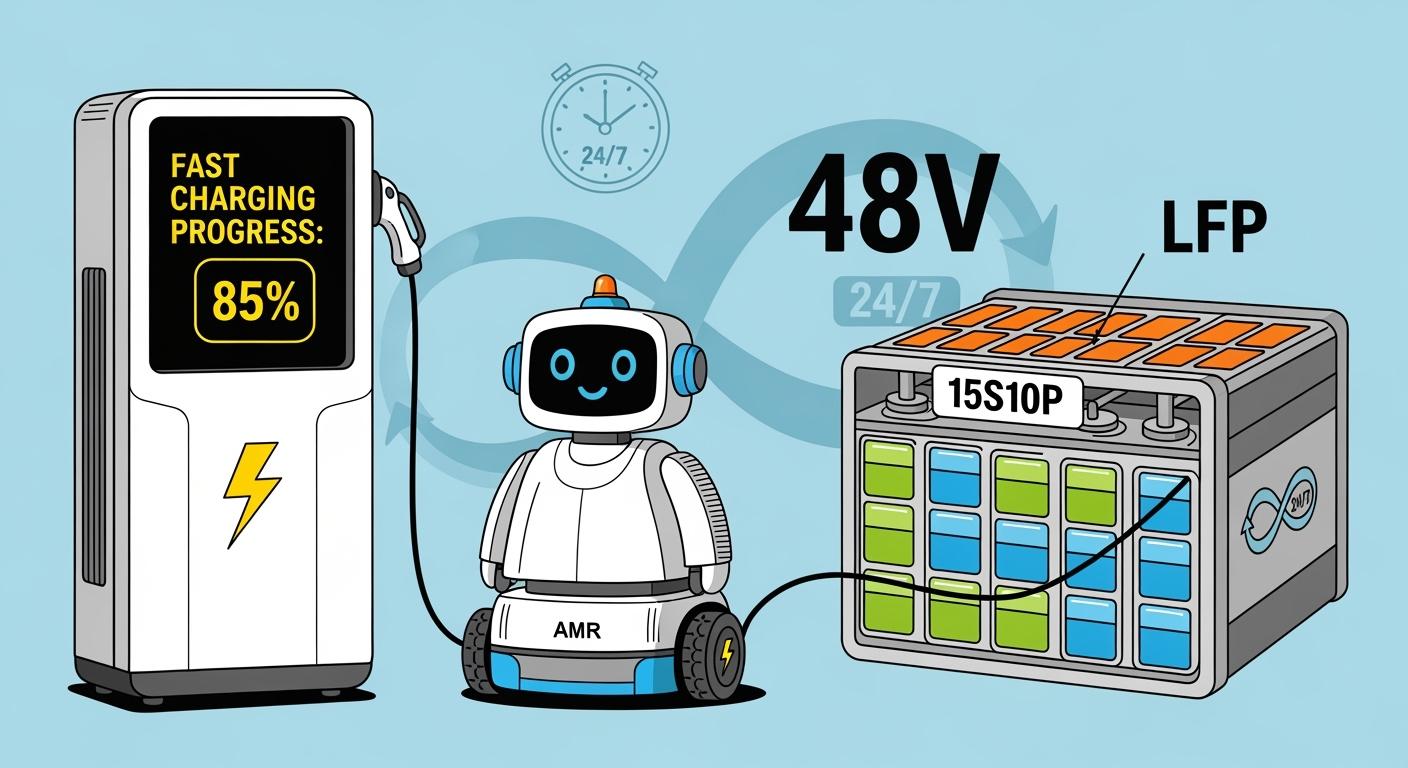
You can achieve 24/7 Autonomy for your AMR and AGV fleets by using 1C fast-charging in 15S10P 48V LFP battery systems. This technology cuts downtime, so your robots work more and wait less. Wireless and automated charging solutions support continuous operation, letting you keep your logistics and manufacturing lines running smoothly.
Key Takeaways
Achieve 24/7 autonomy for AMR and AGV fleets by using 1C fast-charging technology. This reduces downtime and maximizes productivity.
Utilize LFP battery packs for their long cycle life and safety features. Expect over 8,000 cycles, ensuring reliable performance for your operations.
Implement automated and wireless charging solutions to enhance operational efficiency. These systems allow robots to charge autonomously, reducing manual intervention.
Plan your charging logistics carefully to optimize workflow. Identify the best charging locations and use opportunity charging to keep your fleet active.
Monitor battery health regularly with a battery management system. This helps extend battery life and prevent unexpected downtime.
Part1: 24/7 Autonomy and Operational Value
1.1 Uptime and Productivity Gains
You want your AMR and AGV fleets to deliver maximum value. 24/7 Autonomy lets your robots work around the clock, which means you get more output from every asset. When you use lithium iron phosphate (LFP) battery packs with 1C fast-charging, your robots spend less time charging and more time moving goods. This shift increases your overall uptime and helps you meet production targets.
In a scenario where battery swapping is prioritized for 24/7 operations, it is expected that there will be significant throughput gains in the first year, with payback realized in subsequent years through improved asset utilization. This indicates that 24/7 autonomy can enhance overall uptime, despite increased operational complexity.
You can see measurable productivity gains. Warehouses that deploy AMRs often report up to 50% higher productivity and a 40% reduction in labor costs within five years. Safety also improves, with some facilities seeing a 70% drop in workplace accidents after integrating mobile robots.
1.2 Reduced Downtime and Labor
You reduce downtime when your robots operate continuously. LFP battery packs with 1C fast-charging allow for quick energy replenishment, so your fleet stays active. You do not need to schedule long charging breaks or rely on manual battery swaps. This approach cuts labor costs and minimizes human intervention.
Your team can focus on higher-value tasks instead of managing battery logistics. Automated charging solutions further streamline operations, making your workflow more efficient and reliable.
1.3 Flexibility for Industrial Use
24/7 Autonomy gives you flexibility in many industrial environments. AMRs powered by advanced lithium battery systems can handle repetitive and physically demanding tasks without fatigue. They transport raw materials and finished products, operate in harsh conditions, and manage heavy loads.
Transport AMRs automate internal material movement in dynamic environments such as hospitals, warehouses, and laboratories.
They are more flexible than fixed conveyor systems and quicker and more agile than human counterparts.
By incorporating AI and machine learning, they integrate with existing systems, allowing for intelligent routing, obstacle avoidance, and responsive material handling.
You gain a system that adapts to changing needs and scales with your business. This flexibility leads to fewer lost workdays, lower insurance premiums, and higher overall productivity.
Part2: 1C Fast-Charging for Lithium Battery Packs
2.1 1C Charging Explained
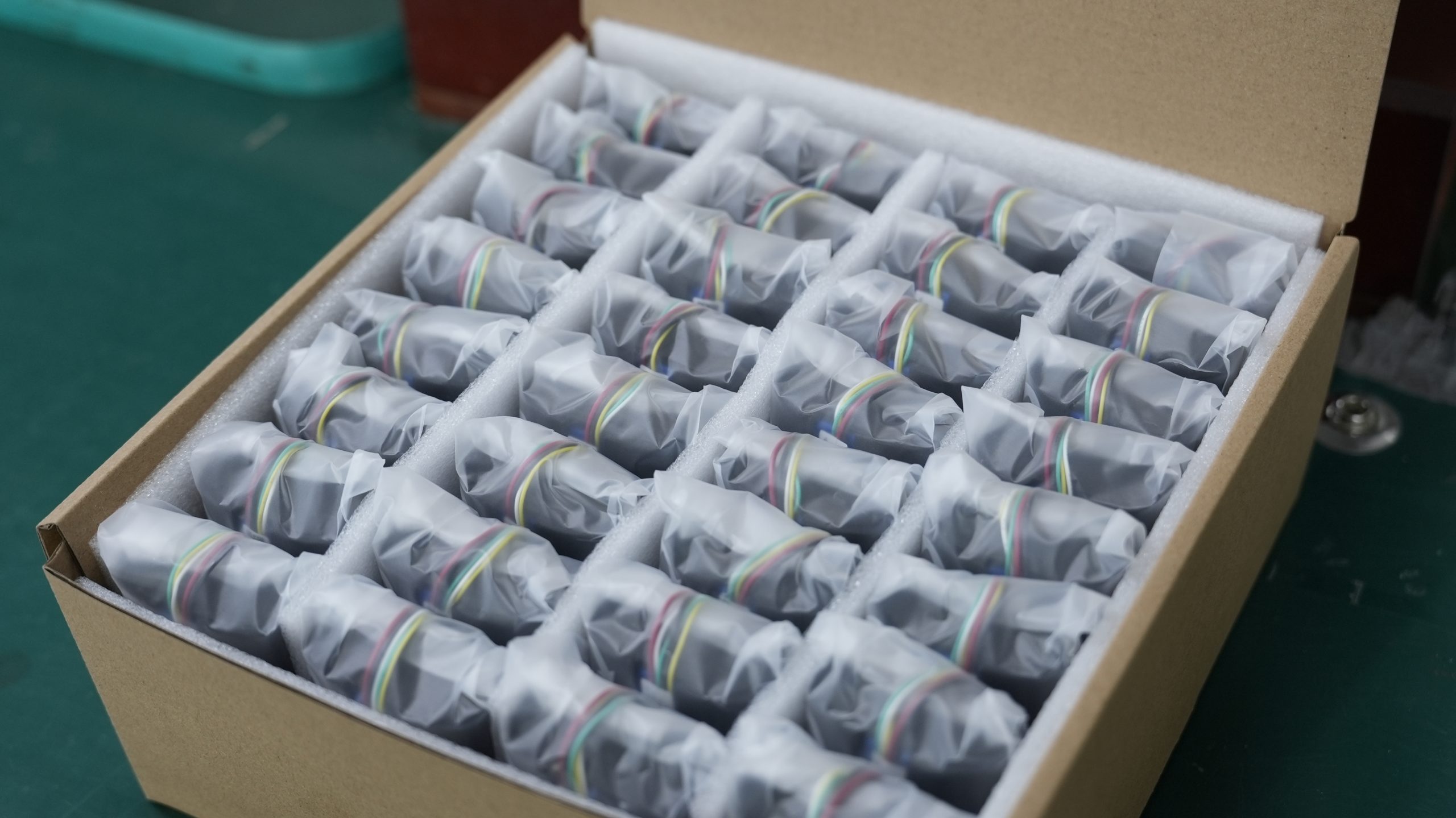
You need to understand the C-rate to optimize your AMR and AGV battery systems. The C-rate measures how quickly you can charge or discharge a lithium battery pack. A 1C rate means you charge or discharge the battery at a current equal to its rated capacity. For example, if you use a 10Ah LiFePO4 (LFP) battery, charging at 1C means you apply 10A of current, so the battery charges in one hour. If you use a 2Ah battery, 1C equals 2A for one hour. This standard applies across lithium chemistries, including LFP, NMC (Nickel Manganese Cobalt Oxide), LCO (Lithium Cobalt Oxide), and LMO (Lithium Manganese Oxide).
Note: Manufacturers rate battery capacity at 1C. If you charge or discharge faster, you may see reduced efficiency due to heat and internal losses.
You can see the impact of C-rate in this table:
Battery Capacity (Ah) | 1C Current (A) | Charge/Discharge Time (h) |
|---|---|---|
2 | 2 | 1 |
10 | 10 | 1 |
20 | 20 | 1 |
Understanding C-rate helps you match your charging infrastructure to your operational needs. You can achieve 24/7 Autonomy by minimizing charge times and maximizing uptime.
2.2 Workflow Impact for AMR/AGV
You gain a major advantage when you use 1C fast-charging in your AMR and AGV fleets. Fast-charging reduces the time your robots spend docked, so they return to work quickly. You can schedule short, frequent charging sessions during idle moments, which keeps your fleet active throughout the day and night.
You reduce bottlenecks at charging stations.
You avoid long queues and downtime.
You can scale your fleet without expanding your charging infrastructure.
This approach supports continuous operation in demanding environments. You can run logistics, manufacturing, or warehouse operations without interruption. Your team spends less time managing battery logistics and more time focusing on core business tasks.
2.3 Safety and Battery Life
You want to balance fast-charging with long-term reliability. LiFePO4 (LFP) batteries offer high cycle life, even with frequent 1C charging. You can expect over 8,000 cycles from a quality LFP pack, which means years of dependable service for your AMR and AGV fleets.
Chemistry | Platform Voltage (V) | Energy Density (Wh/kg) | Cycle Life (cycles) |
|---|---|---|---|
LFP | 3.2 | 90-160 | >8,000 |
NMC | 3.7 | 150-220 | 2,000-4,000 |
LCO | 3.7 | 150-200 | 500-1,000 |
LMO | 3.7 | 100-150 | 1,000-2,000 |
Tip: LFP batteries provide the best combination of safety, long cycle life, and stable performance for industrial AMR and AGV applications.
You also reduce fire risk and thermal runaway events by choosing LFP chemistry. You can operate your fleet with confidence, knowing your batteries support 24/7 Autonomy and meet strict safety standards.
Part3: 15S10P 48V LFP System Design
3.1 Why 15S10P for AMR/AGV
You need a battery system that matches the high demands of industrial automation. The 15S10P configuration means you connect 15 cells in series and 10 in parallel, creating a 48V lithium iron phosphate (LFP) battery pack. This design delivers the voltage and current required for advanced AMR and AGV platforms. You benefit from higher power and energy densities, which allow for smaller battery packs. This leads to increased payload capacity and improved efficiency in your operations.
Higher power and energy densities enable compact battery packs.
Smaller packs increase payload and operational efficiency.
Lithium-ion technology supports high energy density and low maintenance.
You can see how lithium-ion batteries compare to lead-acid batteries in the table below:
Parameter | Lithium-ion Batteries | Lead-acid Batteries |
|---|---|---|
Energy Density | High, compact & lightweight | Low, heavy & bulky |
Cycle Life | 2000–4000+ | 300–500 |
Charging | Fast & opportunity charging | Slow full charging |
This makes the 15S10P 48V LFP system ideal for supporting 24/7 Autonomy in industrial fleets.
3.2 LFP Chemistry Advantages
You gain several advantages by choosing LFP chemistry for your battery packs. LFP batteries produce less heat than other lithium chemistries, which ensures a secure choice for AMR and AGV operations. You also get a remarkably long cycle life, often outperforming other chemistries. LFP chemistry offers high energy efficiency and an inherent safety profile. It is thermally stable up to very high temperatures, which prevents thermal runaway.
LFP batteries provide more power and energy density than lead-acid and many other lithium chemistries.
LFP chemistry is nontoxic and presents a better toxicity profile.
You can expect significantly longer cycle life compared to lead-acid batteries.
These features make LFP battery packs the preferred choice for industrial automation.
3.3 Balancing Safety and Performance
You must balance safety and performance when designing battery systems for high-demand environments. LFP batteries offer reduced risk of thermal runaway and can withstand temperatures up to 518 degrees Fahrenheit. They can last up to 3000 cycles without performance loss, making them suitable for continuous operation.
Feature | Description |
|---|---|
Thermal Runaway Risk | Significantly reduced compared to other lithium-ion batteries |
Thermal Runaway Temp | Withstands up to 518°F (270°C) |
Cycle Life | Up to 3000 cycles without performance loss |
Safety | One of the safest, nontoxic battery chemistries available |
You should also consider industry standards such as UL certification and the GB 38031-2025 standard from China. These standards require early detection of thermal events and strict containment measures. By following these guidelines, you ensure your 15S10P 48V LFP battery systems deliver reliable performance and meet the highest safety requirements for 24/7 Autonomy.
Part4: Automated and Wireless Charging Solutions

4.1 Wireless Charging for AMR/AGV
You can increase operational flexibility and safety by adopting wireless charging for your AMR and AGV fleets. Wireless charging uses magnetic resonance to transfer power, so your robots do not need physical connectors. This reduces risks of electric shock and short circuits. You can deploy wireless charging pads in various locations, which allows robots to charge during short pauses in their workflow. This approach supports 24/7 Autonomy, especially in industries like medical, robotics, security, and infrastructure, where continuous operation is critical.
Recent advancements in wireless charging technology have made it easier to integrate with different brands and models. The table below highlights key developments and their impact:
Advancement Type | Description | Impact on Operational Autonomy |
|---|---|---|
Universal Wireless Charging Systems | Works across brands and models | Simplifies fleet integration |
Opportunity Charging | Enables charging during idle periods | Increases productivity, reduces downtime |
Flexible Charging Solutions | Allows flexible locations and alignment tolerances | Improves asset utilization |
Reduced Maintenance Complexity | Simplified hardware and diagnostics | Lowers operational expenditure |
Wireless charging also offers high fault tolerance, so robots can park with significant alignment errors without losing efficiency. You can expect lower maintenance costs because there are no moving parts.
4.2 Automated Charging Systems
You can further enhance your fleet’s efficiency with automated charging systems. These systems allow robots to autonomously connect to chargers, either through mechanical docking or wireless pads. Automated charging supports unmanned operation, as robots can determine when and where to recharge based on battery levels. This reduces downtime and maintenance costs.
Key features and benefits include:
Feature/Benefit | Description |
|---|---|
Charging Speed | Opportunity charging in 10–20 minutes |
Increased Uptime | Near continuous operation for AMR/AGV fleets |
Low Maintenance | Minimal upkeep compared to traditional systems |
IoT Integration | Enables data collection and autonomous self-charging |
Enhanced Safety | No outgassing, safe for various environments |
You can use automated charging in industrial, medical, and security applications, where reliability and uptime are essential.
4.3 Electrode Customization Options
You can tailor electrode configurations to match your operational needs. Customizable electrodes ensure optimal contact and power delivery for different robot designs and voltages. This flexibility supports a wide range of lithium battery chemistries, including LFP, NMC, LCO, and LMO, each with strict standards for voltage, energy density, and cycle life. Customization allows you to deploy AMRs and AGVs in diverse environments, from consumer electronics manufacturing to large-scale industrial facilities.
Tip: Work with your battery supplier to design electrode solutions that maximize charging efficiency and safety for your specific application.
Part5: Implementation and Monitoring
5.1 Fleet Integration
You can achieve seamless fleet integration by following a structured approach. Start by confirming the usable floor area and the maximum charger footprint for each aisle or staging lane. Record the average and peak cycle times for every robot to calculate accurate duty cycles. Decide if conductive or inductive charging works best for your facility, considering retrofit constraints. Verify that your fleet-management system supports charger reservation and state-of-charge telemetry. Specify alignment tolerance, charge acceptance rate, and target charge windows for each AMR or AGV. Include battery health telemetry and set up an external maintenance loop to receive degradation alerts. These steps help you unlock the full potential of 1C fast-charging lithium battery packs and support 24/7 Autonomy.
Tip: Li-ion batteries support opportunity charging. You can top off batteries for 10–20 minutes during short stops, which provides hours of extra work and reduces downtime.
5.2 Charging Logistics
You need to plan charging logistics to optimize your facility’s workflow. Create a detailed map of aisles, docks, and utility channels to find the best charging locations. Choose between distributed low-profile charging pads and centralized docks based on your facility’s constraints and throughput needs. Implement charging orchestration to manage energy budgets and robot tasks efficiently. Monitor key performance metrics such as uptime, battery lifetime, and labor savings to evaluate your charging infrastructure.
Distributed pads offer flexibility for high-traffic areas.
Centralized docks work well for scheduled charging and maintenance.
Ultra-fast charge batteries allow you to use smart charging during brief stops, such as loading and unloading, which keeps your fleet running continuously.
5.3 Monitoring and Maintenance
You must monitor and maintain your lithium battery packs to ensure long-term performance. Use battery health telemetry to track state-of-charge, cycle count, and temperature. Set up alerts for early signs of degradation. Integrate your battery management system (BMS and PCM) with your fleet software for real-time data and predictive maintenance. Schedule regular inspections and firmware updates to keep your system compliant with industry standards for voltage, energy density, and cycle life. This proactive approach helps you maintain 24/7 Autonomy and maximize the return on your investment.
Note: Continuous monitoring and smart maintenance extend battery life and reduce unexpected downtime.
Part6: Challenges and ROI
6.1 Heat and Safety Management
You must manage heat and safety when you deploy 1C fast-charging in 15S10P 48V LFP battery systems. High charging currents can raise cell temperatures quickly. You should use advanced battery management systems (BMS) to monitor temperature, voltage, and current in real time. LFP chemistry offers a high thermal runaway threshold, often above 270°C (518°F), which reduces fire risk compared to NMC or LCO chemistries. You should install thermal sensors and set strict cut-off limits to prevent overheating.
Tip: Place charging stations in well-ventilated areas. This helps dissipate heat and keeps your fleet safe during fast-charging cycles.
6.2 Battery Degradation
You need to understand how fast-charging affects battery life. Frequent 1C charging can increase internal resistance and cause gradual capacity loss. LFP batteries support over 3,000–8,000 cycles at 1C, which outperforms most NMC and LCO packs. You should track cycle count, depth of discharge, and temperature to predict degradation.
Chemistry | Typical Cycle Life (1C) | Energy Density (Wh/kg) |
|---|---|---|
LFP | 3,000–8,000 | 90–160 |
NMC | 2,000–4,000 | 150–220 |
LCO | 500–1,000 | 150–200 |
You can extend battery life by using opportunity charging and avoiding deep discharges. Schedule regular maintenance checks to catch early signs of wear.
6.3 Cost and ROI
You should evaluate the total cost of ownership when investing in fast-charging LFP battery systems. Initial costs may be higher than lead-acid or basic lithium chemistries. However, you gain value through longer cycle life, reduced downtime, and lower labor costs.
LFP packs require less frequent replacement.
Automated charging reduces manual intervention.
Higher uptime increases asset utilization.
Note: Many facilities report ROI within two to three years due to improved productivity and lower maintenance costs.
You can use these data points to build a strong business case for upgrading your AMR/AGV fleet with advanced lithium battery packs.
You can unlock 24/7 Autonomy for your AMR and AGV fleets by adopting 1C fast-charging, 15S10P 48V LFP battery systems, and advanced charging solutions. These technologies help you reduce downtime, increase productivity, and lower operational costs. You should assess your current fleet, plan for integration, and work with trusted suppliers to future-proof your automation investments. This approach positions your business for long-term success in industrial automation.
FAQ
What does 1C fast-charging mean for lithium battery packs?
You charge a lithium battery at a current equal to its rated capacity. For example, a 10Ah pack charges at 10A. This method shortens charging time and supports continuous AMR/AGV operation.
How does LFP chemistry improve safety in industrial fleets?
You benefit from LFP’s high thermal stability and low risk of thermal runaway. LFP batteries withstand temperatures up to 270°C (518°F). This chemistry meets strict safety standards for industrial automation.
Can you use opportunity charging with 15S10P 48V LFP systems?
Yes, you can. Opportunity charging lets your robots top off batteries during short stops. This approach keeps your fleet active and reduces downtime without deep discharges.
What is the typical cycle life of LFP compared to NMC or LCO?
You get 3,000–8,000 cycles from LFP packs at 1C. NMC offers 2,000–4,000 cycles. LCO provides 500–1,000 cycles. LFP delivers the longest service life for AMR/AGV fleets.
How do you monitor battery health in AMR/AGV fleets?
You use battery management systems (BMS) to track state-of-charge, temperature, and cycle count. Real-time monitoring helps you schedule maintenance and prevent unexpected failures.


