

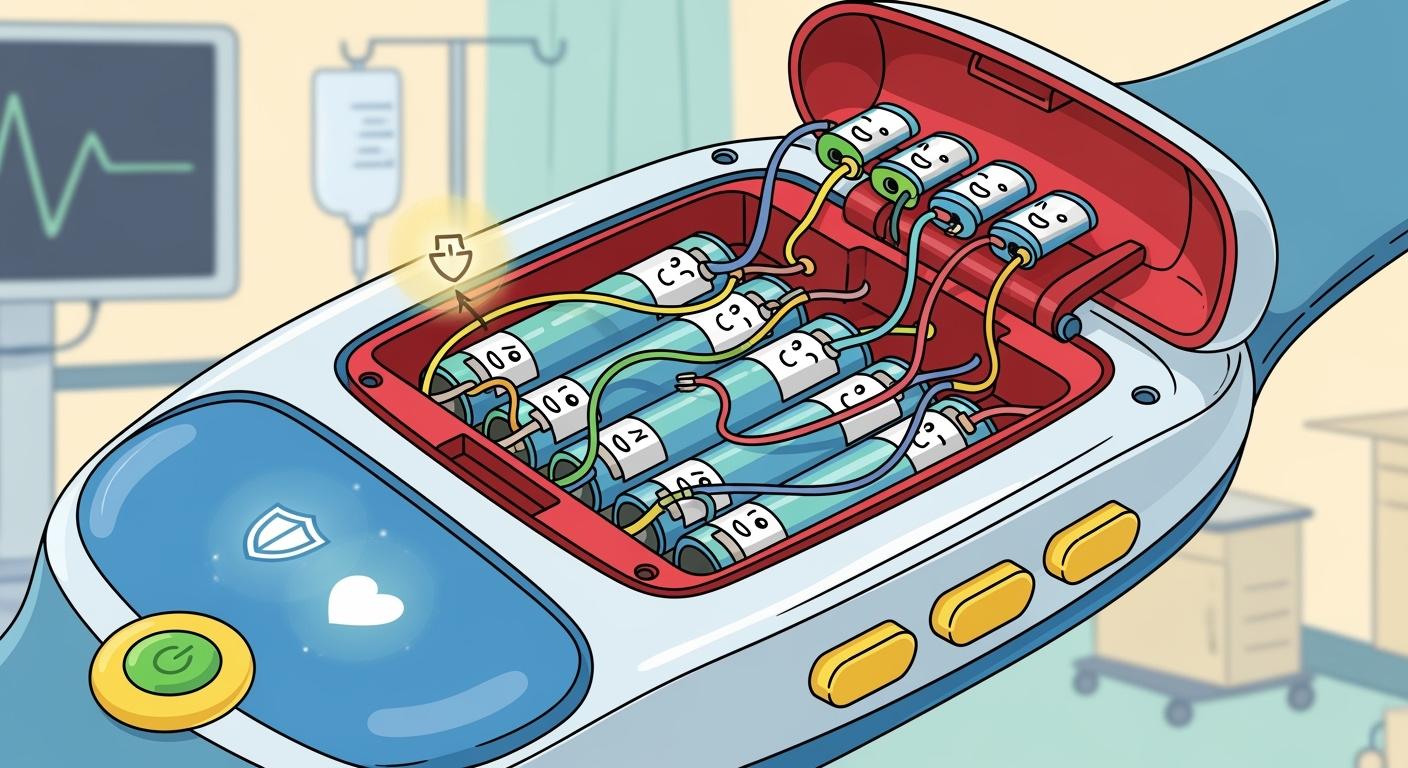
You face strict demands when designing medical devices. Battery selection determines safety, reliability, and compliance for each medical device. Advances in lithium-ion technology support efficient, high-performance battery solutions in medical devices applications. Reliable battery packs reduce risk, improve device uptime, and enhance patient outcomes by minimizing failure rates in medical devices.
Key Takeaways
Low-series, high-parallel battery packs enhance safety by reducing thermal runaway risks. This design allows for better fault isolation, protecting patients during critical care.
Redundant safety features in battery packs ensure consistent performance. These systems monitor for issues and activate emergency protocols, maintaining device reliability.
Choosing advanced lithium battery chemistries can extend cycle life and reduce maintenance costs. This leads to fewer replacements and improved patient care in medical settings.
Part1: Safety And Reliability In Battery Packs For Medical Devices

1.1 Thermal Runaway And Fault Tolerance
You must prioritize safety when designing battery packs for medical devices. Lithium battery packs face risks such as thermal runaway, which can result from internal faults, coolant leaks, or environmental changes. Over the past two decades, incidents have shown that improper packaging, vibration during transport, and electrical shorts often cause failures. These risks highlight the need for robust battery management systems (BMS) and careful pack design.
Low-series, high-parallel configurations reduce the chance of thermal runaway. By distributing current across many parallel cells, you lower the stress on each cell. This approach limits heat generation and makes it easier for the BMS to detect and isolate faults. If a cell fails, the system can quickly isolate the problem, preventing it from affecting the entire pack. This immediate isolation and dynamic reconfiguration enhance patient safety, especially in critical care equipment.
Fault Tolerance Feature | Description |
|---|---|
Immediate Isolation | Faulty cells are isolated to prevent system-wide failure. |
Dynamic Reconfiguration | The pack can bypass faulty cells and continue normal operation. |
Enhanced Safety Management | Sensors provide real-time monitoring for early fault detection. |
You can see that these features work together to ensure that medical devices remain safe and reliable, even under challenging conditions.
1.2 Redundancy And Consistent Performance
Redundancy is essential in battery packs for medical devices. You need comprehensive safety mechanisms, including integrated circuit protection, emergency disconnects, and advanced diagnostic algorithms. These systems monitor for abnormal conditions and electrical anomalies, allowing early detection and response.
Redundant safety systems identify and respond to abnormal conditions.
Sensors and isolation devices prevent fault propagation.
Emergency shutdown systems activate during critical failures.
Pressure relief mechanisms, thermal fuses, and redundant safety circuits add extra layers of protection.
Consistent performance is also vital. High-capacity cells, such as the ICR18650, allow devices to operate for extended periods. Stable voltage ensures that sensitive medical equipment functions accurately, preventing errors in readings. Overcharge and short circuit protection features further enhance reliability, especially during emergencies. Power interruptions can delay treatment and endanger patients, so you must ensure continuous and stable power output.
1.3 Enhanced Cycle Life For Medical Devices
You benefit from enhanced cycle life in lithium battery packs. Chemistries like LiFePO₄ and advanced lithium-ion cells offer thousands of charge-discharge cycles. These batteries have low self-discharge rates and require little to no maintenance throughout their life cycle. For mobile medical carts and portable devices, this means fewer replacements and less downtime.
Long cycle life reduces maintenance costs for healthcare providers. Reliable battery performance ensures that medical devices remain operational, supporting patient care without frequent interventions. This reliability is crucial for meeting FDA standards and regulatory requirements. You must also follow strict quality control and testing protocols, including risk assessment, material qualification, and 100% outgoing inspection. Each battery cell receives a unique identifier for traceability, and complaint management systems ensure continuous improvement in line with ISO 13485 standards.
By choosing low-series, high-parallel battery packs, you address the most critical safety, reliability, and regulatory requirements for medical devices. These configurations support the highest standards in medical batteries, ensuring that your devices deliver consistent, safe, and long-lasting performance.
Part2: Performance, Efficiency, And FDA Compliance In Medical Devices

2.1 Current Delivery And Power Stability
You need reliable current delivery and stable power for medical devices. Parallel battery packs increase capacity and allow for hot-swap capability, which keeps devices running during battery replacement. This feature is critical for medical robots and imaging equipment, where power interruptions can cause errors or damage sensitive components. You benefit from extended capacity and improved uptime, which supports continuous operation in high-demand environments.
Tip: Predictive maintenance with advanced BMS helps you reduce unexpected breakdowns and schedule service efficiently.
Metric | Description |
|---|---|
High Discharge Rates | Delivers required power quickly for medical devices. |
Cell Characteristics | Determines overall performance and reliability of the pack. |
Battery Management System | Optimizes battery performance under high load conditions. |
Design Considerations | Series parallel configuration manages voltage drops and thermal performance. |
Switching to high-parallel battery packs has reduced the size and weight of devices like cardiac pacemakers and hearing aids. You see improvements in patient comfort and device mobility. For handheld and wearable medical devices, battery capacity and reliability are essential for patient safety.
2.3 Meeting FDA And Regulatory Standards
You must meet strict FDA requirements and certifications and standards for battery packs for medical devices. The FDA emphasizes redundancy in safety features, such as temperature cutoffs and current interrupt devices, to protect patients. You comply with UL2054 and IEC 62133 standards, which require extensive testing and documentation.
Serialization in battery pack design simplifies maintenance and supports regulatory documentation.
Rigorous testing and quality control ensure medical batteries meet safety requirements.
You benefit from long-term cost savings due to fewer replacements and improved patient management.
Real-world examples include portable ventilators and infusion pumps, which rely on high-capacity packs for continuous operation. You achieve compliance and efficiency by choosing designs that prioritize redundancy, capacity, and robust BMS integration.
You see low-series, high-parallel battery packs becoming the standard in medical devices because they deliver safety, reliability, and regulatory compliance. These battery pack designs support stable performance and long cycle life. Future medical packs will feature smart power, ultra-fast charging, and extreme temperature stability.
The healthcare industry demands innovative battery packs for wearables.
Smart power solutions will meet dynamic energy needs in medical devices.
Polymer pouch lithium battery packs ensure safety and durability.
Key Findings | Description |
|---|---|
Importance of BMS | Battery management systems monitor and control safety in medical packs. |
Measurable Standards | Updated standards will improve battery pack safety and performance. |
Emerging Challenges | New battery pack technologies require advanced monitoring and regulation. |
You can contact us for a custom battery consultation to optimize your medical device packs.
FAQ
What advantages do low-series, high-parallel lithium battery packs offer for medical devices?
You gain improved safety, higher reliability, and longer cycle life. These packs reduce thermal risk and support critical applications like medical, robotics, and security systems.
How does Large Power support custom battery solutions for medical device manufacturers?
Large Power provides tailored lithium battery packs. You can explore their custom battery solution for specialized requirements in medical and industrial sectors.
How do different lithium battery chemistries compare for medical applications?
Chemistry | Cycle Life | Safety Level | Maintenance |
|---|---|---|---|
LiFePO₄ | High | Excellent | Low |
NMC | Moderate | Good | Moderate |
LCO | Lower | Fair | Moderate |
Note: You should select the chemistry based on your device’s safety and performance needs.


