

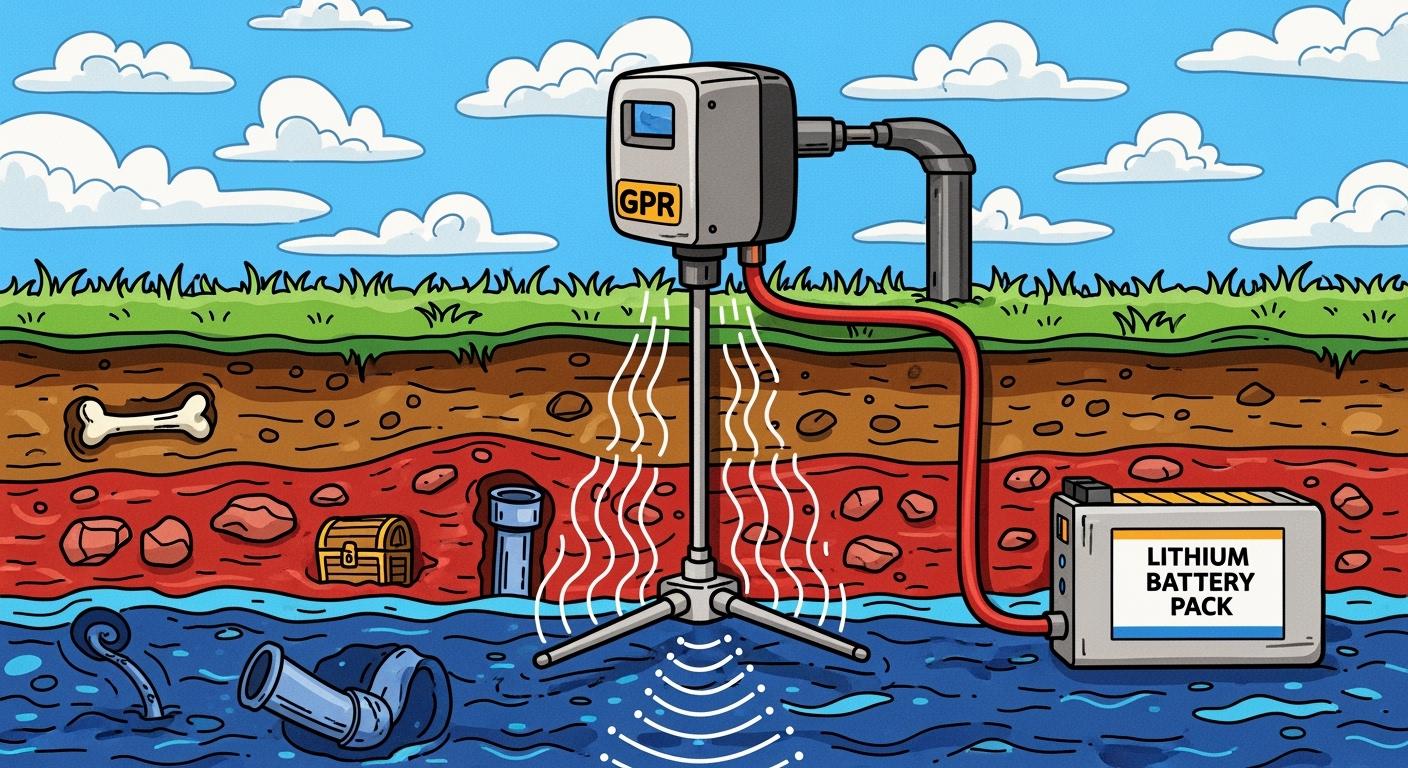
You need reliable power for ground penetrating radar systems in demanding field conditions. Lithium Battery Packs deliver strong performance with features like long runtime, fast charging, and hot-swappability.
For example, a lithium-polymer pack with 1300 mAh capacity supports over 3 hours of continuous operation at 4.2 W, making it ideal for extended surveys.
You benefit from OEM compatibility, which ensures seamless integration and efficient workflow.
Key Takeaways
Lithium battery packs provide reliable power for GPR systems, offering long runtime, high energy density, and stable voltage for accurate subsurface inspections.
Hot-swappable and fast-charging features minimize downtime, allowing continuous operation during extended fieldwork or remote surveys.
Lightweight design improves portability, making GPR systems easier to transport and operate in challenging environments.
Advanced safety features, such as overcharge and thermal protection, ensure safe and efficient operation while reducing maintenance needs.
Choosing the right lithium battery pack involves matching capacity and voltage to your GPR system’s requirements and considering environmental factors for optimal performance.
Part 1: Lithium Battery Packs in GPR Systems
1.1 Definition and Role
You rely on Lithium Battery Packs to power ground penetrating radar (GPR) systems during subsurface inspections. These battery packs use advanced lithium chemistries such as LiFePO4, NMC, LCO, and LMO. Each chemistry offers unique benefits. For example, LiFePO4 provides stable voltage and long cycle life, while NMC delivers high energy density for extended runtime. You find these packs in portable GPR units because they supply consistent voltage and support demanding field operations.
Lithium Battery Packs serve as the main energy source for GPR equipment. You connect them directly to your radar system, ensuring uninterrupted operation. Their compact design allows you to carry them easily, which is essential when you work in remote or challenging environments. You benefit from OEM compatibility, which means these packs integrate seamlessly with most GPR models. This compatibility reduces setup time and helps you maintain efficient workflows.
1.2 Why Lithium for GPR
You choose lithium technology for GPR systems because it offers superior performance compared to older battery types. Lithium Battery Packs deliver high energy density, so you get more power in a smaller package. This feature enables longer surveys without frequent battery changes. You also enjoy hot-swappable packs, which let you replace batteries without shutting down your equipment.
Tip: Hot-swapping keeps your GPR running, even during extended projects.
The industry has adopted lithium batteries because they provide reliable power and long lifespan. You can expect each pack to last up to 8 hours per charge and several years in service. The table below highlights key features that contribute to operational reliability:
Feature | Description |
|---|---|
Hot-swappable battery packs | Allow for extended use without downtime |
Runtime per battery pack | Each lasts a total of 8 hours |
Lifespan of battery packs | Designed to last several years |
You gain confidence in your equipment when you use Lithium Battery Packs. Their advanced safety features protect your GPR system from overcharging and overheating. You spend less time on maintenance and more time collecting accurate subsurface data.
Part 2: Key Benefits of Lithium Battery Packs
2.1 Reliable Power and Runtime
You need consistent power for ground penetrating radar (GPR) surveys. Lithium Battery Packs deliver long operational time, often up to 8 hours per charge. This extended runtime allows you to complete large-scale surveys without frequent interruptions. The high energy density of lithium chemistries like NMC and LCO means you get more power in a compact form. You can trust these packs to maintain stable voltage, which is critical for accurate data collection in GPR, medical devices, and robotics.
The hot-swappable feature lets you replace a depleted battery with a charged one without shutting down your equipment. This ability to quickly swap out lithium battery packs keeps your GPR running and minimizes downtime. You maintain workflow efficiency and avoid costly delays during fieldwork.
Tip: Always keep a spare charged battery on hand to maximize your survey time.
2.2 Portability and Weight
You benefit from the lightweight design of lithium battery packs. Compared to older battery types, lithium-ion packs weigh much less. This makes your GPR system easier to transport and operate, especially during long field sessions. The table below shows how lithium battery packs compare in weight to other common battery types:
Battery Type | Weight Comparison (relative to Lithium-Ion) |
|---|---|
Lead-Acid | Up to 70% heavier |
LiFePO4 | Nearly twice as heavy |
Lithium-Ion | Baseline weight |
You can carry your equipment for longer periods without fatigue. This advantage also applies in other sectors, such as security, infrastructure inspection, and industrial automation, where portability is essential.
2.3 Fast Charging and Hot-Swapping
You save valuable time with fast-charging lithium battery packs. Many lithium chemistries, including NMC and LCO, support rapid charging, so you spend less time waiting and more time working. Hot-swapping further boosts your efficiency. You can remove and replace batteries without powering down your GPR system. This feature is especially useful during continuous surveys or when working in remote locations.
The table below highlights how hot-swappable lithium battery packs improve workflow efficiency in the field:
Feature | Technical Value |
|---|---|
Battery System | Dual removable 18V Li-ion batteries |
Battery Runtime | Full day of field locating; hot-swap capable |
Monitor Weight | 13.2 lbs (lightweight for extended field work) |
Key Advantage | Long battery life with hot-swappable packs |
The Solinas SonicFinder 1000 uses dual removable 18V Li-ion batteries.
These batteries are hot-swap capable, ensuring continuous operation.
The system is designed for extended fieldwork with a lightweight monitor and long battery life.
You see similar benefits in consumer electronics and medical equipment, where fast charging and uninterrupted operation are critical.
2.4 Safety and Maintenance
You want safe and reliable power for your GPR system. Lithium Battery Packs include advanced safety features, such as overcharge, over-discharge, and thermal protection. These features protect both your equipment and your team. Lithium chemistries like LiFePO4 offer excellent thermal stability and long cycle life, making them a preferred choice for demanding applications.
Maintenance is simple. Lithium Battery Packs require less frequent replacement than other battery types. The table below compares the average lifespan of different battery technologies:
Battery Type | Average Lifespan (Charge Cycles) |
|---|---|
Lithium | 1000-5000 |
NiMH | 300-1000 |
Alkaline | N/A |
You spend less time on battery maintenance and more time focusing on your core tasks. This reliability is why you see lithium battery packs used in industrial, robotics, and infrastructure applications, where safety and uptime are top priorities.
Note: Always follow manufacturer guidelines for charging and storage to maximize battery life and safety.
Part 3: Performance Comparison
3.1 Lithium vs. Other Battery Types
You want the best power solution for your ground penetrating radar system. Lithium Battery Packs stand out because they deliver high energy density and long runtime. You see a clear difference when you compare lithium chemistries like LiFePO4, NMC, LCO, and LMO to lead-acid and nickel-metal hydride (NiMH) batteries.
Lithium-ion batteries offer the highest energy density. You get more power in a smaller, lighter package.
NiMH batteries provide moderate energy density. They are heavier and bulkier than lithium-ion.
Lead-acid batteries have the lowest energy density. You find them impractical for portable GPR applications.
Battery Chemistry | Energy Density (Wh/kg) | Typical Cycle Life | Weight | Practicality for GPR |
|---|---|---|---|---|
LiFePO4 | 90-120 | 2000+ | Light | Excellent |
NMC | 150-220 | 1000-2000 | Light | Excellent |
LCO | 150-200 | 500-1000 | Light | Good |
LMO | 100-150 | 1000+ | Light | Good |
NiMH | 60-120 | 300-1000 | Heavy | Moderate |
Lead-Acid | 30-50 | 200-300 | Very Heavy | Poor |
You gain longer runtime and easier transport with lithium chemistries. You avoid frequent battery changes and reduce downtime in the field.
Note: Lithium Battery Packs also provide stable voltage, which improves data accuracy during subsurface inspections.
3.2 Field Use Cases
You see lithium battery packs used in many industries. In infrastructure inspection, you rely on portable GPR systems powered by NMC or LiFePO4 batteries. These chemistries support full-day surveys and hot-swapping. Security teams use lightweight GPR units with LCO batteries for rapid deployment. Robotics applications benefit from LMO batteries, which offer reliable power and long cycle life.
For example, you can operate a GPR system for up to 8 hours on a single lithium battery pack. You swap batteries quickly and continue your survey without interruption. You notice that systems like the GP8800 and LMX series use lithium chemistries to maximize efficiency and minimize downtime. You achieve better results and maintain productivity in demanding environments.
Tip: Choose lithium battery packs with the right chemistry and capacity for your specific GPR application.
Part 4: Choosing and Using Lithium Battery Packs
4.1 Capacity and Voltage
You need to match the battery pack’s capacity and voltage to your GPR system’s requirements. Capacity, measured in amp-hours (Ah), determines how long your equipment runs. Voltage must align with your device’s specifications to ensure stable operation. For example, LiFePO4 batteries offer stable voltage and long cycle life, while NMC batteries provide high energy density for extended runtime. Review your GPR’s power consumption and select a battery pack that supports your survey duration. Always verify OEM compatibility to avoid integration issues.
Tip: Choose a battery pack with a capacity that exceeds your typical survey needs to prevent unexpected downtime.
4.2 Environmental Factors
Field conditions impact battery performance and lifespan. Temperature extremes can degrade lithium battery chemistry and reliability. Review the table below to understand how temperature affects battery packs:
Temperature Condition | Effect on Battery | Impact on Lifespan and Reliability |
|---|---|---|
High Temperatures | Accelerated chemical reactions | Faster degradation and reduced lifespan |
Low Temperatures | Increased internal resistance | Slower ion movement, voltage drops, potential device shutdowns |
Extreme Cold | Thickened electrolyte, sluggish ion movement | Voltage drops under load, potential communication failures |
Store and operate your battery packs within recommended temperature ranges to maximize performance.
4.3 Maintenance Tips
You extend battery life with regular maintenance. Inspect battery packs for rust, dents, deformation, or swelling. If you find any issues, do not use the battery. Keep connections tight and free from corrosion. Use a balancing charger or Battery Management System (BMS) to equalize cell voltages and improve efficiency.
Note: Clean terminals and check voltage regularly to ensure safe operation.
4.4 Charging and Troubleshooting
Follow best practices for charging to protect your investment. Maintain charge levels between 20% and 80% to minimize stress on battery chemistry. Adjust charging speed to balance rapid charging with battery health. Use temperature-compensated charging to ensure safety and efficiency. Secure all connections to prevent voltage drop and overheating.
If you experience charging or performance issues, try these troubleshooting steps:
Check for physical damage or swelling.
Ensure all connections are tight and corrosion-free.
Measure open circuit voltage and current flow.
Reset or replace the Battery Management System if needed.
Use cell balancing to equalize voltages.
You maximize uptime and reliability by following these guidelines for Lithium Battery Packs.
You gain reliable, efficient power for your GPR system with lithium battery packs. Chemistries like LiFePO4, NMC, LCO, and LMO deliver high energy density, long cycle life, and stable voltage. You reduce downtime and improve field productivity. Lightweight packs make transport easy. Advanced safety features protect your investment. For subsurface inspection, you should prioritize lithium battery solutions. These packs help you achieve accurate results and maintain a competitive edge in your industry.
FAQ
What makes lithium battery packs ideal for GPR systems?
Lithium-ion battery packs provide the high energy density, stable voltage, low weight, and extended runtime required by ground-penetrating radar (GPR) systems. NMC batteries are suitable for compact, lightweight equipment, while LiFePO4 batteries offer longer cycle life and greater thermal stability. Both chemistries can support demanding subsurface inspections and extended field surveys.
How do I choose the right lithium battery pack for my GPR system?
Check the GPR system’s nominal voltage, peak current, required runtime, physical dimensions, connector type, charging method, and operating temperature range. The battery pack must provide compatible voltage and sufficient capacity without exceeding the equipment’s size and weight limits. For specialized inspection equipment, a custom battery solution can be designed around the device’s electrical, mechanical, and environmental requirements.
Are lithium battery packs safe to use in the field?
Yes, when the pack uses suitable cells, protective construction, and a properly designed Battery Management System (BMS). The BMS should provide overcharge, over-discharge, overcurrent, short-circuit, and temperature protection. LiFePO4 chemistry can provide additional thermal stability for demanding outdoor and industrial applications. Always follow the manufacturer’s charging, storage, and operating instructions.
Can I use hot-swappable lithium battery packs during continuous surveys?
Yes, provided that the GPR system and its power architecture support hot-swapping. A hot-swappable design allows a depleted pack to be replaced with minimal interruption, helping survey teams reduce downtime during long field operations. The battery interface, connector, protection circuit, and system power buffer must be engineered together to prevent voltage interruption or connector damage.
How should I maintain lithium battery packs for maximum lifespan?
Inspect each pack regularly for swelling, impact damage, corrosion, loose connections, or abnormal heating. Use an approved charger, avoid unnecessary deep discharges, and keep the battery within its specified operating and storage temperature ranges. A well-designed BMS helps monitor cell voltage, balance cells, and prevent damaging operating conditions. For cold-weather surveys, consider a purpose-built low-temperature battery.


