

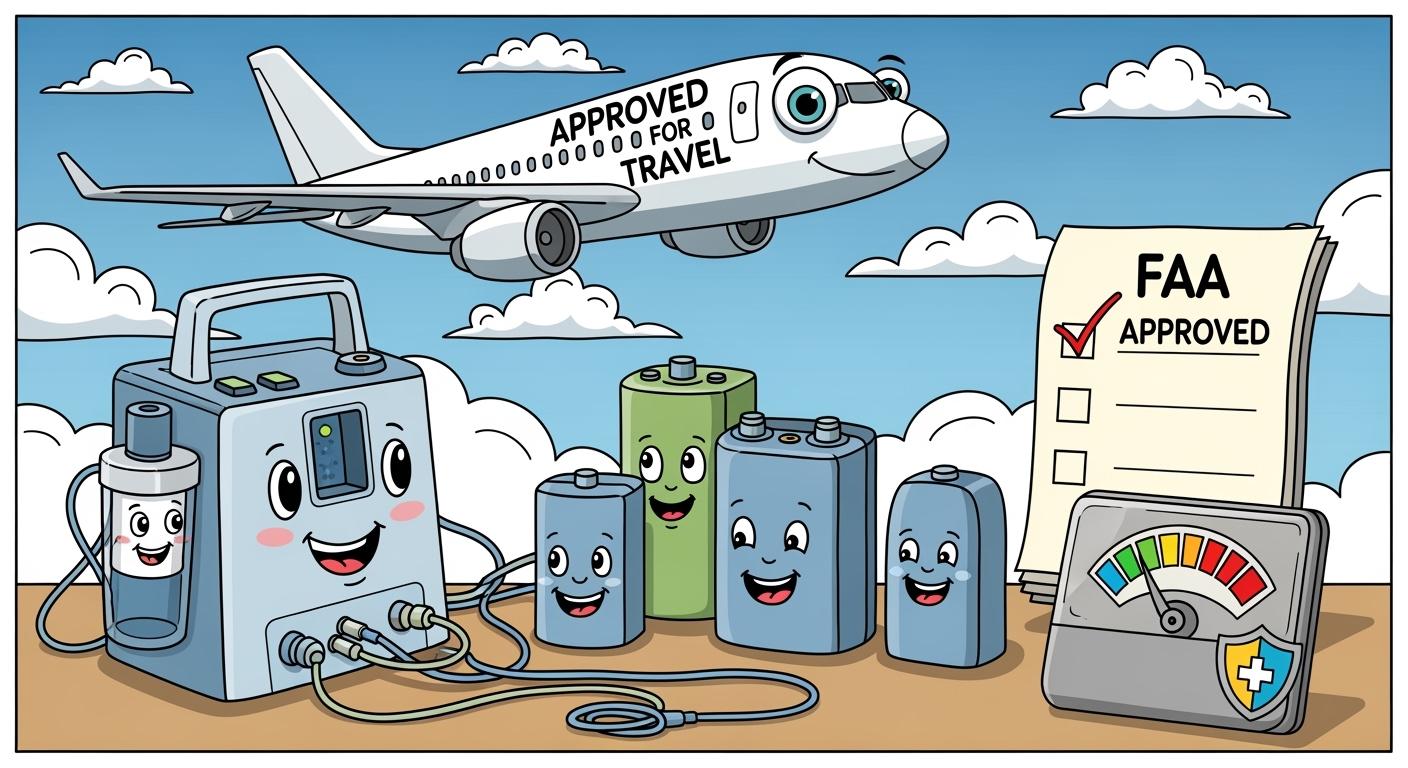
Manufacturers developing oxygen concentrator batteries for air travel must balance energy capacity, runtime, safety, and regulatory compliance. Under current FAA guidance, rechargeable lithium-ion batteries rated at up to 100 Wh are generally permitted on passenger aircraft. Batteries rated from 101 Wh to 160 Wh require airline approval, while batteries exceeding 160 Wh are generally prohibited. These thresholds directly influence cell selection, pack configuration, and modular battery design.
Battery capacity must also support practical in-flight use. Airlines may require passengers to carry enough fully charged batteries to operate a portable oxygen concentrator for at least 150% of the expected flight duration. Manufacturers should therefore provide accurate runtime data for different oxygen flow settings and make replacement batteries easy to identify, carry, and install.
Clear watt-hour markings, effective terminal protection, secure enclosures, and appropriate transport testing help airlines and passengers verify battery suitability. By integrating these requirements early in the design process, manufacturers can develop oxygen concentrator batteries that support patient safety, regulatory compliance, and dependable operation throughout air travel.
Key Takeaways
Follow the FAA’s 160 Wh limit for lithium batteries in oxygen concentrators to ensure safety during flights.
Provide at least 150% of the expected flight time in battery life to cover delays and ensure continuous oxygen support.
Label batteries clearly with watt-hour ratings to help airline staff verify compliance quickly and avoid delays.
Check airline-specific policies before travel, as they may have stricter rules than the FAA.
Always notify airlines in advance about battery use to prevent last-minute issues and ensure a smooth travel experience.
Part1: FAA Rules For Oxygen Concentrator Batteries
1.1 FAA Lithium Battery Energy Limits
Manufacturers developing oxygen concentrator batteries for air travel must consider the FAA’s lithium battery energy limits during pack design. Rechargeable lithium-ion batteries rated at up to 100 Wh are generally permitted on passenger aircraft. Batteries rated from 101 Wh to 160 Wh require airline approval, while batteries exceeding 160 Wh are generally prohibited.
These limits apply to each individual battery rather than the combined capacity of all batteries carried by a passenger. Manufacturers should therefore select the cell configuration carefully and clearly mark the voltage, amp-hour capacity, and watt-hour rating on every battery pack.
Up to 100 Wh: generally permitted without special airline approval.
101–160 Wh: airline approval is required.
Over 160 Wh: generally prohibited on passenger aircraft.
Spare batteries must be protected against short circuits and physical damage.
Airlines may impose additional procedures or quantity limits.
Tip: Calculate watt-hours by multiplying nominal voltage by capacity in amp-hours: Wh = V × Ah. A 14.8 V, 10 Ah battery has a nominal energy rating of 148 Wh and therefore falls within the 101–160 Wh category requiring airline approval.
1.2 Battery Runtime for Air Travel
Airlines may require passengers using portable oxygen concentrators to carry enough fully charged batteries to operate the device for at least 150% of the expected maximum flight duration. This is an airline operating requirement for the passenger, not a requirement that every individual battery provide 150% of the flight time.
For example, a passenger taking a four-hour flight may need access to at least six hours of battery runtime. The required number of batteries should be calculated using the manufacturer’s runtime data at the patient’s prescribed oxygen flow setting. Manufacturers should publish realistic runtime estimates for each supported operating mode because continuous-flow and pulse-flow settings may consume power at different rates.
Provide runtime data for all supported oxygen settings.
Explain how battery age and temperature may affect runtime.
Make replacement batteries easy to identify and install.
Provide instructions for estimating the number of batteries required.
Advise users to confirm requirements with the airline before departure.
1.3 Spare Battery and Carry-On Rules
Spare lithium batteries must be carried in the aircraft cabin rather than placed in checked baggage. Each spare battery must be individually protected from short circuits and physical damage. Passengers can use the original retail packaging, protective terminal covers, separate battery cases, or individual plastic bags.
The FAA generally permits up to two spare rechargeable lithium batteries rated from 101 Wh to 160 Wh per passenger, subject to airline approval. The two-battery restriction should not be applied automatically to batteries rated at 100 Wh or less, although airlines may establish reasonable quantity controls.
Manufacturers should provide durable protective covers and clear handling instructions with replacement batteries. Batteries that are damaged, swollen, leaking, recalled, or capable of producing dangerous heat must not be transported unless they have been made safe under applicable regulations.
Summary of Airline Battery Requirements
Battery requirement | General guidance |
|---|---|
Battery rated up to 100 Wh | Generally permitted |
Battery rated 101–160 Wh | Airline approval required |
Battery rated over 160 Wh | Generally prohibited |
Spare batteries rated 101–160 Wh | Maximum of two per passenger with airline approval |
Spare-battery location | Carry-on baggage only |
Terminal protection | Required for every spare battery |
Battery identification | Voltage, capacity and Wh rating should be clearly marked |
Runtime planning | Airline may require power for 150% of the expected flight duration |
These are general U.S. aviation requirements. Manufacturers and passengers should verify the latest FAA battery guidance and the operating airline’s current policies before travel.
Part2: Airline Policy Variations And Safety Rationale

2.1 Airline-Specific Policies
Airlines may establish additional procedures for passengers who intend to use a portable oxygen concentrator during a flight. These procedures can include advance notification, early check-in, medical documentation, equipment verification, battery-runtime confirmation, and approval for batteries rated above 100 Wh.
Because airline policies can change, a fixed comparison of individual carriers may become inaccurate. Manufacturers should instead provide customers with a general travel checklist and direct them to the operating airline for current requirements.
Common airline requirements may include:
Notification up to 48 hours before departure.
Confirmation that the POC meets applicable FAA acceptance criteria.
Documentation of the device model and battery specifications.
Sufficient battery capacity for the expected journey and possible delays.
Early airport check-in for equipment inspection.
Protection of all spare batteries against damage and short circuits.
Codeshare flights may be operated by a different airline from the one shown on the ticket. Passengers should confirm the requirements of the airline actually operating each flight segment.
2.2 Large and Multiple Battery Configurations
Manufacturers should avoid describing batteries as “single” or “double” without stating their individual watt-hour ratings. Aviation requirements are based primarily on the energy rating of each battery, its installation status, and whether it is carried as a spare.
A modular design can allow a portable oxygen concentrator to achieve longer total runtime while keeping each removable battery within the applicable energy limit. However, combining two battery modules into one permanently connected assembly may cause the assembly to be assessed as a single battery. The electrical architecture and labeling must therefore make each independently removable battery’s energy rating clear.
Individual battery rating | General treatment |
Up to 100 Wh | Generally permitted |
101–160 Wh | Requires airline approval |
Over 160 Wh | Generally prohibited on passenger aircraft |
Manufacturers should not advertise a product as “airline approved” solely because its battery is below 160 Wh. The POC itself must meet applicable FAA acceptance criteria, and the airline may still require advance confirmation.
2.3 Safety and Regulatory Rationale
Lithium batteries can overheat, ignite, or enter thermal runaway when they are damaged, improperly charged, internally short-circuited, or exposed to abnormal temperatures. Aviation requirements reduce these risks by limiting battery energy, requiring terminal protection, controlling the carriage of spare batteries, and excluding damaged or recalled batteries.
Battery safety should be addressed through cell selection, mechanical protection, thermal design, manufacturing controls, and an appropriate Battery Management System. The BMS can monitor voltage, current, and temperature and provide protection against overcharging, over-discharging, overcurrent, short circuits, and abnormal temperatures.
UN 38.3 addresses lithium battery transport testing, but it does not by itself prove that a battery is suitable for a medical device or approved for use with a POC onboard an aircraft. Manufacturers must identify all applicable transport, battery safety, medical-device, electromagnetic compatibility, and market-specific requirements.
Part3: Manufacturer Compliance Steps
As a manufacturer, you play a critical role in ensuring that Oxygen Concentrator Batteries meet all airline and FAA requirements. This section outlines practical steps for designing, labeling, and certifying lithium battery packs for safe and compliant air travel.
3.1 Designing Within Airline Energy Limits
Manufacturers should determine the battery’s nominal watt-hour rating at the beginning of the design process. A pack rated from 101 Wh to 160 Wh may provide longer runtime, but it will require airline approval. Keeping each removable module at or below 100 Wh may simplify travel, although the final design must still satisfy the device’s runtime and power requirements.
Key design considerations include:
Calculate energy using nominal voltage and rated capacity.
Select a configuration that meets device voltage and peak-current requirements.
Integrate a suitable BMS for monitoring and protection.
Prevent accidental battery release or connector short circuits.
Provide durable terminal covers for spare batteries.
Validate performance at the intended oxygen flow settings.
Maintain cell, component, manufacturing-lot, and test traceability.
Complete applicable UN 38.3 transport testing.
The 150% runtime provision should be addressed through modular capacity and accurate runtime documentation. It should not be presented as a requirement that one battery must power the POC for 150% of every possible flight.
3.2 Device and Battery Labeling
The FAA conformity statement applies to the portable oxygen concentrator device, not automatically to each replacement battery. A POC intended for onboard use must meet the applicable FAA acceptance criteria and, unless covered by an existing listed-model exception, bear the required manufacturer conformity label.
The battery label should separately provide information needed for identification, compatibility, and transportation, including:
Manufacturer and battery model.
Nominal voltage.
Rated capacity in Ah or mAh.
Watt-hour rating.
Battery chemistry.
Polarity and connector identification where necessary.
Production or traceability code.
Required handling and safety warnings.
Manufacturers should not state that a battery is “FAA certified,” because the FAA does not issue a general certification for individual replacement batteries. More accurate language includes “designed to meet applicable air-transport battery requirements” or “compatible with a POC that meets FAA acceptance criteria,” provided the claim is supported by documentation.
The FAA conformity label text belongs on the POC and should follow the exact wording and presentation requirements in the applicable regulation. Battery labels should use durable materials capable of remaining legible throughout the expected service life.
3.3 Supporting the Airline Approval Process
The manufacturer does not normally obtain travel approval on behalf of every passenger. Its role is to provide accurate technical information that allows the passenger and airline to evaluate the device and batteries.
A manufacturer support package may include:
POC model and device identification.
Battery model, voltage, capacity and watt-hour rating.
Expected runtime at each oxygen flow setting.
UN 38.3 test summary where applicable.
Instructions for carrying and protecting spare batteries.
Device and battery user manuals.
Manufacturer contact information.
Applicable POC conformity information.
Passengers should contact the operating airline before travel. The airline may request advance notice, medical documentation, early check-in, or approval for batteries rated from 101 Wh to 160 Wh. These requirements should be described as airline-specific rather than universal FAA requirements.
Part4: Troubleshooting And Checklist
4.1 Managing Conflicting Airline Information
When airline information appears inconsistent, passengers and equipment providers should request written clarification from the operating carrier. FAA and DOT regulations establish the regulatory framework, while airlines may add operational procedures such as notice periods, documentation, check-in arrangements, and battery verification.
Use the following process:
Confirm which airline operates each flight segment.
Provide the exact POC and battery model numbers.
State the watt-hour rating of every battery.
Ask whether batteries rated above 100 Wh require advance approval.
Confirm the required battery runtime for the itinerary.
Request written confirmation of any approval.
Retain the airline’s response with the travel documents.
A medical certificate should be described as something an airline may require. It should not be presented as a universal FAA requirement or as always needing to be issued within ten days of departure.
4.2 Spare Batteries and Delay Planning
Passengers should calculate battery needs using the expected maximum flight duration, the required oxygen setting, the manufacturer’s runtime specifications, and the airline’s requested safety margin. Flight time alone may not account for boarding, taxiing, connections, diversions, or delays.
Recommended preparation includes:
Fully charge and test every battery before departure.
Inspect batteries for swelling, damage, leakage, or abnormal heating.
Keep spare batteries in carry-on baggage.
Protect each spare battery’s terminals separately.
Keep batteries accessible for security or airline inspection.
Bring the correct power supply and adapters for use during permitted layovers.
Do not rely on the availability of aircraft electrical outlets.
Do not transport damaged or recalled batteries.
Confirm airline requirements before every journey.
Manufacturers should not recommend that passengers “carry at least two batteries” without first calculating the required runtime. Some journeys may require one battery, while longer journeys may require several lower-capacity modules.
4.3 Manufacturer Compliance Checklist
Use this checklist when developing batteries for portable oxygen concentrators intended for air travel:
Confirm the nominal Wh rating of each battery.
Determine whether the battery falls within the ≤100 Wh or 101–160 Wh category.
Avoid designs exceeding 160 Wh per battery for passenger air travel.
Complete applicable UN 38.3 transport testing.
Integrate appropriate electrical and thermal protection.
Provide clear voltage, capacity and Wh markings.
Supply protective covers or packaging for spare batteries.
Publish runtime data for each supported oxygen setting.
Maintain product and manufacturing traceability.
Distinguish the POC conformity label from the battery identification label.
Provide airline-support documentation to customers.
Review FAA, DOT and airline requirements regularly.
By addressing battery energy, runtime, labeling, transport testing, and documentation during product development, manufacturers can create oxygen concentrator battery systems that are easier for airlines to assess and safer for patients to use during travel.
Conclusion
Manufacturers of airline-compatible oxygen concentrator batteries must design around several connected requirements. Batteries rated up to 100 Wh are generally the simplest to transport. Batteries rated from 101 Wh to 160 Wh require airline approval, and batteries exceeding 160 Wh are generally prohibited on passenger aircraft.
The airline may also require the passenger to carry sufficient battery capacity for at least 150% of the expected flight duration. Manufacturers support compliance by providing accurate runtime data, clear Wh markings, terminal protection, transport-test documentation, and traceable product information. Final travel acceptance remains subject to the applicable regulations and the operating airline’s current procedures.
FAQ
What lithium battery chemistry is suitable for airline-compatible oxygen concentrators?
NMC is commonly considered when high energy density and compact size are priorities. LiFePO4 may be considered when thermal stability and long cycle life are more important, although its lower energy density can increase battery size and weight. Chemistry alone does not determine airline acceptability. The finished battery must meet the applicable energy, safety, transport, and device-integration requirements.
How do you calculate the watt-hour rating of a battery?
Multiply the battery’s nominal voltage by its rated capacity in amp-hours:
Watt-hours = Nominal voltage × Amp-hours
For example, a 14.8 V, 10 Ah battery is rated at 148 Wh. It falls within the 101–160 Wh category and therefore requires airline approval.
What information should manufacturers provide for airline review?
Manufacturers should provide the battery model, nominal voltage, capacity, watt-hour rating, chemistry, compatibility information, runtime data, handling instructions, and applicable transport-test documentation. The portable oxygen concentrator should also carry the required conformity label when applicable.
Must one battery provide 150% of the flight duration?
No. An airline may require the passenger to carry enough total battery capacity to operate the POC for at least 150% of the expected maximum flight duration. This capacity may be provided by multiple compliant, fully charged batteries.
Can the same battery pack be used in medical and industrial equipment?
A similar electrical design may be adapted for different applications, but compliance cannot automatically be transferred from one device to another. Medical equipment, industrial instruments, and aviation use can involve different safety, performance, documentation, and certification requirements. Each finished application must be evaluated independently.
Where can manufacturers request a custom oxygen concentrator battery solution?
Large Power develops custom lithium battery packs for portable medical equipment, including battery systems tailored to device voltage, runtime, dimensions, communication, and protection requirements. Contact our battery engineers to discuss an oxygen concentrator battery project.


